

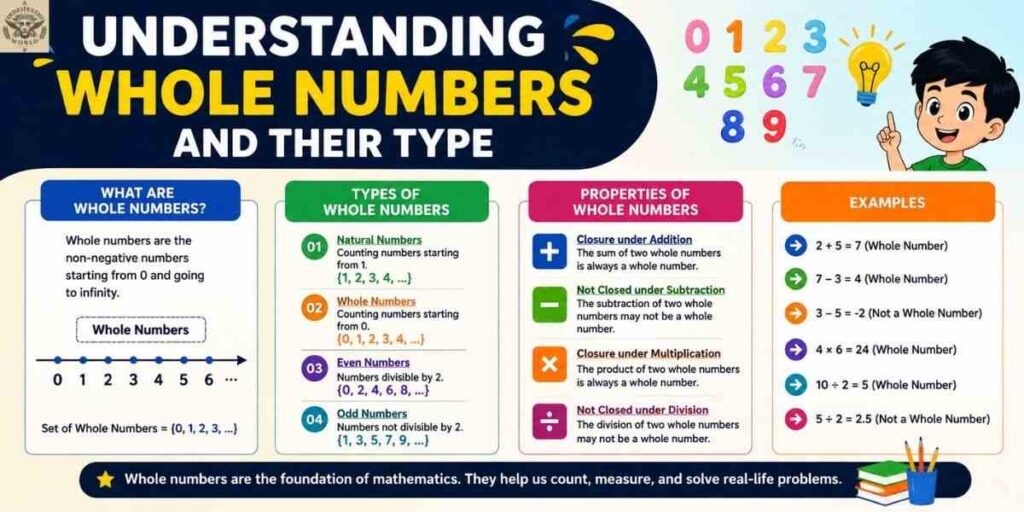
Whole Numbers are one of the simplest and most useful parts of mathematics. They begin with zero and continue through positive counting values such as 1, 2, 3, 4, and beyond. Learning the whole number definition helps students understand counting, place value, arithmetic, measurement, and many later mathematical ideas.
Understanding Whole Numbers also makes it easier to see how numbers are organized. Unlike fractions and decimals, these values do not contain parts of a unit. In this guide, you will learn the definition of whole numbers, their characteristics, examples, properties, operations, relationship with natural numbers and integers, and common ways students practice them.
Understanding Whole Numbers In Mathematics
The whole number definition is simple: Whole Numbers are the numbers 0 and all positive counting numbers. The set can be written as {0, 1, 2, 3, 4, 5, …}. Therefore, zero is included, while negative numbers, fractions, and decimals are not. This definition of whole numbers is commonly used in elementary mathematics.
In whole numbers in math, each value represents a complete quantity. For example, 7 apples, 25 books, or 100 students can be represented by Whole Numbers. The whole number meaning becomes especially clear when comparing these values with 7.5 or 3/4, which describe quantities containing parts.
Why Are Whole Numbers Important?
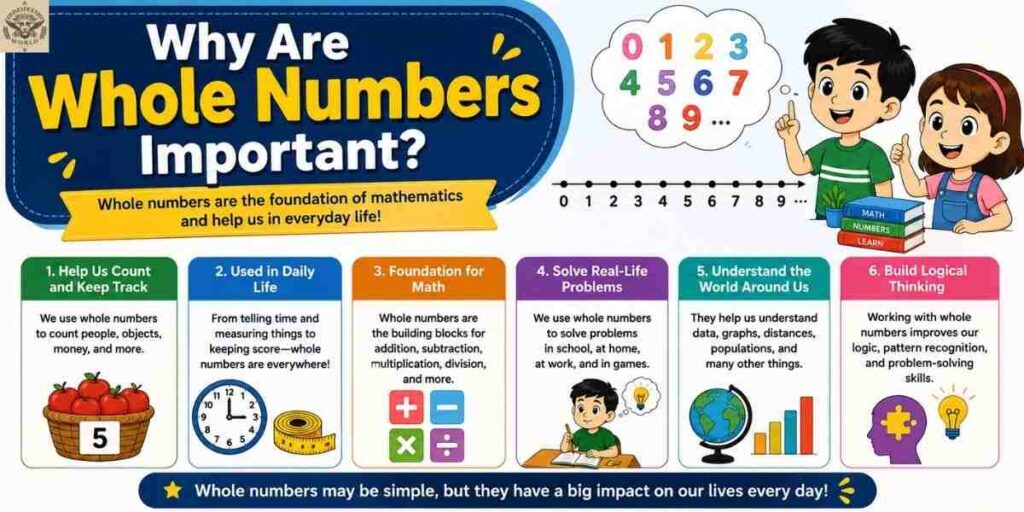
Whole Numbers provide a foundation for arithmetic and number sense. Students use them when counting objects, comparing quantities, identifying positions, solving basic problems, and understanding larger mathematical concepts. The whole number characteristics make them easy to organize on a number line.
They also connect naturally with place value and the base ten number system. Once students understand Whole Numbers, they can move toward integers,ancient civilizations, fractions, study.com login decimals, algebra, and more advanced mathematics with greater confidence.
The Foundation of Number Sense
Number sense develops when learners recognize quantity, order, size, and relationships between numbers. Counting numbers help students connect symbols with real objects. For example, seeing five objects and connecting them with the digit 5 builds an important mathematical connection.
Building the Base Ten System
The base ten system uses digits from 0 through 9 and gives each digit a position. In 582, the 5 represents hundreds, the 8 represents tens,slope and the represents ones. This place based structure explains why the same digit can have different values depending on its position.
Read More:Understanding Fractions
The Discrete Nature of Whole Numbers
Whole numbers are discrete because they move from one complete value to the next. There is no Whole Number between 4 and 5. This differs from fractions and decimals, where many values can exist between two consecutive whole values.
Legal
When using educational resources, students should respect copyright, privacy, and website terms. Materials from educational platforms should be used according to their stated rules.
Social
Mathematics learning can be strengthened through responsible discussion and sharing. Students can compare solutions, explain reasoning, and help classmates understand difficult ideas.
Get our free apps

Educational apps can provide extra practice with counting, arithmetic, place value, and Whole Numbers. Always check that an app is appropriate for the learner and uses reliable mathematical content.
Whole numbers 1 to 10
The Whole Numbers 1 to 100 are 1 through 100, with 0 also belonging to the complete whole number set. Therefore, when discussing the range from 1 to 100, the listed values start at 1, but the broader set of Whole Numbers still begins with zero.
Whole numbers list
A Whole Numbers list from 1 to 100 includes:
1, 2, 3, 4, 5, 6, 7, 8, 9, 10, and continuing through 100.
For a longer list, the same sequence continues without fractions, decimals, or negative values.
Natural numbers
Natural numbers usually describe the counting sequence 1, 2, 3, 4, and onward. Some mathematical conventions also include zero in the natural number set. This is why Whole Numbers and natural numbers overlap but are not always defined identically.
Whole numbers definition and examples
The definition of whole numbers includes zero and every positive integer. Whole number examples include 0, 1, 8, 15, 42, 100, and 1,000. Examples of non-whole numbers include −3, 2.5, 1/2, and 7.25.
The main whole number characteristics are that they are complete, nonnegative values without fractional or decimal parts. These whole number rules make classification straightforward: if a number is zero or a positive integer, it belongs to the whole number set.
Whole numbers 1 to 1000
The sequence from 1 to 1000 contains every positive integer in order. Adding zero gives the broader whole number set: 0 through 1000. Students can practice reading, writing, comparing, and ordering these values to strengthen number sense.
For example, 245, 500, 701, and 999 are Whole Numbers. However, 245.5 and 999.2 are not. Understanding Whole Numbers at this larger range also strengthens place value skills.
Whole numbers worksheets

Whole numbers worksheets can provide practice with identifying, comparing, ordering, adding, subtracting, multiplying, and dividing values. Good exercises should gradually increase difficulty instead of presenting many unrelated questions.
Whole number operations become easier when students understand the underlying number system. Practice may include adding whole numbers such as 25 + 14, multiplying whole numbers such as 6 × 7, and applying mathematical properties to simplify calculations.
Whole numbers examples
Here are useful whole number examples:
• 0 is a Whole Number because zero belongs to the set.
• 12 is a Whole Number because it is positive and complete.
• 350 is a Whole Number because it has no fractional or decimal part.
• 4.5 is not a Whole Number because it is a decimal.
• 3/4 is not a Whole Number because it is a fraction.
• −8 is not a Whole Number because it is negative.
The properties of whole numbers include closure property,study.com login commutative property, associative property, and distributive property. These mathematical properties explain how operations behave. For example, adding two Whole Numbers produces another Whole Number, showing closure for addition. The commutative property explains why 4 + 6 equals 6 + 4.
Whole numbers in maths
Whole numbers in maths are essential for basic calculations and everyday quantities. They can be compared using greater than, less than, or equal to relationships. Whole numbers and integers are related because every Whole Number is an integer, but negative integers are not Whole Numbers.
Whole numbers and natural numbers also overlap strongly, although definitions of natural numbers can vary. Whole numbers vs decimals and Whole numbers vs fractions are easier to understand when students remember that Whole Numbers represent complete nonnegative quantities.
Frequently Asked Questions
What is a whole number example?
Examples of Whole Numbers include 0, 1, 2, 10, 50, and 100. They contain no negative sign, fraction, or decimal part.
What are whole numbers 1 to 100?
They are the positive counting values from 1 through 100. Zero is also a Whole Number, although it is outside the stated 1 to 100 range.
What are whole numbers in math?
Whole Numbers are zero and all positive integers. They are used for counting complete quantities and performing basic arithmetic.
Why is 0 a whole number?
Zero is a whole number because the standard whole number set begins with 0 and continues with positive integers. It represents no quantity while still being a complete number.
What is the first whole number?
The first Whole Number is 0. After zero, the sequence continues with 1, 2, 3, 4, and so on.
Conclusion
Understanding Whole Numbers gives students a strong foundation for the wider number system. Their simple structure makes it easier to learn counting, place value, arithmetic, comparison, and mathematical properties. Once these ideas are clear, students can more confidently distinguish Whole Numbers from integers, fractions, and decimals.
Whether you are preparing for a study lesson, completing worksheets, or reviewing basic mathematics, learning Whole Numbers through definitions and examples makes number classification much easier. The key idea to remember is simple: zero and every positive integer belong to the set of Whole Number

