

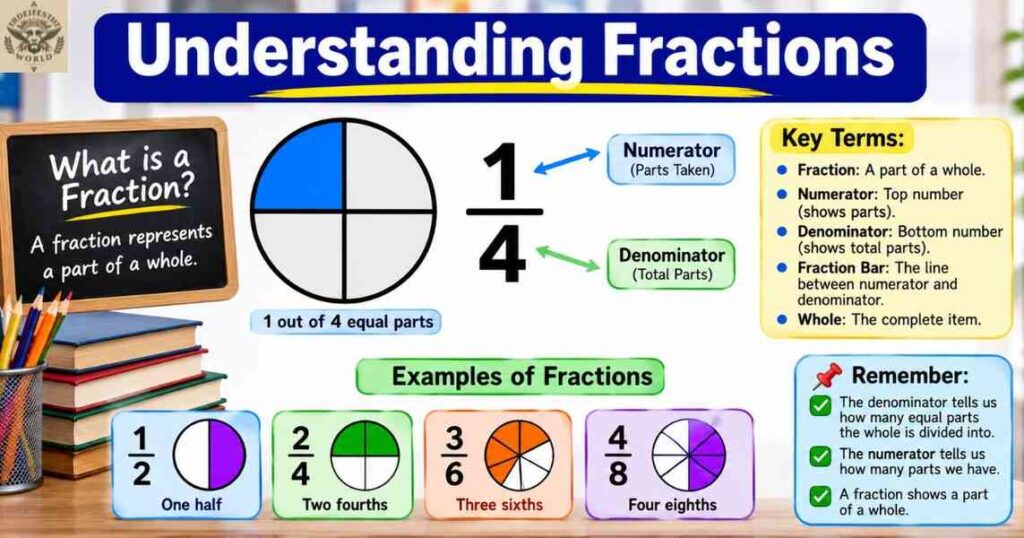
Understanding Fractions becomes much easier when learners stop seeing fractions as two numbers separated by a line and start seeing them as parts of a whole. A fraction describes how a whole is divided into equal parts and how many of those parts are selected. This simple idea supports later work with fraction comparison, equivalent fractions, mixed numbers, and more advanced mathematical fractions.
A good beginning uses pictures, familiar objects, and clear language before introducing complicated rules. Whether you are learning fractions at home, teaching children, or reviewing the topic as an adult, the same foundation matters: identify one whole, divide it into equal parts, count the selected parts, and connect the picture with fraction notation.
See what a fraction means
Understanding fractions starts with the idea of a part of a whole. Imagine one pizza divided into four equal slices. If one slice is selected, the fraction is 1/4. If three slices are selected, the fraction is 3/4. The whole is the complete pizza, the equal parts are the four slices, and the selected parts are the slices being counted. This is the central fraction meaning.
A fraction model makes this idea easier to see. A bar model can show one whole divided into sections, while a circle model can represent the same fraction as parts of a round shape. A visual fraction model connects fraction symbols with real quantities, helping learners develop fraction understanding instead of memorizing isolated rules. Visual fractions are especially useful for fractions for children and fractions for kids.
Build the fraction
To build a fraction, begin with one whole and divide it into equal parts. The number of equal parts becomes the denominator. Then select some of those parts. The number of selected parts becomes the numerator. The fraction bar separates these two numbers and helps show the relationship between them.
For example, if a rectangle is divided into five equal parts and two are shaded, the fraction is 2/5. The denominator is 5 because there are five equal parts, while the numerator is 2 because two parts are selected. This fraction representation gives learners a practical way to understand fraction notation.
Which model shows equal parts?
A correct fraction model must divide the whole into equal sized parts. If a circle has four sections but one section is much larger than the others, it does not correctly represent four equal parts. Equal partitioning matters because a fraction describes a fair division of the whole.
When comparing a fraction picture with another model, first ask whether every part has the same size. This simple check builds strong fraction reasoning and prevents one of the most common fraction mistakes. It also gives learners a visual way to understand why equal parts are necessary.
Focused fraction lessons
Focused learning works better when each fraction concept is introduced separately. A fraction lesson can begin with the meaning of a fraction, move to fraction vocabulary, and then use visual examples before introducing fraction comparison or operations. Learners who understand the basic idea can connect later fraction skills to something they already know.
For parents and teachers, teaching fractions becomes easier when explanations are short and visual. Instead of giving several rules at once, show a whole, divide it, select parts, and ask learners to describe what they see. This approach supports visual learning and makes fraction concepts for kids easier to remember.
A strong foundation before children move into harder fraction skills
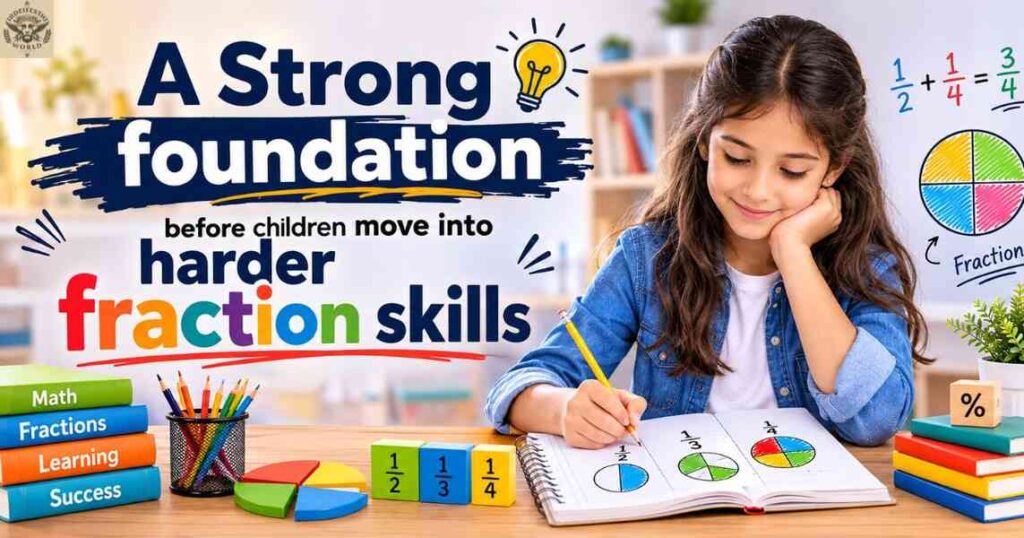
Understanding Fractions is not simply about remembering that the top number is the numerator and the bottom number is the denominator. Learners need to understand what those numbers represent. The whole must be identified first, followed by the number of equal parts and the number of selected parts. Once these relationships are clear, more advanced fraction skills become easier.
This foundation is useful for proper fraction, improper fraction, equivalent fractions, mixed numbers, and unit fractions. It also supports fraction comparison and works on a fraction number line. A learner who understands the meaning behind a fraction can reason about new examples instead of relying only on memorized procedures.
What is a fraction?
What is a fraction? A fraction is a mathematical way to describe selected parts of a whole divided into equal parts. In the fraction 3/4, the whole is divided into four equal parts, and three of those parts are selected. This is the basic definition behind many fraction examples.
The fraction meaning becomes clearer when the symbol is connected to a picture. A 1/2 fraction means one part from two equal parts. A 1/3 fraction means one part from three equal parts. A 3/4 fraction means three parts from four equal parts. These simple fractions help beginners connect words, pictures, and numbers.
Why equal parts matter
Equal parts are essential because fractions depend on consistent division. If a whole is divided into unequal pieces, counting the pieces does not accurately describe the same fraction of the whole. This is why equal parts and equal sized parts should be emphasized during early teaching fractions activities.
A useful teaching question is, “Are the parts equal?” Asking this before naming the fraction encourages learners to inspect the fraction diagram rather than simply count visible pieces. Equal partitioning becomes a key skill that supports later fraction representation and fraction reasoning.
Numerator and denominator in simple language
The denominator tells how many equal parts make one whole. The numerator tells how many of those equal parts are selected. In 2/5, the 5 is the denominator and the 2 is the numerator. Remembering this relationship is more useful than memorizing the words without understanding their meaning.
Numerator and denominator confusion is common among beginners. A helpful method is to point to the complete group of equal parts first and then point to the shaded or selected parts. This connects the numerator and denominator directly to a fraction model and reduces confusion.
Simple real life examples
Real life fractions appear in cooking, shopping, measuring, sharing food, and dividing objects. Half of a sandwich is one-half, one-third of a chocolate bar is one-third, and three-fourths of a measuring cup is three-fourths. These examples show that fractions in everyday life describe real amounts.
When using real-life fractions, Understanding Fractions make sure the example genuinely contains equal parts. A sandwich cut into two equal pieces is a useful model for one-half. A cake divided into four equal slices can demonstrate three-fourths. These situations make real-life fractions easier to understand.
A few clear examples do more than many rushed ones
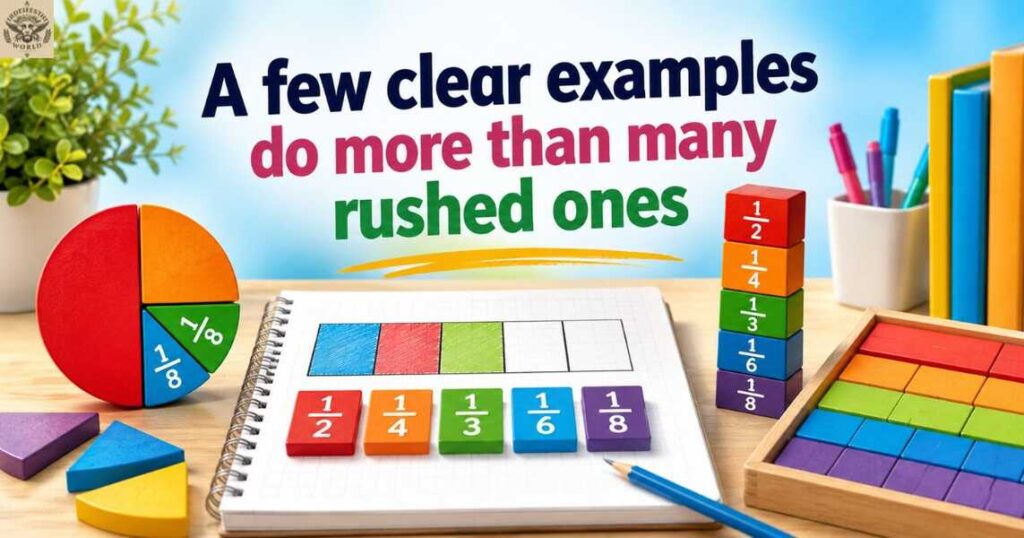
A few carefully explained fraction examples can create stronger understanding than a long list of problems. Start with 1/2, then 1/3, 3/4, and 2/5. For 1/2, the whole has two equal parts and one is selected. For 1/3, there are three equal parts and one is selected.
For 3/4, there are four equal parts and three are selected. For 2/5, there are five equal parts and two are selected. These examples introduce different denominators while keeping the same basic structure. They also help learners recognize a fraction picture and translate it into fraction symbols.
Fraction vocabulary
Strong fraction vocabulary helps learners explain what they see. Rather than teaching words separately, connect each word with a fraction model. This makes the vocabulary meaningful and helps learners communicate their fraction reasoning clearly.
The most important words include whole, equal parts, denominator, numerator, fraction bar, fraction model, and selected parts. Learning these terms supports fraction concepts and gives children the language they need to discuss their answers.
Whole
The whole is the complete object, group, or amount before it is divided. In a pizza example, the entire pizza represents one whole. In a set of objects, the complete set can represent one whole.
Recognizing one whole is one of the most important early fraction skills. Without knowing what the whole represents, it is difficult to interpret the selected parts correctl
Read More: Understanding Grams In Mathematics
Equal parts
Equal parts are sections that have the same size or value within the model. A whole divided into four equal parts creates four fourths. The parts do not have to look identical in every possible representation, but they must represent equal quantities.
Understanding equal parts supports fraction representation,Understanding Fractions fraction diagrams, and visual fractions. It also helps learners avoid counting unequal pieces as though they represent identical shares.
Denominator
The denominator is the bottom number in a fraction. It tells the number of equal parts into which the whole has been divided. In 4/5, the denominator is 5.
A useful way to remember the denominator is to think about the complete structure first. The denominator describes how many equal parts exist in the whole, not how many have been selected.
Numerator
The numerator is the top number in a fraction. It tells how many equal parts are selected, shaded, counted, or used. In 4/5, the numerator is 4.
The numerator becomes easier to understand when learners look at shaded parts in a fraction picture. If four of five equal sections are shaded, the numerator is four and the denominator is five.
How to explain fractions
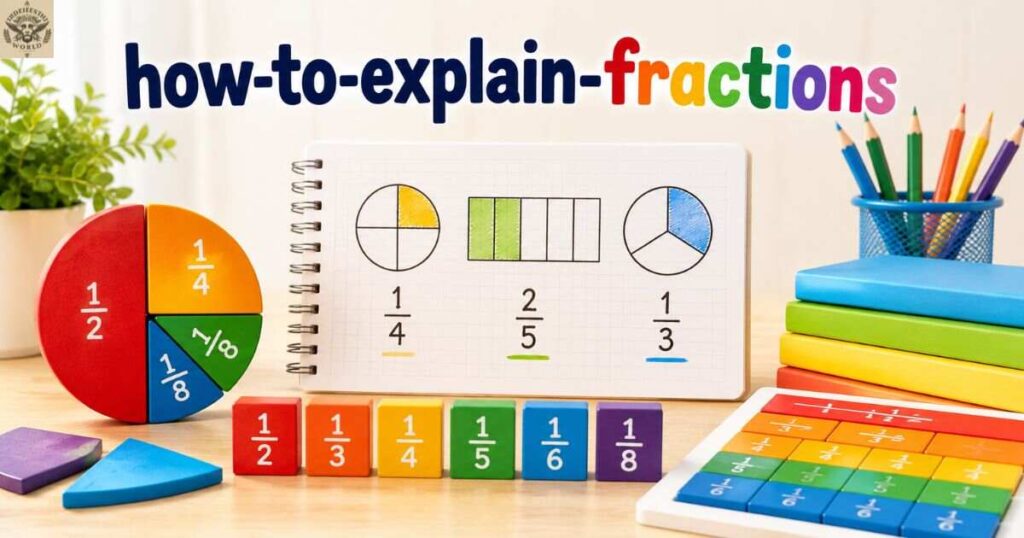
Understanding Fractions becomes easier when explanations follow a consistent sequence. Rather than starting with abstract terminology, begin with something visible. Show one complete object, divide it fairly, select parts, and then name the resulting fraction.
This method can be used for fractions for children, Understanding Fractions beginners, adults, and classroom learners. It is also useful for teaching fractions to children because each step answers a natural question. What is the whole? How many equal parts are there? How many parts are selected? What fraction describes them?
Start with the whole
Show one whole before dividing anything. It could be a rectangle, circle, chocolate bar, measuring cup, or group of objects. Tell the learner that this complete item represents one whole.
Split it into equal parts
Divide the whole into equal parts. If the whole is divided into four equal sections, the denominator is four. Ask the learner to check whether the sections are equal before continuing.
Count the selected parts
Now count the selected parts. Shaded parts, eaten pieces, colored sections, or chosen objects can all represent selected parts. The number selected becomes the numerator.
Name the fraction in words
Say the fraction aloud. A learner might say one-half, one-third, three-fourths, or two-fifths. Speaking the fraction connects fraction notation with mathematical language and strengthens fraction vocabulary.
Tips for Parents
Parents can make learning fractions less stressful by using short conversations instead of long explanations. Ask children to describe a picture,understand Fractions identify the whole, count equal parts, and explain why their answer makes sense. This approach encourages active fraction reasoning.
Using ordinary objects can also help. Cut fruit into equal sections, divide a sandwich fairly, or use a measuring cup during cooking. These activities connect fraction concepts to fractions in everyday life and can make fraction practice feel more meaningful.
A good parent routine is to use one visual example, ask two or three questions, and then let the child explain the answer. If the explanation is incomplete, return to the fraction model rather than immediately giving the answer.
Mistakes children often make when fractions are still new
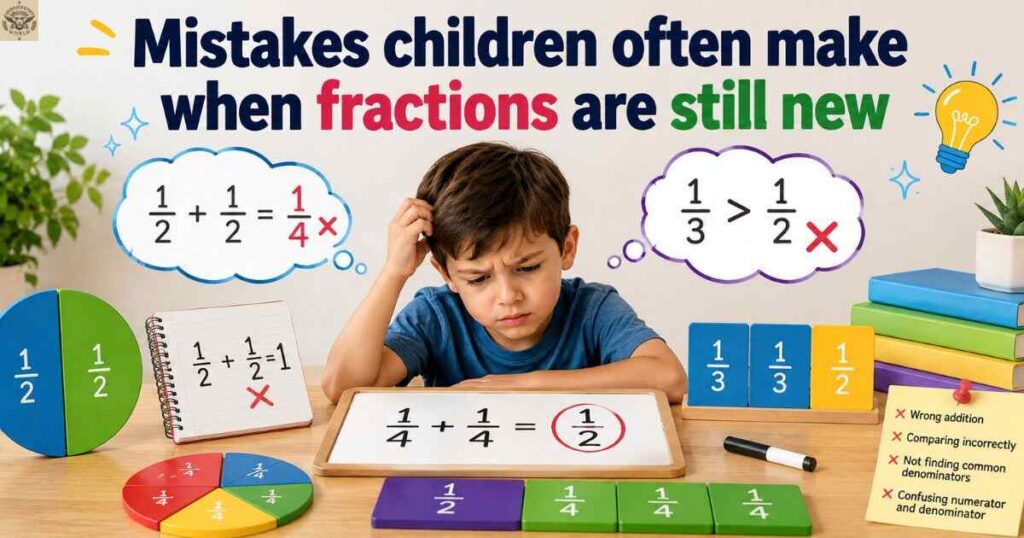
Early mistakes are a normal part of learning fractions. The most useful response is to identify the misunderstanding and use a clearer example. A child who makes a mistake with a fraction may understand part of the idea but need more practice connecting the picture and the numbers.
Common fraction mistakes include counting unequal pieces,Understanding Fractions reversing the numerator and denominator, and assuming every fraction is smaller than one. Each problem can be addressed through simple models and repeated explanations.
Counting unequal pieces
A learner may count three visible pieces and call them three thirds even when the pieces are different sizes. Explain that fractions require equal partitioning. Use a bar model with clearly equal sections to reinforce the idea.
Mixing up numerator and denominator
Numerator denominator confusion happens when learners remember the words but not their meanings. Return to the model. Ask how many equal parts make the whole,Understanding Fractions then ask how many are selected. The first answer identifies the denominator, and the second identifies the numerator.
Thinking fractions are always less than one
Some learners think every fraction must be smaller than one. Show that 2/2 equals one whole, 3/3 equals one whole, and 4/4 equals one whole. When all equal parts are included, the complete whole has been represented.
Fractions can also equal one complete whole
Understanding Fractions should include the important idea that a fraction can represent one whole. If every equal part has been selected, the fraction has the same value as one complete whole. For example, 4/4 means all four fourths are present, so the result is one whole.
This idea prepares learners for improper fraction and mixed numbers. It also strengthens fraction reasoning because children begin to understand that fractions are numbers representing quantities, not simply pieces that must always be smaller than one.
Signs a child is ready to move beyond understanding fractions
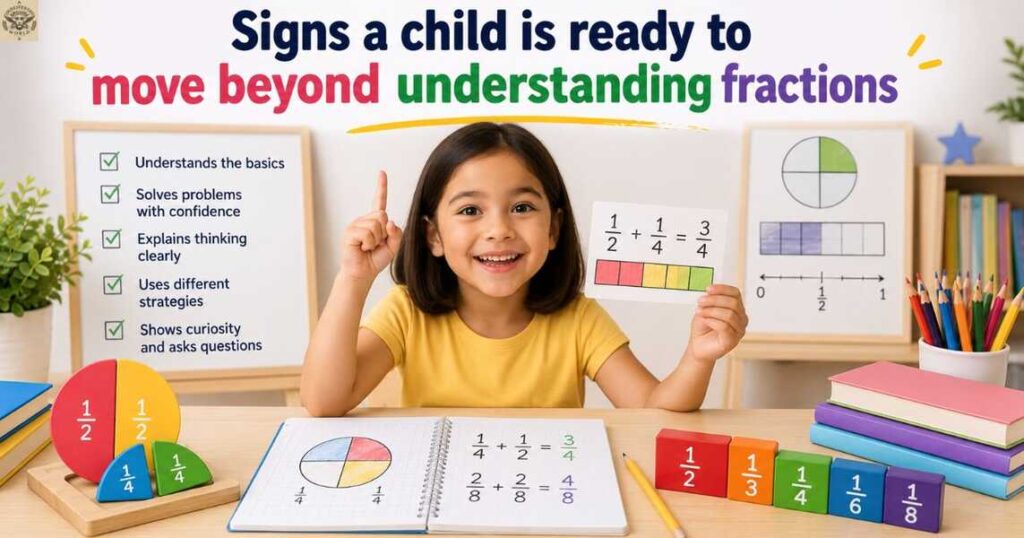
A child is ready for more advanced fraction skills when the basic idea feels natural. They should be able to look at a fraction model and describe the whole, equal parts, selected parts, numerator, and denominator without relying entirely on memorization.
They should also recognize simple fraction symbols and connect them to fraction pictures. Once this foundation is stable, learners can begin working with equivalent fractions, fraction comparison, mixed numbers, and a fraction number line.
They can explain a picture in words
The child can describe how the whole was divided and how many equal parts were selected. This shows that the fraction has meaning rather than being only a symbol.
They can use the vocabulary correctly
The child knows the difference between numerator and denominator and can explain what each represents. They can also use words such as whole and equal parts correctly.
They recognize one whole
The child understands that 2/2, 3/3, and 4/4 each represent one whole. This is a strong sign that the learner understands the relationship between parts and the complete quantity.
Understanding fractions worksheets
Understanding Fractions worksheets can be useful after the learner understands the concept. A good worksheet should include visual fraction models, fraction pictures, shaded parts, and simple fraction examples rather than relying only on symbolic questions.
For beginners, start with identifying equal parts and naming basic fractions. Later, introduce fraction comparison, equivalent fractions, and number line activities. Worksheets should reinforce understanding rather than replace visual learning.
Understanding fractions for beginners
Understanding Fractions for beginners should begin with one whole and equal parts. Learners can practice 1/2, 1/3, 3/4, and 2/5 using pictures before moving toward more difficult questions.
Beginners should learn the basic fraction vocabulary gradually. Once they can identify the whole, denominator, numerator, and selected parts, they have a strong foundation for future fraction practice.
Understanding fractions for adults
Understanding Fractions for adults can be approached in exactly the same conceptual way. Start with familiar quantities such as half a cup, one-third of an amount, or three-fourths of a measurement. Then connect those examples to fraction notation.
Adults who had difficulty with fractions in school may benefit from returning to visual fraction models instead of immediately studying complex rules. A clear foundation can make fraction comparison, equivalent fractions, and operations much easier.
Understanding fractions Grade 4
Understanding Fractions Grade 4 work often builds on the basic meaning of fractions and moves toward comparison, equivalence,the number of equal parts used in a fraction and more complex fraction reasoning. Students should still be able to explain what the numerator and denominator represent.
Visual models remain valuable at this level. Bar models, circle models, and fraction number lines can help students connect abstract notation with quantity. Strong fraction understanding makes later Grade 4 work more manageable.
Understanding fractions pdf
An Understanding Fractions pdf can be useful as a printable reference or practice resource. Look for material that includes fraction models,the number of equal parts used in a fraction vocabulary, examples, and space for learners to explain their reasoning.
A useful printable resource should not focus only on memorizing rules. It should provide opportunities to identify the whole, divide it into equal parts, count selected parts, and write the corresponding fraction.
How to learn fractions step by step
Understanding Fractions develops gradually. First identify one whole. Next divide the whole into equal parts. Then identify the selected parts. After that, write the numerator and denominator. Finally, say the fraction in words and explain what it represents.
Once these steps are comfortable, learners can move to equivalent fractions, proper fraction, improper fraction, mixed numbers, unit fractions, fraction comparison, and fraction number lines. Each new skill becomes easier when the original concept remains clear.
Fractions basics
The fractions basics can be summarized in a few ideas. A fraction represents a part of a whole, the whole is divided into equal parts, the denominator tells how many equal parts exist, and the numerator tells how many are selected.
These fraction concepts are the foundation for mathematical fractions. They also support real life fractions, fraction representation, fraction notation,the number of equal parts used in a fraction and later calculations involving addition, subtraction, multiplication, and division.
Fraction examples
Consider 1/2. The whole is divided into two equal parts and one part is selected. This is one-half. For 1/3, the whole is divided into three equal parts and one is selected. For 3/4, four equal parts exist and three are selected. For 2/5, five equal parts exist and two are selected.
Another useful example is 4.2 as a fraction. The decimal 4.2 can be written as 42/10 and then simplified to 21/5. This shows that fractions can represent quantities greater than one and connects fraction understanding with decimal notation.
Frequently Asked Questions
What is the easiest way to understand fractions?
The easiest approach is to start with one whole, divide it into equal parts, shade or select some parts, and connect the picture to the fraction symbol.
Which is bigger, 1 ⁄ 8 or 1 ⁄ 4?
1/4 is bigger than 1/8. When one whole is divided into four equal parts, each part is larger than a part created by dividing the same whole into eight equal parts.
What are the basic rules of fractions?
The basic ideas are to identify the whole, use equal parts, understand the numerator and denominator, and interpret the fraction correctly. Later operations have additional rules for working with fractions.
What are 7 types of fractions?
Seven commonly discussed categories include proper fractions, improper fractions, mixed numbers, unit fractions, like fractions, unlike fractions, and equivalent fractions. These categories describe different relationships between fraction values and their parts.
What are the four main types of fractions?
Four common types are proper fractions, improper fractions, mixed numbers, and unit fractions. A proper fraction has a smaller numerator than denominator, while an improper fraction has a numerator equal to or greater than its denominator.
Conclusion
Understanding Fractions becomes much simpler when the focus remains on meaning rather than memorization. Start with one whole, divide it into equal parts, identify the selected parts, and connect those parts to the numerator and denominator. Pictures, bar models, circle models, and real life examples can make abstract fraction concepts easier to see.
A strong foundation in Understanding Fractions prepares learners for equivalent fractions, improper fractions, mixed numbers, fraction comparison, decimals, and more advanced mathematical work. Whether the goal is fractions for children, fractions for kids, beginner review, Grade 4 learning, or adult study, clear models and steady fraction practice provide a reliable path forward.

