

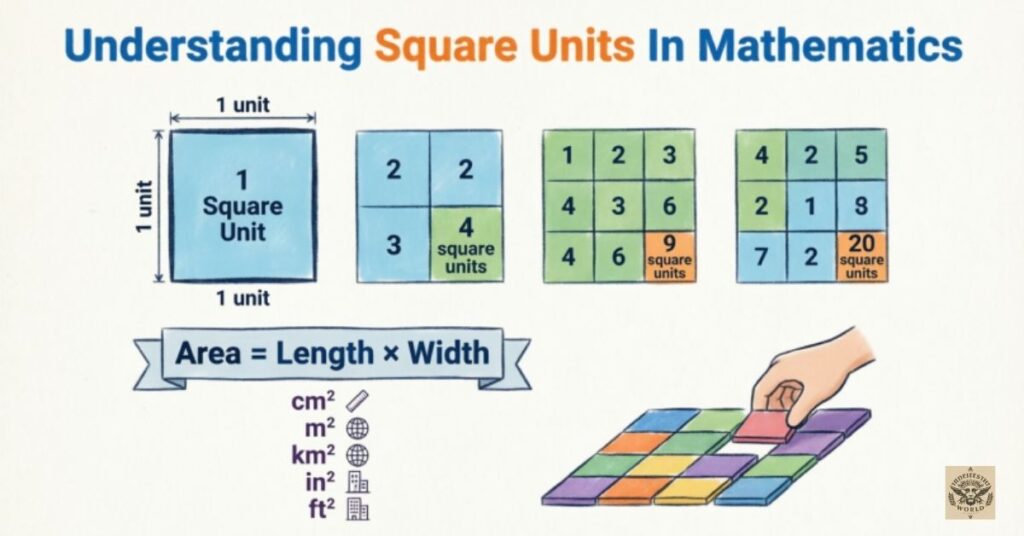
Square units are one of the most basic yet essential concepts in mathematics, especially when learning how to measure flat surfaces and calculate area. If you have ever wondered what are square units, think of them as small identical squares used to cover a surface without leaving any gaps or overlaps. Every measurement of area whether in square inches, square centimeters, or square meters relies on this simple idea of counting how many of these units fit inside a shape.
Understanding the square unit concept helps learners build a strong foundation for geometry, spatial reasoning, and real-life problem solving, such as measuring a room, a garden bed, or a wall before painting. In this guide, we will cover the square unit definition, how a unit square works, useful formulas, real examples, and answers to the most common questions people search for, making the whole topic simple and practical to apply.
Why Understanding Square Units Is Important
Before diving into formulas or advanced geometry, it is worth pausing on why square units deserve so much attention in the first place. They are not just a classroom formality they are the actual language used to describe how much space something occupies, which is a skill needed everywhere from basic homework to professional fields like architecture and design. A solid grasp of the square unit concept early on makes every later topic in measurement, geometry, and even algebra noticeably easier to follow, because so many of those topics quietly depend on this same underlying idea of counting space.
Connecting Square Units To Area
Area is essentially a count of how many square units are needed to completely cover a surface, whether that surface is a rectangle, a triangle, or an irregular shape. This connection is what makes the unit square such a powerful measuring tool instead of guessing the size of a space, you can express it precisely using a standard unit that anyone can understand and compare. This foundation supports almost every topic that follows in geometry and measurement.
Read More: Understanding Vertical In Mathematics
Building Spatial Reasoning With Square Units
Working with square units sharpens spatial reasoning by encouraging learners to picture how shapes form, how they fit together, and how changing one dimension affects the total space covered. It offers a hands-on way to explore relationships such as how doubling the length of a rectangle changes the number of units required to fill it, which builds intuition long before formulas are introduced.
Understanding Real-World Contexts With Square Units
Square units show up constantly outside the classroom. People use them to figure out how many tiles are needed for a floor, how much fabric covers a table, or how much paint a wall will need. Because of these everyday uses, mastering the square unit definition early makes later, more advanced measurement problems feel far less abstract.
Teaching Strategies For Square Units
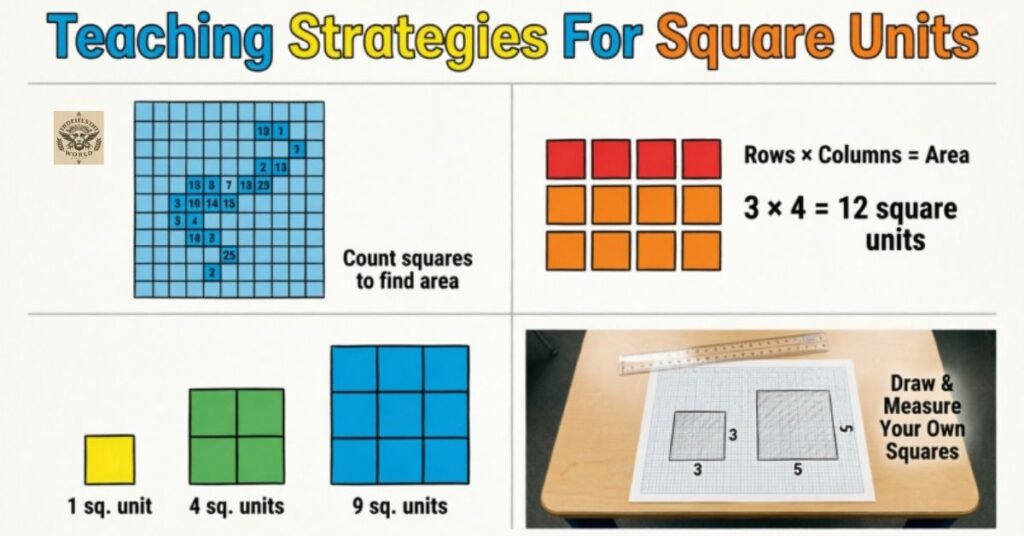
Teaching square units effectively usually works best when it moves through stages starting with something learners can touch, moving to something they can draw, and finally something they can calculate mentally. Jumping straight to formulas without this progression often leaves gaps in understanding, since the numbers stop feeling connected to an actual physical space. The strategies below are arranged in that same order, from hands-on and visual to more abstract reasoning, so that the unit square concept builds naturally rather than being memorized in isolation.
Hands-On Exploration Of Square Units
Physical square tiles let learners build an intuitive sense of area before ever touching a formula. Covering different surfaces desks, books, or paper cut-outs and counting how many tiles were used turns the square unit idea into something they can literally see and touch, which makes the abstract concept of area far easier to grasp.
Visual Models Of Square Units
Grids and graph paper are excellent tools for representing square units on paper. Each small square on the grid stands for one unit, so learners can shade shapes, count squares, and estimate partially filled ones. Comparing shapes with equal areas but different outlines is a great way to show that area, and not shape, is what the count of units actually measures.
Abstract Reasoning With Square Units
Once learners are comfortable with tiles and grids, they can move toward reasoning about square units without a physical model in front of them for example, calculating how many units cover a 5-by-7 space purely through multiplication. This step bridges the gap between concrete counting and the formulas used in formal geometry.
Common Misconceptions And Challenges With Square Units
Even after a good introduction to square units, certain mix-ups tend to show up again and again, and most of them come from rushing toward formulas before the underlying idea has fully settled in. Recognizing these common trouble spots ahead of time makes it much easier to catch and correct them early, rather than letting a shaky understanding of the square unit definition turn into repeated errors later in more advanced geometry problems.
Difficulty Visualizing Square Units in Irregular Shapes
Irregular shapes often contain partially filled squares, which can confuse learners who are used to neat rectangles. Starting with simple shapes and gradually introducing irregular ones, while allowing reasonable estimation, helps learners see that the square unit itself never changes even when the shape being measured is unusual.
Inconsistent Use Of Square Units
A common mistake is dropping the unit label entirely or mixing systems, such as combining square inches with square centimeters in the same answer. Reinforcing that every area value needs a matching square unit label keeps measurements accurate and prevents confusing comparisons later on.
Confusing Square Units Of Area With Linear Units Of Perimeter
Many learners mix up area, measured in square units, with perimeter, which is measured in plain linear units like centimeters or feet. Comparing a tiled surface with a string outlining the same shape is a simple way to show that one measures the inside space and the other measures the boundary distance.
Overgeneralizing Formulas Without Understanding Square Units
Relying purely on “length times width” without knowing why it works can leave learners stuck when shapes get more complex. Breaking the formula down to show that it is really just counting rows and columns of square units keeps the reasoning connected to the underlying concept rather than a memorized shortcut.
Square Units Symbol
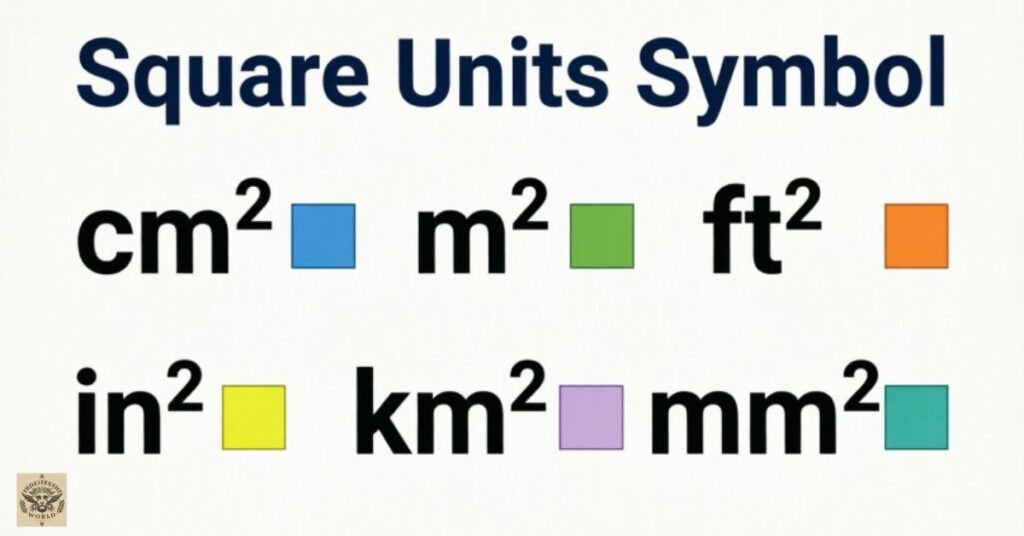
The square unit symbol is written using a small superscript “2” placed after the unit of length, such as cm², m², ft², or in². This small notation is a shorthand way of showing that a measurement covers two dimensions length and width rather than just one straight line.
Whenever you see a number followed by this symbol, it means the value represents area, not distance. Learning to read and write this symbol correctly is an important step in the square unit definition, since mixing it up with a plain linear unit can lead to incorrect answers in both schoolwork and real-world measuring tasks.
Square Units Formula
The most common square units formula for a rectangle or square is area = length × width. This works because multiplying the two dimensions effectively counts how many unit square blocks fit along the rows and columns of the shape, giving the total number needed to cover it completely.
For shapes that are not perfect rectangles, such as triangles or circles, different formulas apply, but the underlying idea stays the same: every formula for area is ultimately a way of predicting how many square units a shape contains without physically counting each one. Once learners understand this link, formulas feel far less like arbitrary rules to memorize.
How To Write Square Units
Writing square units correctly simply means pairing the number with the correct unit and its squared symbol, for example, “24 cm²” instead of just “24.” When writing it out in words rather than symbols, phrases like “24 square centimeters” work just as well and are often used in early grades before the symbol is introduced.
Consistency matters here mixing systems, such as writing part of an answer in square feet and another part in square meters, creates confusion. A good habit is to always double-check that the final answer states both the number and its matching square unit clearly before moving on.
Square Units In Maths
In mathematics, square units are the standard way of expressing two-dimensional measurements across nearly every branch of the subject, from basic arithmetic to advanced geometry and even calculus. Any time a problem asks you to measure a flat surface, the answer will be expressed in terms of a unit square.
This concept also connects to coordinate geometry, where the area between plotted points is calculated in square units, and to real-world applications like land surveying, architecture, and construction, where accurate area measurement is essential for planning and cost estimation.
Square Unit Example
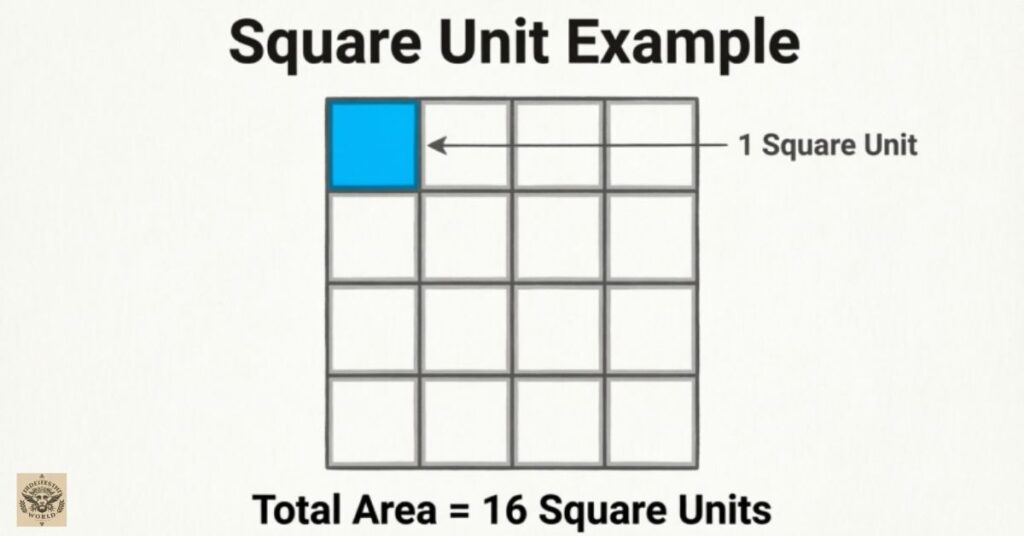
A simple square unit example is a rectangle measuring 4 units long and 3 units wide. Multiplying these dimensions gives 12, meaning the rectangle is made up of exactly 12 square units, which can be verified by drawing the shape on grid paper and counting each individual square.
Another helpful example involves irregular shapes: if a figure partially fills 8 full squares and 4 half squares on a grid, the total area comes out to 10 square units. Working through examples like these helps solidify the connection between counting and calculating.
Square Units Area
Area, by definition, is always reported in square units because it measures a two-dimensional space rather than a single length. Whether the shape is a rectangle, triangle, circle, or an irregular polygon, the final answer must include the appropriate square unit label to be considered complete and accurate.
Comparing the square units area of two different shapes is also a useful classroom exercise, since it shows learners that very different-looking shapes can still cover the exact same amount of space, reinforcing that area depends on total coverage rather than outward appearance.
How Many Square Units Are In The Figure
This is one of the most common instructions on worksheets and tests, and it simply asks learners to count or calculate the total number of square units covering a given shape. For grid-based figures, this often means counting whole squares first, then estimating any partially covered ones.
For figures given with numeric dimensions instead of a grid, applying the relevant formula such as length × width for rectangles gives the answer directly. Practicing both methods, counting and calculating, builds confidence in handling any unit square problem that comes up.
Square Unit Definition 3rd Grade
At the 3rd grade level, the square unit definition is usually kept simple: a square unit is one small square, with each side equal to one unit long, used to measure how much space a shape covers. Teachers often introduce this using colorful square tiles or grid paper so students can physically build and count area rather than jumping straight into formulas.
By this stage, the goal is mainly conceptual helping students understand that area is a count of these small squares, setting them up for formulas like length × width in later grades. Keeping the square unit idea concrete at this age makes the transition to abstract math much smoother.
Frequently Asked Questions
What are square units?
Square units are standard units used to measure area, representing the amount of space a flat shape covers. They are shown with a small “2” symbol, such as cm² or m².
What is 1 unit square?
A unit square is a square with each side measuring exactly one unit in length, making its area equal to one square unit by definition.
Why is area in square units?
Area measures two dimensions length and width at the same time, so the result is naturally expressed in square units rather than a single linear measurement.
What are the units of square area?
Common square unit options include square inches, square feet, square centimeters, and square meters, chosen based on the size of the surface being measured.
How do you find square units?
For most regular shapes, multiply the relevant dimensions, such as length × width for a rectangle, to calculate how many square units the shape covers.
Conclusion
Square units form the backbone of how we measure and understand area, from a simple classroom tile activity to real-world tasks like flooring a room or planning a garden. Knowing the square unit definition, recognizing the correct symbol, and understanding how the unit square connects to common formulas gives learners a practical toolkit they will use throughout their education and everyday life. Common mix-ups, such as confusing area with perimeter or forgetting to label answers correctly, are easy to avoid once the core concept is clear.
Whether you are counting tiles on a grid, applying a formula to a rectangle, or estimating the coverage of an irregular shape, the underlying idea stays the same: area is simply a count of how many square units fit inside a boundary. With consistent practice using hands-on models, visual grids, and real examples, this concept becomes second nature rather than something to memorize.

