


Vertical In Mathematics What is vertical? In the simplest terms, vertical describes any direction or position that runs straight up and down. It’s one of the earliest orientation concepts students encounter, and it shows up everywhere from the way a flagpole stands to how a y-axis is drawn on a graph. If you’ve ever asked yourself what direction is vertical, picture a straight line connecting the floor to the ceiling; that’s the essence of it.
Understanding what does vertical mean in math goes beyond simple direction, though it also shapes how students classify lines, recognize symmetry, measure height, and interpret data. Building this foundation early supports spatial reasoning skills that carry forward into geometry, graphing, and even real-world problem-solving. This guide breaks down exactly what way is vertical, how it connects to horizontal direction, and practical strategies for teaching the concept with confidence .
Why Understanding Vertical Is Important
Grasping the concept of vertical direction gives students a reliable, consistent vocabulary for describing position, orientation, and movement skills that extend well beyond a single math lesson.
Vertical Describes Direction And Spatial Relationships
At its core, understanding vertical direction gives students a clear way to talk about how objects are arranged or positioned in space. This shared vocabulary supports spatial thinking by offering a consistent reference point for describing alignment and movement. In measurement, students rely on vertical orientation whenever they compare heights or read a ruler standing upright. In geometry, recognizing lines and shapes helps students identify symmetry and alignment more easily. And in daily life, this same thinking helps students read maps, understand why buildings and trees stand upright, and describe common objects like thermometers or lampposts.
Vertical In Geometry, Symmetry, and Graphing
In early geometry lessons, the idea of vertical direction reveals meaningful patterns across shapes and data alike. Symmetry is one of the clearest examples: when a figure has vertical symmetry, one half mirrors the other perfectly across a line running straight up and down. Recognizing this balance sharpens how precisely students can describe shapes, and it sets the stage for later ideas like congruence and reflection.
Vertical direction also plays a central role in early graphing when students first encounter bar graphs, they typically compare bar height to represent quantity, using vertical length as a visual stand-in for “how much” or “how many.” As students progress to coordinate grids, they learn that the y-axis itself runs vertically, reinforcing the idea that direction frequently represents height, growth, or change across different types of data and measurement tasks.
The Relationship Between Vertical And Horizontal
Vertical and horizontal are opposite orientations, and understanding how they relate to one another allows students to describe position, direction, and shape with much greater precision. In mathematics, these two directions form the backbone of axes, grids, and reference points used throughout geometry and graphing. Recognizing how and horizontal lines interact helps students understand perpendicularity, parallel lines, and symmetry concepts that come up repeatedly when comparing height versus width.
Vertical direction typically represents elevation, while horizontal represents spread or width. This distinction becomes especially important later on, as the y-axis and horizontal x-axis work together to provide a reliable reference system for plotting and interpreting data, ultimately laying the groundwork for understanding angles, slope, and broader spatial relationships in more advanced mathematics.
Teaching Strategies For “Vertical”
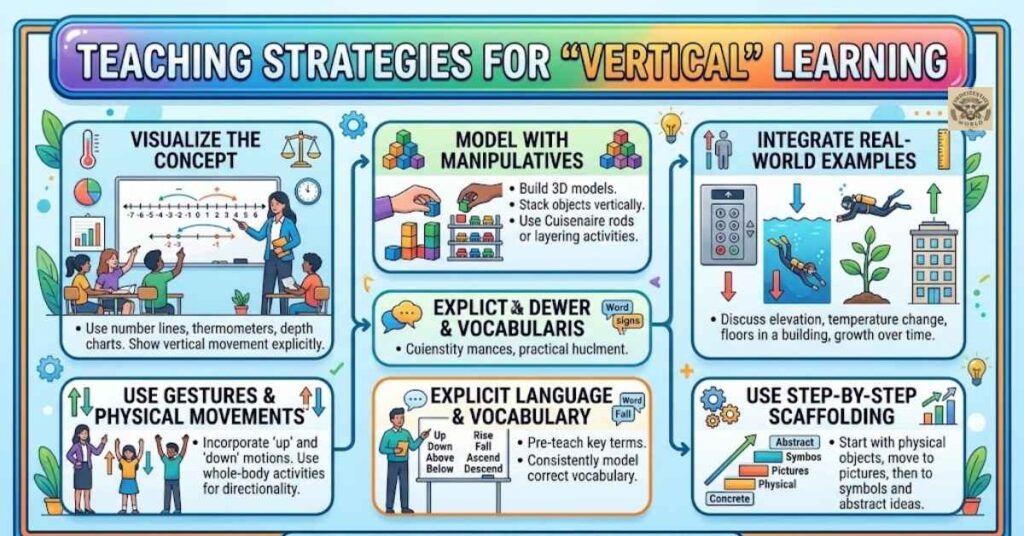
Effective lessons on vertical direction combine movement, observation, and reasoning, helping students build an intuitive, lasting sense of the concept rather than a purely memorized definition.
Read More: IYKYK Meaning in Text: Uses, Examples
Exploring “Vertical” in the Real World
Students build a natural understanding of verticality by observing, representing, and reasoning about the objects and movements around them every day. Start with movement-based exploration have students jump up and down, reach toward the ceiling, or stretch tall like a tree to physically experience vertical motion. This kind of physical grounding helps students associate “vertical” with a consistent, recognizable direction in space. From there, run a vertical scavenger hunt, encouraging students to spot vertically oriented objects around the classroom or school, such as flagpoles, tree trunks, or the edges of a doorframe.
Having students sketch and label what they find shifts their understanding from physical experience into visual representation. To deepen the concept further, compare these vertical examples with horizontally oriented objects, like a table or an open book, and ask guiding questions such as “How do you know this object is?” This kind of comparison pushes students to articulate the concept clearly in their own words.
Vertical Alignment and Structure
Constructing and analyzing vertical structures gives students a hands-on way to explore height, balance, and stability, blending physical building with visual documentation and reasoning. Try a simple building challenge using blocks, straws, or toothpicks and clay, asking students to construct structures that remain upright without tipping. As they build, encourage them to notice what keeps a structure stable and what tends to cause it to topple. Afterward, have students represent their creations through sketches, photos, or a recreation on a basic grid, clearly labeling the elements. Providing a simple grid with lines running in different directions is another effective tool ask students to highlight only the vertical lines and explain their reasoning. Reinforcing that vertical lines run straight up and down, and typically appear perpendicular to a horizontal surface like a floor or tabletop, helps solidify the concept both visually and conceptually.
Vertical Symmetry and Patterns
At this stage, students apply their understanding of vertical direction to analyze symmetry and spatial patterns, moving fluidly between concrete, visual, and abstract reasoning. Begin with a hands-on symmetry activity have students fold paper along a vertical crease, or hold a small mirror upright against a shape to test whether one side mirrors the other.
These physical tools make vertical symmetry tangible before students are asked to identify it independently on paper. Next, present a mix of symmetrical and asymmetrical letters, numbers, and shapes, and ask students to trace or draw the line of symmetry wherever one exists, explaining their reasoning as they go. Encouraging students to design their own shapes with a vertical line of symmetry, and to justify why their design works, reinforces the concept through creative, open-ended application.
Vertical in Mathematics Examples
Common vertical in mathematics examples include a flagpole standing upright, the edge of a doorframe, the y-axis on a coordinate grid, and the straight side of a rectangle running from top to bottom. Each of these examples shares the same defining trait: a straight-line orientation running from bottom to top, unaffected by tilt or slant.
Vertical in Mathematics Formulas
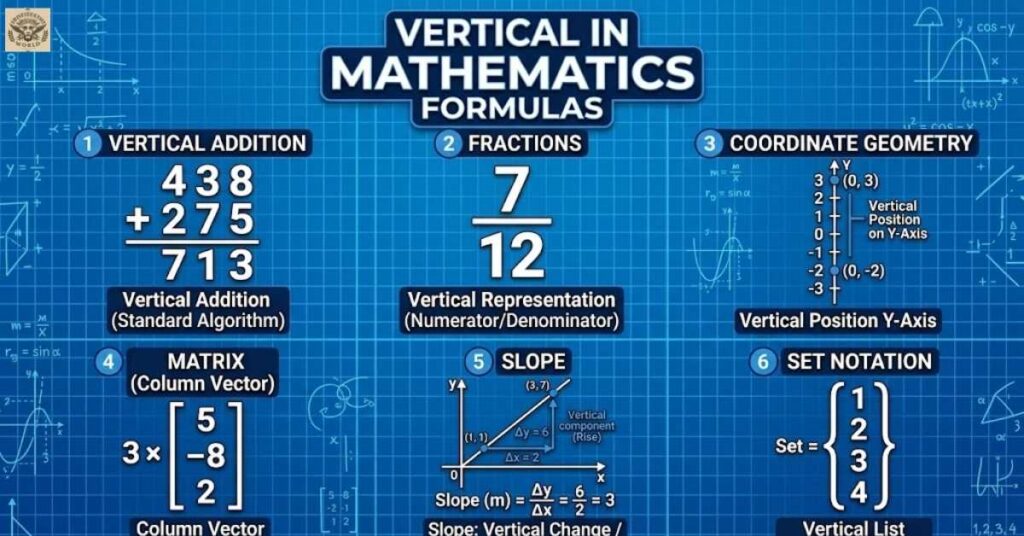
While “vertical” itself isn’t tied to a single formula, it appears throughout key mathematical relationships. A vertical line is defined by the equation x = a constant value, since every point on the line shares the same x-coordinate regardless of height. This formula distinguishes lines from horizontal ones, which are instead defined by y = a constant value.
Vertical and Horizontal
The relationship between vertical and horizontal lines forms one of the most fundamental building blocks in geometry. Vertical lines run straight up and down, while horizontal lines run flat, side to side. Together, they form perpendicular intersections that define coordinate grids, right angles, and countless real-world structures, from building frames to graph axes.
What is Vertical Line in Math
A vertical line in math is a straight line that runs directly up and down on a coordinate plane, with every point sharing the same x-coordinate. Unlike diagonal or slanted lines, a line has an undefined slope, since there is no horizontal change between any two points along it.
Vertical Meaning Math Angles
When vertical direction intersects with angle measurement, it often relates to how angles are measured relative to a reference line. A vertical angle, in a separate but related concept, refers to the pair of opposite angles formed when two lines cross, which are always equal in measure regardless of their orientation.
Vertical Example
A simple, everyday vertical example is a ladder leaning straight up against a wall, or the trunk of a tree rising from the ground toward the sky. Both illustrate the same core idea: a straight path moving from a lower point to a higher one.
Vertical Line Segment

A vertical line segment is a finite portion of a vertical line, marked by two clear endpoints rather than extending infinitely in both directions. These segments are commonly used in geometry problems to measure height, represent boundaries, or divide shapes into symmetrical halves.
Vertical Math Problems
Typical vertical math problems ask students to identify vertical lines on a grid, calculate the equation of a line through a given point, or determine whether a figure has vertical symmetry. These problems reinforce both visual recognition and algebraic understanding of the concept.
Frequently Asked Questions
How is vertical used in mathematics?
Vertical direction is used to describe lines, angles, symmetry, and axes in graphing. It helps students measure height, compare quantities, and understand spatial relationships.
What is a vertical example?
A flagpole, a ladder leaning against a wall, or the y-axis on a graph are all common vertical examples. Each runs straight up and down without tilting.
What is vertical and horizontal in math?
Vertical and horizontal are opposite directions used to describe orientation. Vertical runs up and down, while horizontal runs side to side, and together they form the basis of coordinate grids.
Which shape is vertical?
No single shape is inherently “vertical,” but shapes like rectangles or triangles can havesides or a vertical line of symmetry. The term describes orientation rather than shape type.
Which is called vertical?
Any line, object, or direction that runs straight up and down is called vertical. This includes standing objects, the y-axis, and vertical lines of symmetry.
Conclusion
Vertical direction plays a foundational role in how students understand position, symmetry, and structure throughout mathematics. From recognizing that what is vertical simply means a straight up-and-down orientation, to understanding how it interacts with horizontal direction on coordinate grids, this concept supports skills that extend far beyond a single lesson. Whether measuring height, analyzing symmetry, or interpreting graphs, vertical thinking gives students a reliable framework for describing the world around them with precision.
Hands-on strategies from movement exercises to scavenger hunts to building challenges help transform an abstract idea into something students can see, touch, and confidently explain. With consistent practice across real-world examples and mathematical contexts, students develop a lasting, intuitive grasp of direction that supports everything from basic geometry to advanced graphing and spatial reasoning.

