


A prism is a 3D shape with two parallel, congruent bases connected by rectangular or parallelogram faces. Whether it’s a triangular prism, rectangular prism, pentagonal prism, or hexagonal prism, the same rule holds: the base shape names the prism, and its cross section stays the same all the way through, setting it apart from a pyramid.
This page breaks down how to name a prism, how the volume formula V = Bh works, and how folding a net brings the shape to life. It also clears up common prism and pyramid mix ups, helping students build real, lasting understanding of this key geometry term.
Understanding Prism in Mathematics
A prism belongs to a family of shapes called polyhedrons. That simply means every prism is built entirely from flat faces, with no curves anywhere on its surface. What makes a prism a prism, specifically, comes down to two things: a prism always has a pair of bases that are congruent and sit parallel to one another, and the faces running between those bases on a prism are always parallelograms or rectangles.
Picture a prism sliced straight through, parallel to its bases. No matter where along its length you make that cut, the cross section you see stays exactly the same shape and size. This single trait is what separates a prism from shapes like pyramids, which narrow down and come to a single point instead of keeping a steady cross section from end to end.
Key Concepts Related to Prisms
Grasping a prism really comes down to a handful of connected ideas: naming it by its base, calculating its volume with V = Bh, and unfolding its net to see how the flat faces fit together. Once students link these pieces, a prism stops feeling like an abstract term and starts feeling like a shape they can build, measure, and reason about with confidence.
Read More: Rectangle – Meaningful Math
Naming a Prism
Every prism gets its name from the polygon that forms its base. Once a student can identify that base shape, naming any prism becomes second nature, and the same logic applies whether the prism has three sides or eight.
| Prism Name | Base Shape |
| Triangular prism | Triangle |
| Rectangular prism | Rectangle |
| Pentagonal prism | Pentagon |
| Hexagonal prism | Hexagon |
Worth remembering: a prism can technically use any polygon as its base. As long as the two bases stay identical and every side face stays flat, the shape still qualifies as a prism, no matter how many sides the base has.
Finding the Volume of a Prism

Every prism follows one dependable volume formula: V = Bh. Here, B stands for the area of the base of the prism, and h stands for the height of the prism itself.
This formula does something clever. It bridges flat, two dimensional thinking with solid, three dimensional thinking, and it asks students to work through two steps:
- Calculate the area of the base (B), which is a purely two dimensional task.
- Multiply that base area by the height (h) to stretch it into the third dimension.
Thinking about a prism this way, as layer after layer of the same flat shape stacked upward, helps students genuinely grasp why area and volume are so closely linked rather than just memorizing a formula.
Unfolding the Net of a Prism
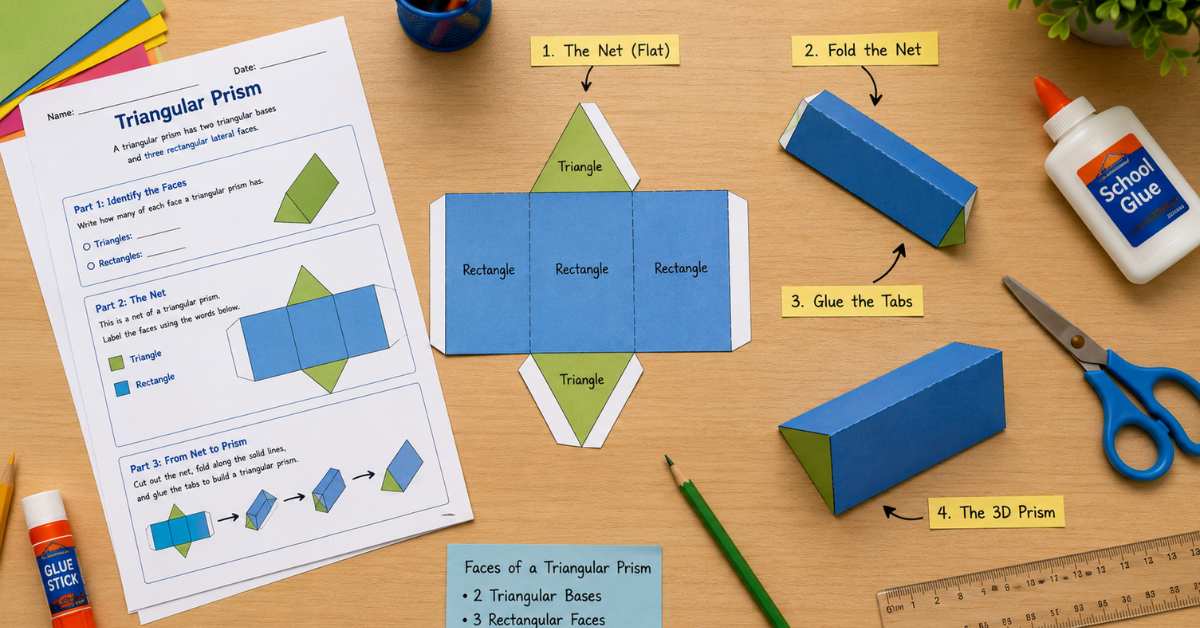
A net is the flattened, two dimensional version of a prism, the pattern you could fold back up to rebuild the solid shape of that prism. Every prism’s net always includes two matching polygon bases, plus rectangular or parallelogram side faces joining them together.
Working with nets gives students a hands-on way to see exactly how a flat sheet becomes a solid prism. It also lays the groundwork for surface area calculations on a prism and builds spatial reasoning skills that carry into more advanced geometry later on.
Common Misconceptions About Prisms
Students often assume any solid with flat faces counts as a prism, but a shape only earns that name when it has two parallel, congruent bases and keeps the same cross section all the way through. Comparing prisms next to pyramids, and letting students fold both nets themselves, clears up this confusion far faster than a definition ever could.
Mixing Up Pyramids and Prisms
Students often lump pyramids in with a prism, but the two shapes differ in several important ways:
- A prism has two parallel bases, while a pyramid has just one base and a set of triangular faces that all meet at a single apex.
- The side faces of a prism are rectangles or parallelograms, while the side faces of a pyramid are always triangles.
- A prism keeps the same cross section throughout its length, while a pyramid’s cross section shrinks as it climbs toward the apex.
Letting students place a prism and a pyramid side by side, comparing their nets, their faces, and their cross sections, makes these differences click far faster than a definition of a prism alone ever could.
Prism LaTeX
LaTeX gives math writers a reliable way to draw a prism, or any 3D shape, directly inside a document instead of pasting in an outside image. Packages like TikZ and its 3D extensions let you plot the vertices of a triangular prism, a rectangular prism, or a hexagonal prism, connect them with clean lines, and shade the faces so the base and the lateral faces read clearly on the page.
Building a prism in LaTeX usually starts with defining coordinates for each polygonal base, then drawing straight edges between the two identical bases to form the lateral faces. Once the code is set up, changing the shape from a triangular prism to a pentagonal prism, or stretching the height, only takes a small edit to the coordinates.
Prism Shape
A prism shape is any solid figure built from two identical, parallel bases connected by flat side faces, and it is one of the first 3D shapes students learn to identify and classify. What sets a prism shape apart from other solids is a simple test: slice it parallel to its bases anywhere along its length, and the cross section stays the same size and shape all the way through. That single property lets students compare shapes and separate a prism from a pyramid, since a pyramid narrows toward a single point instead of holding a steady cross section.
The type of prism shape you get depends entirely on the polygon forming its base. A triangular prism uses two triangles, a rectangular prism uses two rectangles, a pentagonal prism uses two pentagons, and a hexagonal prism uses two hexagons, with rectangular or parallelogram faces connecting each pair. Because any polygon can technically serve as a polygonal base, the prism family covers a wide range of forms while sharing the same underlying rules for volume, surface area, and net construction.
Prism AI
The name “Prism AI” isn’t tied to one single product. Several unrelated companies currently use it: some apply it to session replay and product analytics tools that watch user behavior, others attach it to short form video generation, strategic decision making platforms, or defense grade computer vision systems. Because the name is shared across so many different tools, it’s worth checking which specific company or product a source is referring to before assuming they mean the same thing.
One company under this name, founded in 2025, focuses on deploying AI agents through a single API call, giving developers infrastructure, orchestration, and memory without heavy custom engineering. Other companies bearing the same name build entirely different tools, from marketing analytics to industrial robotics research. Because “Prism AI” isn’t a single standardized product the way a rectangular prism or triangular prism is a standardized shape, readers researching it should confirm which company they’re looking at rather than assuming one definition covers them all.
Prism Software
When people search for “Prism software” without further context, they’re most often looking for GraphPad Prism, a statistical analysis and graphing tool widely used in scientific research for data analysis, curve fitting, and generating publication ready graphs. Students, graduate researchers, and laboratory scientists rely on it to run statistical tests, interpret experimental results, and build clear figures for papers and reports, which makes it a staple in biology, pharmacology, and medical research labs rather than a general purpose spreadsheet substitute.
GraphPad Prism supports a broad range of analyses, including t tests, ANOVA, linear and nonlinear regression, dose response curves, and survival analysis, alongside customizable graphing options for presenting that data. It’s worth noting that “Prism software” can also point to unrelated tools, such as Blue Prism’s robotic process automation platform used in enterprise workflow automation, so context matters when someone mentions the term.
Triangular Prism

A triangular prism gets its name because both of its bases are triangles, sitting parallel to each other and connected by three rectangular side faces. Students often meet this shape first because it’s easier to picture than prisms with more sides, and it works well for teaching the base area and height relationship that drives the volume formula.
To find the volume of a triangular prism, you calculate the area of one triangular base, then multiply that base area by the prism’s height, following the same V = Bh formula every prism uses. Folding a triangular prism’s net is also a common classroom activity, since it clearly shows how three rectangles wrap around two triangles to close up the solid shape.
Rectangular Prism
A rectangular prism, sometimes called a box shape, has two rectangular bases and four rectangular side faces, making every face on the shape flat and four-sided. It’s usually the very first 3D shape young learners identify by name, since so many everyday objects like books, cereal boxes, and bricks are rectangular prisms.
Because every face is a rectangle, finding a rectangular prism’s volume or surface area becomes a straightforward multiplication exercise once students know the length, width, and height. This makes the rectangular prism a natural bridge between basic multiplication and more formal geometry, letting students practice the area of base and stacking layers concept before moving on to prisms with less familiar base shapes.
Pentagonal Prism
A pentagonal prism uses two identical five sided polygons as its bases, joined by five rectangular or parallelogram lateral faces. It sits a step above triangular and rectangular prisms in complexity, so it usually appears once students are comfortable identifying polygons with more than four sides.
Working out a pentagonal prism’s volume still follows V = Bh, but finding the base area takes a bit more work since a pentagon’s area calculation is less immediate than a triangle’s or rectangle’s. Teachers often use the pentagonal prism to reinforce that the volume formula stays consistent across every prism type, no matter how the base area itself gets calculated.
Hexagonal Prism
A hexagonal prism has two congruent hexagons as bases, connected by six flat side faces. Its shape appears often in real objects, from pencils to nuts and bolts, which gives students an easy way to connect the abstract geometry term to something they can picture or hold.
Just like every other prism, a hexagonal prism keeps the same cross section from one base to the other when sliced parallel to its bases. Comparing a hexagonal prism’s net to a pentagonal or rectangular prism’s net helps students see how the number of sides on the polygonal base directly changes the number of lateral faces in the net.
Polygonal Base
The term polygonal base simply refers to the flat, many sided shape forming each end of a prism, and it’s the key to naming and classifying every prism type. Since a prism can use practically any polygon as its base, from a triangle up through shapes with many more sides, this base is what gives the whole solid its identity.
Once students grasp that a prism’s polygonal base determines both its name and its base area, they can apply the same volume formula and net building logic to any prism they encounter. This is why teaching the polygonal base concept early pays off, it turns prism identification from memorization into pattern recognition.
Pyramid vs Prism
A prism keeps two parallel bases and a uniform cross section throughout, while a pyramid has just one base and narrows to a single apex.
| Feature | Prism | Pyramid |
| Bases | Two parallel, congruent bases | One base only |
| Lateral Faces | Rectangles or parallelograms | Always triangles |
| Cross Section | Stays the same throughout | Shrinks toward a point |
| Apex | No apex | Comes to a single apex |
| Naming | Named after the base shape (triangular, rectangular, pentagonal, hexagonal) | Named after the base shape (triangular, square, pentagonal, hexagonal) |
| Volume Formula | V = Bh | V = (1/3)Bh |
| Example | A cereal box or a pencil (hexagonal prism) | The Great Pyramid of Giza |
Net of a Prism
A net is the flattened, two dimensional layout of a 3D shape, showing exactly how the faces of a prism connect before it’s folded into its solid form. Every prism’s net includes its two identical polygonal bases plus the rectangular or parallelogram faces that link them, arranged so folding along the edges recreates the original prism.
Building nets by hand gives students a concrete, hands-on way to understand surface area, since they can count and measure every face before assembling the shape. It also strengthens spatial reasoning, letting students mentally construct a 3D prism from a flat pattern well before they can do that calculation on paper alone.
Surface Area of a Prism
The surface area of a prism is the total area covering every one of its faces, both bases and every lateral face combined. Unlike volume, which measures the space inside a prism, surface area measures the material needed to wrap around the outside of it, which is why nets are such a useful tool for calculating it.
To find a prism’s surface area, students calculate the combined area of the two congruent bases, then add the area of every rectangular or parallelogram lateral face. Breaking the calculation into these separate flat pieces reinforces the same two dimensional thinking that supports volume, just applied to the outer surface instead of the inner space.
Volume of a Prism
Every prism’s volume follows the same dependable rule, V = Bh, where B represents the base area and h represents the prism’s height. This formula holds true whether the base is a triangle, rectangle, pentagon, or hexagon, which is part of why understanding it unlocks every prism type at once rather than requiring a separate formula for each.
Thinking of volume as stacking layers, imagining the base shape repeated over and over up to the prism’s full height, helps students see why multiplying base area by height works. That mental image connects two dimensional areas directly to three dimensional volume, turning an abstract formula into something students can visualize.
Height of a Prism
The height of a prism is the perpendicular distance between its two parallel bases, and it’s one of only two values needed to calculate volume. Getting this measurement right matters, since height must always be measured straight across between the bases, not along a slanted side face.
Height plays the same role across every prism type, whether triangular, rectangular, pentagonal, or hexagonal, which makes it a reliable, consistent piece of the volume formula. Once students can correctly identify a prism’s height, they’ve cleared one of the two hurdles standing between them and a confident volume calculation.
Spatial Reasoning and Prisms
Spatial reasoning is the skill of mentally picturing, rotating, and manipulating shapes, and prisms are one of the best tools for building it in young learners. Working through nets, cross sections, and volume problems forces students to hold a 3D shape in their mind while reasoning about its flat, 2D components.
This kind of spatial transformation practice pays off well beyond geometry standards like 1.G.A and 3.G.A. Strong spatial reasoning supports later math work in measurement, algebra, and even everyday problem solving, which is exactly why elementary math curricula lean so heavily on hands-on prism activities in the early grades.
Frequently Asked Questions
What are four types of prisms?
The four common types are triangular, rectangular, pentagonal, and hexagonal prisms, each named after the shape of its base.
What is prism used for?
A prism helps students learn to calculate volume, understand cross sections, and connect 2D area to 3D space through hands-on geometry practice.
Is prism better than Excel?
It depends on the task. GraphPad Prism handles statistical analysis and scientific graphing far better than Excel, but Excel remains stronger for general spreadsheet work and everyday data organization.
What is the shape of a prism?
A prism has two parallel, congruent bases connected by flat rectangular or parallelogram side faces, giving it a consistent cross section throughout.
What is the definition of a prism?
A prism is a solid 3D shape, or polyhedron, with two identical parallel bases and flat sides linking them together.
Conclusion
A prism stops being just a vocabulary word once students can name it, calculate its volume, and fold its net with real confidence. That understanding builds a base for every geometry unit that follows, from surface area to spatial reasoning, and it starts with something as simple as recognizing two parallel, congruent bases and a matching set of flat side faces.
Whether it’s a triangular prism, a rectangular prism, or a hexagonal prism, the same core ideas carry students through: identify the base, apply V = Bh, and picture the shape as stacked layers rather than a static solid. Keep coming back to hands-on comparisons between prisms and pyramids, and this concept will stay clear long after the formulas are memorized.

