

Ask any student what do rectangles have in common, and most will point to four straight sides meeting at sharp corners, but there’s a lot more going on underneath that simple observation. A rectangle definition in geometry rests on a few clear rules: it’s a quadrilateral, a polygon with four sides, where every angle forms a right angle, opposite sides stay equal in length, and those same opposite sides run parallel to each other. Does a rectangle have four right angles? Always, and that one detail is what separates rectangles from every other four sided shape, including its close relative, the parallelogram.
What do all rectangles have in common isn’t just a question for a worksheet, it’s the foundation for understanding shape families and hierarchical classification. Once students see a rectangle as a special type of parallelogram, and a square as a special type of rectangle, they start recognizing shared attributes across shapes instead of memorizing each one separately. This kind of thinking sets the stage for everything from sorting shapes and classifying shapes with cut out shapes, to reasoning about length, width, perimeter, and area, and eventually connecting rectangles to arrays, area models, and grid based reasoning used in spatial reasoning and data representation.
Understanding Rectangles in Mathematics
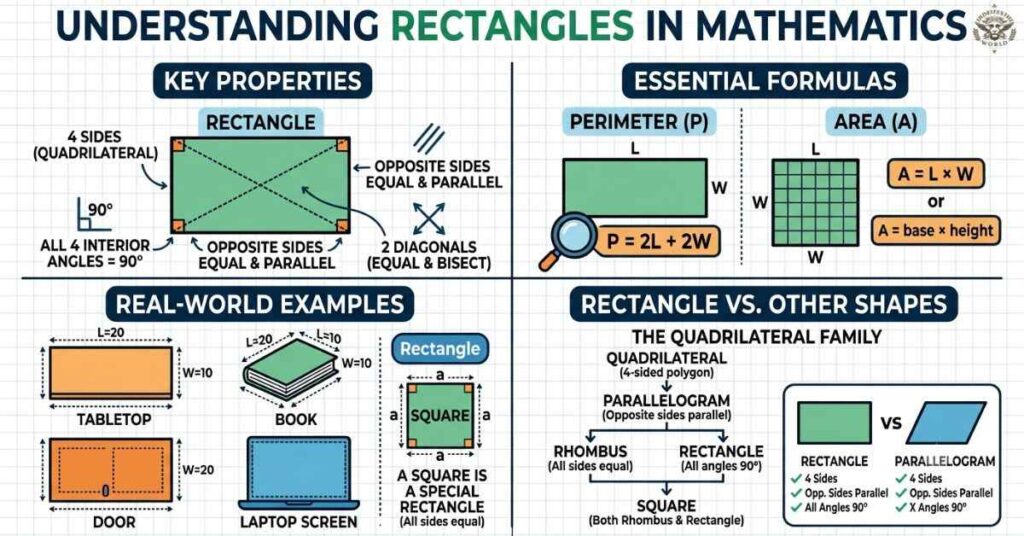
When someone asks for the rectangle definition in geometry, the answer comes down to three properties working together. A rectangle is a four sided polygon, or quadrilateral, where every angle measures exactly 90 degrees, opposite sides are equal in length, and opposite sides run parallel to each other. So does a rectangle have four right angles? Yes, always, and that single fact is what separates a rectangle from every other quadrilateral shape.
Because a rectangle has four right angles, it automatically qualifies as a special type of parallelogram. A square takes this one step further. A square is a special type of rectangle, since it checks every box a rectangle needs (right angles, equal opposite sides, parallel sides) while also having all four sides the exact same length. This relationship gives young learners their first real taste of hierarchical classification: every square is a rectangle, but not every rectangle is a square.
Read More: Row – Meaningful Math
Why Understanding Rectangles Matters
Understanding a rectangle gives students a starting point for measurement, since ideas like length, width, perimeter, and area all build on its simple, predictable properties. It also strengthens shape classification skills, helping students see how a rectangle
Rectangles as a Foundation for Measurement and Shape Classification
Few shapes show up as often in daily life as a rectangle does, from doors and windows to notebooks and phone screens, which makes it a natural anchor point for teaching shape classification. Once students see a rectangle as belonging to bigger shape families like quadrilaterals and parallelograms, they start recognizing shared attributes across shapes instead of memorizing each one in isolation.
A rectangle also opens the door to measurement concepts like length, width, perimeter, and area. Students who can confidently identify a rectangle by its defining properties are far better prepared to calculate its perimeter or area later on, because they already understand what makes the shape what it is.
Rectangles connect naturally to grid based reasoning too. Their straight sides and right angles make them ideal for building arrays, area models, and other visual tools used in data representation. This connection helps students develop spatial reasoning skills that carry over into multiplication, division, and even early data analysis.
Teaching Strategies for Rectangles
Students grasp a rectangle best when they can sort, fold, and compare real shapes, not just look at drawings. Pairing that hands-on work with guiding questions pushes them to reason about the properties instead of just naming the shape.
Comparing a Rectangle to Other Quadrilaterals
One of the most effective ways to help students understand what makes a rectangle unique is by placing it next to other four sided shapes. Hand out cut out shapes, including squares, trapezoids, rhombuses, and a variety of rectangles, and ask students to sort them by similarities and differences. As students physically compare corners and sides, ask them: what do all rectangles have in common? Encourage them to fold corners to check for right angles or line up sides to test for equal length.
This kind of visual analysis works even better when paired with verbal explanation. After sorting, have students describe out loud (or in writing) why a shape belongs in the rectangle group and why another shape doesn’t. Follow up with pre-drawn quadrilaterals and ask students to pick out every rectangle from the group, checking their choices against the cut out shapes they already sorted.
Exploring How a Rectangle Relates to Other Shape Families
Once students can spot a rectangle with confidence, push them toward bigger questions about shape families. Ask: what do rectangles have in common with squares? Or, can a rectangle ever be a rhombus? These questions get at shared attributes and defining properties rather than surface appearance.
Have students test their answers with physical shapes instead of just talking about them. A student who thinks every square is a rectangle can lay a square cut out directly on top of a rectangle cut out and compare the properties side by side. This hands-on testing makes the idea of a special type of parallelogram, and a special type of rectangle, much easier to grasp. A simple chart showing overlapping properties between rectangles, squares, and rhombuses can turn this abstract reasoning into something visible and concrete.
Reasoning About the Defining Properties of a Rectangle
As students grow more comfortable identifying and drawing a rectangle, shift the focus toward reasoning about why the properties matter. Pose an open ended question like, “I have a quadrilateral with four right angles. What shape could I be?” This kind of prompt forces students to think beyond a single rectangle and consider every shape that could fit the description.
Guiding questions worth asking during this stage include:
- What do you notice about shapes that have four right angles?
- Which quadrilaterals always have equal opposite sides and parallel sides?
- How can you check whether a shape’s side lengths make it a rectangle?
These questions keep students focused on right angles, opposite sides, equal sides, parallel sides, and side lengths, which are the actual building blocks of a rectangle’s identity, rather than a shape’s general look.
Common Misconceptions About Rectangles
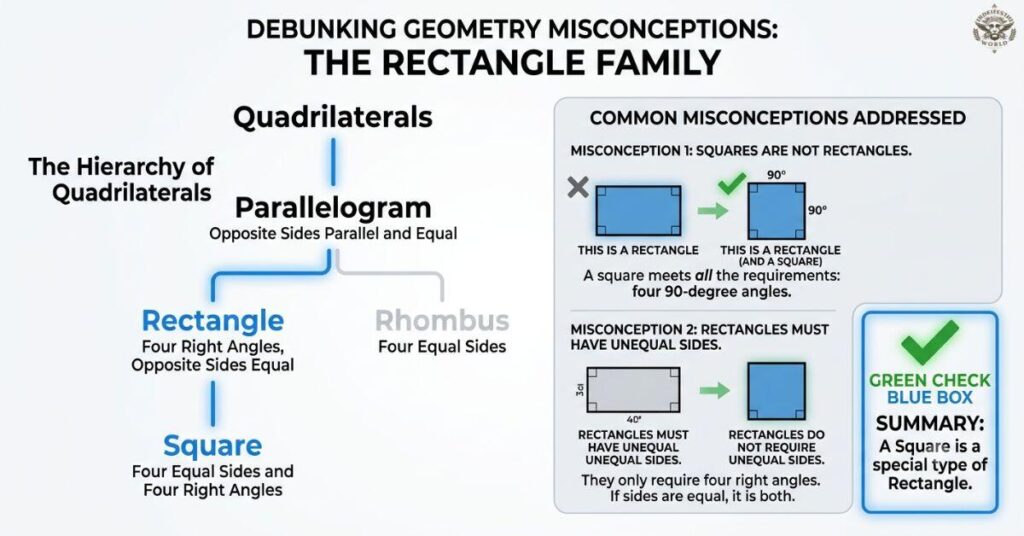
Many students believe a rectangle must always have one long pair of sides and one short pair, so they don’t recognize a square as a rectangle too. Clearing up this idea early helps students judge a rectangle by its actual properties, not by how it happens to look.
Misconception: A Rectangle Must Have Two Long Sides and Two Short Sides
Because textbooks so often draw a rectangle with one long pair of sides and one short pair, students sometimes assume that unequal side lengths are part of the definition. This misconception overlooks the fact that a square, with four equal sides, is still a rectangle. Address this directly by placing a square and a longer rectangle side by side and asking students to list what both shapes have in common. When students see that right angles, parallel sides, and equal opposite sides define a rectangle (not the specific side lengths) the misconception starts to break down, and their shape classification skills grow stronger for it.
Types of Rectangle
When people picture a rectangle, they usually imagine one standard shape, but a rectangle actually comes in several forms depending on its proportions. A regular rectangle keeps two long sides and two short sides, while a square counts as a special type of rectangle since all four sides turn out equal. Beyond these, rectangles also appear as elongated shapes used in architecture, rounded rectangles used in design, and even three dimensional versions like a rectangular prism, which stretches the same flat properties into a solid object.
What do all rectangles have in common, regardless of their size or proportion? Every single one keeps four right angles and two pairs of parallel, equal opposite sides. Classifying shapes this way helps students move past surface level visual features and focus on the actual defining properties vs. appearance. A long, narrow rectangle and a nearly square one still belong to the same family, because the properties, not the look, decide the category.
Rectangle Mac
Outside of geometry class, “Rectangle” also refers to a popular window management app built for macOS. Since Mac computers don’t come with a built in way to snap windows to the edges of the screen, developers created Rectangle to fill that gap. The free, open source tool lets users organize their desktop by dragging windows to screen edges or pressing customizable keyboard shortcuts, snapping each window into halves, thirds, or quarters of the display.
Rectangle Mac has become one of the first apps many people install on a new machine, largely because it solves a real productivity problem without any cost or complicated setup. It works well for anyone juggling multiple windows at once, whether that means writing a document next to a browser or comparing two spreadsheets side by side. A paid version, Rectangle Pro, adds extra features like custom layouts and cloud syncing for people who want even more control over their workspace.
Rectangle Area
Finding the area of a rectangle comes down to one simple idea: multiply the length by the width. Since a rectangle has straight, parallel sides and four right angles, its area formula stays consistent no matter how the shape is stretched or rotated. This makes a rectangle one of the easiest shapes for students to measure early on, long before they tackle more complex polygons.
Understanding the rectangle area also builds a foundation for real world tasks, from figuring out how much paint covers a wall to calculating flooring for a room. Guiding questions like “how many unit squares fit inside this rectangle” help students visualize areas rather than just memorizing a formula. Over time, this conceptual understanding of area connects naturally to grid based reasoning and even to more advanced topics like arrays and area models.
Rectangle Formula
The rectangle formula for area is length multiplied by width, often written as A = l × w. For perimeter, the formula adds up all four sides, which simplifies to P = 2(l + w) since opposite sides share the same length. Both formulas rely entirely on a rectangle’s defining properties: equal opposite sides and consistent right angles, which is exactly why the math stays so predictable.
Students often benefit from seeing these formulas modeled with real shapes before jumping straight into abstract equations. Measuring a physical rectangle, counting its unit squares, and then comparing that count to the formula’s result helps turn a memorized rule into genuine understanding. Once students trust the formula, they can apply it confidently to rectangles of any length and width, without needing to recheck their reasoning every time.
Define Rectangle with Example
A clear rectangle definition in geometry describes a quadrilateral with four right angles, where opposite sides are equal in length and run parallel to each other. A common example is a standard sheet of paper or a door, both of which show two pairs of matching sides meeting at perfect right angles. Even a phone screen or a picture frame demonstrates the same defining properties, just at a different size.
Using everyday examples like these helps students connect an abstract definition to something they already recognize. Ask them to look around the classroom and identify objects that fit the rectangle definition, then challenge them to explain why each object qualifies. This kind of hands-on verbal explanation reinforces the properties behind the shape, rather than letting students rely on memorized appearances alone.
Rectangle Length and Breadth
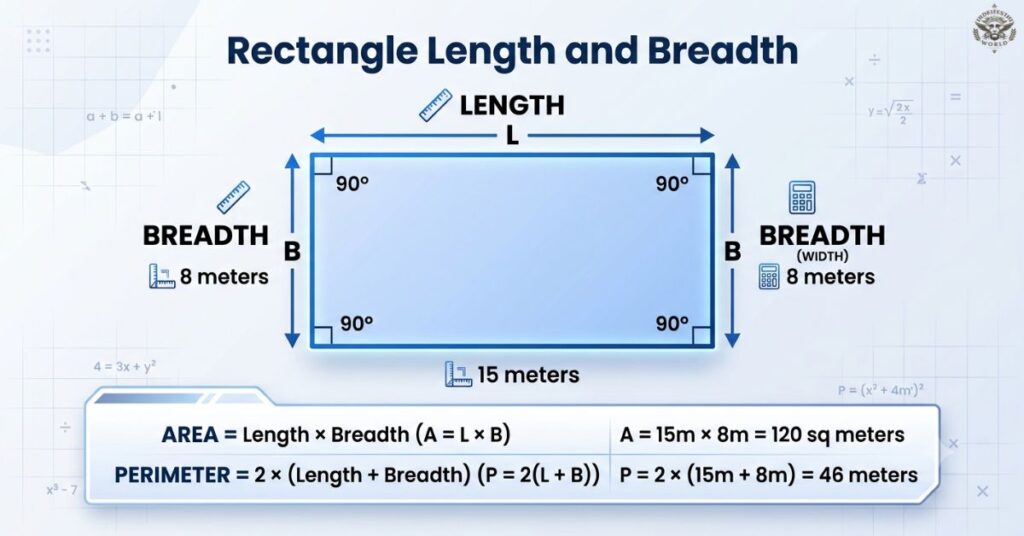
In a rectangle, length refers to the longer pair of opposite sides, while breadth (also called width) refers to the shorter pair. These two measurements work together in every rectangle formula, whether the goal is finding area or calculating perimeter. Since opposite sides of a rectangle are always equal, only two distinct measurements are ever needed to describe the entire shape.
It’s worth noting that length and breadth don’t have to be dramatically different. A rectangle can have a length and breadth that are very close in size, or even identical, at which point the shape becomes a square. Helping students see length and breadth as flexible measurements, rather than fixed “long side, short side” values, supports a much stronger grasp of what actually makes a rectangle a rectangle.
Rectangle Shape Size
A rectangle’s shape stays the same across every size, since its defining properties (right angles and parallel, equal opposite sides) never change no matter how large or small the rectangle gets. A tiny sticky note and a large whiteboard can both count as rectangles, as long as they follow the same underlying rules. This consistency is part of why the rectangle shape works so well as an early teaching tool.
Because size doesn’t affect classification, students sometimes need extra practice recognizing rectangles that look unusual, like a very long, thin one or a nearly square one. Encouraging students to draw rectangles of different sizes and then compare them side by side builds this kind of abstract reasoning. Over time, they start to judge a rectangle by its properties rather than by how big or small it happens to appear.
Rectangle App
Beyond geometry, “Rectangle app” points back to the same macOS window manager mentioned earlier, and it remains one of the most recommended free tools for organizing a Mac desktop. Users install the rectangle app to snap windows into place using either keyboard shortcuts or simple drag gestures, cutting out the tedious manual resizing that macOS doesn’t handle well on its own.
The rectangle app supports multiple displays, offers fully customizable shortcuts, and stays lightweight enough to run in the background without slowing down a machine. Because it’s open source and free, with no ads or subscriptions attached, it has built a large, loyal user base among people who want a faster, keyboard driven way to manage their workspace.
Frequently Asked Questions
Which shape is a rectangle?
A rectangle is any four sided shape with four right angles and two pairs of equal, parallel sides, like a door, a book, or a phone screen.
What is the definition of a rectangle?
A rectangle is a quadrilateral where all four angles measure 90 degrees, and opposite sides are equal in length and run parallel to each other.
Which is a rectangular?
Anything that follows the rectangle’s shape, four right angles with equal, parallel opposite sides, counts as rectangular, from a table top to a television screen.
What are the 7 basic shapes?
The 7 basic shapes usually taught are the circle, triangle, square, rectangle, pentagon, hexagon, and oval.
What is a rectangle also called?
A rectangle doesn’t really go by another name, though when all four sides are equal, it’s specifically called a square.
Conclusion
A rectangle might seem like a simple shape at first glance, but it carries a surprising amount of depth once students start exploring its properties. From understanding right angles and parallel sides to connecting those ideas with area, perimeter, and shape classification, a rectangle gives learners a solid foundation they’ll rely on throughout geometry. Recognizing that a square counts as a special type of rectangle, or that length and width can vary while the core properties stay fixed, helps students think in terms of defining properties rather than memorized appearances.
Whether the conversation turns to everyday examples like doors and picture frames, or even to tools like the Mac window manager that borrows the same name, the rectangle keeps showing up because its structure is so dependable. Building conceptual understanding through hands-on sorting, guiding questions, and real world connections gives students the confidence to identify and reason about rectangles anywhere they appear, not just on a worksheet.

