


The zero property shows up early in every student’s math journey, yet it carries more weight than most quick lessons give it credit for. At its core, the zero property covers two simple but powerful ideas, adding zero to a number leaves that number unchanged, and multiplying any number by zero always results in zero. These two rules sound easy on the surface, but students only truly own them once they understand the reasoning behind each one, not just the pattern.
This guide walks through the zero property from every angle a teacher or parent might need, from grade level introductions and hands on models to common misconceptions, division and subtraction edge cases, the zero product property formula, and practical worksheet ideas. Whether you’re introducing the zero property for the first time or reinforcing it after a few shaky lessons, the goal here is the same: help students see zero as a number with real purpose, not just a rule to memorize.
Understanding the Zero Property in Math
The zero property carries two big ideas that every young learner needs to grasp.
The first idea is the addition property of zero. When you add zero to any number, that number stays unchanged. This holds true whether students are working with whole numbers or with variables. For example, 6 + 0 = 6 shows a specific case, while x + 0 = x shows the same idea working for any number at all. Adding zero simply does not touch the value you started with, the number stays exactly where it was.
The second idea is the multiplication property of zero. When you multiply any number by zero, the answer is always zero. So 4 x 0 = 0, 0 x 9 = 0, and even y x 0 = 0 for any variable y. This is the property of zero that trips students up the most, because it feels different from every other multiplication fact they have learned.
Many teachers present these rules as something to memorize, but that approach skips the reasoning underneath. Once students only rely on tricks, they can produce correct answers without truly grasping why the answer is correct. Teaching the zero property through models and reasoning gives zero a real identity as a quantity, not just a shortcut to remember.
Teaching the Zero Property With Hands On Models
Concrete models and visual aids give students something to see and touch while they work through the zero property, and that hands-on approach builds real conceptual understanding.
To explore the additional property of zero, hand a student 5 counters and ask them to add zero more counters to the pile. Have them count the total out loud and notice it is still 5. Repeat the activity with different starting amounts so students see the pattern hold every time, the number stays unchanged no matter how many counters they begin with.
To explore the multiplication property of zero, bring out cups and cubes. Ask students to line up 4 cups and place zero cubes inside each one. Then ask them how many cubes they have altogether. Repeat with different numbers of cups while always leaving the cups empty, and students will start to see that zero groups of anything still leaves them with nothing, the absence of a quantity in every group means there is no total to count.
Zero Property in Real Life
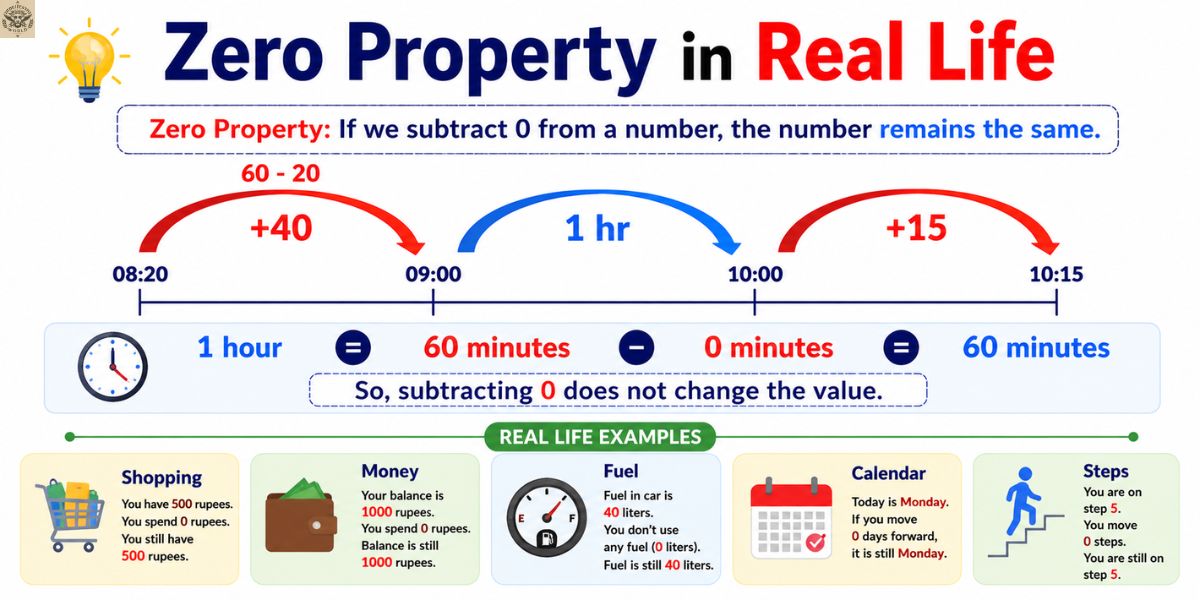
Real world examples turn the zero property from an abstract rule into something students already understand from daily life. Try questions like, “You have 10 pencils and you don’t add any more, how many pencils do you have now?” or “You own 5 empty jars with no marbles inside any of them, how many marbles do you have in total?” These simple word problems connect straight back to the addition property of zero and the multiplication property of zero without needing a single worksheet.
Read More: Elapsed Time – Meaningful Math
Growing Math Vocabulary Through the Zero Property
Strong math vocabulary helps students explain their thinking instead of just producing an answer. Encourage students to describe zero using precise language tied to mathematical reasoning. Help them understand that zero acts as the additive identity, meaning it is the one number that leaves every other number unchanged when added to it. A student working through 8 + 0 = 8 should be able to explain that zero is the additive identity because the total never moves.
On the multiplication side, guide students toward explanations like, “9 times 0 equals 0 because I have zero groups of 9, so there is nothing there at all.” This kind of explanation builds real number sense around the multiplication property of zero rather than a memorized rule with no meaning behind it.
Common Misconceptions About the Zero Property
Most misconceptions around the zero property come from students treating zero as “nothing” rather than as a number with its own structure and purpose.
Misconception: Adding zero does nothing. Some students describe the addition property of zero as “nothing happens,” which skips the real idea. Push them toward the understanding that zero preserves the number’s value rather than simply doing nothing to it.
Misconception: Multiplying by zero cancels the other number out. Students sometimes describe the multiplication property of zero as “canceling” the other factor. Redirect that language toward the true reasoning, the product is zero because there are zero groups or zero items inside each group, not because anything got erased.
Zero Property Grade 2
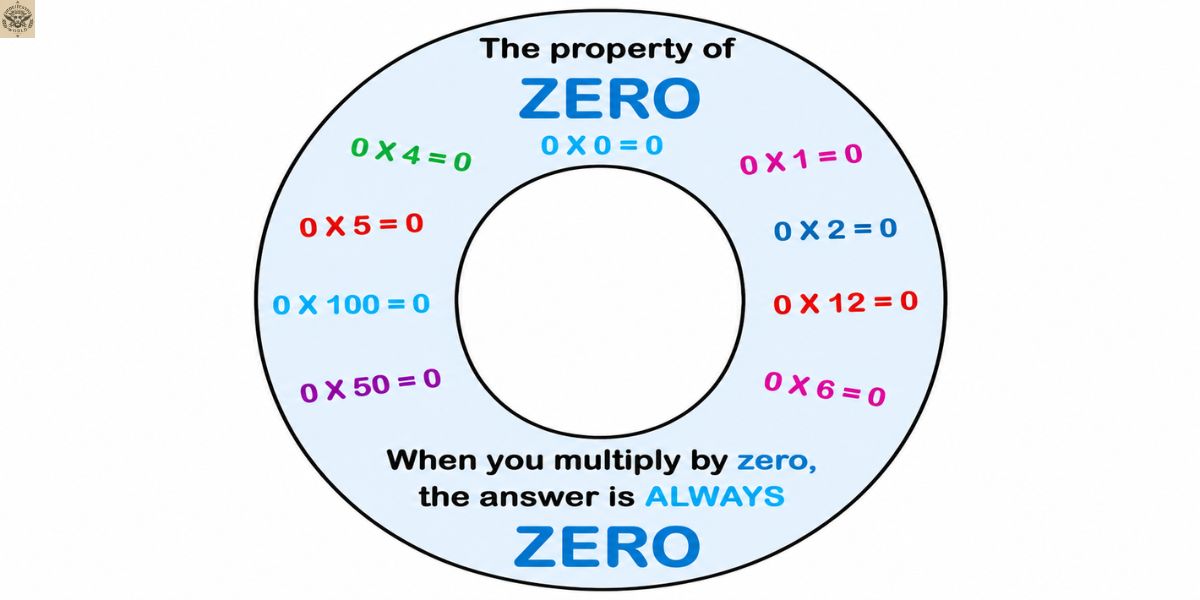
Second grade math introduces the zero property as one of the earliest number rules students meet outside basic counting. At this stage, kids are usually working with small whole numbers, so teachers lean on simple equations like 4 + 0 = 4 to show that adding zero never changes the starting amount. This early exposure sets the stage for a stronger sense of the addition property of zero before students move into larger numbers or algebraic thinking.
Grade 2 classrooms often pair this lesson with counters, number lines, or short number talks so students physically see why the total stays the same. Many teacher resources built for elementary math frame this as a warm up activity, since it builds confidence early and connects naturally to later lessons on the multiplication property of zero once students begin learning basic multiplication facts.
Zero Property of Division
The zero property of division works differently from addition and multiplication, and it often confuses students who expect the same pattern to repeat. When zero is divided by any nonzero number, the answer is zero, since there is nothing to split into groups. But dividing any number by zero is undefined, because there is no way to split a quantity into zero equal parts.
Teachers usually introduce this idea after students already understand the property of zero in addition and multiplication, since the contrast helps the concept stick. A quick real world example works well here, if you have zero cookies and three friends to share them with, each friend still gets zero cookies, but the reverse situation, splitting cookies among zero friends, simply does not make sense.
Zero Property of Multiplication
The multiplication property of zero, sometimes called the multiplicative property of zero, states that any number multiplied by zero always equals zero. This holds true no matter how large or small the other number is, so 8 x 0 = 0 and 500 x 0 = 0 follow the exact same rule. Students often find this surprising at first, since multiplication usually makes numbers grow rather than disappear.
A helpful way to explain this is through groups. Multiplying by zero means you have zero groups of something, so there is nothing to count. Elementary math teachers frequently use cups, counters, or simple drawings to model this idea, which turns an abstract rule into something students can actually picture and explain in their own words.
Zero Property of Addition
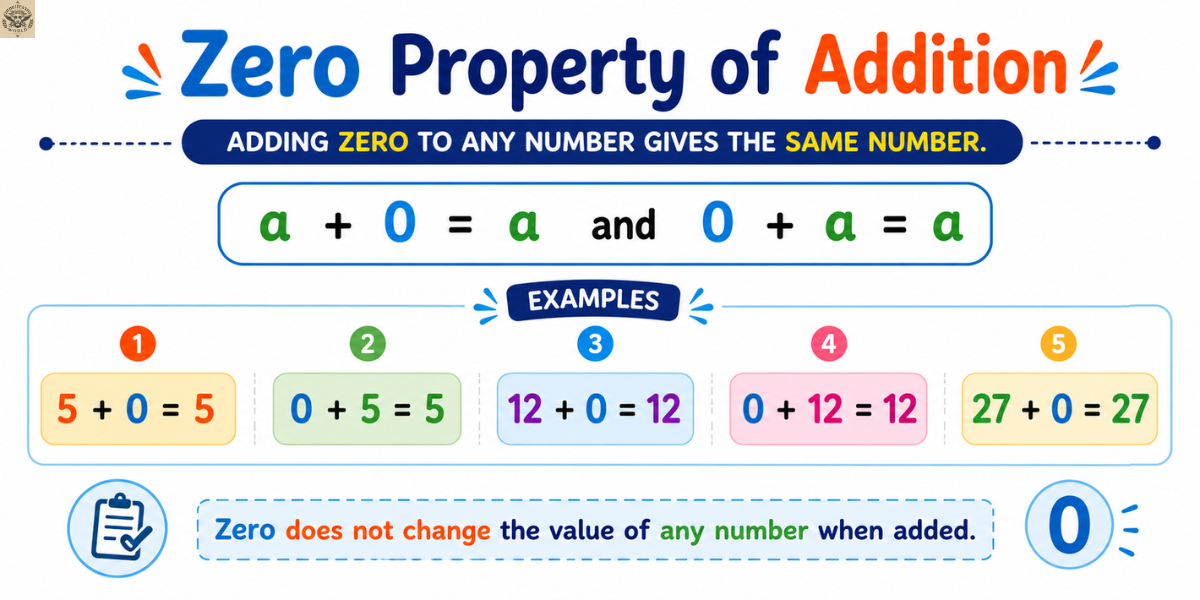
The zero property of addition tells students that adding zero to a number leaves that number completely unchanged. Whether the equation reads 7 + 0 = 7 or uses a variable like n + 0 = n, the outcome always stays the same. This idea connects directly to the concept of the additive identity, since zero is the one number that never alters the value it joins.
Students usually meet this rule early in elementary math, often before they fully understand more complex operations. Simple visuals help reinforce it, such as showing a group of 6 objects with zero more added, then asking students to count and confirm the total never moved. Repeating this with different numbers builds a strong, lasting sense of the addition property of zero.
Zero Product Property Formula
The zero product property is a slightly different idea usually introduced later, once students start working with equations rather than simple number facts. It states that if the product of two factors equals zero, then at least one of those factors must be zero. In formula form, this looks like: if a times b equals 0, then a equals 0 or b equals 0, or both.
This concept becomes especially useful in algebra, where it helps students solve equations by breaking a multiplication statement into simpler parts. While younger students focus on the basic multiplication property of zero, older students build on that same foundation when they apply the zero product property formula to factor and solve equations later in their math journey.
Zero Property of Multiplication Worksheets
Worksheets built around the zero property of multiplication give students repeated practice recognizing the pattern in different formats. A well designed worksheet mixes numeral equations, such as 6 x 0 = 0, with word problems and simple visual models like empty cups or groups, so students are not just repeating a memorized fact but applying it in different contexts.
Good worksheets also avoid turning the lesson into pure repetition. Mixing in real world examples, short answer explanations, and a few problems that ask students to explain their reasoning helps teachers check whether students actually understand the multiplication property of zero rather than just guessing the pattern from the shape of the numbers.
Zero Property of Subtraction
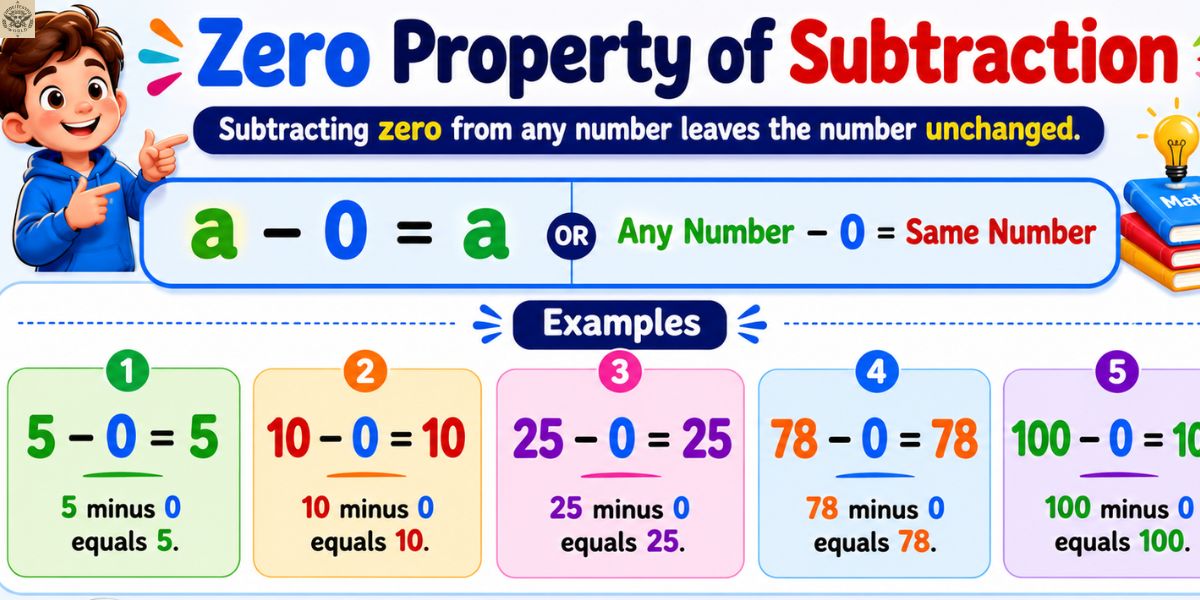
Subtraction with zero behaves a bit differently depending on which side of the equation zero sits on. Subtracting zero from a number leaves the number unchanged, so 9 minus 0 still equals 9. However, subtracting a number from zero produces a negative version of that number, which is usually introduced later once students are ready for negative numbers.
Because of this difference, teachers often wait to formally name a zero property of subtraction until students already have a solid grip on the addition property of zero. Framing it as an extension of familiar additional facts, rather than a brand new rule, helps students transfer their existing number sense instead of treating subtraction with zero as something completely separate.
Zero Property of Multiplication Example
A simple zero property of multiplication example helps make the rule concrete for students who are still building confidence with the concept. Take 5 x 0 = 0, if you have 5 empty cups with no cubes inside any of them, counting the cubes across all 5 cups still gives you zero, no matter how many cups you line up.
Word problems offer another useful example format. Asking a question like, “You have 4 baskets and each one holds zero apples, how many apples do you have in total?” turns the abstract multiplication property of zero into a scenario students can picture and solve without needing to memorize a rule they don’t fully understand.
Frequently Asked Questions
What is the difference between zero property and identity property?
The zero property is one specific example of the identity property, since zero acts as the additive identity when it’s added to a number.
How to apply zero property?
Add zero to a number to keep it unchanged, or multiply a number by zero to get zero every time.
What is the zero property rule?
Adding zero never changes a number, and multiplying by zero always gives zero.
What is the meaning of zero property?
It describes how zero behaves in addition and multiplication, preserving value in one and erasing it in the other.
What is the zero property also known as?
It’s also called the addition property of zero and the multiplication property of zero.
Conclusion
The zero property might look like a small rule tucked into an early math unit, but it quietly supports everything students build on later, from basic number sense to algebra and beyond. Once a student truly understands why adding zero leaves a number untouched and why multiplying by zero wipes a product out completely, they stop guessing and start reasoning, and that shift in thinking carries them through harder concepts down the road.
Teaching the zero property well takes more than a worksheet full of equations. Counters, cups, real world questions, and honest conversations about common misconceptions all give students something to hold onto beyond a memorized trick. Whether you’re covering this for the first time in second grade or circling back to reinforce it later, the payoff is the same, a student who actually gets zero, not just one who can repeat the rule.

