


Elapsed Time bachon ko worksheet se pehle hi mehsoos hota hai, chahe woh game time kar rahe hon ya recipe bake hone ka wait kar rahe hon. Yeh concept start time aur end time ke darmiyan duration measure karta hai. Isi wajah se ek fuzzy feeling clear time interval mein badal jati hai jo clock par parhi ja sake aur confidence se explain ki ja sake.
Meaningful Math mein Elapsed Time sirf definition yaad karna nahi hai, balke iski real understanding banayi jati hai. Analog clocks, open number lines aur simple T charts se ise hands-on aur concrete banaya jata hai. Clock hands, hours aur minutes ko travel time ya sports schedule jaisi routines se joda jata hai, jisse number sense aur logical reasoning majboot hote hain ek aisi skill jo test ke baad bhi kaam aaye.
Elapsed Time Meaning
So what is Elapsed Time, really? In the simplest terms, Elapsed Time is the amount of time that passes between a start time and an end time. If a child starts reading at 3:00 and finishes at 3:45, the Elapsed Time is 45 minutes. That’s the whole idea, though teaching it well takes a bit more thought than that one example suggests.
Elapsed Time shows up everywhere, from cooking dinner to catching a bus, yet for many young learners it’s one of the trickier math concepts to grasp. Unlike a ruler that measures length or a scale that measures weight, time can’t be held in your hand. You can’t point to duration the way you point to a pencil. This is part of what makes Elapsed Time such an abstract idea for kids who are still learning to read a clock and tell time.
Understanding Elapsed Time in Mathematics
Elapsed Time refers to the stretch of time between when something begins and when it ends. It’s usually expressed in hours and minutes, sometimes seconds, and it asks students to track a moving target rather than a fixed quantity. Because time keeps flowing and can’t be seen or touched, grasping Elapsed Time means learning to think about something invisible. For a child who is still working on telling time on a 12 hour clock, that’s genuinely difficult.
Making sense of Elapsed Time means connecting number sense with the way a clock cycles around and around. This is where an analog clock becomes such a useful tool for Elapsed Time lessons. Watching the hour hand creep forward while the minute hand sweeps a full circle gives kids something concrete to watch, and that visual helps them notice patterns in how hours and minutes relate to one another. A digital clock, by contrast, only shows the moment, so students often need both clock hands and digital numbers to fully understand Elapsed Time. Over time, students start to see the rhythm behind the numbers instead of just memorizing rules.
Why Is Elapsed Time Important?

Learning Elapsed Time gives kids a life skill they’ll lean on again and again, not just in the classroom but everywhere they go. Once a student can work out Elapsed Time on their own, they can plan their morning, figure out how long a task will take, and reason through everyday situations that involve a clock.
Elapsed Time also connects to other parts of math. Calculating Elapsed Time often calls on addition and subtraction, and it can even tie into fractions when students break an hour into quarters or halves. As kids get comfortable measuring the passage of time, they naturally get better at managing their own schedules, hitting deadlines, and making smart choices about how they spend their day. Every one of these habits traces back to a solid grasp of Elapsed Time.
Read More: Side – Meaningful Math
Everyday Situations Where Elapsed Time Matters
Elapsed Time isn’t just a worksheet topic. It pops up constantly in daily life, including situations like these.
- Morning Routines: Figuring out how long it takes to get dressed, eat breakfast, or finish a chore before school, which is Elapsed Time in action before the day even really starts.
- Time Management: Juggling homework, chores, and free time while still meeting deadlines depends on tracking Elapsed Time throughout the day.
- Travel: Working out travel time, reading a bus or train schedule, or planning when to leave so you arrive on time all come down to reading Elapsed Time correctly.
- Cooking and Baking: Watching the clock so a recipe doesn’t overcook or undercook is a hands on lesson in Elapsed Time.
- Sports and Activities: Timing a lap, tracking the length of a game’s halves or quarters, or keeping tabs on progress during a timed drill all rely on quick Elapsed Time calculations.
When kids see how Elapsed Time connects to things they already care about, the idea stops feeling abstract. Suddenly it’s not just a math term, it’s a tool they use to move through their own day with a bit more confidence.
Teaching Strategies for Elapsed Time
Because Elapsed Time is such an abstract concept, teaching it well means giving students something concrete to hold onto first. The strategies below help bridge the gap between an idea students can’t touch and experiences they can, and each one supports Elapsed Time in a slightly different way.
Using Manipulatives to Make Elapsed Time Concrete
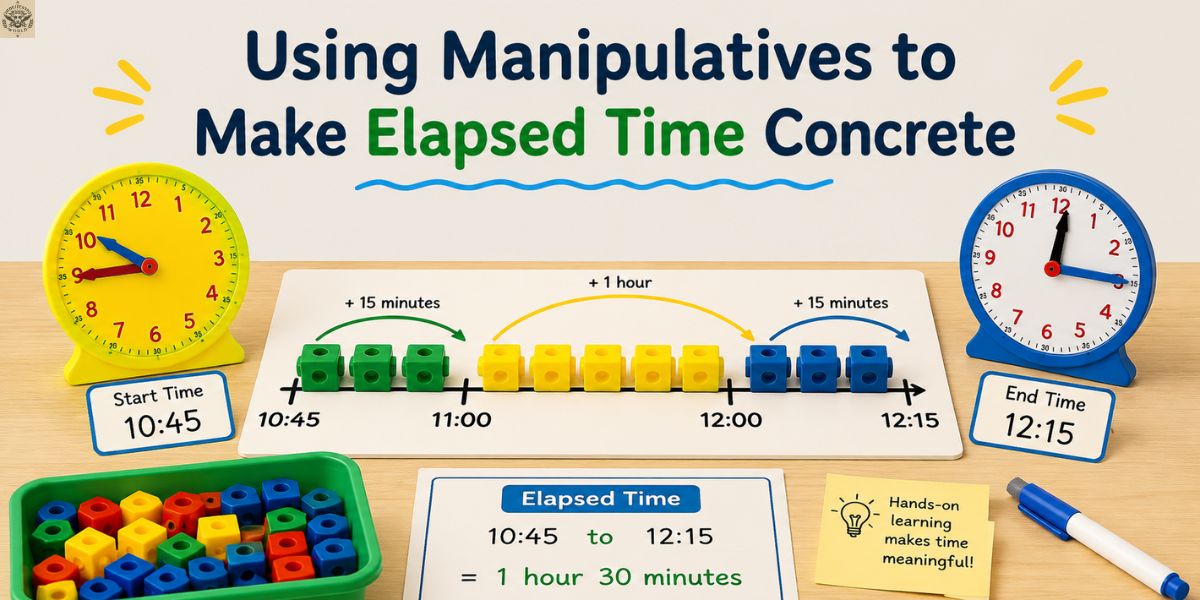
A hands on tool like a Judy Clock does wonders for teaching Elapsed Time. These manipulatives usually come with color coded hour and minute hands, which makes it easy for kids to tell them apart while practicing Elapsed Time. When a teacher sets a start time and an end time on the clock, students can physically move the clock hands themselves. That kind of direct interaction turns Elapsed Time from a puzzle in their head into something they can see and touch, which makes the whole concept of Elapsed Time click a lot faster.
Using an Open Number Line to Teach Elapsed Time
An open number line is another favorite tool for teaching Elapsed Time, and for good reason. Instead of the fixed, circular layout of a clock face, a number line stretches out flat and lets students see Elapsed Time as one continuous quantity. Kids mark the start time and the end time, then use number line jumps to represent chunks of hours and minutes. Breaking the problem into smaller pieces this way, then adding those pieces back together, builds strategic thinking and strengthens number sense. It’s especially useful for students who aren’t quite ready to track Elapsed Time using a clock alone.
Using T Charts to Organize Elapsed Time
The T chart method gives students a clean, simple structure for working through Elapsed Time problems. Split the chart into two columns, one for the time interval and one for the matching clock time, and students can move through each step of an Elapsed Time problem without losing their place. This setup supports logical reasoning because it makes the connection between passing minutes and the changing clock time easy to see. For longer or more complicated problems, a T chart keeps Elapsed Time calculations organized from start to finish.
Using Games to Practice Elapsed Time

Games turn Elapsed Time practice into something kids actually look forward to. Whether they’re setting a clock to match a target time, racing to calculate a time interval, or solving a time based riddle, games give students repeated, low pressure practice with Elapsed Time. That playful approach keeps motivation high while a real understanding of Elapsed Time quietly builds in the background.
Elapsed Time Examples
A good way to understand Elapsed Time is to see it in action. If a movie starts at 6:15 and ends at 8:05, the Elapsed Time is 1 hour and 50 minutes, found by counting forward from the start time to the end time. Everyday moments like a car ride, a recess period, or a science experiment all give kids a natural start time and end time to work with, which turns an abstract idea into something they can actually calculate.
These kinds of examples show up often in classroom practice problems because they connect a math skill to something a student has actually lived through. Teachers often walk through a few examples together before handing students similar problems on their own, using an open number line or a simple T chart to make the step by step calculation easier to follow.
Elapsed Time Meaning
So what is Elapsed Time? In plain terms, the elapsed time meaning comes down to the amount of time that passes between a start time and an end time. It’s a measure of duration, and once a student understands that idea, reading a clock for elapsed time becomes a matter of counting hours and minutes rather than memorizing a formula.
Elapse time, or the passage of time, is something students experience constantly, even before they can name it. Learning the meaning behind the term gives that everyday feeling a math identity, one built on time interval, time measurement, and the simple relationship between when something starts and when it stops.
Elapsed Time Worksheets

Worksheets built around Elapsed Time usually mix a few formats, including number lines, T charts, and word problems that ask students to find a missing start time, end time, or duration. Good worksheets move from simple, whole hour problems toward ones that involve minutes and even crossing over the hour, giving students steady practice with the step by step calculation involved.
These practice problems are especially common in K to 3 math and elementary math classrooms, where they support standards tied to measurement and data. A well designed worksheet doesn’t just test the skill, it reinforces conceptual understanding by pairing each problem with a visual, whether that’s a clock face or a simple line for jumps.
Elapsed Time Calculator
An Elapsed Time calculator takes a start time and an end time and instantly returns the duration between them, which is handy for checking homework or working through a tricky travel schedule. Behind the scenes, the tool is really just doing the addition and subtraction a student would do by hand, only faster.
For classroom use, a calculator works best as a way to confirm an answer rather than replace the thinking. Students still benefit from working through the time measurement themselves first, using clock hands or a number line, before turning to a calculator to double check their reasoning.
Elapsed Time Clock
A clock is where most Elapsed Time lessons begin, since it gives students a visual anchor for something that can otherwise feel invisible. On an analog clock, the hour hand and minute hand move together, and watching that motion helps students connect telling time with the broader idea of duration. A digital clock, meanwhile, shows a single moment, which is useful once students already understand how the hands on an analog face relate to a.m. and p.m.
Manipulatives like a Judy Clock bring this idea into a student’s hands quite literally, letting them set a start time, move the clock hands forward, and land on an end time themselves. That kind of hands-on learning makes the 12 hour cycle of a clock much easier to grasp than a diagram alone.
Elapsed Time Grade 4

By grade 4, students are expected to handle more demanding Elapsed Time problems, often involving multi-step scenarios and word problems that require converting between hours and minutes with more precision. This lines up with common core math expectations under the measurement and data strand, building on what students learned in second grade math and third grade math.
At this level, teachers lean more heavily on strategic thinking and logical reasoning rather than manipulatives alone, though tools like an open number line still help students organize longer calculations. The goal is for students to move fluidly between a math dictionary definition of the term and a fully worked, real world problem.
Elapsed Time in Maths
Within a broader math vocabulary, Elapsed Time sits alongside other measurement concepts, offering a student-friendly definition that ties numerical reasoning to something as familiar as a clock. It’s a concept that bridges number sense with practical, everyday skills, which is part of why it appears early and often across elementary math.
Because Elapsed Time draws so directly on addition and subtraction, it also reinforces those foundational skills in a fresh context. Students aren’t just adding numbers on a page, they’re tracking a passage of time, which strengthens both their math vocabulary and their conceptual understanding of how numbers describe the world around them.
Elapsed Time Game
Games are one of the most effective ways to turn Elapsed Time practice into something students actually enjoy. Interactive games that ask students to set a clock, race against a timer, or solve a time based puzzle offer visual learning and repeated practice without feeling like a drill.
Classroom activities built around Elapsed Time games also encourage a bit of friendly competition, whether students are working alone or in pairs. That engaging format keeps motivation high while quietly reinforcing time interval, duration, and clock reading skills through play rather than a worksheet.
Frequently Asked Questions
What is the total elapsed time?
The total elapsed time is the full amount of time that passes between a start time and an end time. You find it by counting the hours and minutes that separate the two.
How to calculate elapsed duration?
Start with the earlier time and count forward to the later time, adding up hours first and then minutes. A number line or a simple T chart makes this step by step process much easier to follow.
How to write elapsed time?
Elapsed time is usually written in hours and minutes, like “2 hours 15 minutes,” rather than as a clock time. It should always reflect the actual duration between the start and end points, not just a single moment.
How do you calculate elapsed time to the hour?
Round both the start time and end time to the nearest hour, then find the difference between them. This gives a quick estimate of elapsed time without worrying about the exact minutes.
What is the elapsed time?
Elapsed time is the amount of time that has passed between a starting point and an ending point. It’s essentially a measure of duration, whether that’s minutes, hours, or even seconds.
Conclusion
At the end of the day, Elapsed Time is simply about helping kids make sense of something they already experience every single day. Once a student can look at a start time and an end time and confidently work out the duration between them, they’ve gained a skill that follows them well beyond the classroom, from catching a bus on time to timing dinner just right.
The real win comes when this concept stops feeling like a math lesson and starts feeling like common sense. With the right mix of clocks, number lines, and a little practice, kids move from guessing at time to genuinely understanding it, and that confidence tends to stick with them far longer than any worksheet ever could.

