

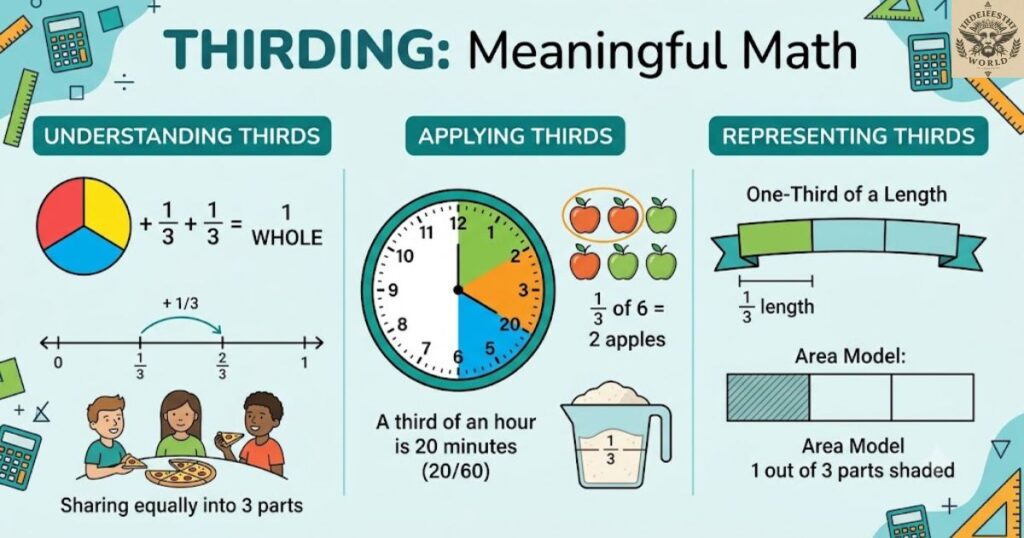
Ever wonder what is a third, exactly? Take any whole pizza, a dollar, a stretch of road and split it into three equal pieces, and you’ve just created thirds. A third of 3 objects means splitting those three items into three equal groups of one, which makes thirds one of the easiest fractions to picture and count with your own hands.
So what is a 3 really doing in a fraction like this? When you divide a whole by 3, you get three equal shares, and grabbing just one of those shares gives you a third.You’re figuring out a third of 3 cookies or picturing a third of a candy bar, thirds show up everywhere once you start looking, making them one of the first fractions kids learn to trust.
Understanding Thirds In Mathematics
Thirds show up the moment you cut, split, or share something into three equal pieces. Take a pizza, slice it into three matching wedges, and each wedge is a third of the whole pizza. In fraction form, that single wedge becomes ⅓, and because it represents just one part out of the whole, mathematicians classify it as a unit fraction.
Every fraction built from thirds follows the same simple rule. The bottom number, or denominator, is always 3, and it tells you the whole has been broken into three equal parts. The top number, or numerator, tells you how many of those parts you’re counting. So while ⅓ means one part out of three, ⅔ means two parts out of three, and ³⁄₃ means all three parts which is really just one whole.
Thirds also connect neatly to decimals, and this connection often surprises students the first time they see it. Divide 1 by 3 on a calculator and the answer never ends: 0.333333… The 3 repeats forever, which is why teachers write it as 0.3̅ with a bar over the repeating digit. Double that fraction to ⅔ and the decimal doubles too, landing on 0.6̅. Thirds are one of the clearest examples students encounter of a fraction that can’t be written as a “clean” decimal, and that alone makes them worth slowing down for.
Thirds As A Benchmark Fraction
Mathematicians and teachers alike treat thirds as benchmark fractions, meaning they act as trustworthy reference points for judging the size of other, less familiar fractions. Because a third is easy to picture just imagine three equal slices students can hold that mental image in their head and use it to size up fractions that look more complicated at first glance.
Say a student is asked whether ⁴⁄₉ is bigger or smaller than ⅓. Without a benchmark, that comparison feels abstract. But once a student knows what ⅓ looks like and roughly where it sits, they can reason that ⁴⁄₉ is a little more than ⅓ (since ³⁄₉ would equal exactly ⅓), so ⁴⁄₉ must be slightly larger. That’s the real power of benchmark fractions like thirds they turn an unfamiliar comparison into a familiar one.
Thirds also pair well against other common benchmarks. Set ⅓ and ⅔ next to ½, ¼, and ⅛ on a number line, and students start to see the whole fraction landscape at once: halves split the line in two, quarters in four, and thirds in three each system offering a different lens for the same stretch of numbers between 0 and 1.
Connecting Thirds To Sixths, Ninths, And Twelfths
One of the most useful things about thirds is how naturally they connect to other fractions. Any denominator that’s a multiple of 3 6, 9, 12, and beyond can be rewritten in terms of thirds, and recognizing that relationship builds real fluency with equivalent fractions.
Thirds And Sixths
Six is double three, so every third can be split into two smaller pieces to make sixths. That means any fraction written with a denominator of 3 can be rewritten with a denominator of 6 simply by doubling the numerator and denominator together. For example, ⅓ becomes ²⁄₆, and ⅔ becomes ⁴⁄₆. Picture a fraction strip divided into three sections; slice each of those sections in half, and you’ve just turned thirds into sixths without changing how much of the whole you actually have. This is often the first equivalent-fraction relationship students discover on their own, because doubling feels so intuitive.
Thirds And Ninths
Nine is three times three, so this time each third splits into three smaller pieces instead of two, creating ninths. Following the same logic, ⅓ becomes ³⁄₉, and ⅔ becomes ⁶⁄₉. A fraction strip makes this easy to see: take a strip already divided into thirds, cut each third into three equal slivers, and you’re left with nine equal pieces, three of which make up each original third. Lining up thirds and ninths on the same number line also helps students place trickier fractions like ⁴⁄₉ relative to ⅓, since ⁴⁄₉ sits just past the ³⁄₉ mark that equals exactly one third.
Thirds And Twelfths
Twelve is four times three, so each third divides into four smaller parts to make twelfths. Following the pattern, ⅓ becomes ⁴⁄₁₂, and ⅔ becomes ⁸⁄₁₂. Partitioned rectangles work well here: split a rectangle into three columns to represent thirds, then divide each column into four smaller boxes, and the twelve resulting boxes show the equivalence visually. On a number line, this relationship also reveals subtler comparisons: ⁵⁄₁₂ sits just under ½ (which equals ⁶⁄₁₂), while ⁴⁄₁₂, equal to exactly ⅓, sits noticeably farther away from ½.
Teaching Strategies For Thirds
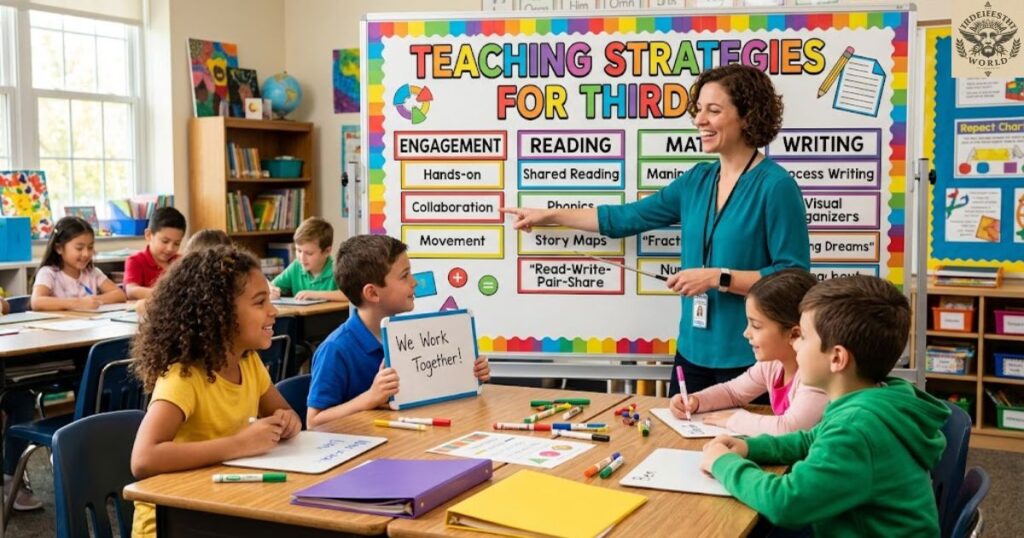
Thirds click fastest when students can see, touch, and place them rather than just read about them. Pairing hands-on models with number line practice gives students two different ways to build the same understanding.
Use Visual Models When Working With Thirds
Concrete models turn thirds from an abstract idea into something students can point to and manipulate. Fraction strips, circles, or bars split into three matching sections give students a physical representation of a third; each section is one third, no matter the shape of the whole.
These same models make comparisons obvious. Fold or shade two of the three sections, and a student can see directly that ⅔ is twice the size of ⅓, without needing to do any calculation. Partitioned rectangles work especially well for comparing thirds against other fractions: set a rectangle divided into three parts beside one divided into six parts, and students can see for themselves that ⅔ lines up exactly with ⁴⁄₆.
Use Number Lines When Working With Thirds
Number lines shift the focus from “parts of a shape” to “a fraction as a real number with its own location.” Marking ⅓, ⅔, and ³⁄₃ on a line from 0 to 1 shows students that thirds are evenly spaced each interval is the same length, and moving from one mark to the next always adds exactly one third.
This spacing does something important: it teaches students that a fraction isn’t just a slice of pie, it’s a specific point along a continuum of numbers. Once a student can place thirds correctly, they’re ready to compare them against other benchmarks. Ask where ⅓ falls next to ½, and a student building number sense will recognize that ⅓ falls short of the halfway point, while ⅔ passes it. That kind of reasoning judging size and distance rather than just naming a fraction is exactly what a strong grasp of thirds is meant to build.
Why Thirds Matter Beyond The Classroom
Thirds aren’t just a textbook exercise they show up constantly in daily life. Splitting a restaurant bill three ways, dividing a recipe that serves six into portions for two, or measuring a third of a cup all rely on the same idea: breaking a whole into three equal, fair shares. Recognizing thirds in these everyday moments helps students see fractions as a practical tool rather than an abstract school topic, which in turn makes the concept stick.
Thirds As A Benchmark Fraction
Mathematicians and teachers alike treat thirds as benchmark fractions, meaning they act as trustworthy reference points for judging the size of other, less familiar fractions. Because a third is easy to picture just imagine three equal slices. Students can hold that mental image in their head and use it to size up fractions that look more complicated at first glance.
Say a student is asked whether ⁴⁄₉ is bigger or smaller than ⅓. Without a benchmark, that comparison feels abstract. But once a student knows what ⅓ looks like and roughly where it sits, they can reason that ⁴⁄₉ is a little more than ⅓ (since ³⁄₉ would equal exactly ⅓), so ⁴⁄₉ must be slightly larger. That’s the real power of benchmark fractions like thirds they turn an unfamiliar comparison into a familiar one.
Thirds also pair well against other common benchmarks. Set ⅓ and ⅔ next to ½, ¼, and ⅛ on a number line, and students start to see the whole fraction landscape at once: halves split the line in two, quarters in four, and thirds in three each system offering a different lens for the same stretch of numbers between 0 and 1.
Connecting Thirds To Sixths, Ninths, And Twelfths
One of the most useful things about thirds is how naturally they connect to other fractions. Any denominator that’s a multiple of 3 6, 9, 12, and beyond can be rewritten in terms of thirds, and recognizing that relationship builds real fluency with equivalent fractions.
Thirds And Sixths
Six is double three, so every third can be split into two smaller pieces to make sixths. That means any fraction written with a denominator of 3 can be rewritten with a denominator of 6 simply by doubling the numerator and denominator together. For example, ⅓ becomes ²⁄₆, and ⅔ becomes ⁴⁄₆. Picture a fraction strip divided into three sections; slice each of those sections in half, and you’ve just turned thirds into sixths without changing how much of the whole you actually have. This is often the first equivalent-fraction relationship students discover on their own, because doubling feels so intuitive.
Thirds And Ninths
Nine is three times three, so this time each third splits into three smaller pieces instead of two, creating ninths. Following the same logic, ⅓ becomes ³⁄₉, and ⅔ becomes ⁶⁄₉. A fraction strip makes this easy to see: take a strip already divided into thirds, cut each third into three equal slivers, and you’re left with nine equal pieces, three of which make up each original third. Lining up thirds and ninths on the same number line also helps students place trickier fractions like ⁴⁄₉ relative to ⅓, since ⁴⁄₉ sits just past the ³⁄₉ mark that equals exactly one third.
Thirds And Twelfths
Twelve is four times three, so each third divides into four smaller parts to make twelfths. Following the pattern, ⅓ becomes ⁴⁄₁₂, and ⅔ becomes ⁸⁄₁₂. Partitioned rectangles work well here: split a rectangle into three columns to represent thirds, then divide each column into four smaller boxes, and the twelve resulting boxes show the equivalence visually. On a number line, this relationship also reveals subtler comparisons: ⁵⁄₁₂ sits just under ½ (which equals ⁶⁄₁₂), while ⁴⁄₁₂, equal to exactly ⅓, sits noticeably farther away from ½.
Teaching Strategies For Thirds
Thirds click fastest when students can see, touch, and place them rather than just read about them. Pairing hands-on models with number line practice gives students two different ways to build the same understanding.
Use Visual Models When Working With Thirds
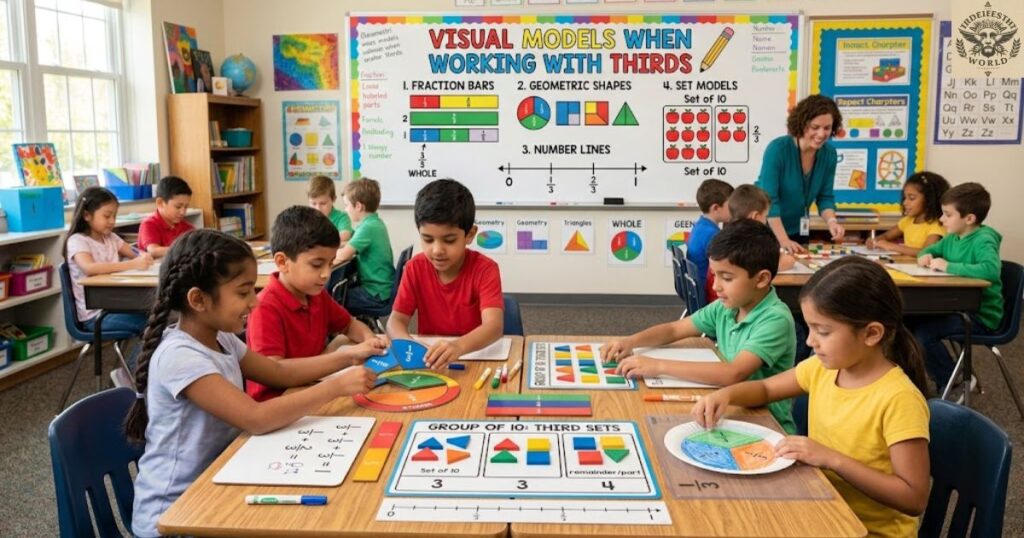
Concrete models turn thirds from an abstract idea into something students can point to and manipulate. Fraction strips, circles, or bars split into three matching sections give students a physical representation of a third; each section is one third, no matter the shape of the whole.
These same models make comparisons obvious. Fold or shade two of the three sections, and a student can see directly that ⅔ is twice the size of ⅓, without needing to do any calculation. Partitioned rectangles work especially well for comparing thirds against other fractions: set a rectangle divided into three parts beside one divided into six parts, and students can see for themselves that ⅔ lines up exactly with ⁴⁄₆.
Use Number Lines When Working With Thirds
Number lines shift the focus from “parts of a shape” to “a fraction as a real number with its own location.” Marking ⅓, ⅔, and ³⁄₃ on a line from 0 to 1 shows students that thirds are evenly spaced each interval is the same length, and moving from one mark to the next always adds exactly one third.
This spacing does something important: it teaches students that a fraction isn’t just a slice of pie, it’s a specific point along a continuum of numbers. Once a student can place thirds correctly, they’re ready to compare them against other benchmarks. Ask where ⅓ falls next to ½, and a student building number sense will recognize that ⅓ falls short of the halfway point, while ⅔ passes it. That kind of reasoning judging size and distance rather than just naming a fraction is exactly what a strong grasp of thirds is meant to build.
Why Thirds Matter Beyond The Classroom
Thirds aren’t just a textbook exercise, they show up constantly in daily life. Splitting a restaurant bill three ways, dividing a recipe that serves six into portions for two, or measuring a third of a cup all rely on the same idea: breaking a whole into three equal, fair shares. Recognizing thirds in these everyday moments helps students see fractions as a practical tool rather than an abstract school topic, which in turn makes the concept stick.
Relevant post………..mm-math-terms-tally-marks
Two Thirds Meaning
Two thirds means two out of three equal parts of a whole, written as ⅔. Picture a whole divided into three equal sections, take any two of those sections, and you’re holding two thirds of the original whole. In fraction notation, the denominator (3) tells you the whole was split into three equal parts, while the numerator (2) tells you how many of those parts you’re counting. Because two thirds represents more than one part out of three, it’s larger than ⅓ but still smaller than the whole itself.
Two thirds also has a clear decimal identity: it equals 0.6̅, a repeating decimal that never terminates. Students often meet two thirds for the first time through everyday examples filling two out of three glasses with juice, or completing two of three chores on a list. Understanding two thirds alongside one third gives learners a fuller picture of how thirds work as a fraction family, and it reinforces that a fraction’s value depends entirely on how many equal parts you’re counting, not just how the whole was divided.
Thirds Examples
Thirds appear constantly once you start looking for them, and real objects make the concept far easier to grasp than numbers alone. Cut a sandwich into three equal strips, and each strip is a third. Pour a bottle of juice evenly into three cups, and each cup holds a third of the total liquid. Even a clock face offers a natural example of thirds: the hour hand sweeps through a third of the clock every four hours, since 12 hours split into three equal groups gives four hours per group.
Classroom examples work the same way. A fraction strip folded into three equal sections, a circle split into three matching wedges, or a number line marked at ⅓, ⅔, and ³⁄₃ all model thirds visually. Word problems bring the idea further to life if a garden bed is divided into three equal rows and one row is planted with tomatoes, that row represents one third of the garden. These kinds of concrete, real-life examples help students recognize thirds outside the math book, not just inside it.
Thirds Synonym
Mathematics doesn’t offer many true synonyms for thirds, since the term refers to a very specific division of a whole into three equal parts. The closest related phrasing includes “one out of three equal parts,” “a third portion,” or simply “one-third share.” In everyday language, people sometimes use “a third” interchangeably with “a piece” or “a portion,” but those looser terms don’t necessarily mean the parts are equal while thirds, by definition, always are.
Outside strict math vocabulary, “third” can also describe rank or order, as in “finishing third in a race,” which is unrelated to fractions entirely. It’s worth pointing this distinction out to students, since the word “third” carries two very different meanings depending on context: one describing position, the other describing a fraction of a whole. When discussing fractions specifically, the safest and clearest wording remains “one third” or “⅓,” since these terms leave no room for confusion about equal parts.
Thirds Meaning
At its core, the meaning of thirds comes down to fairness and equal division. Whenever a whole shape, a quantity, a distance gets split into three parts of exactly the same size, each of those parts is a third. This equal-parts requirement is what separates thirds from a random or uneven split; three pieces of cake only count as thirds if each piece is the same size as the other two.
Thirds carry meaning both as a physical division and as a number. As a physical division, a third is a visible piece of something whole, like a slice of pizza or a section of a garden. As a number, a third is a specific point on the number line, sitting exactly one-third of the way between 0 and 1. Both meanings matter in math education: students need to see thirds as tangible pieces before they can fully grasp them as abstract fractional values.
Thirds Media
In photography and filmmaking, “thirds” takes on a different meaning through the rule of thirds, a composition guideline that divides an image into a 3-by-3 grid using two evenly spaced horizontal lines and two evenly spaced vertical lines. Photographers and videographers place important elements: a subject’s eyes, a horizon line, a focal point along these grid lines or at their intersections rather than dead center, since off-center framing tends to feel more natural and visually engaging.
While the rule of thirds lives in a different subject entirely from fraction math, it borrows the same underlying idea of thirds: dividing a whole space into three equal sections. That shared foundation is a useful bridge for students who enjoy photography or video. The same equal-parts thinking that helps them understand ⅓ and ⅔ in math class also explains why a photo grid splits into three even columns and three even rows.
One Third Example
One third, written as ⅓, describes a single part out of three equal parts of a whole. A simple example: split a chocolate bar into three equal pieces, and eating just one piece means eating one third of the bar. Another everyday example is time since an hour contains 60 minutes, one third of an hour equals 20 minutes, because 60 divided into three equal groups gives 20 minutes per group.
Measurement offers plenty of practical one third examples too. A recipe calling for one third of a cup of sugar means filling a measuring cup only up to the ⅓ line, not all the way. In a classroom setting, a teacher might divide 12 counters into three equal groups of four, showing that one third of 12 is 4. These varied examples of food, time, measurement, and counting all reinforce the same underlying rule: one third always means one equal part out of three.
Thirds Music
In music theory, a “third” refers to a specific interval between two notes rather than a fraction of a whole. Counting from one note to another that’s three scale steps away creates a third for example, from C to E on a piano. Musicians further classify thirds as major thirds or minor thirds, depending on the exact distance in half-steps between the two notes, and these intervals form the backbone of chords used across nearly every style of music.
Although musical thirds and fraction thirds come from completely different fields, both rely on counting equal steps to define a relationship; one counts equal parts of a whole, the other counts equal steps between notes. Pointing out this coincidence of naming can spark curiosity in students who play an instrument, showing them that the same word “third” shows up in very different corners of learning, from math class to music class.
Three Thirds In Percentage
Three thirds represents the entire whole, since combining all three equal parts ⅓ + ⅓ + ⅓ adds back up to one whole, or ³⁄₃. Converted into a percentage, three thirds equals 100%, because a whole always equals 100% no matter how many equal parts it’s divided into. This is a useful checkpoint for students: no matter whether a whole is split into thirds, fourths, or tenths, adding all the equal parts back together always returns 100%.
Breaking that down further, each individual third equals approximately 33.3%, since 100% divided by three parts gives a repeating decimal, just like ⅓ equals the repeating decimal 0.3̅. Two thirds, by extension, equals about 66.6%. Seeing thirds expressed as percentages helps students connect fractions, decimals, and percentages as three different ways of describing the exact same value, reinforcing that ³⁄₃, 1, and 100% are simply different notations for a complete whole.
Frequently Asked Questions
What does “thirds” mean?
Thirds are what you get when you split a whole into three equal parts. Each part is called one third and written as ⅓.
How much is 3 thirds?
Three thirds add up to one whole, since ⅓ + ⅓ + ⅓ equals 1, or ³⁄₃.
What are thirds in maths?
In math, thirds are a type of fraction where the whole is divided into three equal parts, with the denominator always showing 3.
What did “third” mean?
A third simply means one out of three equal parts of something the same meaning it’s always had in fractions.
How to identify thirds?
Check that a whole is split into exactly three parts, and that all three parts are the same size that’s what makes them thirds.
Conclusion:
Thirds might start out as a simple slice of pizza or a shared candy bar, but they open the door to some of the biggest ideas in fraction math equal parts, benchmark comparisons, equivalent fractions, and even repeating decimals. Once students can picture a whole split into three even pieces, they’re ready to stretch that same thinking toward sixths, ninths, twelfths, and beyond.
The best way to keep thirds sticking is to keep them visible: fraction strips, number lines, real snacks cut into three equal pieces. The more often students see thirds in action, the more naturally they’ll reach for them when comparing fractions or solving problems down the road.

