


Tally marks are one of the very first tools students reach for when they start counting. A quick vertical line for every count, grouped into fives with a diagonal slash, turns everyday counting into something clear and organized. Whether it’s counting classmates’ favorite snacks or tracking how many books got read this week, tally marks make data collection feel simple and hands-on right from the start.
Beyond just counting, tally marks quietly teach big math ideas. Grouping by fives builds number sense and skip counting fluency, while the shift from tallies to tables to graphs shows students how the same information can look different depending on how it’s shared. That’s what makes tally marks such a meaningful first step in a student’s math journey.
What Are Tally Marks?
Tally marks are one of the simplest tools a student ever picks up, and yet they quietly carry some of the biggest ideas in early math. In plain terms, the definition of tally marks is this: a system for recording data using single vertical lines, where every fifth line is drawn as a diagonal slash across the previous four. That one small rule is four lines, then a slash turns a messy pile of individual marks into a chart that anyone can read at a glance.
Before children ever touch a calculator or memorize a multiplication table, they use tally marks to make sense of the world around them. Counting how many red cars pass by, how many classmates prefer chocolate over vanilla, how many books were read this week, tally marks turn all of it into something visible and countable. That’s really what tally marks are for: fast, honest, real-time counting.
How Tally Marks Work: The Basic Rule Behind the System
Understanding tally marks starts with one simple habit: draw a single vertical line for every count you make. Once you reach four vertical lines, the fifth one is drawn diagonally across the group, closing it off. This is often called a “gate” or a “bundle,” and it’s the reason tally marks are so easy to read quickly instead of counting one by one, your eyes count in fives.
This grouping is not just a neat trick. It’s the earliest version of a skill mathematicians call unitizing, treating a group of five as a single unit rather than five separate items. That single habit is what makes tally marks such a powerful bridge between simple counting and multiplication down the road.
Tally Marks Chart: Counting From 1 to 100

A tally marks chart from 1 to 100 is one of the best ways to see the full pattern in action. Rather than listing a hundred individual lines, tally marks group everything into sets of five, which means a count of 100 is really just twenty complete groups of five tally marks.
Here’s how that looks in practice:
- 5 = one complete group (four lines + one diagonal slash)
- 25 = five complete groups
- 50 = ten complete groups
- 75 = fifteen complete groups
- 100 = twenty complete groups
When students build a tally marking 1 to 100 charts, they’re practicing skip counting by fives out loud “5, 10, 15, 20…” while physically drawing each group. This repetition does double duty: it strengthens number sense and it previews multiplication, since twenty groups of five tally marks is really just 20 × 5.
Why Are Tally Marks Important in Early Math?
Tally marks matter because they turn abstract counting into something students can see, touch, and understand right away.This grouping habit also builds skip counting fluency that carries straight into multiplication and place value.
Data Collection Made Simple
Tally marks are usually the very first data collection tool a student ever uses, and for good reason they don’t require any special vocabulary or equipment, just a pencil and a willingness to count. When a class surveys itself (“What’s your favorite snack?”) and records the results with tally marks, students are doing real data collection and real classify-and-categorize work, even in kindergarten or first grade.
A simple tally chart might look like this:
| Snack | Tally | Total |
| Apples | ⫮⫮ | 7 |
| Crackers | ⫮ | 5 |
| Carrot Sticks | II | 2 |
Once the tally chart is filled in, students can see instantly which category collected the most responses, no counting required, because the groups of five do that work for them.
Building Number Sense Through Grouping by Fives
Every time a student groups tally marks into fives, they’re rehearsing a skill that will show up again and again throughout their math education. Grouping by fives builds number sense because it forces students to see quantity in chunks instead of single units. That habit transfers directly into place value, where numbers are grouped by tens, and later into multiplication, where numbers are grouped by any factor at all.
Unitizing: The Hidden Skill Behind Tally Marks
Unitizing sounds like a complicated word for something students grasp naturally through tally marks. It simply means recognizing that “one group of five” can be treated as a single quantity, a single “unit” instead of five separate items. Tally marks make this concrete: a completed group with its diagonal slash is one visual unit, even though it represents five counts. This is the same thinking students later need for place value and repeated addition.
Tally Marks and Skip Counting: The Natural Connection
Skip counting and tally marks were basically made for each other. As soon as a student finishes a group of five tally marks, the natural next step is to count that group as “5” instead of “1, 2, 3, 4, 5.” Add another group, and the count becomes “10.” A third group makes it “15.”
This is where tally marks quietly become a multiplication lesson in disguise. If a student has four complete groups of tally marks, a teacher can ask, “How many tallies is that?” A student who answers “20” because “four groups of five is twenty” is already doing early multiplicative thinking years before the times tables are formally introduced.
Teaching Strategies for Tally Marks in the Classroom
Teachers bring tally marks to life through hands-on data collection, like classroom surveys students can tally themselves. These simple activities turn tally marks into real practice for skip counting, number talks, and building toward tables and graphs.
Survey-Based Data Collection

Give students a real question to investigate favorite color, favorite season, favorite pet and have them survey classmates, recording answers with tally marks as they go. This kind of hands-on data collection keeps tally marks meaningful rather than abstract, and it naturally introduces the ideas of category and classify.
Number Talks With Tally Marks
Use a completed tally chart as the centerpiece of a number talk. Ask students to count the total out loud using skip counting: “5, 10, 15… plus 2 more is 17.” Follow up by asking how many complete groups there are, and what that tells them about the number. Number talks built around tally marks strengthen both counting fluency and mental math strategies at the same time.
From Tally Chart to Data Table
Once a tally chart is complete, have students transfer their tally marks into a data table with a “Total” column. This step matters because it teaches accuracy the numbers in the table have to match the tally marks exactly. Encourage students to double-check their work by recounting the tally marks or by adding all the totals together to confirm they match the total number of responses collected.
From Table to Bar Graph
The data table becomes the foundation for a bar graph, where each total from the table determines the height of a bar. Students don’t need to go back and recount the original tally marks; the table already did that work. This progression (tally marks → table → bar graph) shows students that the same information can be represented in different ways, and each representation serves its own purpose: tally marks for fast collection, tables for organizing and calculating, and graphs for comparing and communicating results.
Tally Marks vs. Skip Counting: What’s the Difference?
It’s worth clearing up a common mix-up. Tally marks are a way to record a count a physical mark for every item counted. Skip counting, on the other hand, is a way to read that count quickly, by counting in groups (5, 10, 15…) instead of one at a time. Tally marks and skip counting work together: the tally marks organize the data into groups of five, and skip counting is the strategy used to read those groups efficiently. Neither replaces the other; they’re two halves of the same efficient counting system.
Common Mistakes Students Make With Tally Marks
- Losing count of the group of five some students draw five vertical lines instead of four lines plus a diagonal slash, which breaks the “groups of five” pattern and makes the tally marks harder to skip count.
- Skipping the slash without the diagonal line closing each group, a tally chart turns back into individual marks that must be counted one by one, defeating the purpose of tally marks.
- Miscounting leftover marks after counting complete groups of tally marks, students sometimes forget to add the remaining single lines, leading to an incorrect total.
Catching these mistakes early keeps tally marks useful as a reliable counting and data collection tool.
Why Tally Marks Matter for Long-Term Math Success
Tally marks might look like a simple classroom tool, but the thinking behind them shows up throughout a student’s math journey. The habit of grouping by fives supports place value, where digits are grouped by tens. The practice of skip counting through tally marks builds fluency that later supports multiplication and telling time including reading a clock to the half hour.
And the progression from tally marks to data tables to bar graphs lays the foundation for reading scaled axes and comparing data sets in later grades. Tally marks give students an early, low-pressure way to succeed at data collection and counting and that early success quietly builds skills they’ll rely on for years of math ahead.
Relevant post…………….mm-math-terms-half-past
Tally Marks Symbol
Tally marks symbol asal mein sirf ek simple pattern hai chaar seedhi vertical lines aik ke baad aik, aur phir paanchvi line un chaaron ke upar se diagonal cut karti hai. Yehi diagonal slash pura symbol banata hai, jo random lines ko ek organized, ginne-layak group mein badal deta hai. Iski simplicity ki wajah se tally marks kagaz, whiteboard, ya kahin bhi bina kisi tool ke banaye ja sakte hain.
5 Tally Marks Symbol
5 tally marks symbol poore system ki building block hai. Yeh fixed order mein banta hai: pehli line, doosri line, teesri line, chauthi line, aur phir paanchvi line un char ke upar diagonal slash ke tor par. Jab yeh paanchvi mark lag jati hai, group “close” ho jata hai aur ek unit ke tor par gina jata hai yehi cheez baad mein skip counting ko asaan banati hai.
Tally Marks 1 to 100
Tally marks 1 to 100 chart mein poori ginti 20 complete groups mein taqseem hoti hai, har group mein 5 tally marks. Yani 5 = 1 group, 25 = 5 groups, 50 = 10 groups, 75 = 15 groups, aur 100 = 20 complete groups. Yeh chart banate waqt students “5, 10, 15, 20…” bol kar skip counting practice karte hain.
Tally Marks 1 to 50
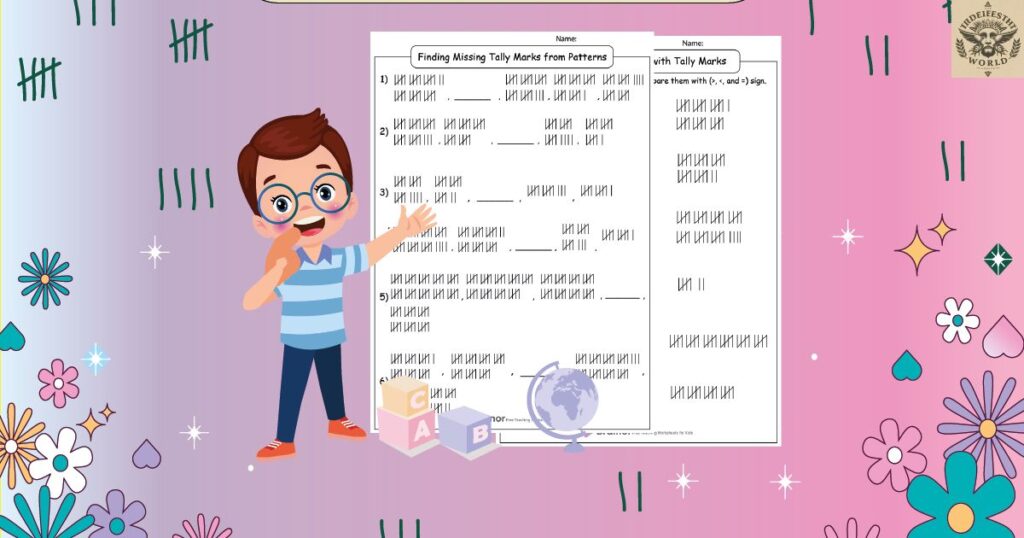
Tally marks 1 to 50 chart chhote students ke liye asaan starting point hota hai, 100 tak jane se pehle. 50 exactly 10 complete groups banta hai, jisse skip counting pattern zeh mein rakhna easy ho jata hai: “5, 10, 15… 50.”
Tally Marks 1 to 20
Tally marks 1 to 20 chart wahan se hai jahan zyada tar students shuru karte hain. 20 sirf 4 complete groups banta hai itna chhota ke aik hi sitting mein bina galti ke bana sakein, phir bhi itna bara ke real skip counting practice ho sake.
Tally Marks Table
Tally marks table ek aisa data table hota hai jisme category, tally marks, aur total teeno columns saath hote hain. Isse students dono represent raw tally marks aur unka total side by side dekh sakte hain, jo ginti ki galti pakarna asaan banata hai.
Tally Marks Online
Tally marks online tools digital counters ya apps hote hain jo classroom mein paper tally charts ke saath use hote hain. Yeh whole-class counting activities ke liye useful hote hain kyunke sab log real-time mein tally marks update hote dekh sakte hain.
Tally Marks Free
Tally marks free resources in blank tally charts, 1 to 20 aur 1 to 100 practice sheets, aur survey templates shamil hain jo teachers bina kisi cost ke seedha use kar sakte hain, apni data collection lessons ke liye.
Frequently Asked Questions
What do tally marks mean?
They’re single lines used to count items, grouped in fives for quick, easy counting.
How to write 5 in tally marks?
Draw four vertical lines, then a fifth diagonal line across them.
Who uses tally marks?
Students, teachers, and anyone doing quick manual counting like surveys or scorekeeping.
What is the tally formula?
Count complete groups × 5, then add any leftover single marks.
How to solve tally marks?
To solve tally marks, count each complete group of five, then add any leftover single lines to get the total.
Conclusion
Tally marks give students one of the earliest, most honest ways to make sense of counting. From a simple tally chart to a full tally marks 1 to 100 spread, this system turns raw counting into real data collection, a skill kids carry into surveys, number talks, and everyday classroom life. Grouping by fives builds number sense naturally, and that habit of unitizing quietly sets the stage for place value and multiplication down the road.
Whether it’s a quick tally marks table, a free printable chart, or a digital tally marks online tool, the goal stays the same: help students record, organize, and read data with confidence. As tallies grow into tables and tables grow into bar graphs, students see firsthand how one simple counting method can carry them through years of meaningful math learning.

