


Once kids can spot a side, name it, count it, and measure it, they’ve got a real handle on how shapes work, not just a memorized fact. That’s what makes side such a foundational idea in early geometry: it shows up again in perimeter, area, and eventually more advanced shape work, so the time spent building this concept early pays off for years.
The goal isn’t just getting students to recite definitions, it’s helping them see a side as something real they can trace, build, and compare with their own hands. Whether they’re sorting cut-out shapes, measuring with paper clips, or figuring out why a circle doesn’t have one, every activity points back to the same idea: a side is a straight line segment, and understanding it opens the door to everything else in geometry that follows.
What Is a Side in Math?
Picture a triangle. Now trace one edge of it with your finger. That straight line you just followed is a side. In geometry, a side is a straight line segment that forms part of the outline of a two-dimensional shape. When several sides connect end to end at points called vertices, they form a closed plane figure and that closed figure is what we call a polygon.
Here’s a detail that trips kids up early on: sides only exist in flat, 2D shapes. The 3D version of a side is called an edge. A square has sides; a cube has edges. Same idea, different dimension and drawing that line for students early pays off later when they start comparing flat shapes to solid ones.
How Sides Define and Classify Polygons
Count the sides, and you’ve basically named the shape. That’s how central this property is to classifying polygons:
| Polygon | Number of Sides |
| Triangle | 3 |
| Quadrilateral | 4 |
| Pentagon | 5 |
| Hexagon | 6 |
| Octagon | 8 |
There’s a rule worth repeating often with young learners: every side has to connect to the next one at a vertex, with zero gaps. Leave even a small opening, and the shape stops being a polygon altogether; closure is non-negotiable.
Not all sides within a shape have to match in length, either. When every side (and every angle) is equal, mathematicians call it a regular polygon. When the sides or the angles differ, it’s an irregular polygon. Either way, the side count still determines the shape’s category; length just adds another layer of detail.
Read More: Rectangle – Meaningful Math
Why Sides Matter for Young Learners

Sides give kids their first real handle on sorting and naming shapes, and that simple skill quietly builds the foundation for perimeter, area, and spatial reasoning down the road. Once a child can count and compare sides, they’re already thinking like a young geometer.
They Build Shape Recognition and Classification Skills
Counting sides is often a child’s first real tool for sorting and identifying shapes. Once students start noticing “this one has three sides, that one has four,” they’re doing genuine mathematical reasoning spotting patterns and shared attributes that later support more advanced geometry work.
They Bridge 2D and 3D Geometry
Even though sides technically belong to flat shapes, they don’t stay isolated from solid geometry for long. The flat faces on a 3D object are themselves 2D polygons; a cube’s faces, for instance, are simply squares. Making that connection explicit helps students move comfortably between flat and solid thinking.
They Set Up Measurement and Spatial Reasoning
Because a side has a measurable length, it becomes a natural entry point into perimeter, area, and length more broadly. As kids measure, compare, and combine shapes, they start developing the spatial reasoning that later work in geometry and measurement depends on.
Teaching Strategies for Sides
Teaching kids about sides works best when they get their hands dirty first building shapes with sticks or pipe cleaners, sorting cut-outs, then talking through what they notice. Once counting feels easy, push them into measuring, comparing, and reasoning through the differences.
Build and Sort Shapes by Their Sides
The strongest early understanding of sides comes from combining hands-on construction with visual recording and verbal reasoning not from any one of those alone.
Start with cut-out polygons, triangles, quadrilaterals, pentagons, and so on and have students sort them by side count. As they sort, ask them to sketch each shape and label how many sides it has. Pairing the physical sorting with a drawn record gives them something concrete to refer back to.
From there, hand out popsicle sticks or pipe cleaners and let students construct their own shapes. While they build, ask them to count sides out loud and describe what they’ve made. Afterward, have them trace or sketch what they built and label each side.
Useful prompts include:
- “How many sides does your shape have?”
- “What happens if you add another side?”
Geoboards and dot paper push this further, connecting dots to form triangles, quadrilaterals, and other polygons helps students visualize sides as literal line segments. Ask them to compare their geoboard creations to the earlier cut-outs and built shapes: “Is this the same kind of shape? How do you know?”
Moving between building, drawing, and talking about shapes helps students recognize sides as a defining feature no matter the format.
Compare and Measure Sides
Once counting sides feels automatic, students are ready to dig into how side lengths vary and what that variation reveals about a shape.
Have them measure the sides of their shapes using nonstandard units like paper clips or connecting cubes, then record the results. Ask: “Are all the sides the same length, or are some different? What do you notice?”
This is the perfect moment to introduce regular versus irregular polygons. Give students examples of both, and have them measure and sort: “Which shapes have equal sides all around? Which don’t?” A simple chart to log findings works well here. Push a bit further with: “Can two quadrilaterals look totally different but still both count as quadrilaterals?”
You can also stretch students’ thinking across shapes: “Could a triangle have longer sides than a square? Would that make the triangle bigger overall?” Questions like these separate two related but distinct ideas: the number of sides classifies a shape, while the length of those sides determines its size.
Reason About Sides and Shape Properties
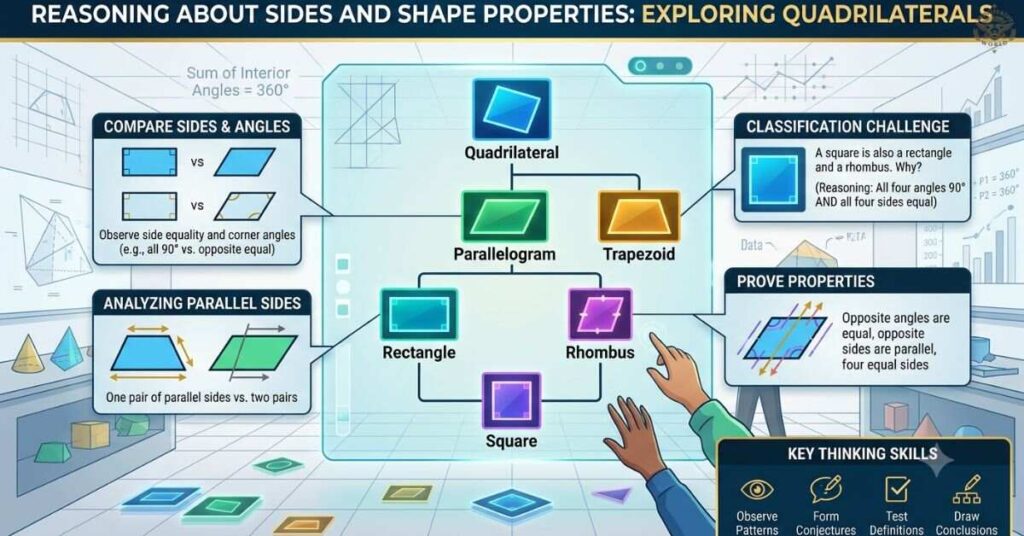
As confidence grows, students can move into reasoning challenges that ask them to think about how sides define and distinguish shapes while still having concrete tools available if they need them.
“Guess My Shape” is a great format for this: “I have six sides and six vertices. What am I?” or “I have four sides, and my opposite sides are equal in length. What shape could I be?” Let students build or sketch their guesses before answering, then check the guess against the clues.
Push comparison further with shapes that share a side count but differ otherwise: “What’s the difference between a square and a rectangle if both have four sides?” Have them build or draw both and list similarities and differences. This kind of precision-focused comparison strengthens their reasoning skills.
To connect back to 3D geometry, have students compare a square to a cube. Ask them to explain how a square’s sides differ from a cube’s edges, and let them physically trace both with their fingers: “What feels different?” This hands-on comparison helps solidify the distinction between sides, edges, and faces.
A Common Misconception: “Does a Circle Have Sides?”
Plenty of students assume a circle has a side simply because it’s a closed shape, just like a triangle or square. It’s an understandable mix-up; kids often associate “closed shape” with “has sides” before they’ve learned to separate straight boundaries from curved ones.
The fix is to compare circles directly against polygons, emphasizing that polygons are built entirely from straight sides meeting at vertices, while a circle’s boundary curves continuously with no straight sections or corners at all.
A simple but effective activity: have students trace a triangle, a square, and a circle with their fingers. On the polygons, their fingers will stop and change direction at each vertex. Around the circle, the motion stays smooth and uninterrupted. Ask them to explain, in their own words, why a circle doesn’t have sides; this reinforces that straightness is the defining trait of a side.
Side+ free
Side+ is the subscription app run by the Sidemen, giving fans ad-free access to exclusive shows, behind-the-scenes footage, and a weekly podcast you won’t find on YouTube. The app offers a short free trial before switching to a paid subscription, and it’s downloadable on iOS, Android, and Amazon Appstore.
While the core library sits behind a paywall, new users can explore a limited catalog of videos at no cost before deciding whether to subscribe. Pricing and trial length can shift depending on your region, so it’s worth checking the current offer inside the app before signing up.
Side meaning in relationship

In everyday relationship talk, “side” describes someone a person sees secretly while already committed to a partner, commonly shortened to “side chick” or “side piece.” It carries a negative connotation, pointing to infidelity or a hidden, non-exclusive arrangement rather than an open or honest relationship.
The term shows up mostly in casual conversation, music, and social media rather than in any formal relationship vocabulary. Context matters here “on the side” can also describe something kept separate or secondary in a non-romantic sense, so the romantic meaning only applies when the conversation is clearly about dating or infidelity.
Side PTW
Side, formerly known as PTW (Pole To Win), is a global game development and services company that got its start in Japan over three decades ago. After growing through several acquisitions, the company rebranded from PTW to Side in 2025, unifying studios like 1518 Studios, Ghostpunch Games, and its original audio-services arm under one name.
Today, Side supports major game publishers with services ranging from quality assurance and localization to art, audio, and co-development, operating out of dozens of studios worldwide. The rebrand didn’t change what the company does; it simply brought a scattered portfolio of studios and specialties together under a single, recognizable identity.
Side company
“Side” the company is best known in two very different industries, and which one comes up depends on context. In real estate, Side Inc. is a brokerage platform founded in 2017 that lets top-performing agents run their own branded businesses while Side quietly manages compliance, technology, and back-office work behind the scenes.
In gaming, Side (formerly PTW) is a services company supporting major studios with development, QA, and localization work. Both companies share the same short, simple name, but they operate in completely separate markets so it’s worth confirming which “Side” you mean before digging further into either one.
Side Inc address
Side Inc., the real estate brokerage platform, is headquartered in San Francisco, California, though its agent network and partner offices span multiple states across the country. Because Side operates as a platform for independent brokers and agent teams rather than a single storefront brand, local addresses vary depending on which partner office or agent you’re working with.
If you’re trying to reach a specific Side-affiliated office, the most reliable approach is checking the agent or brokerage listing directly, since Side’s partners operate under their own branded businesses even though Side handles the infrastructure behind them.
Side tm
The “TM” symbol next to a brand name including “Side™” simply means the company is claiming the name as a trademark, even without full government registration. Businesses use it to put competitors on notice that the name, logo, or phrase belongs to them, and it applies to virtually any brand that wants a first layer of legal protection.
Unlike the registered trademark symbol (®), which can only be used once a mark is officially approved, “TM” requires no paperwork or approval; a company can start using it the moment it begins using the name in commerce. It’s a common early step for growing brands, including tech and service companies operating under the “Side” name.
Side real estate
Side is a real estate brokerage platform, not a traditional agency; it partners exclusively with high-performing agents, teams, and independent brokers, giving them the tools to run their own branded companies. Rather than working directly with home buyers and sellers under its own name, Side operates behind the scenes, handling compliance, technology, and back-office support so agents can focus on clients.
Since launching in 2017, the company has helped launch hundreds of independent real estate businesses and grown into a sizable presence across the industry, particularly in California. Agents who join keep full ownership of their business while relying on Side for the operational side of running a brokerage.
Side gaming
In gaming circles, “Side” refers to the services company formerly known as PTW, a long-established partner to major game developers and publishers around the world. Side provides quality assurance, localization, audio production, art, and co-development support, working behind the scenes on titles across nearly every genre and platform.
The company’s roots go back to Japan’s first video game QA studio, and decades of acquisitions eventually folded several specialty studios into one unified brand. Today, Side is recognized industry-wide as a support partner rather than a game publisher itself, helping studios polish and localize titles before they reach players.
Frequently Asked Questions
What does side mean?
A side is a straight line segment that forms part of a 2D shape’s outline, connecting to other sides at vertices to close the figure.
What are called sides?
The straight edges of a flat, closed shape are called sides for example, a square has four, and a triangle has three.
What is sideman slang?
In music slang, a “sideman” is a supporting musician who plays in a band or session without being the lead artist or bandleader.
How much is the side?
It depends on context Side+ (the Sidemen app) runs on a monthly or yearly subscription after a short free trial, while real estate or gaming services from companies named “Side” don’t have a fixed public price and vary by deal.
What is another word for side?
Common alternatives include edge, flank, border, or face, though the right synonym depends on whether you’re talking geometry, direction, or general use.
Conclusion
Once kids can spot a side, name it, count it, and measure it, they’ve built real understanding, not just memorized a fact. This makes one of the most useful ideas in early geometry, since it keeps showing up later in perimeter, area, and more advanced shape work.
The real goal is helping students see a side as something they can trace, build, and compare with their own hands, not just a word in a textbook. Whether they sort cut out shapes, measure with paper clips, or work out why a circle doesn’t have one, every activity leads back to the same idea. A side is a straight line segment, and once students understand that, the rest of geometry starts to make sense.

