

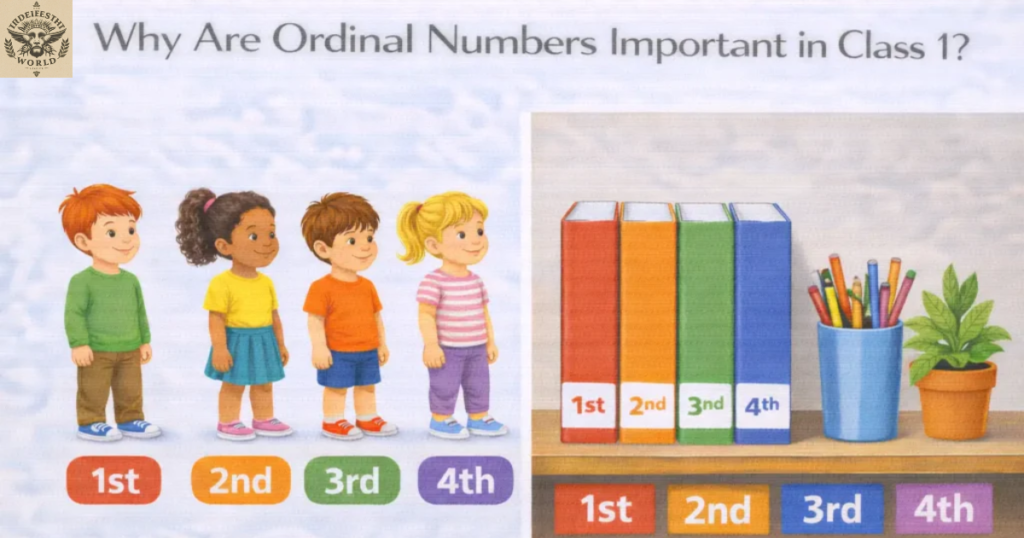
Every time a child points to the “1st” place trophy or asks “who’s 2nd in line?”, they’re using ordinal numbers without even realizing it. Ordinal numbers describe the position or rank of something in a sequence, answering the question “What is the order?” rather than “How many?” You’ll spot them everywhere on a race podium, a calendar date, or a classroom lineup because sequencing and ranking shape so much of how we talk about the world around us.
Understanding ordinal numbers matters far beyond a math worksheet. Students who master this concept build stronger number sense, sharper reading comprehension, and clearer language skills, since ordinal numbers help them describe order in stories, follow multi-step directions, and make sense of dates and rankings in everyday life. This guide walks through what ordinal numbers are, how to write them, and practical ways to teach them from simple visual examples to hands-on classroom activities.
Understanding Ordinal Numbers in Mathematics
Ordinal Numbers tell us the position or rank of something in a sequence. Instead of answering “How many?”, they answer the question “What is the order?” A runner who crosses the finish line first earns the label “1st,” while the runner right behind takes “2nd,” and the one after that takes “3rd.” You’ll also spot Ordinal Numbers on a calendar; the 5th day of the month simply marks its position among the days that came before it.
Students usually write Ordinal Numbers in one of two ways:
- Numerical form with a suffix: 1st, 2nd, 3rd, 4th…
- Word form: First, second, third, fourth…
Both forms matter. When students can move between “3rd” and “third” without hesitation, they’ve built a real connection between spoken and written Ordinal Numbers and that connection carries them a long way in math class.
What Sets Ordinal Numbers Apart from Cardinal Numbers
Cardinal numbers count things three apples, five chairs, ten students. They rank things instead the third apple, the fifth chair, the tenth student in line. This difference feels small at first, but it shapes how children talk about the world. Once a child understands Ordinal Numbers, they can describe not just how much of something exists, but exactly where each item sits in relation to the rest.
Ordinal Numbers Every Student Should Recognize
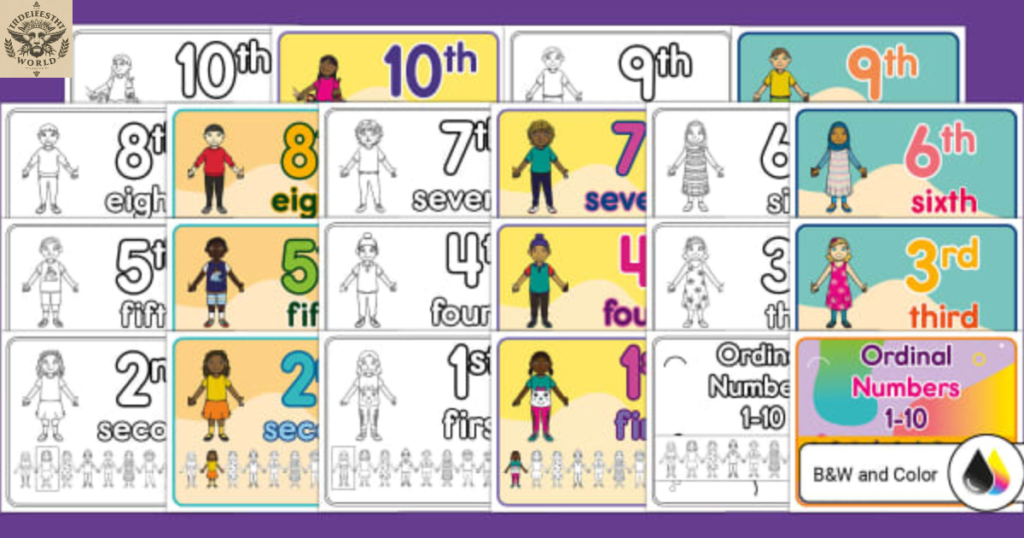
Before diving into strategies, it helps to nail down the basics. Most classrooms start with a simple progression: 1st 2nd, then 1st 2nd 3rd, and eventually 1st 2nd 3rd 4th, building up toward 10th and beyond. Teachers often display this progression on a wall chart so students can point to them as they count off in line or work through a worksheet.
Teaching Strategies for Ordinal Numbers
Teaching ordinal numbers works best when students see, touch, and act out position and order themselves, not just read about it. Visual examples, physical lineups, and hands-on problem-solving turn an abstract concept into something students genuinely understand.
Building Understanding Through Visual Examples
Pictures and objects make Ordinal Numbers click for young learners. Line up toy cars or building blocks, then ask, “Which car sits in 1st place?” or “What position does the blue block hold?” Visuals turn an abstract idea into something a child can point to and touch.
Teaching Ordinal Numbers Through Movement
Kids remember Ordinal Numbers better when their own bodies are part of the lesson. Have the class line up at the door and ask, “Who stands 2nd in line?” or “Who raised a hand 4th?” This kind of physical activity locks the concept into memory far more effectively than a worksheet alone.
Stretching the Concept with Problem-Solving
Once students grasp the basics, push them a little further with questions like:
- “If the person in 3rd place swaps spots with the person in 5th, what does the new line look like?”
- “What happens to everyone’s position if a new student joins in the middle?”
These prompts turn Ordinal Numbers into a genuine thinking exercise rather than a memorization task.
Why Ordinal Numbers Matter
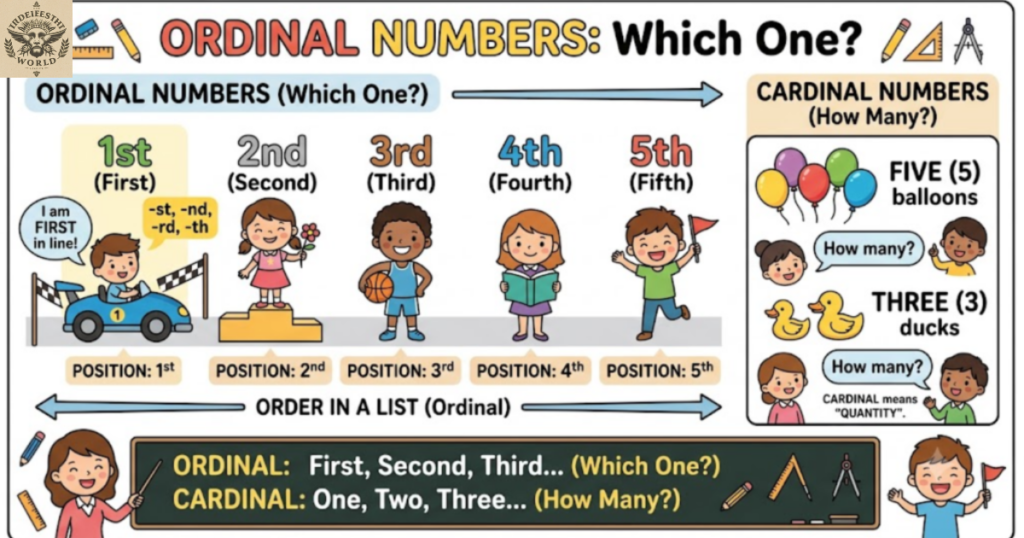
Ordinal numbers give students the vocabulary to describe sequencing, ranking, and position with real precision skills that carry over into reading comprehension, storytelling, and following daily instructions. Beyond the classroom, they shape how we read calendar dates, follow recipe steps, and talk about rank in sports and everyday conversation.
Ordinal Numbers and Broader Mathematical Thinking
Ordinal Numbers give students an early entry point into sequencing and ranking , two ideas that show up again and again in math and daily life. Following a recipe (“Add the flour first, then the eggs second”) depends on that same order-based thinking. Marking a date like “the 3rd of April” on a calendar uses that same skill to pinpoint a specific moment in time. Even in sports commentary, phrases like “the second runner passed the baton to the third” lean on Ordinal Numbers to describe rank and progress.
Ordinal Numbers and Everyday Language Skills
Learning Ordinal Numbers strengthens more than math ability; it builds language and reading skills too. As students practice this skill, they pick up vocabulary that lets them describe order and rank with real precision. That vocabulary carries over into storytelling, giving directions, and explaining their own thinking out loud.
Reading comprehension leans on sequencing just as heavily. Ordinal Numbers give students the words they need to follow and retell events in order: “First, the character went to the store. Second, she picked up some groceries. Third, she walked home.” Without a solid grasp of this skill, following multi-step instructions or retelling a story in order becomes much harder.
Ordinal Numbers in Real Life
Children encounter Ordinal Numbers far beyond the classroom. Birthday countdowns (“It’s my 7th birthday!”), sports rankings (“She finished 3rd in the race”), and even seating arrangements (“You’re 2nd in line for the bus”) all rely on this same idea. The more chances kids get to notice Ordinal Numbers in the world around them, the faster the concept sticks.
Ordinal Numbers 1 to 50
Learning ordinal numbers 1 to 50 gives students a strong foundation for describing position in longer sequences, such as page numbers, race rankings, or seating charts. The pattern stays fairly simple once students master the first ten: 1st, 2nd, 3rd, 4th, 5th, 6th, 7th, 8th, 9th, 10th, and then the “-th” suffix repeats for most numbers after that, with only 21st, 22nd, and 23rd breaking the pattern within each set of ten.
Teachers often introduce this range gradually, starting with 1 to 20 before stretching toward 50. A hundred-square chart works well here, since students can trace the number pattern visually and notice how the suffix changes at each new decade. Practicing counting aloud from 1st to 50th also helps students internalize the rhythm of the sequence rather than just memorizing isolated numbers.
Ordinal Numbers 1 to 20
Ordinal numbers 1 to 20 form the core range most children learn in kindergarten and first grade. This set includes a few tricky spots, like 11th, 12th, and 13th, which don’t follow the usual “one, two, three” pattern and need extra practice on their own. Once students memorize these irregular forms, the rest of the sequence up to 20th tends to fall into place quickly.
A simple way to reinforce this range is through daily classroom routines asking who is 1st, 5th, or 15th in line, or numbering activity stations from 1st to 20th. Repetition in real, physical contexts helps students move beyond rote memorization and start using ordinal numbers naturally in conversation.
Read More: Half Past – Meaningful Math
Ordinal Numbers 1 to 100
Extending ordinal numbers up to 100 challenges students to apply the pattern they’ve already learned to much larger numbers. The good news is that once a student understands 1st through 20th, the rest of the sequence mostly repeats familiar endings, with special attention needed only at each new decade (30th, 40th, 50th) and each “one,” “two,” and “three” position within those decades (31st, 42nd, 53rd).
This range works well for older elementary students who are ready to connect ordinal numbers with place value concepts. Activities like ordering a shuffled deck of number cards from 1st to 100th, or identifying the ordinal position of a specific date within a 100-day school countdown, give students meaningful practice with the full range.
Ordinal Numbers 1-31
Ordinal numbers from 1 to 31 come up constantly on a calendar, since every month has between 28 and 31 days. Students naturally encounter this range when they talk about dates, such as “my birthday is on the 15th” or “school starts on the 1st of September.” Because calendars are part of daily classroom routines, this range often becomes one of the most practical, real-world applications of ordinal numbers.
Teachers can reinforce this range with a classroom calendar activity, asking students to identify what day of the month it is using ordinal language. Questions like “What was yesterday’s date?” or “What ordinal number comes after the 30th?” help students connect ordinal numbers directly to a tool they already use every day.
Cardinal Numbers
Cardinal numbers answer a different question than ordinal numbers instead of describing position, they describe quantity. Cardinal numbers like one, two, three, and four tell us how many objects exist in a group, without saying anything about order or rank. A child counting five apples on a table is using cardinal numbers, while a child pointing out which apple is the third one picked is using ordinal numbers.
Understanding the difference between these two number types helps students build a more complete sense of how numbers work. Many teachers introduce cardinal numbers first, since counting objects tends to come naturally to young learners, and then layer ordinal numbers on top once students are comfortable with basic counting and quantity.
Ordinal Numbers 1 to 20
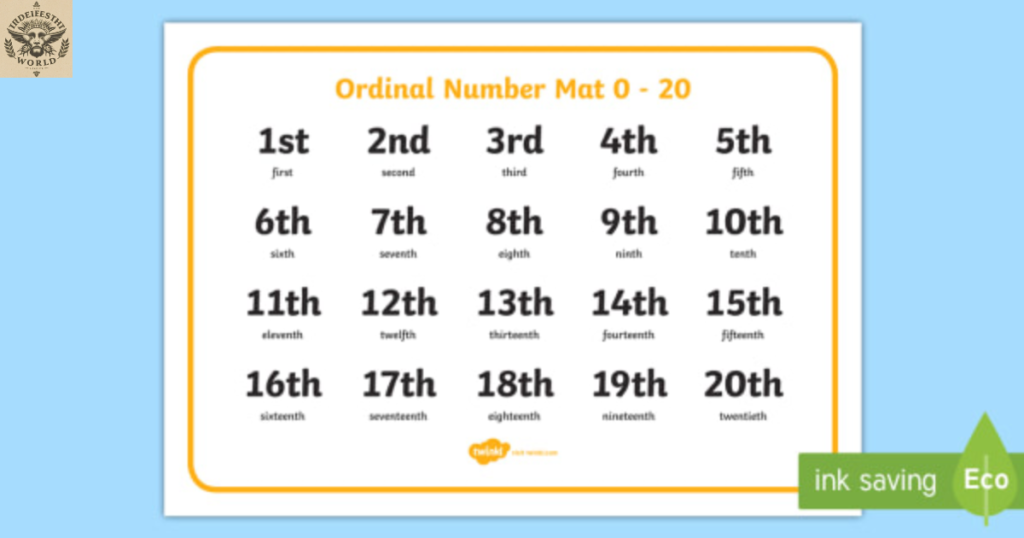
Ordinal numbers 1 to 30 sit right in the sweet spot for calendar-based learning, since most months have close to 30 days. This range also gives students enough repetition to notice the underlying pattern after the irregular 11th, 12th, and 13th, the “-th” ending repeats consistently.
Practicing this range works especially well through monthly calendar routines, where students identify today’s date, tomorrow’s date, or a date a few days away using ordinary language. Over time, this steady exposure helps the pattern become second nature rather than something students have to consciously work out each time.
Ordinal Numbers in Urdu
Ordinal numbers in Urdu follow their own distinct set of words, separate from the numeral forms used in English. Just as English speakers say “first, second, third,” Urdu speakers use words like “pehla,” “doosra,” and “teesra” to describe position in a sequence. Learning these terms alongside their English equivalents can help bilingual students strengthen number sense in both languages at once.
For students learning Urdu as a second language, or for English speakers picking up basic Urdu vocabulary, starting with the first ten ordinal numbers offers the most practical foundation. Everyday contexts like describing your position in a queue or the day of the month give students natural opportunities to practice ordinal numbers in Urdu outside a formal lesson.
Ordinal Numbers Worksheet
A well-designed ordinal numbers worksheet gives students hands-on practice identifying position and order without needing a teacher standing over every activity. Common worksheet formats include labeling objects in a row with their correct ordinal number, circling the “3rd” item in a picture, or filling in missing ordinal numbers in a sequence like 5th, 7th.
Worksheets work best when they mix formats rather than repeating the same question type throughout. Combining picture-based questions, fill-in-the-blank sequences, and short word problems keeps students engaged while reinforcing ordinal numbers from multiple angles. Many teachers also pair worksheets with a hands-on activity beforehand, so students already have a physical or visual reference to draw on when they sit down to complete the page.
Frequently Asked Questions
What is an ordinal number?
An ordinal number shows the position or rank of something in a sequence, like 1st, 2nd, or 3rd. It answers “What is the order?” rather than “How many?”
What are ordinal numbers from 1 to 100?
This range starts 1st, 2nd, 3rd, 4th… and continues through 100th, following the same “-th” pattern after each new decade. Only the “one,” “two,” and “three” positions within each ten (like 21st, 32nd, 43rd) break the standard pattern.
What are ordinal numbers 1 to 50?
Ordinal numbers 1 to 50 run from 1st through 50th, following the regular suffix pattern after the first ten. Students usually need extra practice around 11th, 12th, and 13th, since these don’t follow the typical rule.
What are ordinal numbers from 1 to 20?
This set runs from 1st to 20th and covers the core range most children learn first in school. It includes the tricky 11th, 12th, and 13th, which require separate memorization from the rest.
How to write ordinal numbers?
Ordinal numbers can be written in numerical form with a suffix (1st, 2nd, 3rd) or in word form (first, second, third). Both forms describe the same position, just in different styles.
What is the first ordinal number?
The first ordinal number is “1st,” or “first” in word form. It marks the very beginning of a sequence or order.
Conclusion
Ordinal numbers give students a clear way to describe position and order, whether they’re lining up for recess, marking a date on the calendar, or following the steps in a recipe. Once students master the pattern behind 1st, 2nd, 3rd, and beyond, they carry that skill into reading, math, and everyday conversation without much extra effort.
Teachers who mix visual examples, physical activities, and simple worksheets help students internalize ordinal numbers far faster than memorization alone allows. With steady practice across ranges like 1 to 20, 1 to 50, and 1 to 100, students build the confidence to use ordinal numbers accurately in any situation they encounter.

