


Understanding Ones in Mathematics is an important first step in learning how numbers work. The ones place represents individual units, such as 1, 2, 3, or 9 objects. By learning how ones connect with tens, hundreds, and other place values, students can develop a stronger understanding of counting, addition, subtraction, and number structure.
Have you ever wondered why the number 25 means twenty-five and not simply two and five? The answer starts with place value. Understanding Ones in Mathematics helps students see that every digit has a specific value based on its position. Once students understand the ones place, many other mathematical concepts become easier to learn and apply.
Understanding Ones in Mathematics teaches students that digits in the ones place represent individual units. For example, the number 7 means seven ones. Understanding Ones in Mathematics also provides a foundation for learning place value, addition, and subtraction. With Understanding Ones in Mathematics, students can develop stronger number sense and feel more confident when working with numbers.
Teaching Strategies to Explore Ones
Teaching ones effectively works best when instruction moves through a clear progression starting with something students can physically hold, then shifting to visual representations, and finally reinforcing everything through spoken and written mathematical language. This step-by-step approach keeps the concept grounded in real experience rather than turning place value into an abstract rule to memorize, and it gives every student, regardless of learning style, multiple ways to connect with the idea of a one number and how it fits into the larger number system.
Start with Hands-On Manipulatives
Physical tools give students a concrete way to understand that each one represents a single, countable unit before any abstract symbols are introduced. Handing students counters, cubes, or base-ten blocks and asking them to count out a specific quantity, such as 7, lets them physically see and touch each individual unit while connecting it directly to the written numeral on the board.
Once students are comfortable counting individual units, introducing grouping activities builds the next layer of understanding. Giving students 12 connecting cubes and asking them to bundle 10 together into a “ten,” leaving 2 remaining as ones, mirrors exactly how a place value chart represents the number showing that 12 is made of 1 ten and 2 ones. This kind of hands-on regrouping reinforces that larger numbers are simply organized collections of smaller units.
Move to Visual Representations
After manipulatives, shifting to drawings helps students transition toward more abstract thinking. Rather than handling physical counters, students might draw seven dots or tally marks and label the group as “ones,” practicing the same counting concept in a more symbolic form.
As this skill develops, connecting these drawings to a place value chart deepens the link between pictures and numbers. Representing 12 as one grouped shape for the ten and two separate dots for the remaining ones helps bridge concrete counting with the more abstract number sense students will rely on later, particularly when working with a hundreds tens ones example involving larger multi-digit numbers.
Encourage Mathematical Communication

Using precise vocabulary strengthens both understanding and confidence. Encouraging students to use terms like “ones place,” “single units,” and “groups of ones” instead of vague language helps them explain their reasoning clearly rather than relying on guesswork.
Prompting questions such as “how many ones are in the number 18?” or “what happens to the ones place when we add one more?” pushes students to articulate their thinking out loud. This kind of mathematical discussion strengthens conceptual understanding while also building the communication skills needed to explain reasoning in more advanced math later on.
Building Flexibility With Ones
As students grow more comfortable with place value, their understanding of ones naturally shifts moving from viewing it strictly as “the smallest possible unit” toward recognizing that a one can also represent an entire whole, depending on context. This transition can feel challenging at first, since it asks students to rethink an idea they previously considered fixed and unchanging.
Early on, learners typically picture ones as individual, countable pieces, much like single cubes or counters lined up one after another. But once decimals and fractions enter the picture, that same digit can represent something different entirely. In a number like 1.3, for example, the leading “1” now stands for one complete whole rather than a single countable unit, which can feel unfamiliar compared to earlier counting experiences. Measurement introduces a similar shift: recognizing that one meter or one pound is itself a whole unit made up of smaller components, like centimeters or ounces, requires the same kind of flexible thinking. Providing consistent, concrete examples across these different contexts helps students build the confidence needed to apply their understanding of ones no matter how the number system presents it.
Ones In Mathematics Worksheets
Ones in mathematics worksheets typically include activities like counting objects, identifying the ones digit in multi-digit numbers, and matching numerals to grouped place value blocks. These worksheets are especially useful for reinforcing classroom lessons through independent, repeatable practice.
Well-designed worksheets often progress in difficulty, starting with simple counting tasks and gradually introducing regrouping problems that require students to separate a number into tens and ones. Using a mix of picture-based and numeral-based questions helps reinforce the concept from multiple angles, supporting different learning styles within the same lesson.
Ones In Mathematics Examples
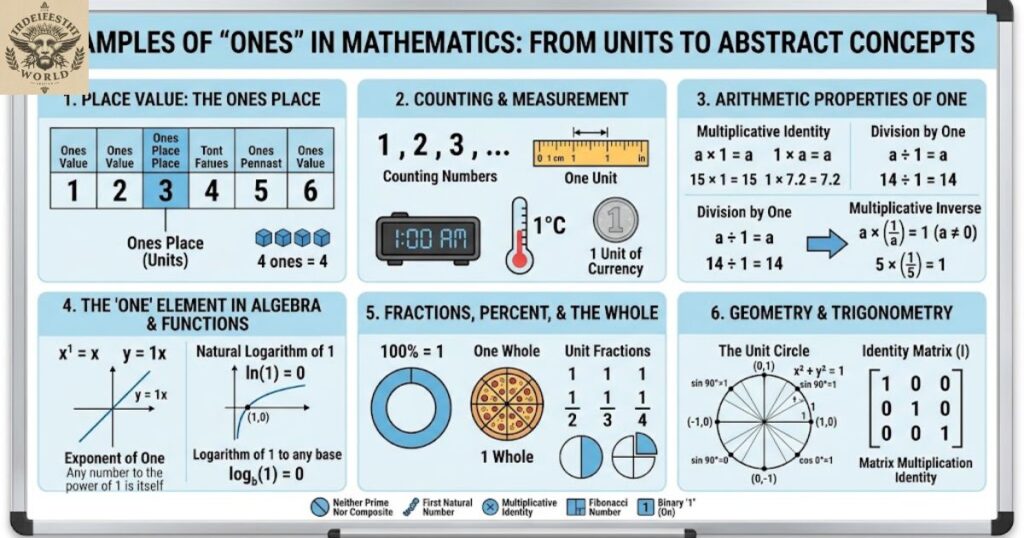
Clear ones in mathematics examples make the concept far easier to grasp than abstract explanations alone. For instance, in the number 36, the digit 6 represents 6 individual ones, while the 3 represents three groups of ten, giving a total of 36 single units when fully expanded.
Another helpful example involves comparing two numbers with the same ones digit but different tens digits, such as 14 and 24, to show that while both share “4 ones,” their overall value differs significantly based on the tens place. Working through several examples like these strengthens the connection between digit position and actual quantity.
2 Ones Means In Maths
When a number statement says “2 ones,” it simply means two individual, single units, equal to the number 2 itself. This might seem like a small detail, but it’s an important stepping stone for younger learners who are just beginning to connect spoken number language with written numerals.
Understanding that “2 ones” and the numeral “2” represent exactly the same quantity helps students build a stronger mental link between verbal counting and symbolic representation, which becomes especially useful once they begin working with expanded form and place value charts involving larger numbers.
Ones, Tens, Hundreds Thousands Millions Chart
A place value chart showing ones, tens, hundreds, thousands, and millions gives students a visual map of how our number system scales upward, with each column representing a value ten times larger than the one before it. This kind of chart makes it easy to see exactly how much each digit in a large number is actually worth.
Using this chart consistently across lessons helps students recognize patterns as numbers grow, reinforcing that every place value, no matter how large, ultimately traces back to the same foundational concept of counting individual ones and grouping them repeatedly by tens.
Relevant Post…….Understanding Fractions
Tens And Ones Examples With Answers
Practicing tens and ones examples with answers gives students immediate feedback while reinforcing correct place value reasoning. For instance, the number 47 breaks down into 4 tens and 7 ones, while 82 breaks down into 8 tens and 2 ones, both of which can be verified using base-ten blocks or a simple place value chart.
Providing answer keys alongside practice problems allows students to self-check their work, building independence and confidence. Mixing straightforward examples with slightly trickier ones, such as numbers ending in zero, helps ensure students fully understand the concept rather than relying on a single repeated pattern.
Tens And Ones In Math
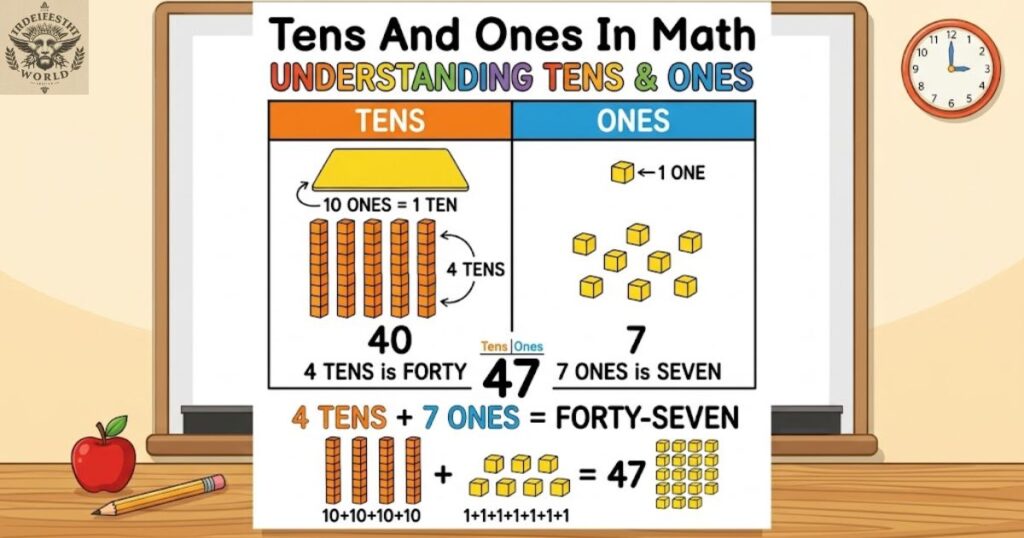
The relationship between tens and ones in math forms the backbone of two-digit number understanding, showing students exactly how a number like 53 is built from 5 groups of ten combined with 3 individual ones. This foundational skill directly supports addition and subtraction strategies that rely on regrouping.
Mastering this relationship early makes later math concepts, such as carrying and borrowing during multi-digit addition and subtraction, far more intuitive, since students already understand that these operations are really just reorganizing groups of tens and ones rather than following unrelated procedural steps.
Ones In Mathematics Multiplication
When multiplying multi-digit numbers, understanding ones in mathematics multiplication helps students see why the standard algorithm works the way it does. Multiplying the ones digit first, before moving to the tens digit, mirrors exactly how place value is structured, ensuring each part of the number is accounted for correctly.
This concept also supports mental math strategies, where breaking a number into its tens and ones components before multiplying for example, calculating 23 × 4 as (20 × 4) + (3 × 4) makes larger multiplication problems feel more manageable and easier to solve without relying solely on memorized steps.
Ones Number Example
A simple ones number example is the digit found at the end of any whole number, such as the 8 in 128, which tells us there are 8 individual units beyond the hundreds and tens. This single digit carries significant meaning about the number’s exact value.
Comparing multiple examples, such as 128, 138, and 148, shows how changing only the ones digit shifts the total value by small, predictable increments, helping students see the direct relationship between a digit’s position and its actual contribution to the number as a whole.
Frequently Asked Questions
What are ones in math?
Ones are the smallest place value unit in a number, representing individual single units before grouping into tens, hundreds, or beyond.
What is 100 ones equal to?
100 ones is equal to the number 100 itself, since one hundred individual units combine to form exactly one hundred.
What is the value of 7 ones?
The value of 7 ones is simply 7, since each one contributes exactly one unit to the total count.
What are tens and ones?
Tens and ones are place values where tens represent groups of ten units, and ones represent the remaining individual, ungrouped units.
How to explain tens and ones to kids?
Use physical objects like blocks or counters, grouping ten items into a “ten” and leaving extras as separate ones for a clear visual.
Conclusion
Ones are the essential building blocks of our entire number system, giving every digit its precise meaning within a larger whole number. From simple counting activities with physical manipulatives to more advanced concepts like multiplication and decimal place value, understanding ones supports nearly every stage of a student’s math education. Recognizing a hundreds tens ones example, working through worksheets, and practicing with visual charts all reinforce the same core idea: numbers are flexible, composable structures built from smaller, countable units.
As students progress, their understanding of a one number naturally expands from a simple single unit to a concept that adapts across whole numbers, decimals, and measurement. With consistent hands-on practice, clear mathematical language, and real examples, this foundational skill becomes second nature and supports confident, flexible number sense for years to come.

