


Counterclockwise is one of those math terms that shows up everywhere once students start looking for it, from a spinning clock hand to a twisting bottle cap. Learning this direction builds real spatial reasoning skills and gives young learners a standardized way to describe rotation, angle measurement, and pattern prediction long before they ever touch a protractor.
This guide walks through what counterclockwise means, why it matters in elementary geometry, and how teachers can bring it to life through hands-on activities and whole body movement. It also answers common questions families and educators search for, covering everything from counterclockwise versus clockwise to how the term connects to a well known book on mindset and health.
What Counterclockwise Means In Math
Counterclockwise describes a turn that moves opposite to the way clock hands travel around a clock face. This kind of rotation follows a circular path, and it gives students a standardized way to talk about direction and turning. Whether a shape completes a quarter turn, a half turn, or a full turn, that turn can move one of two ways, and naming the direction correctly is part of understanding rotation itself.
Clockwise motion often feels more natural to young learners because they see it every day while reading time. Counterclockwise motion, though, carries equal weight in math, particularly once students start exploring geometry and spatial reasoning.
Why Counterclockwise Matters
Learning to recognize counterclockwise motion builds a child’s spatial reasoning skills. When students rotate shapes, spin objects, or track movement patterns, they need a reliable way to describe direction, and counterclockwise gives them exactly that. Once students grasp that counterclockwise rotation always follows the same circular path, they gain a dependable, counterclockwise reference point for describing turns, spotting patterns, and understanding symmetry, including a line of symmetry.
Counterclockwise motion also shows up in everyday life more often than most students realize. Twisting a bottle cap open or loosening a bolt both involve a counterclockwise turn. Many running tracks move counterclockwise, and baseball players run the bases in a counterclockwise direction too. Linking counterclockwise rotation to these familiar, real world examples helps students view it as a consistent and predictable pattern instead of a random direction.
Ways To Teach Counterclockwise
Teaching counterclockwise works best when students see it, feel it, and practice it in more than one way. The activities below move from simple clock watching to full body movement and pattern prediction, building understanding step by step.
Watching And Practicing Counterclockwise Motion
A real or toy analog clock gives students a familiar tool for exploring counterclockwise movement. Slowly moving the clock hands counterclockwise while students trace the counterclockwise path with a finger draws their attention to the direction itself. Comparing this motion with clockwise movement, and asking learners to explain what stays the same and what changes, strengthens their grasp of the two directions and builds their spatial vocabulary.
Students can also record what they notice by sketching curved arrows over printed clock faces or circles, marking which arrow shows clockwise and which shows counterclockwise. This links their physical exploration directly to a visual record they can revisit, one that keeps the meaning fresh long after the activity ends.
Read More: Prism – Meaningful Math
Spotting Counterclockwise Turns In Pictures
Give students pairs of images, arrows, letters, or shapes shown before and after a turn. Ask them to study both versions and decide whether the object rotated clockwise or counterclockwise.
Prompts such as “How do you know which way it turned?” and “Which part moved first?” push students to put their reasoning into words and start recognizing the visual signs of counterclockwise rotation on their own. Over time, students begin spotting these turns almost instantly, without needing to trace the movement step by step.
Guessing What Comes Next In Counterclockwise Patterns

Once students feel comfortable, they should start predicting where counterclockwise motion will lead and noticing patterns as objects rotate. A strong way to build this skill is through prediction activities, where learners study a sequence of images turning counterclockwise and guess what comes next.
For instance, show students a short repeating sequence that follows a counterclockwise pattern and ask them what the next image in line should look like. An arrow that steps counterclockwise from pointing up, to pointing left, to pointing down gives students a clear counterclockwise pattern to continue, and predicting the next counterclockwise position tests their understanding directly.
These prediction tasks push students to apply what they know about direction and rotation, think through spatial changes step by step, and defend their answers with reasoning. Predicting a counterclockwise sequence correctly shows that a student truly understands the pattern, rather than just recognizing counterclockwise motion after it already happened.
Mistakes Students Often Make With Counterclockwise
Learning to spot counterclockwise motion takes practice, and a few common mix ups tend to show up along the way.
Mixing Up Clockwise And Counterclockwise
Many students mix up clockwise and counterclockwise when they first meet these terms. Physically acting out both directions and watching how real objects move helps clear up the confusion, and repeated practice naming counterclockwise motion out loud speeds up that understanding.
Comparing their own body turns with objects like clocks, jar lids, and wheels reinforces the idea that clockwise and counterclockwise each follow one consistent pattern, never varying. Talking through why a clock’s hands always travel the same way, or how twisting a bottle cap open differs from twisting it closed, deepens understanding and heads off future mix ups. Instead of memorizing the terms by rote, students build lasting understanding of clockwise and counterclockwise through repeated, hands-on experience.
Counterclockwise Left Or Right
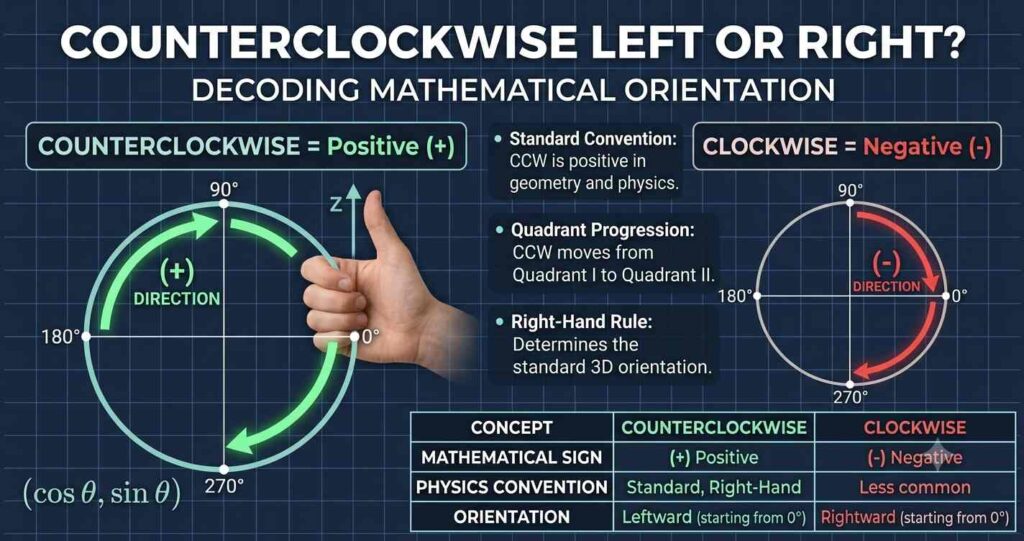
Counterclockwise motion moves toward the left when an object sits at the top of a circle, since a clock’s hands travel to the right at that same point. This left leaning path is why people often describe counterclockwise as a leftward turn, even though the true direction depends on where the object starts along the circular path.
Because the left or right label shifts depending on position, teachers usually steer students back to the more reliable comparison, using the clock face itself as the reference point. Watching an object move counterclockwise around a full circle, rather than judging a single moment, gives students the clearest sense of direction and keeps the turning motion easy to picture.
Counterclockwise Vs Anticlockwise
Counterclockwise and anticlockwise describe the exact same rotation, just with different regional vocabulary. Counterclockwise is the term most commonly used across the United States and Canada, while anticlockwise shows up more often in British, Australian, and other Commonwealth English.
Both words point to the same opposite direction relative to a clock’s hands, so students who encounter either term in a textbook, video, or worksheet are learning about identical rotation. Introducing both words early helps students build flexible math vocabulary and prevents confusion if they meet anticlockwise in an unfamiliar resource later on.
Counterclockwise Meaning
At its core, counterclockwise means turning or rotating in the direction opposite to how a clock’s hands move. The word breaks down simply once students see it: counter signals opposite, and clockwise refers to the clock’s own direction, so together the term names a specific, standardized turn.
This meaning stays consistent everywhere it appears, whether students meet it in a geometry lesson, a science experiment, or a set of instructions for assembling something at home. Understanding the meaning behind the term, rather than memorizing it as an isolated word, helps students recognize counterclockwise motion the moment they see it, regardless of the context.
Counterclockwise Rotation

Counterclockwise rotation refers to circular movement that travels opposite to a clock’s hands, and it plays a central role in geometry once students begin working with angles and coordinate planes. On a standard coordinate grid, counterclockwise rotation is treated as the positive direction, which makes it the default starting point for measuring angles from a 0° reference line.
Students practice this type of rotation by turning shapes a set number of degrees, whether that means a quarter turn, a half turn, or a full turn, and observing how the shape’s position changes along the circular path. Repeated practice with counterclockwise rotation builds a strong foundation for later topics like rotational symmetry and other forms of geometric transformation.
Counterclockwise Book
Counterclockwise is also the title of a well known book by psychologist Ellen Langer, exploring how mindset and belief influence physical health and aging. The book takes its name from Langer’s own 1979 research, in which a group of older men spent a week living as though the calendar had turned back two decades, and many showed measurable improvements afterward.
While this book explores psychology rather than math, its title borrows the same core idea found in the geometric term, turning back or reversing the usual direction of change. Students and readers encountering both meanings can appreciate how one word describes a physical rotation in math class and a metaphorical reversal in a completely different field.
Counterclockwise Direction
A counterclockwise direction is any movement that curves opposite to the path a clock’s hands follow, always tracing a consistent circular route. This direction gives students, engineers, and everyday objects a shared, standardized way to describe rotation without needing extra explanation.
Recognizing a counterclockwise direction becomes easier once students connect it to real examples, such as unscrewing a jar lid or watching the second hand of a clock reversed on a screen. Once that direction feels familiar, students can apply it confidently to shapes, patterns, and diagrams across many different math topics.
Counterclockwise Synonym
Anticlockwise stands as the most common synonym for counterclockwise, used widely in British and Commonwealth English to describe the same rotational direction. Some contexts also use widdershins, an older, more poetic term for the same opposite to clock hands motion, though it appears far less often in modern classrooms.
Knowing these synonyms helps students avoid confusion when a term other than counterclockwise shows up in a book, app, or international resource. Since every synonym points to one identical direction, students only need to master the underlying concept once and can then recognize it under any of its names.
Counterclockwise Vs Clockwise
Counterclockwise and clockwise describe the two possible directions a circular motion can take, and they always move opposite to one another. Clockwise follows the same path a clock’s hands travel, while counterclockwise reverses that same circular path entirely.
Comparing the two directly, rather than teaching each one in isolation, helps students internalize the difference faster. Simple activities like tracing both directions with a finger, walking both directions in a circle, or twisting a lid open and closed give students a clear, physical contrast between counterclockwise and clockwise that sticks long after the lesson ends.
Frequently Asked Questions
Is it counterclockwise right or left?
Counterclockwise moves left at the top of a circle, opposite to a clock’s hands. The direction can shift at other points, so the clock face stays the best reference.
What is counterclockwise and anticlockwise?
Both words describe the same rotation, opposite to a clock’s hands. Counterclockwise is common in American English, anticlockwise in British English.
Which clockwise is left?
Clockwise never moves left at the top of a circle. It always curves right, matching the path a clock’s hands follow.
How to identify anticlockwise and clockwise?
Compare the motion to a clock’s hands to check the direction. Matching the hands means clockwise, moving opposite means anticlockwise.
What is another word for counterclockwise?
Anticlockwise is the most common alternative term. Widdershins is an older word for the same direction.
Conclusion
Counterclockwise starts as a simple direction on a clock face, but it grows into a building block for angle measurement, symmetry, and geometric reasoning as students advance. Once learners can spot this rotation confidently, whether they’re tracing a clock hand, predicting the next shape in a pattern, or twisting open a jar lid, they carry that skill into every new math concept built on turns and angles.
Teaching this direction well means giving students more than a definition. Movement, visuals, and real world connections turn an abstract idea into something students can feel and describe with confidence, setting them up for the geometry and spatial reasoning work still ahead.

