

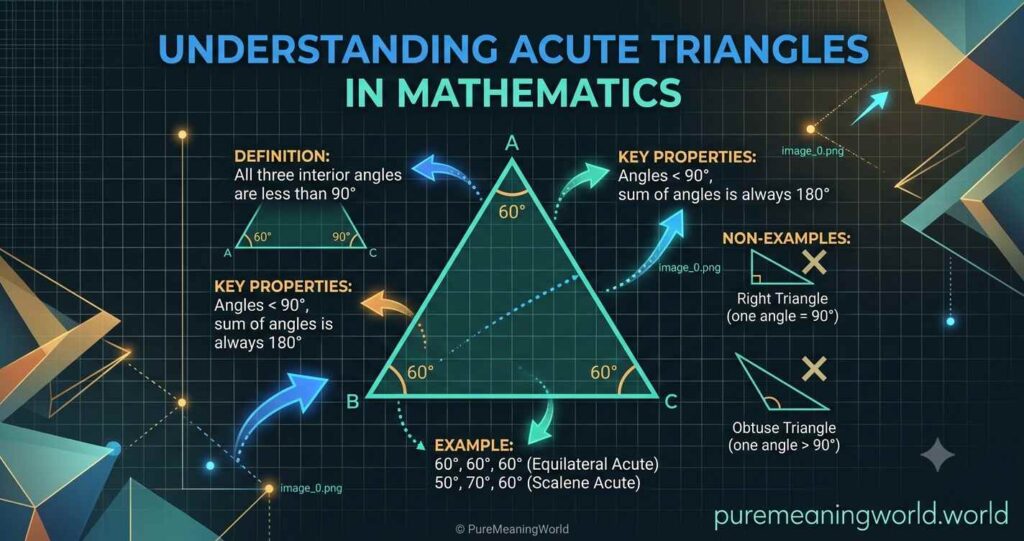
An acute triangle is a triangle with three angles that are each less than 90 degrees. Many students ask what makes a triangle acute. The answer is simple. Every angle must be greater than 0 degrees and less than 90 degrees. That is what makes an acute triangle different from a right or obtuse triangle. An acute triangle can have equal sides or different side lengths. For example, an acute isosceles triangle has two equal sides and all three angles stay acute.
Learning about an acute triangle helps you understand geometry better. You can identify an acute triangle by measuring each angle with a protractor or by comparing it to a right angle. Knowing what makes a triangle acute builds strong math skills. Once you know what makes an acute triangle, you can classify triangles with confidence and solve geometry problems more easily.
Why Understanding Acute Triangle Is Important
Learning about an acute triangle helps you build a strong foundation in geometry. Once you know what makes a triangle acute, it becomes much easier to classify different triangle types. An acute triangle has three angles that are each less than 90 degrees. This simple rule helps you tell it apart from right and obtuse triangles. You can also find shapes like an acute isosceles triangle, which has two equal sides and three acute angles.
Knowing what makes an acute triangle improves your math skills and confidence. It also helps you solve geometry questions more quickly. You will use this knowledge when measuring angles, comparing shapes, and drawing triangles. The more you practice with an acute triangle, the easier it becomes to recognize one in class and real-life examples.
Read More: Counterclockwise – Meaningful Math
Identifying And Measuring Acute Triangles
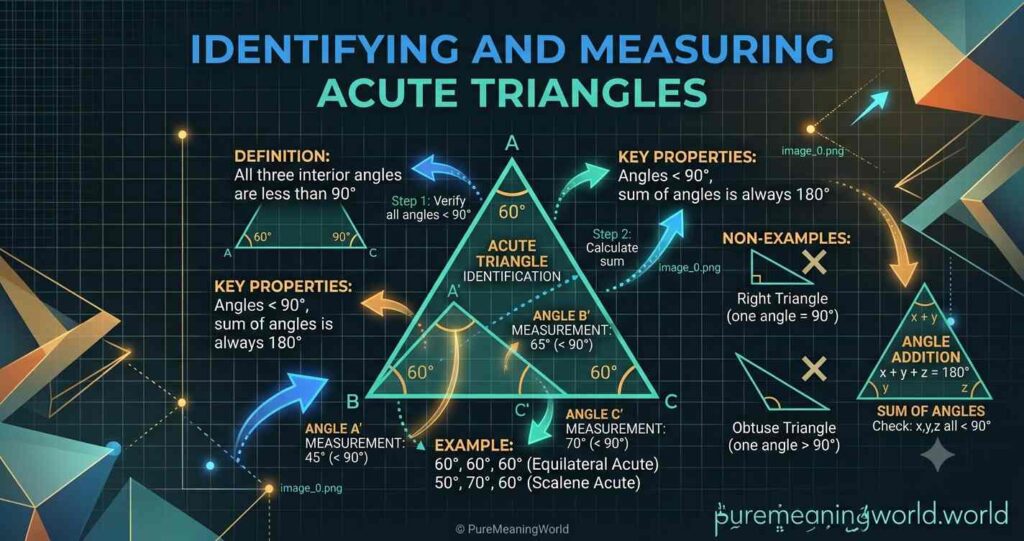
You can identify an acute triangle by looking at all three interior angles. Each angle must be greater than 0 degrees and less than 90 degrees. That is what makes a triangle acute. A protractor is the best tool for checking each angle. If every angle is acute, then you have an acute triangle. An acute isosceles triangle follows the same rule while also having two equal sides.
Measuring angles is an easy way to confirm what makes an acute triangle. Compare each angle with a right angle to see if it is smaller. Then measure the angles with a protractor for accuracy. This method helps you avoid mistakes when classifying triangles. With regular practice, you will identify an acute triangle quickly and understand its unique properties.
Recognizing Acute Triangles Using Benchmarks
An acute triangle has three angles that are all smaller than a right angle. Learning what makes a triangle acute is easier when you compare each angle with a 90-degree corner.
You can use the corner of a book or a right-angle template as a simple benchmark. This method helps you see what makes an acute triangle, even in an acute isosceles or other triangle shapes.
Measuring Angles in a Triangle to Confirm It Is Acute
Use a protractor to measure every angle in an acute triangle carefully. If each angle is less than 90 degrees, you know what makes a triangle acute.
Check all three angles instead of only one because every angle must be acute. This confirms what makes an acute triangle and helps you identify an acute triangle, including an acute isosceles, with confidence.
Teaching Strategies For Acute Triangles
Teach an acute triangle by using simple drawings, paper cutouts, and a protractor. Let students compare shapes and discover what makes a triangle acute through hands-on activities. Use real examples, including an acute isosceles, to explain what makes an acute triangle in a fun and easy way.
Hands-On Exploration of Acute Triangles
Students learn faster when they build an acute triangle with paper, straws, or a geoboard. This hands-on activity shows what makes a triangle acute in a simple and fun way.
Try making an acute isosceles and compare it with other triangle types. This helps you understand what makes an acute triangle through real examples and careful observation.
Visual Models for Understanding Acute Triangles
Pictures and diagrams make it easier to recognize an acute triangle. You can compare each angle with a right angle to see what makes a triangle acute.
Color-coded models also help you spot an acute triangle more quickly. They make what makes an acute triangle easier to remember, including the shape of an acute isosceles triangle.
Abstract Reasoning With Acute Triangles
After learning the basics, you can explain why an acute triangle has three angles smaller than 90 degrees. This strengthens your understanding of what makes a triangle acute.
Reasoning without measuring every angle builds confidence and math skills. It also helps you identify an acute triangle, including an acute isosceles, by knowing what makes an acute triangle.
Common Misconceptions About Acute Triangles
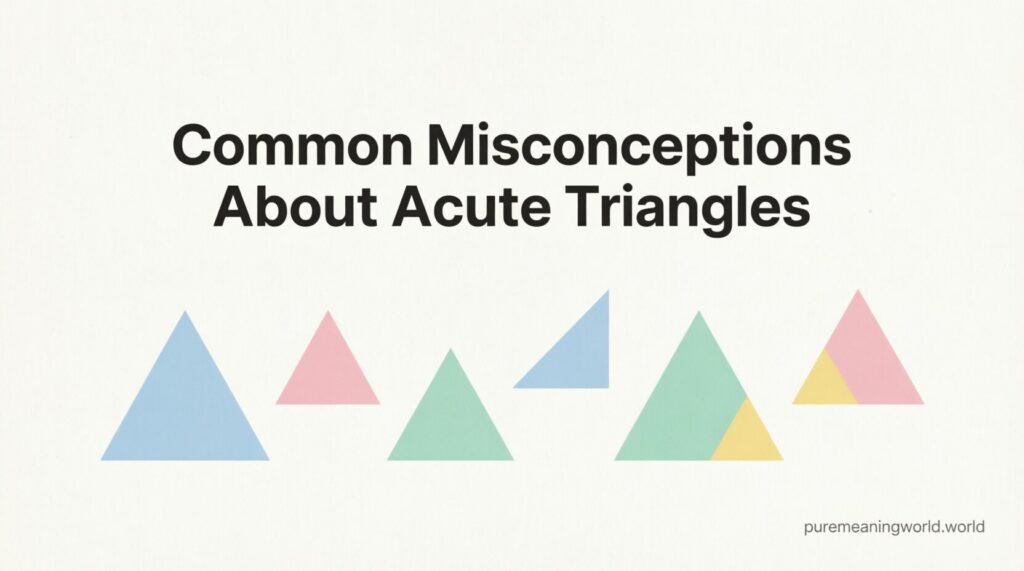
Many students think one small angle is enough to make an acute triangle, but all three angles must be less than 90 degrees. Another common mistake is believing every acute triangle has equal sides, even though only an acute isosceles triangle has two equal sides. Once you understand what makes a triangle acute and what makes an acute triangle, it becomes much easier to identify triangles correctly.
Misconception: Thinking a Triangle With One Acute Angle Is an Acute Triangle
Many students think one small angle is enough to make an acute triangle. In fact, what makes a triangle acute is that all three angles must be less than 90 degrees.
A triangle with only one acute angle is not always an acute triangle. Understanding what makes an acute triangle helps you avoid this common mistake and classify triangles correctly.
Misconception: Believing That Acute Triangles Must Always Have Equal Sides or Angles
Some students believe every acute triangle has equal sides or equal angles. This is not true because an acute triangle can have different side lengths and different angle sizes.
An acute isosceles triangle has two equal sides, but many acute triangles do not. Learning what makes a triangle acute and what makes an acute triangle helps you focus on the angles instead of the side lengths.
Acute Triangle Scalene
An acute triangle can also be a scalene triangle. In this case, all three angles are less than 90 degrees and all three sides have different lengths. This is another way to understand what makes a triangle acute.
- All three angles are less than 90 degrees.
- All three sides have different lengths.
- No sides or angles are equal.
- It is different from an acute isosceles triangle.
- It is still an acute triangle because every angle is acute.
Acute Triangle Drawing
Drawing an acute triangle is easy when you know what makes an acute triangle. Make sure every angle is smaller than a right angle before you finish your drawing.
- Step 1: Draw one straight line.
- Step 2: Mark a point above the line.
- Step 3: Connect the point to both ends of the line.
- Step 4: Check that all three angles are less than 90 degrees.
- Step 5: Measure the angles with a protractor if needed.
Acute Triangle Area
The area of an acute triangle is found the same way as any other triangle. Once you know the base and height, you can calculate the area easily. This does not change what makes a triangle acute.
Formula:
Area = (Base × Height) ÷ 2
Example: If the base is 8 cm and the height is 5 cm, then the area is (8 × 5) ÷ 2 = 20 cm².
Acute Triangle Properties
An acute triangle has special features that make it easy to identify. Learning these properties helps you understand what makes an acute triangle and compare it with other triangles.
- All three angles are less than 90 degrees.
- The three angles add up to 180 degrees.
- It has three sides and three vertices.
- It can be scalene, acute isosceles, or equilateral.
- It is never a right triangle.
- It is never an obtuse triangle.
- Every interior angle is acute.
Acute Triangle Formula
An acute triangle uses the same formulas as other triangles. These formulas help you solve geometry problems after identifying what makes a triangle acute.
Area = (Base × Height) ÷ 2
Perimeter = Side 1 + Side 2 + Side 3
Acute Triangle Sides

The sides of an acute triangle can be equal or different. Side lengths do not decide what makes an acute triangle because the angles determine its type.
- A scalene acute triangle has three different sides.
- An acute isosceles triangle has two equal sides.
- An equilateral triangle has three equal sides and is also an acute triangle.
- Side lengths may change, but all angles must stay below 90 degrees.
Acute Triangle Angle
The angles are the most important part of an acute triangle. They explain what makes a triangle acute and help you classify the shape correctly.
- Every angle is greater than 0 degrees.
- Every angle is less than 90 degrees.
- The three angles always add up to 180 degrees.
- Measure the angles with a protractor for accuracy.
- All three angles must be acute for an acute triangle.
FAQ’s
What is an acute triangle?
An triangle has three angles smaller than 90 degrees.This is what makes an acute triangle different from other triangles.
How do you identify an acute triangle?
Measure all three angles with a protractor carefully.If every angle is below 90 degrees, it is an triangle.
Can an acute triangle have equal sides?
Yes. An acute isosceles has two equal sides.An equilateral triangle is also an triangle with equal sides.
What makes a triangle acute?
All three interior angles must be less than 90 degrees.That is what makes a triangle acute every time.
Can an acute triangle become a right triangle?
No. A triangle cannot have a 90-degree angle.Adding one right angle changes the triangle’s classification.
Conclusion
An acute triangle is one of the first shapes you learn in geometry. Once you know what makes a triangle acute, it becomes easy to identify it anywhere. Remember that an acute triangle always has three angles smaller than 90 degrees. An acute isosceles triangle is also an acute triangle because all of its angles stay below 90 degrees. This simple rule helps you avoid common mistakes and build confidence in math.Keep practicing with different triangle examples and measure the angles with a protractor.
The more you practice, the faster you will understand what makes an acute triangle. Compare different triangle types and check every angle carefully. Soon, you will recognize an acute triangle without any trouble. Learning about an acute triangle improves your geometry skills and makes future math lessons much easier. Small steps and regular practice will help you master what makes a triangle acute and use this knowledge with confidence every day.

