

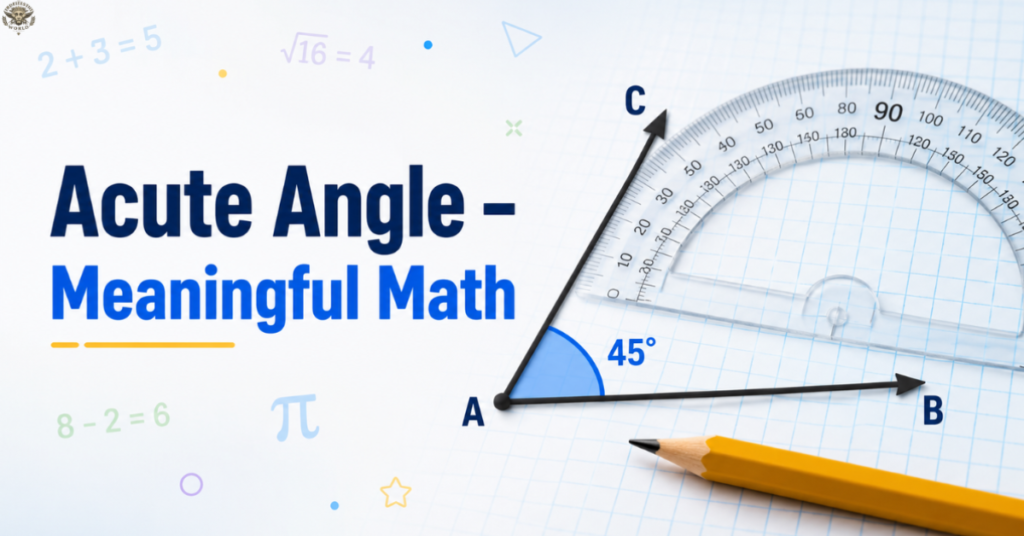
An acute angle is one of the first shapes students learn to spot in math class, and it stays useful for years afterward. Simply put, an acute angle is any angle that measures more than 0 degrees and less than 90 degrees, making it smaller and sharper than a familiar right angle.
Once students know what an acute angle looks like, they start noticing acute angle shapes everywhere, from the corner of a folded card to the tip of a triangle. This guide walks through the acute angle definition math relies on, how to measure one accurately, and simple strategies that help the idea truly stick.
Understanding Acute Angles in Mathematics
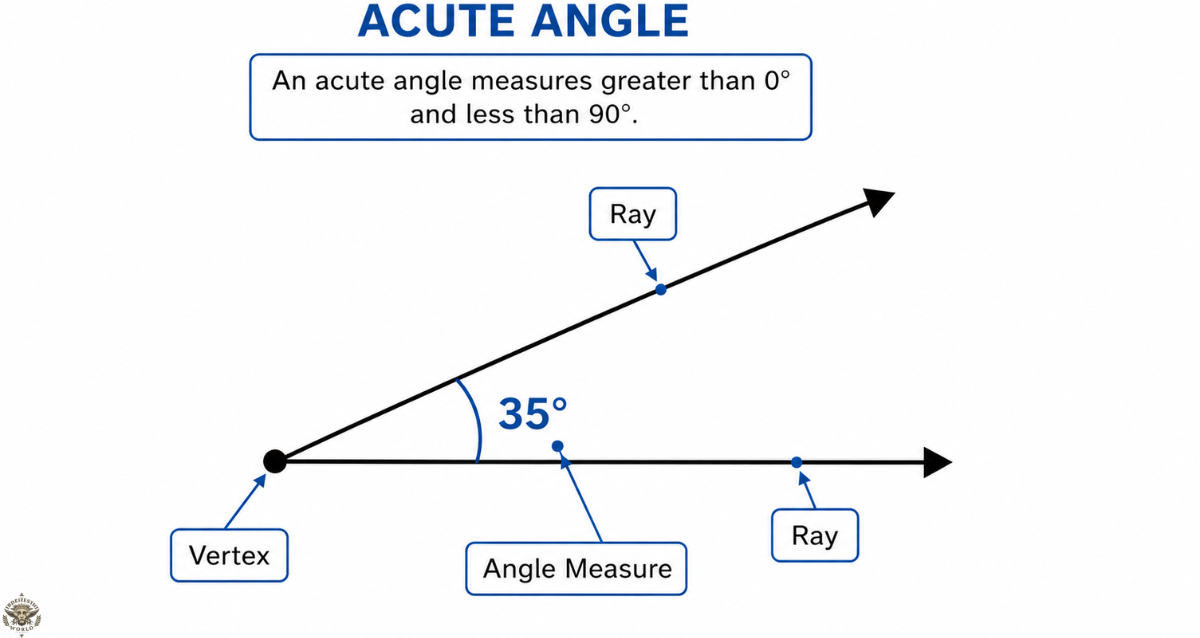
Before a student can understand an acute angle, they first need to understand what an angle actually is. An angle is formed when two rays meet at a single shared point, called the vertex. The space between these two rays, measured in degrees (°), tells us how much one ray has turned away from the other. This “amount of turn” is the real meaning behind angle measure, and it is the idea that acute angle instruction should always come back to.
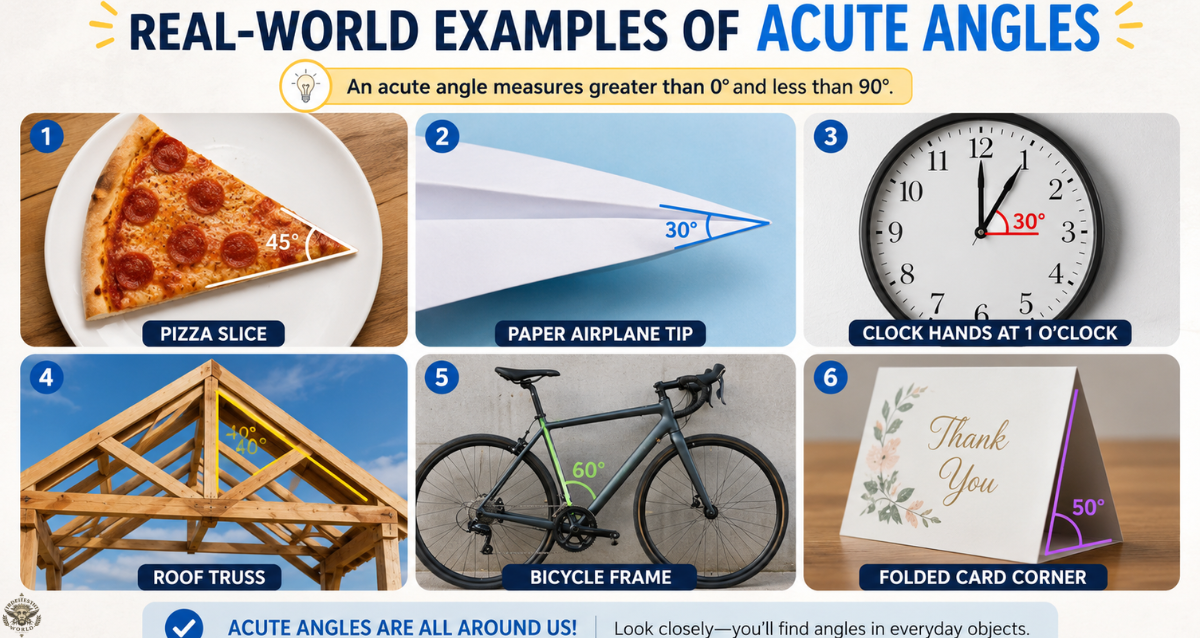
An acute angle sits at the smaller end of this scale. Any angle that measures less than 90 degrees, but more than 0 degrees, is classified as an acute angle. Picture the hands of a clock at one o’clock, or the corner of a slice of pizza cut a little thinner than usual. These are everyday pictures of an acute angle, and they help students build a mental image long before they ever pick up a protractor.
Once students grasp what an acute angle is, they usually start spotting acute angle shapes everywhere, from the tip of a folded napkin to the point of a coat hanger. This everyday noticing matters more than it seems, because a student who can point out an acute angle in the room around them is far more likely to remember the acute angle definition math class introduces later.
It also helps to place the acute angle next to its neighbors on the angle classification scale. A right angle measures exactly 90 degrees. An obtuse angle measures more than 90 degrees but less than 180 degrees. A straight angle measures exactly 180 degrees, forming a straight line. When students can see all four types of angles side by side, an acute angle becomes much easier to recognize on sight, because they are no longer memorizing a lone definition, they are comparing it against a full set of angle classification benchmarks.
Read More: Area – Meaningful Math
Why Understanding Acute Angles Is Important
Learning to identify and measure an acute angle is not just a stand-alone skill. It is one of the earliest building blocks of geometry, and it feeds directly into several other areas of math that students will meet later on.
- Classifying angles builds shape knowledge. Once a student can label an angle as acute, right, or obtuse, they can start describing polygons more precisely. A triangle made up of three acute angles is called an acute triangle, which links this single vocabulary word to a whole category of triangle classification.
- Angle comparison strengthens number sense. Estimating whether an angle looks closer to 0 degrees or closer to 90 degrees asks students to reason proportionally, the same proportional reasoning skill they will later use with fractions, ratios, and scale drawings.
- Symmetry and transformations depend on angle measure. Reflections, rotations, and other transformations in geometry all rely on an accurate sense of angle measure, and the acute angle is usually the first place students practice this kind of careful looking.
- Real-world design uses acute angle shapes constantly. Roof trusses, road signs, bicycle frames, and even the folded corner of a paper airplane all rely on acute angle shapes, giving students a reason to care about the math beyond the worksheet.
Every one of these skills traces back to the same starting point: a confident, working understanding of the acute angle. Students who can recognize an acute angle quickly and explain why it is acute tend to move through the rest of angle-based geometry with far less friction.
Identifying and Measuring Acute Angles
Spotting an acute angle starts with a simple comparison against a right angle, then gets confirmed with a protractor for an exact angle measure. This hands-on process answers what an acute angle looks like in real terms, turning the acute angle definition math class teaches into something students can see, measure, and recognize confidently across different acute angle shapes.
Using a Right Angle as a Benchmark
The fastest way for a student to identify an acute angle is to compare it against a right angle. Since a right angle measures exactly 90 degrees, any angle with less turn than a right angle is automatically an acute angle. This benchmark angle approach lets students make a quick visual judgment before they ever touch a measuring tool, which builds spatial sense and confidence at the same time.
Visual comparison is a great starting point, but it has limits. Two angles can look similar and still have different degree measures, so measuring angles with a protractor is the step that turns a guess into a fact. To measure an angle, line up the protractor’s center point with the vertex, align the baseline with one ray, and read the degree measure where the second ray crosses the scale. If that reading falls between 0 and 90 degrees, the angle is confirmed as an acute angle. If a student wants a fast answer to “what does an acute angle look like,” this benchmark method is the clearest place to start, because it gives them a physical reference instead of an abstract rule.
It is worth noting that not every narrow-looking angle is actually an acute angle once it is measured. A shape can trick the eye, especially when it is drawn at an unfamiliar angle or scaled unusually large or small on the page. That is exactly why the benchmark comparison and the protractor check should always be used together: the benchmark gives a quick first impression of an acute angle, and the protractor confirms it with an exact degree measure.
Teaching Strategies for Acute Angles
Students learn an acute angle best when they see it before they measure it, so effective teaching moves from hands-on shapes to formal angle measure step by step. These strategies build a real sense of what an acute angle looks like, ground the acute angle definition math class introduces, and help students recognize acute angle shapes with confidence, whether they’re comparing one acute angle or several acute angles side by side.
Hands-On Exploration
Formal angle measurement should never be a student’s first exposure to the acute angle. Before any numbers enter the picture, students benefit from touching, building, and sorting real angles with their hands. Give a group of students a mixed set of angles built from straws, craft sticks, pipe cleaners, or paper strips, and ask them to sort the collection into groups.
As students sort, they naturally start asking the right questions on their own: does this open wider than that one, does this angle fit inside a square corner, is this one sharper or wider than my last example. These informal comparisons are the foundation of classifying angles, and they let a student develop an intuitive feel for the acute angle definition math teachers eventually formalize with numbers. Manipulatives like these turn an abstract vocabulary word into something a student can physically hold and compare.
A useful extension of this activity is to challenge students to build their own acute angle from scratch using two craft sticks and a paper fastener. Ask them to adjust the sticks until they believe they have created an acute angle, then check their work with a right angle template or protractor. Building an acute angle themselves, rather than only sorting angles someone else made, adds a layer of ownership that helps the definition stick.
Visual Models
Once students have handled physical objects, the next step is transferring that reasoning to two-dimensional pictures. A simple paper folding activity works well here: fold a square sheet of paper in half diagonally to create a right angle template. Students can then hold that folded corner up against any drawn angle to test it.
- If the drawn angle fits neatly inside the folded corner, it is an acute angle.
- If the drawn angle sticks out past the folded corner, it is an obtuse angle.
This angle template turns an invisible standard, the 90 degree right angle, into something a student can physically carry around the room and use as a checking tool. It bridges the gap between hands-on manipulatives and formal visual models drawn on paper or displayed on a screen.
Teachers can extend this activity by asking students to draw three shapes on grid paper: one that contains only acute angles, one that contains at least one right angle, and one that contains at least one obtuse angle. Sorting their own drawings by angle type reinforces angle classification while giving students repeated, low-pressure practice spotting an acute angle in a shape they created themselves.
Abstract Reasoning
The final stage moves students from comparison toward numerical precision. Start by showing a student an angle and asking them to estimate its measure before checking with a tool. Is it closer to 0 degrees or closer to 90 degrees? This kind of estimating angles practice sharpens number sense long before a formal measurement is taken.
Next, hand students a protractor and have them measure the same angle, comparing the actual degree measure to their estimate. Over time, this routine of estimating first, then measuring, builds strong estimation skills and helps students internalize what different acute angle shapes actually look like at a glance. To deepen the reasoning even further, rotate the same angle into a new orientation and ask whether its measure has changed. This single question uncovers one of the most common misunderstandings students carry about angle measure, and it sets up the exact misconception the next section addresses about how an acute angle behaves under rotation.
Common Misconceptions About Acute Angles
Many students form the wrong picture of what an acute angle looks like once it gets rotated or resized on the page, mistaking a change in appearance for a change in angle measure. Clearing these acute angle definition math mix-ups early helps students recognize true acute angle shapes with confidence, no matter how an acute angle or acute angles are drawn.
Misconception: Rotating an Angle Changes Its Measure
Many students believe that spinning, flipping, or redrawing an angle in a new direction changes how big it is. This misconception happens because young learners tend to judge an angle by its overall appearance on the page rather than by the actual amount of turn between its two rays. A thin sliver drawn sideways can look completely different from the same angle drawn upright, even though the degree measure has not changed at all.
To correct this, have students physically rotate a paper angle and re-measure it with a protractor after each turn. When they see the same number appear every time, the idea that an angle’s measure is independent of its orientation becomes concrete rather than theoretical. This single exercise usually resolves the confusion faster than any verbal explanation could, and it reinforces the core truth behind every acute angle: its measure is fixed, no matter how it is rotated, flipped, or resized on the page.
A related misconception involves size on the page rather than rotation. Some students assume that a larger drawing of an acute angle must have a bigger degree measure than a small drawing of the same acute angle. In reality, the length of the rays has nothing to do with the angle’s measure, only the amount of turn between them does. Comparing a tiny acute angle and a large acute angle with the same degree measure, side by side, is a quick way to put this misconception to rest.
Obtuse angle
An obtuse angle is the direct opposite of an acute angle on the angle classification scale, measuring more than 90 degrees but less than 180 degrees. Where an acute angle stays narrow and sharp, an obtuse angle opens wider than a right angle, giving students a clear visual contrast once they’ve learned what an acute angle looks like.
Placing an obtuse angle next to an acute angle side by side helps students build lasting number sense around degree measure. This comparison is often the fastest way to correct confusion, since a student who can spot the difference between the two rarely mixes them up again.
Acute angle triangle
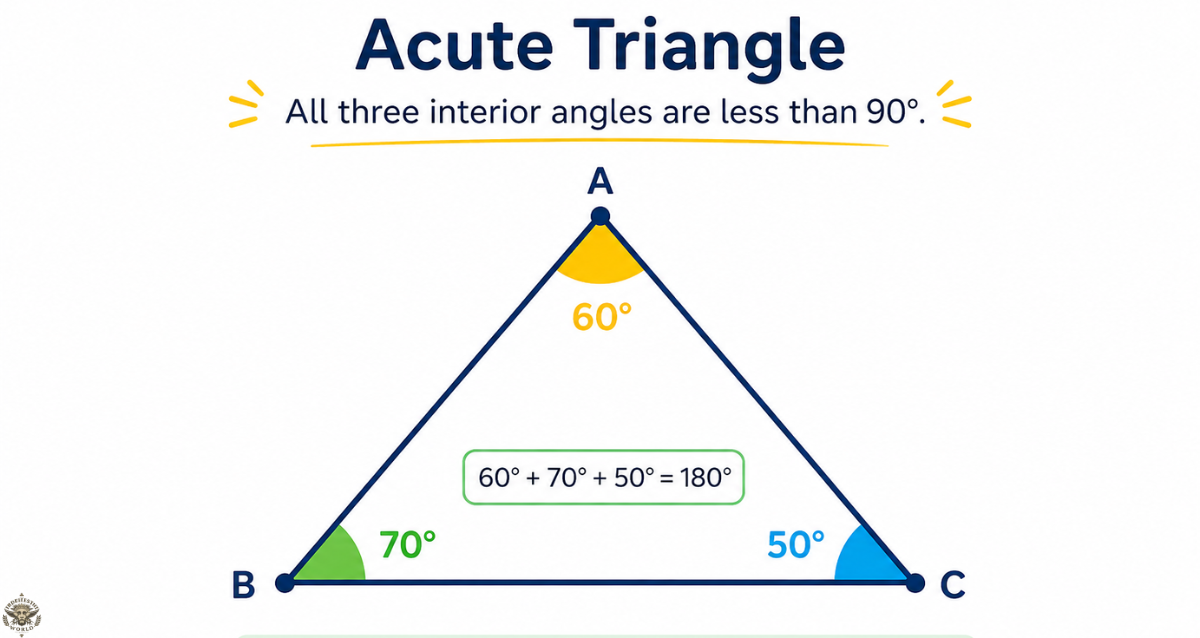
An acute triangle is any triangle whose three interior angles are all acute angles, meaning every corner measures less than 90 degrees. This connects the acute angle definition math students already know to a whole new category of shape classification, since the triangle’s name comes directly from the angles inside it.
Recognizing acute angle shapes inside a triangle takes practice, because a triangle can look balanced and still contain one angle close to 90 degrees. Measuring all three angles with a protractor is the surest way to confirm a triangle truly qualifies as an acute triangle.
Acute angle value
The value of an acute angle always falls somewhere between 0 degrees and 90 degrees, never touching either endpoint. This range is what separates an acute angle from a right angle on one side and a straight line on the other, and it’s the core idea behind the acute angle definition math teachers introduce early on.
Students often ask what an acute angle looks like at different values, and the answer changes quite a bit across the range. An angle near 10 degrees looks like a thin sliver, while one near 80 degrees looks almost square, yet both are still classified as an acute angle.
Acute angle obtuse angle
Comparing an acute angle and an obtuse angle side by side is one of the clearest ways to teach angle classification. The acute angle stays under 90 degrees, while the obtuse angle stretches past it, so lining the two up against a right angle benchmark makes the difference easy to see at a glance.
This comparison also builds proportional reasoning, since students start estimating how far an angle sits from 90 degrees rather than guessing at random. Over time, distinguishing an acute angle from an obtuse angle becomes second nature, especially once students have measured a few real examples with a protractor.
Acute angle properties
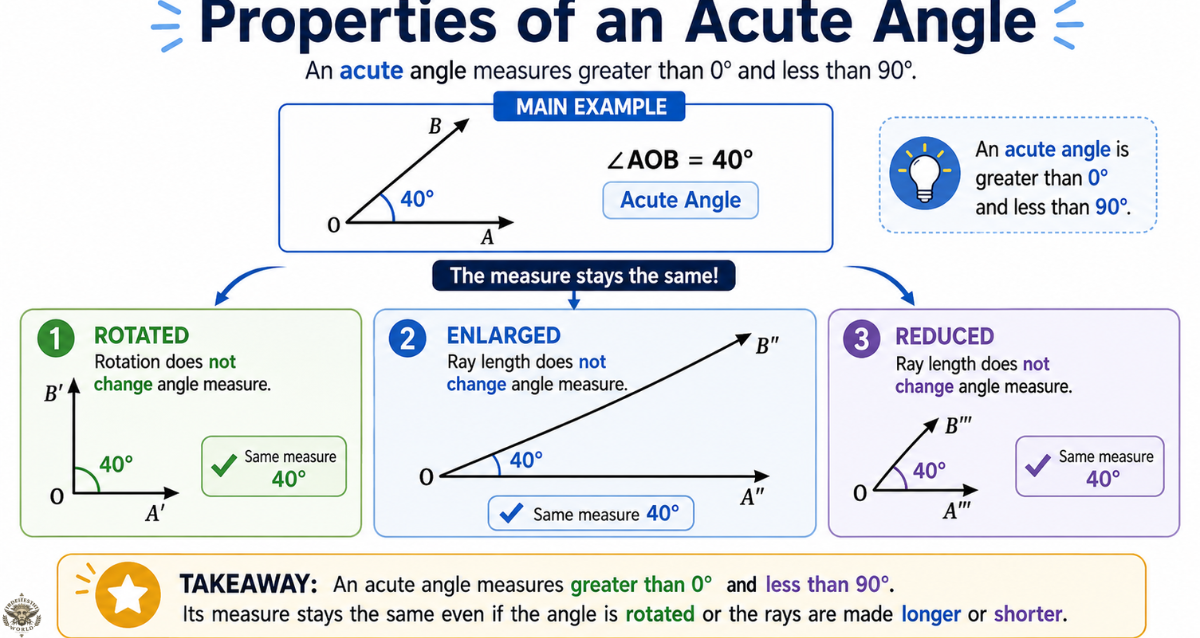
An acute angle carries a few defining properties: its measure sits strictly between 0 and 90 degrees, it forms a narrower opening than a right angle, and its size stays fixed no matter how the angle is rotated or resized on the page. These properties are what make an acute angle easy to identify once a student knows what to look for.
Understanding these properties also supports shape work later on, since an acute angle inside a polygon behaves the same way it does on its own. A sharp corner in a triangle, a star, or an arrow all follow the same rule, which is exactly why acute angle shapes appear so often in geometry.
Acute angle example
A slice of pizza cut thinner than a quarter, the tip of a paper airplane, or the hands of a clock at two o’clock are all everyday examples of an acute angle. Each one shows a narrow opening between two rays, giving students a real-world picture to hold onto before they see the formal acute angle definition math class introduces.
Working through several examples side by side also helps students answer what an acute angle looks like in different contexts, from drawings on paper to angles they notice around a classroom. The more examples a student sees, the faster they learn to spot acute angle shapes without needing a protractor first.
Acute Angle opposite
The direct opposite of an acute angle on the classification scale is the obtuse angle, which opens wider than 90 degrees instead of narrower. Thinking in opposites like this gives students an anchor point, since every acute angle can be described by how much smaller it is than a right angle.
This opposite relationship also reinforces angle measure as a whole, because students start to see the full range of angles as one connected scale rather than separate, unrelated categories. Once that connection clicks, identifying an acute angle becomes a matter of comparison rather than memorization.
Acute angle diagram
A clear diagram is often the fastest way to teach an acute angle, since it shows the vertex, the two rays, and the degree measure all in one picture. Labeling each part of the diagram helps students connect the visual shape to the formal acute angle definition math relies on.
Diagrams also make it easy to demonstrate acute angle shapes in different positions and sizes, reinforcing that rotation and scale never change the measure. A well-labeled diagram, paired with a real protractor reading, gives students both the picture and the proof behind every acute angle they encounter.
Frequently Asked Questions
Which is an obtuse angle?
An obtuse angle is any angle that measures more than 90 degrees but less than 180 degrees, opening wider than a right angle without forming a straight line.
What are 7 types of angles?
The seven common types are acute, right, obtuse, straight, reflex, full, and zero angles, each defined by a specific range or exact degree measure.
What are the 4 types of angles?
The four basic types are acute, right, obtuse, and straight angles, which together cover the full range from 0 to 180 degrees.
What is the name of a 360-degree angle?
A 360-degree angle is called a full angle or complete angle, since it represents one full rotation back to the starting point.
Why is it called obtuse?
The name comes from the Latin word “obtusus,” meaning blunt or dull, which fits since an obtuse angle looks wider and less sharp than an acute angle.
Conclusion
Learning to recognize an acute angle is one of those small skills that quietly supports a student’s entire geometry journey. Once they can spot a narrow angle, compare it to a right angle, and confirm it with a protractor, they’ve built a foundation they’ll lean on again and again, from classifying triangles to reasoning about shapes and symmetry.
More than anything, this concept works best when it’s discovered rather than simply told. Give students real objects to sort, drawings to fold and compare, and plenty of chances to estimate before they measure, and the idea will stick far longer than any memorized rule ever could.

