

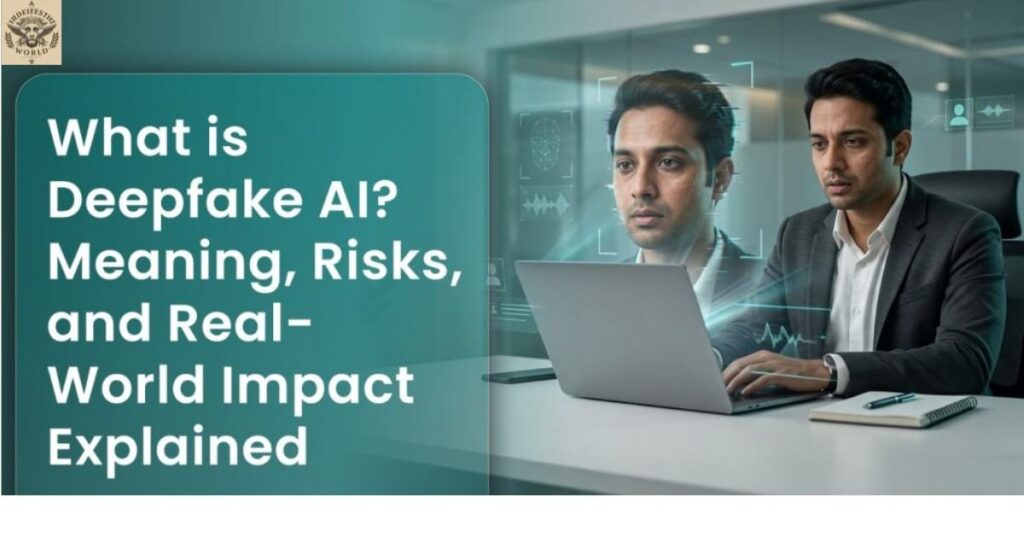
Artificial intelligence is changing the way people create and share digital content. Today, AI tools can generate realistic pictures, copy voices, Deepfake Meaning and produce videos that look as if real people said or did something. Some of these creations are called deepfakes.
Understanding deepfake meaning in Urdu helps people recognize manipulated media and avoid being misled by fake videos, images, or audio recordings. Deepfakes can be created for entertainment, education, filmmaking, and creative projects. However, they can also be used to spread misinformation, impersonate people, and commit fraud.
In this guide, the meaning of deepfake is explained in simple English and Urdu. It also covers how deepfakes work, common examples,Deepfake Meaning their advantages and disadvantages, and practical ways to identify suspicious content online.
What Is the Meaning of Deepfake?
A deepfake is an image, video, or audio recording created or altered with artificial intelligence to make a person appear to say or do something that did not actually happen. The technology can imitate a person’s face, voice, expressions, or movements.
For example, a manipulated video might show a famous actor speaking words that the actor never said. Another example could be an audio recording that sounds like a family member asking for money, even though that person never made the call.
The term combines the words “deep learning” and “fake.” Deep learning is a type of machine learning used in many AI systems, while fake refers to something false or misleading. However, not every AI-generated image or edited video is automatically a deepfake. The term is generally used for realistic synthetic or manipulated media, particularly when it imitates a real person.
Deepfake Meaning in Urdu
In simple Roman Urdu, deepfake ka matlab hai AI ki madad se kisi shakhs ki aisi fake video, tasveer ya awaaz banana jo bilkul asli lag sakti hai,Deepfake Meaning lekin us shakhs ne asal mein woh kaam nahi kiya hota ya woh alfaaz nahi kahe hote.
Misal ke taur par, agar kisi shakhs ki video edit karke usay aisi baat kehte hue dikhaya jaye jo us ne kabhi nahi kahi, to yeh deepfake ho sakti hai. Isi tarah, kisi ki awaaz ki naqal karke fake phone call banana bhi deepfake technology se related ho sakta hai.
Simple Urdu example: Agar kisi mashhoor shakhs ki AI-generated video mein usay kisi product ki tareef karte hue dikhaya jaye, lekin us ne asal mein us product ki endorsement na ki ho, to video logon ko gumrah kar sakti hai.
What Does Deepfake Mean in Simple English?
In simple English,Deepfake Meaning a deepfake is fake or altered media that uses AI to make a person or event appear real. It can change a person’s face in a video, copy a voice, or create a realistic scene that never happened.
For example, imagine receiving a video of a friend saying something unusual. The video looks real, but the friend never recorded it. If AI was used to imitate the friend’s appearance or voice, the clip may be a deepfake.
The important point is that realistic-looking media is not always genuine. People need to consider where a video came from, Deep fake Meaning whether the person has confirmed it, and whether trustworthy sources support the claim.
Read More: Prompt Meaning in AI: Definition, Examples, Types, and How It Works
How Does Deepfake Technology Work?
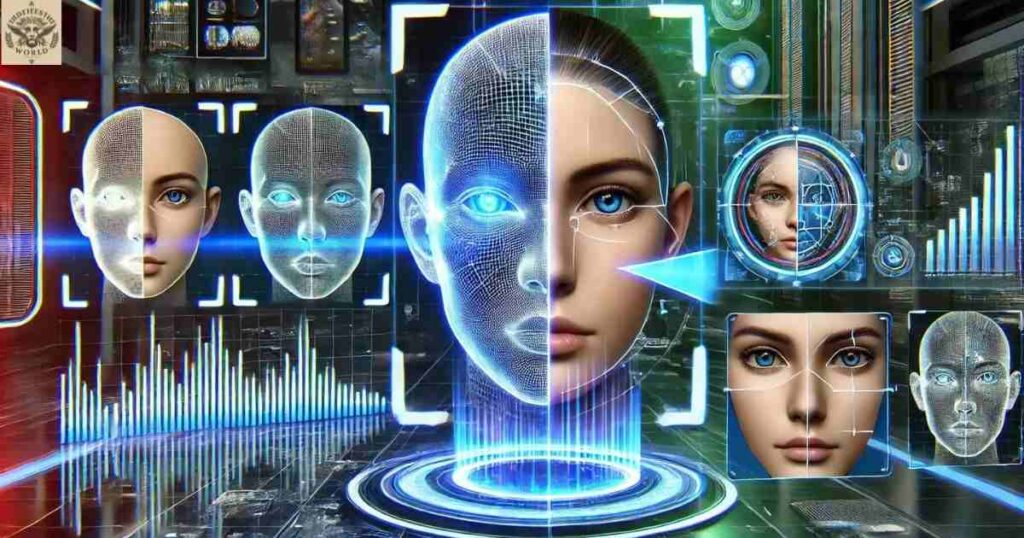
Deepfake technology uses AI models trained or configured to generate or manipulate digital content. Depending on the method,Deepfake Meaning a system may learn patterns in facial appearance, speech, expressions, or movement and use those patterns to create convincing synthetic media.
Some deepfake systems replace one person’s face with another in a video. Others generate speech that resembles a target voice or synchronize artificial speech with a moving face. More advanced systems can produce entirely synthetic people who do not exist in real life.
The quality of the result depends on the model, the available data, the input quality, and the techniques used. Some manipulated media contain visible mistakes, while other examples can be difficult to identify just by looking at them.
Collecting or Providing Input Data
A creator may provide photographs,Deepfake Meaning video clips, or voice recordings, depending on the intended result and the tool. Some systems can also generate synthetic people or voices without directly copying a specific individual.
Using someone’s personal images or voice without permission can raise serious privacy, consent, and legal concerns.
Training or Generating With AI
The AI system processes relevant information and generates or changes parts of the content. For instance, it may produce facial movements,Deepfake Meaning imitate speech patterns, or create a new visual scene.
Not every deepfake tool trains a new model from scratch. Many use existing models or software designed for a particular type of generation.
Editing and Combining Media
The generated elements may be combined with a video, image, or audio recording. The creator might adjust lighting, facial movement, timing, Deepfake Meaning or sound to make the result appear more natural.
Producing the Final Content
The final result may look like an ordinary video or sound recording. Viewers who do not know it has been altered might believe it shows a genuine event, especially if it is shared without context.
This is why understanding deepfake meaning in Urdu is useful for people who regularly watch videos and receive voice messages on social media.
Common Types of Deepfakes
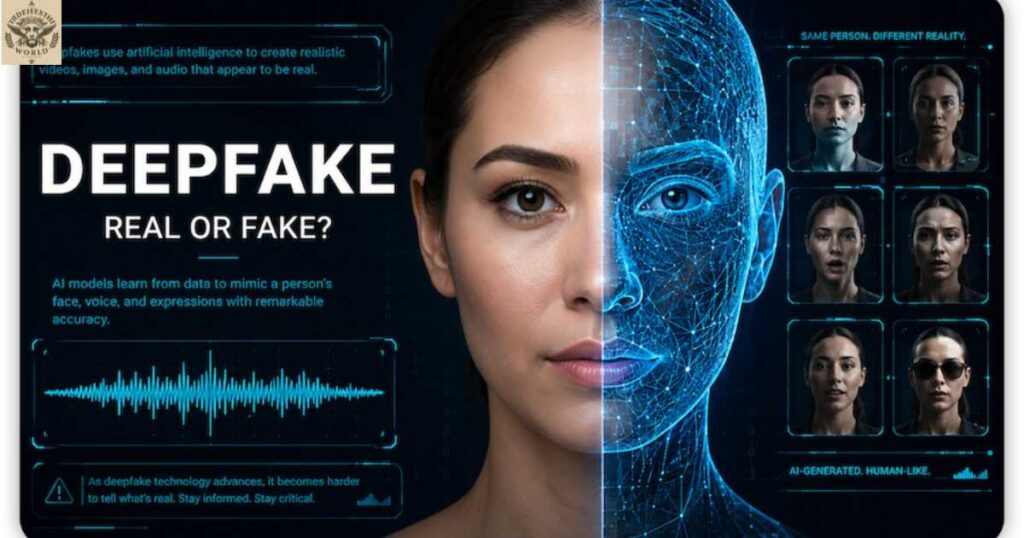
Deepfakes can take several forms. Each type can be used for harmless creative purposes or for harmful impersonation and deception.
Deepfake Videos
Deepfake videos manipulate a person’s face, expressions, voice, or movements. They may show someone appearing to deliver a speech, attend an event, or participate in a conversation that never happened.
For example, a fake video might show a public figure announcing a new policy. Before believing or sharing it, viewers should check whether reliable news outlets or official accounts have confirmed the announcement.
Deepfake Audio
Deepfake audio uses AI-generated or manipulated speech to imitate a voice. A recording may sound like a friend, relative, business owner, or public figure.
One dangerous example is a fake emergency call in which someone imitates a family member and asks for urgent financial help. A familiar voice alone is not proof that the caller is genuine.
Deepfake Images
AI can generate or manipulate realistic images of people in situations that never occurred. These images may be shared as supposed photographs of real events.
For example, a fake image could appear to show a celebrity attending an event they never visited. Reverse image searches and reliable reporting may help establish the image’s context, although neither method always provides a definitive answer.
Face Swapping
Face swapping replaces a person’s face with another person’s face in a picture or video. It may be used in films, comedy, visual effects, and creative projects.
However, using another person’s face to mislead viewers, damage their reputation, or create intimate content without consent can cause serious harm.
AI-Generated Digital Characters
Some AI tools generate realistic virtual people who do not exist. These characters can be used in advertisements, games, entertainment, and training videos.
A synthetic character is not necessarily a deep fake of a real individual. The distinction matters because a completely fictional person and an impersonation of a real person raise different concerns.
Real-Life Examples of Deepfakes
Deepfakes are easier to understand when their possible uses are explained through everyday situations.
Example 1: A fake celebrity endorsement
A video appears to show a famous actor recommending an investment scheme. The actor never made the endorsement, and the clip was generated or altered using AI. Viewers who trust the video could lose money.
Example 2: A cloned family voice
Someone receives a phone call that sounds like a relative asking for an urgent money transfer. Instead of acting immediately, the recipient contacts the relative through a known phone number to confirm the situation.
Example 3: A misleading political video
An edited video makes it appear that a politician made an offensive statement. The original footage or reliable reporting may reveal that the clip was manipulated or taken out of context.
Example 4: A film production
A production team uses permitted digital effects to recreate a younger version of an actor for a scene. When used transparently and with appropriate consent, this can be a legitimate creative application.
These examples show that deepfake technology itself is a tool. Its impact depends on how it is created, used, and presented to other people.
Advantages and Disadvantages of Deepfake Technology
Deepfake technology has both positive and negative applications. Understanding both sides helps readers evaluate its impact instead of assuming that every use is harmful.
Advantages of Deepfakes
- Film and entertainment: Digital effects can help filmmakers create fictional scenes or recreate certain appearances.
- Education and training: Synthetic videos can demonstrate situations that would otherwise be difficult or expensive to record.
- Creative projects: Artists can experiment with virtual characters, animation, and digital storytelling.
- Language and accessibility tools: Certain synthetic speech technologies can support dubbing, narration, and accessible media when used responsibly.
- Historical storytelling: Authorized digital recreations may help explain historical events, provided they are clearly identified as synthetic.
Disadvantages of Deepfakes
- Misinformation: Fake videos can make it appear that a person said or did something that never happened.
- Financial fraud: Voice imitation and fake video calls can be used to deceive individuals or businesses.
- Reputational harm: Manipulated media can damage someone’s reputation and personal relationships.
- Privacy violations: A person’s face or voice may be used without permission.
- Non-consensual intimate imagery: Deepfake technology can be abused to create sexual images or videos of people without their consent.
- Loss of trust: Widespread synthetic media can make people doubt genuine photographs, recordings, and news reports.
Responsible use requires consent, transparency, respect for privacy, and appropriate safeguards against deception.
Deepfakes and Online Scams
One of the biggest concerns surrounding deepfakes is their use in scams. Criminals can combine synthetic voices, manipulated videos,Deepfake Meaning fake profiles, and persuasive messages to make a fraudulent request appear legitimate.
Common Deepfake Scams
Fake emergency calls: A scammer imitates a relative’s voice and claims to need money urgently.
Fake investment promotions: A video appears to show a trusted celebrity or financial expert endorsing an investment that may actually be fraudulent.
Business impersonation: Someone receives a convincing audio or video message that appears to come from a manager requesting a payment or confidential information.
Fake news clips: Manipulated recordings are shared to influence opinions or create confusion about a public event.
How to Protect Yourself
- Verify unusual requests through a separate, trusted communication channel.
- Never transfer money simply because a familiar voice or face appears on a call.
- Confirm investment opportunities through official sources.
- Avoid clicking suspicious links or sharing verification codes.
- Report suspected impersonation to the relevant platform or organization.
- Discuss a family verification phrase or another safe method for confirming urgent requests.
A video call or voice recording should not be treated as absolute proof of identity. Independent verification is especially important when money,Deepfake Meaning account access, or private information is involved.
How to Identify a Deepfake Video
Some deepfakes contain visible inconsistencies, but modern AI-generated content can look convincing. No single visual clue can reliably identify every manipulated video.
Check Facial Movements
Look for unnatural facial expressions, inconsistent mouth movements, or unusual transitions between expressions. These can be warning signs,Deepfake Meaning but genuine recordings can also contain visual distortions.
Listen to the Voice
Pay attention to unusual pauses, inconsistent pronunciation, strange changes in tone, or speech that does not match the visible mouth movements. However,Deepfake Meaning high-quality synthetic audio may not contain obvious problems.
Examine Lighting and Background Details
Look for inconsistent shadows, strange edges around a face, or objects that change unexpectedly between frames. Compression and poor lighting can also produce these effects, so they are not conclusive evidence.
Find the Original Source
Search for the earliest available version of the video. Check whether the person involved, their official organization, or reliable news outlets have confirmed the event.
Use Reverse Image Search
A screenshot from a suspicious video can sometimes be checked through a reverse image search to find earlier appearances or related reporting. This can help establish context, although it may not detect sophisticated manipulation.
Use Detection Tools Carefully
Some tools analyze images, audio, or video for signs of synthetic generation. Their results can be wrong, particularly when content has been compressed, edited, or produced with newer models. Treat detection scores as supporting evidence rather than a final verdict.
Deepfake vs. Real Video
A real video generally records an actual scene, although it can still be edited, taken out of context, or misleadingly presented. A deepfake is generated or manipulated with AI to imitate a person or event in a way that may misrepresent reality.
| Feature | Genuine video | Deepfake video |
| Source | Records an actual scene or event | Contains AI-generated or manipulated elements |
| Face and voice | Usually reflects the recorded person | May imitate another person’s face or voice |
| Context | Can still be misleading when edited | May depict words or actions that never occurred |
| Verification | Check the source and original context | Check the source, context, and possible manipulation |
| Reliability | Not automatically trustworthy | Requires careful verification |
This comparison is a general guide, not a perfect detection method. A genuine video can be deceptive, and a high-quality deepfake may show no obvious visual errors.
Is Deepfake Technology Legal?
The legality of deepfake creation and distribution depends on the country, the purpose, the content, and the circumstances. Some uses may be lawful,Deepfake Meaning such as authorized visual effects or clearly disclosed satire. Other uses can violate privacy, intellectual property, harassment, fraud, election, or intimate-image laws.
Deepfake Rules in the United States
In the United States, the legal treatment of deepfakes varies by state and by the conduct involved. Fraud, impersonation, Deepfake Meaning certain non-consensual intimate imagery, and other harmful uses may be covered by federal or state laws. Specific rules and available remedies depend on the facts and the applicable legislation.
Deepfake Rules in the United Kingdom
In the United Kingdom, certain harmful deepfake uses may fall under laws relating to fraud, privacy, harassment, or sexually explicit imagery. The applicable law depends on the content and circumstances,Deepfake Meaning and legal protections can change as legislation develops.
Anyone affected by a deepfake should preserve relevant evidence, report the content to the platform, and consider seeking advice from a qualified legal professional or appropriate support service.
How to Report a Deepfake
If someone creates or shares a deepfake to impersonate, threaten, exploit, or defraud a person, the following steps may help:
- Save relevant evidence, such as links, screenshots, dates, and account details, where it is safe and lawful to do so.
- Report the content using the platform’s impersonation, manipulated media, harassment, or privacy-reporting options.
- Contact the impersonated person’s organization or official account when appropriate.
- If financial fraud is involved, contact the bank or payment provider promptly.
- Report serious threats or suspected crimes to the relevant local authorities.
- Seek specialist support if the content involves intimate imagery, harassment, or threats.
Avoid resharing harmful material simply to warn others, as doing so can spread it further and increase the harm to the person targeted.
Deepfake Meaning in Urdu: Common Words and Related Terms
Readers searching for deepfake meaning in Urdu may also want to understand related AI and media terms.
| Term | Simple meaning |
| Artificial intelligence | Technology that performs tasks associated with human intelligence |
| Deep learning | A machine-learning approach that uses multiple layers of computation |
| Face swapping | Replacing one person’s face with another in an image or video |
| Voice cloning | Generating speech that imitates a person’s voice |
| Synthetic media | Content generated or substantially altered using digital tools or AI |
| Misinformation | False or inaccurate information, whether shared intentionally or unintentionally |
| Disinformation | False information deliberately spread to mislead people |
| Digital manipulation | Changing digital content using software or other tools |
These terms are related but do not all mean the same thing. For example, voice cloning is a technique that can be used in a deepfake,Deepfake Meaning while synthetic media is a broader category that includes many types of AI-generated content.
Frequently Asked Questions
What Is Deepfake Meaning in Urdu?
Deepfake ka Urdu meaning hai AI ki madad se banayi ya badli gayi aisi fake tasveer, video, ya awaaz jo asli lag sakti hai. Isay bhi kaha ja sakta hai.
How Does a Deepfake Work?
A deepfake uses AI to generate or manipulate visual or audio content. Depending on the technique, it may imitate a person’s face, voice, expressions, or movements to create realistic-looking media.
Are All Deepfakes Dangerous?
No. Deepfakes can be used for entertainment, filmmaking, education, and creative projects with appropriate consent. They become harmful when used for fraud, deception, harassment, or non-consensual content.
How Can Someone Recognize a Deepfake?
Check the original source, look for inconsistencies, compare the content with reliable reports, and verify unusual requests through another communication channel.
Can Deepfakes Be Used for Scams?
Yes. Criminals may use cloned voices, manipulated videos, or fake endorsements to trick people into sending money or sharing private information.
Conclusion
Understanding deep fake meaning in Urdu helps people recognize the difference between authentic recordings and AI-generated or manipulated media. Deep fakes can support creative work, entertainment, and education, Deep fake Meaning but they can also be used to spread false information, imitate real people, and commit scams.
The safest approach is to check the original source, verify surprising claims, protect personal information, and avoid trusting a video or voice recording simply because it looks or sounds real. As AI technology continues to improve, digital awareness and responsible sharing will become increasingly important.

