

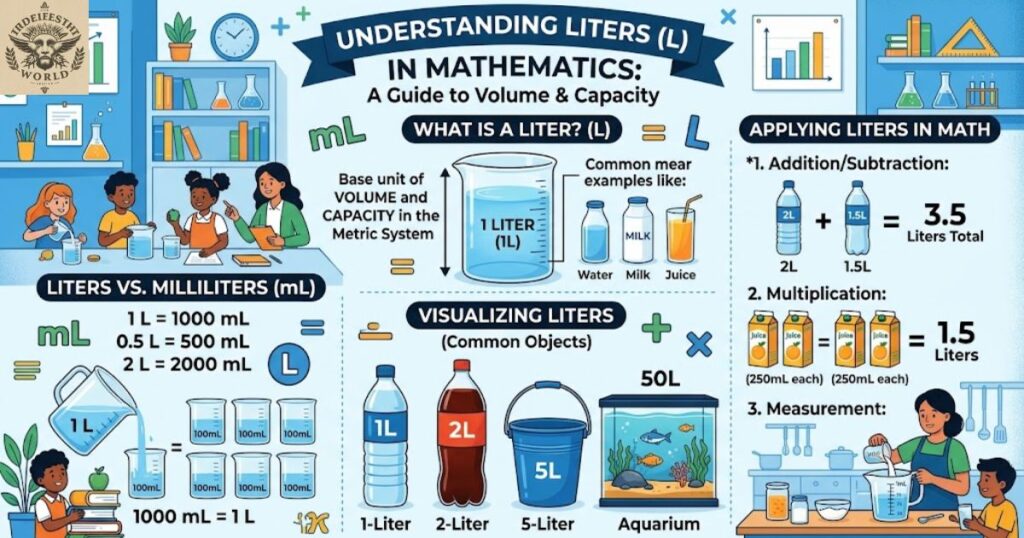
Liters in Mathematics A liter is a standard unit used to measure volume, or the amount of space a substance takes up, most commonly liquids. If you’ve ever asked what is a liter, picture a large water bottle most hold about 2 liters, giving a familiar, everyday sense of the unit’s size. Wondering how big is a liter in more concrete terms? It’s roughly the same volume as a standard carton of milk found in most grocery stores, making it easy to visualize even without a measuring tool in hand.
Within the metric system, liters connect directly to smaller units called milliliters, with 1 liter equal to exactly 1,000 milliliters. This relationship makes liters ideal for measuring larger quantities of liquid like a full water jug while milliliters handle smaller amounts, such as a spoonful of medicine. This guide walks through why understanding liters matters, how to teach the concept effectively, common mix-ups students run into, and answers to the most frequently searched questions about this everyday measurement unit.
Why Is Understanding Liters Important?
Learning about liters supports several core mathematical ideas tied to measurement and number relationships. First, students build an understanding of volume as something that can be measured and compared using standard, consistent units, rather than relying on guesswork or visual appearance alone.
Working with liters also reinforces the base-ten structure of the metric system, since converting between liters and milliliters directly connects to place value and decimal reasoning students encounter elsewhere in math. Because the metric system scales in powers of ten, this connection makes liters a particularly useful entry point for decimal understanding.
Beyond the classroom, understanding liters supports real-world estimation and problem-solving. Liquid measurements show up constantly in recipes, science experiments, and packaged beverages, giving students countless everyday opportunities to apply and reinforce what they’ve learned a soda bottle label is often the simplest example of a liter a student will see in a single day.
Teaching Strategies to Develop Understanding of Liters

Building a genuine understanding of liters works best when instruction moves from hands-on experience toward more abstract reasoning, rather than jumping straight into conversions and formulas. Giving students opportunities to see, pour, and compare real liquid volumes before introducing decimal relationships helps the concept stay grounded in something tangible, making later topics like unit conversion and decimal operations feel like a natural extension of what they already understand rather than a completely new set of rules.
Use Hands-On Measurement Activities
Physical, hands-on experiences help students build an intuitive feel for exactly how big is a liter in real terms. Giving students measuring cups, pitchers, and containers of water, then asking them to estimate a container’s volume before pouring it into a 1-liter measuring cup, lets them compare their guesses to the actual amount and adjust their sense of scale accordingly.
Use Familiar Objects as Benchmarks
Relatable, everyday objects make the abstract concept of a liter far easier to visualize, especially for students still asking what is a liter in practical terms. Showing students common items that hold roughly 1 liter a carton of milk, a large water bottle, or a soda bottle gives them a mental liter example to compare against, helping them estimate whether other containers hold more or less than that same benchmark.
Read More: Understanding Fractions
Connect Liters to Real-World Contexts
Real-life scenarios highlight the practical value of measurement in daily life. Presenting a situation where students must calculate how many liters of juice are needed for a party, or how many 1-liter bottles it would take to fill a much larger container, gives students an example of a liter being applied to solve an actual, relatable problem. This kind of task also naturally reinforces how big is a liter feels in a real setting, since students are picturing actual bottles rather than abstract numbers.
Connecting Liters to Decimal Understanding

This decimal work often begins with a simple liter example, since it’s easier to picture a fraction of something familiar. Because the metric system is built entirely on powers of ten, working with liters creates a natural, meaningful context for learning decimals. Since 1 liter equals 1,000 milliliters, students can express smaller volumes as decimal fractions of a liter for instance, 500 milliliters becomes 0.5 liters, and 250 milliliters becomes 0.25 liters, giving decimal practice a concrete, real-world anchor. Students may also practice decimal addition by combining volumes, such as adding 1.75 liters and 2.5 liters together, building comfort with decimal operations through a context they can visualize.
Common Misconceptions and Challenges About Liters
Even after solid instruction, certain misunderstandings about liters tend to resurface, usually because students fall back on visual intuition or whole-number habits instead of applying what they’ve actually measured. Spotting these common trouble areas ahead of time makes it much easier to address them directly, rather than letting a shaky grasp of volume carry over into more advanced measurement and conversion problems later on.
Confusing Volume With the Size or Shape of a Container
Students often assume a taller or wider container automatically holds more liquid, even when two differently shaped containers actually share the same capacity. A tall, narrow bottle might visually appear to hold more than a short, wide one, despite both containers holding exactly 1 liter. This misconception happens because students tend to rely on visual appearance rather than actual measurement when reasoning about volume. Pouring the same amount of liquid into differently shaped containers, and letting students observe that the quantity stays constant regardless of shape, helps correct this misunderstanding directly.
Assuming Larger Numbers Always Mean Larger Quantities
When comparing values like 900 milliliters and 1 liter, students frequently assume 900 milliliters is the larger quantity simply because 900 is a bigger number than 1. This reflects a common whole-number reasoning habit that doesn’t account for differing units. Showing the conversion directly 900 mL equals 0.9 L and reinforcing it with visual models helps students see the true relationship between the two values clearly.
Liters In Mathematics Formula
Once students understand what is a liter, applying formulas becomes much easier. The core liters in mathematics formula for converting between units relies on the fact that 1 liter equals 1,000 milliliters, meaning any conversion simply involves multiplying or dividing by 1,000 depending on the direction. For volume calculations involving rectangular containers, the formula length × width × height gives volume in cubic units, which can then be converted into liters using standard metric relationships a straightforward liter example worth practicing with real container dimensions.
Understanding these formulas gives students a reliable method for solving both simple unit conversions and more complex volume problems involving real containers, connecting arithmetic directly to practical measurement tasks they’ll encounter regularly.
How Many Liters In Mathematics
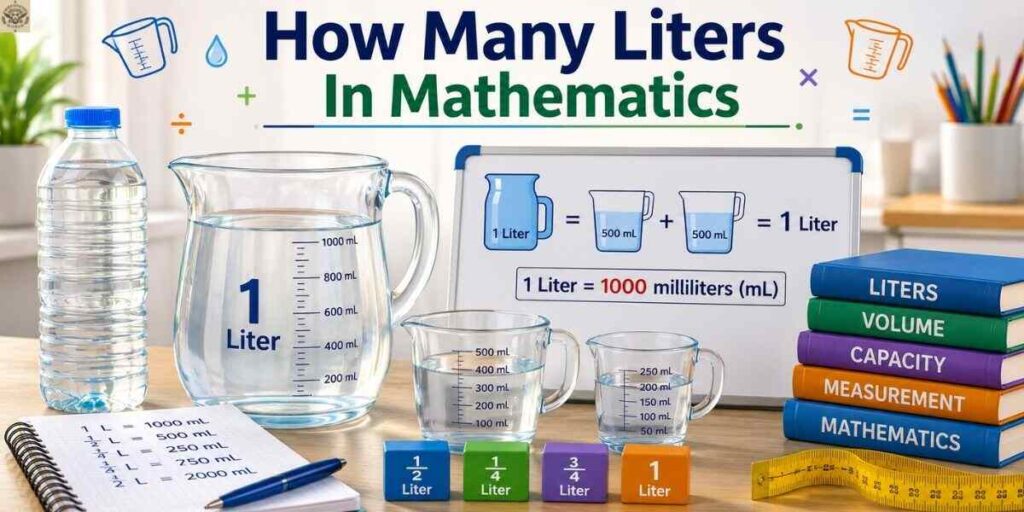
For students still solidifying what is a liter, answering how many liters in mathematics problems typically involves converting between metric units or calculating the total volume of a given container. For example, if a tank holds 5,000 milliliters, dividing by 1,000 shows it holds exactly 5 liters a simple liter example students will repeat often across various measurement problems.
These conversion problems also appear in word problems involving multiple containers, such as calculating the total volume when combining several smaller containers into one larger amount, reinforcing both addition and unit conversion skills simultaneously.
1 Liter Ml
Understanding that 1 liter ml conversion means exactly 1,000 milliliters is one of the most frequently used metric relationships in everyday math. This single fact underlies nearly every liquid measurement conversion students will encounter, from recipes to science labs.
Practicing this conversion in both directions converting liters to milliliters and milliliters back to liters helps solidify the relationship as an automatic, memorized fact rather than something that needs to be recalculated every time, which speeds up problem-solving considerably.
100 Liters In Mathematics
A quantity like 100 liters in mathematics is a useful example of a liter scaled up dramatically, and it often appears in scenarios involving larger containers, such as water tanks, swimming pools, or bulk liquid storage. Converting this value shows that 100 liters equals 100,000 milliliters, illustrating how quickly volume totals scale up in the metric system.
Working with larger quantities like this also helps students practice multiplying and dividing by powers of ten, reinforcing the same base-ten thinking that underlies the entire metric measurement system.
Liter Symbol
Once students know how big is a liter, recognizing its symbol becomes easier too. The standard liter symbol used in mathematics and everyday measurement is a lowercase “L,” though an uppercase “L” is also widely accepted internationally to avoid confusion with the number 1. This symbol appears on product labels, recipes, and scientific instruments alike.
Learning to recognize and correctly use the liter symbol helps students read real-world measurements accurately, whether they’re checking a beverage label or interpreting data in a science class, reinforcing the connection between classroom math and everyday life.
Liters In Mathematics Calculator
Checking a liter example by hand first, and then confirming it with a tool, builds trust in the process. A liters in mathematics calculator is a helpful tool for quickly converting between liters, milliliters, and other volume units without manual calculation. These calculators are especially useful for checking homework or solving more complex, multi-step conversion problems accurately.
While calculators speed up the process, understanding the underlying conversion logic remains essential, since students need to recognize whether an answer from a liters in a mathematics calculator makes logical sense based on their own estimation skills.
Liter Or Litre Meaning

The liter or litre meaning is identical both spellings refer to the exact same unit of volume, with the difference simply coming down to regional spelling conventions. “Liter” is the standard American English spelling, while “litre” is used throughout the UK, Canada, and most other English-speaking countries.
Regardless of spelling, both versions represent the same measurement value and are used interchangeably in international science and math contexts, so students shouldn’t be confused if they encounter either spelling in different textbooks or resources.
Litre Measurement
Knowing how big is a liter in advance helps students choose the right tool. A litre measurement is typically taken using tools like measuring cups, graduated cylinders, or marked containers designed specifically for liquid volume. These tools allow for precise readings, which is especially important in contexts like cooking, science experiments, or industrial settings.
Accurate litre measurement also depends on reading the container at eye level and checking the bottom of the liquid’s curve, known as the meniscus, for the most precise result a small but important detail that helps prevent measurement errors in more advanced science and math applications.
Frequently Asked Questions
What is a liter?
What is a liter is one of the most common questions in early metric lessons it’s the base unit for measuring liquid volume, equal to 1,000 milliliters.
What is 1 litre equal to?
1 litre is equal to 1,000 milliliters, making it the standard base unit for measuring liquid volume in the metric system.
What is 1 litre in numbers?
1 litre is simply written as “1 L” or “1,000 mL” when expressed in its equivalent smaller unit.
How do you write 1/2 litre?
Half a litre is written as 0.5 L or 500 mL, both representing the exact same volume of liquid.
What is 1 liter in metric?
1 liter is the base metric unit for liquid volume, equal to 1,000 milliliters or 0.001 cubic meters.
How to calculate 1 liter?
One liter equals 1,000 cubic centimeters, so multiplying length, width, and height in centimeters that total 1,000 gives exactly 1 liter.
Conclusion
Liters are a fundamental unit for measuring volume, and once students can confidently answer what is a liter and picture how big is a liter really is, appearing constantly in everyday situations from cooking and shopping to science experiments and classroom math problems. Understanding what is a liter, recognizing how big is a liter through familiar objects, and practicing conversions between liters and milliliters all build a strong foundation for both metric measurement and decimal reasoning.
Common misconceptions, like assuming a taller container always holds more liquid or confusing larger numbers with larger quantities, are easy to correct once students see real, hands-on comparisons. Whether working through a liter example, exploring an example of a liter in daily life, or using a conversion calculator, or applying a liters in mathematics formula to solve a word problem, the underlying concept remains consistent and practical. With repeated exposure to real containers, decimal practice, and everyday measurement tasks, this unit becomes an intuitive and lasting part of every student’s math toolkit.

