

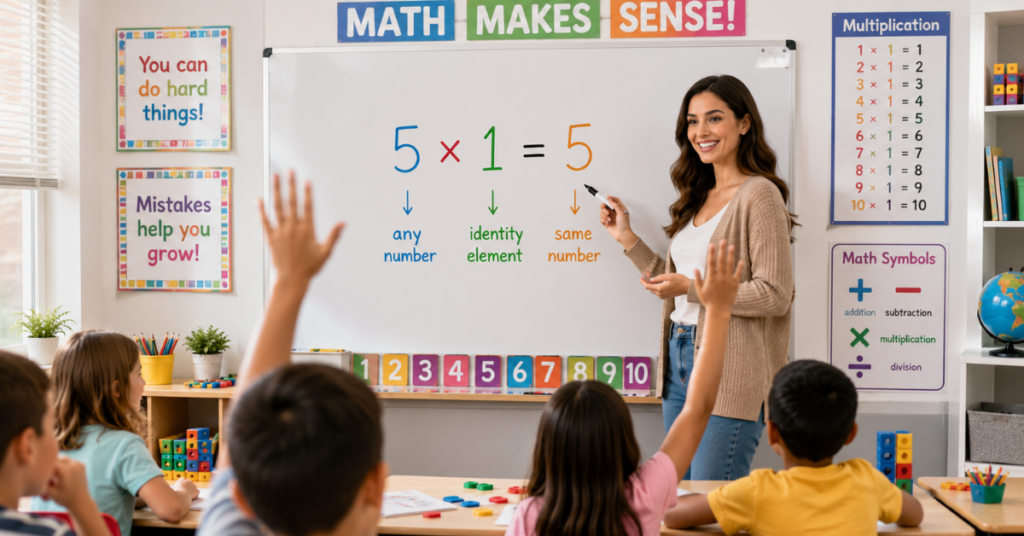
The identity property of multiplication sits at the center of how young learners understand multiplication as a whole. When a student multiplies any number by one, that number keeps its value exactly as it was, and this simple rule opens the door to real number sense rather than rote memorization. Instead of treating one as a small, unremarkable number, students start to see it as the multiplicative identity, a number with a genuine job to do inside every multiplication problem.
This guide breaks down what the identity property of multiplication means, why it matters for young mathematicians, and how teachers can introduce it with clear language, hands on examples, and sentence frames that build real conceptual understanding. It also walks through common misconceptions students run into along the way, so the property sticks as a concept they understand rather than a fact they simply repeat.
What the Identity Property of Multiplication Really Means
The identity property of multiplication centers on the number one and the job it does inside a multiplication problem. Whenever you multiply a number by one, nothing about that number changes. This is exactly why mathematicians call one the multiplicative identity: it identifies and protects the value of whatever it touches.
Two simple equations capture this idea:
a × 1 = a 1 × a = a
These equations tell students something bigger than a fact to memorize. They show that multiplication behaves predictably and that certain numbers, like one, carry a fixed job inside that operation. Take 5 × 1 = 5 as a case in point. The factor 1 sits right there in the equation, yet the other factor, 5, comes out exactly as it went in.
Read More: Elapsed Time – Meaningful Math
Why Does the Identity Property of Multiplication Matter?
The identity property of multiplication matters because it teaches students that numbers can have special jobs inside an operation, not just values to calculate. It helps kids see the number one as meaningful rather than “just small,” which sets them up for stronger reasoning with fractions, reciprocals, and algebra later on.
One Deserves More Credit Than Students Give It
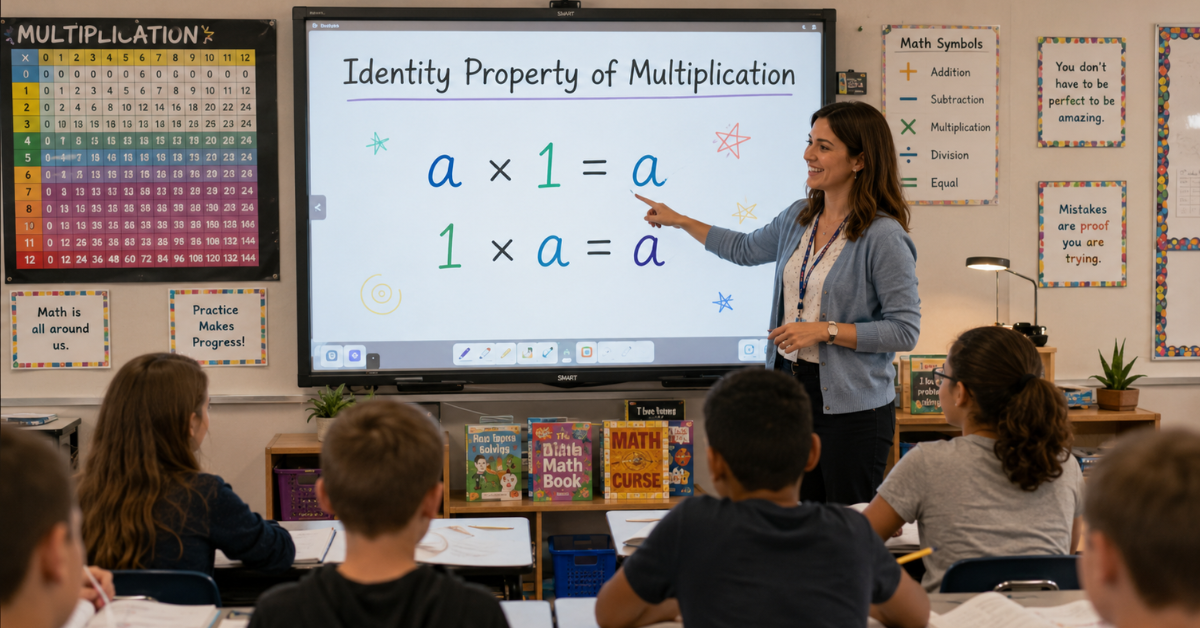
Kids meet the number one early, usually as a single object or a single unit, so it often gets treated as the “smallest” or “least interesting” number in their toolkit. This is where the identity property of multiplication earns its keep in the classroom. It pushes students past the idea that one is simply small and shows them instead that one holds a distinct mathematical role: it preserves the identity of any number it multiplies.
Once students grasp this, their whole relationship with the number one shifts. Instead of a plain unit, one becomes a number with its own set of properties. That shift pays off later, in places like these:
- Fractions and decimals: Students see that a fraction such as ⁵⁄₅ actually equals 1, and that multiplying a fraction or decimal by one leaves its value unchanged.
- Multiplicative inverses and reciprocals: Once a student understands a × 1 = a, reasoning about a reciprocal relationship, such as a × (1/a) = 1, becomes far easier. This groundwork matters when solving equations later on.
- Algebraic identities: The same rule reappears in algebra as x × 1 = x, and students lean on it whenever they simplify or solve equations.
Teaching Strategies for the Identity Property of Multiplication
Good teaching strategies turn the identity property of multiplication from a fact students memorize into an idea they actually understand. Using precise language and sentence frames gives students the words to explain why multiplying by one keeps a number’s value the same, not just that it does.
Choose Precise Mathematical Language
Precision matters from the first lesson. When you introduce the identity property of multiplication, model exact mathematical language rather than casual shortcuts. This habit builds real conceptual understanding and gives students the vocabulary to explain their own mathematical reasoning with confidence.
A strong way to frame it out loud sounds like this: “One is the multiplicative identity because multiplying any number by one keeps its value the same.”
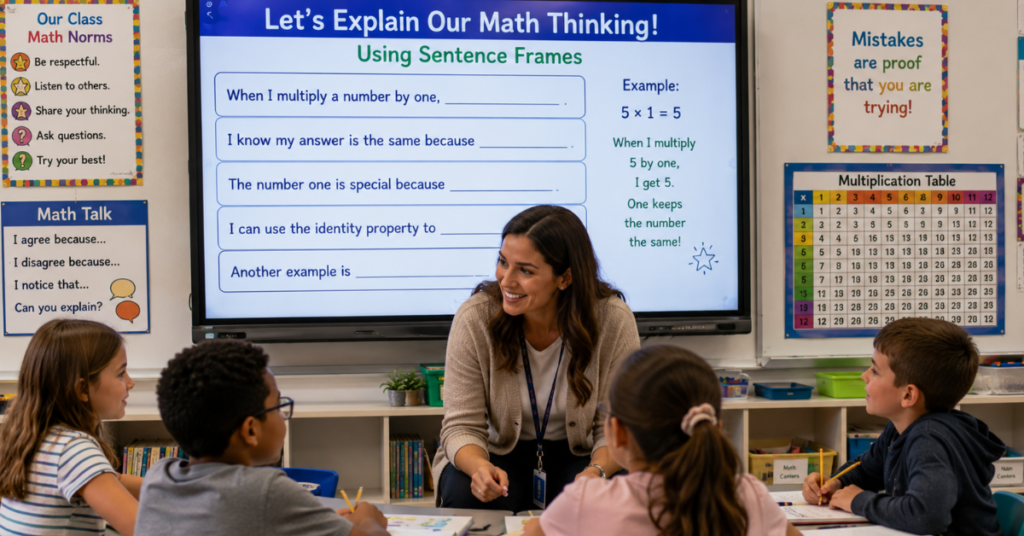
Sentence frames give students a scaffold for that same idea. Try prompts such as:
- “When I multiply a number by one, the product is…”
- “The number one keeps the product the same because…”
- “The number one is special in multiplication because…”
- “When I multiply by the number one, the total…”
These frames let students practice number sense and mathematical language at the same time, which deepens their grasp of why the property holds true rather than just that it holds true.
Getting Ahead of Common Misconceptions
Even a rule as simple as this one trips students up. Catching the misunderstanding early keeps the concept from becoming confusing later.
Misconception One: “The Number One Doesn’t Really Do Anything”
Some students decide one isn’t meaningful since it “doesn’t change anything” in a multiplication problem. Counter this with a hands on approach. Build 5 × 1 using one group of five counters and let students see the array for themselves. Reinforce the idea verbally too: “When we multiply by 1, we are finding the total for 1 group, which is the same as the number of counters in that group.”
Follow up with reflection questions that keep students reasoning instead of just recalling. Ask things like “What happens to the total when we only have one group?” or “Why does the total stay the same when we multiply by one?”
Misconception Two: “Multiplication Always Makes Numbers Bigger”
Plenty of students walk in assuming multiplication only ever increases a value. Challenge that belief with manipulatives. Have students build two arrays side by side: one for 4 × 1, with four rows holding a single counter each, and one for 4 × 2, with four rows holding two counters each. Then ask, “What do you notice is the same or different about the arrays?” and “Why doesn’t multiplying by one increase the total like multiplying by two does?”
Comparing the two arrays helps students see the pattern clearly: multiplying by a number greater than one grows the total, while multiplying by one keeps the original quantity exactly as it was. This distinction becomes especially useful once students start multiplying fractions and decimals, where the product can actually shrink, as in 8 × 1/2 = 4.
Identity Property of Multiplication Calculator
A calculator built around the identity property of multiplication gives students a quick way to check their reasoning instead of just their arithmetic. Type in any number, multiply it by one, and the tool confirms what the identity property already promises: the value stays exactly the same. For a classroom, this kind of tool works best as a companion to hands on learning rather than a replacement for it. Teachers can pair it with counters or manipulatives so students first predict the outcome, then use the calculator to confirm their prediction, which strengthens number sense far more than typing in numbers alone ever could.
Used well, this kind of calculator also supports mathematical reasoning during number talks. A student might multiply several numbers by one, watch the result stay constant every time, and start to form their own explanation for why that happens. That moment, where a student notices the pattern before a teacher names it, is exactly what builds conceptual understanding. The calculator becomes less about getting an answer and more about testing an idea, which fits naturally into elementary math instruction focused on properties of operations rather than memorized steps.
Identity Property of Multiplication Worksheets
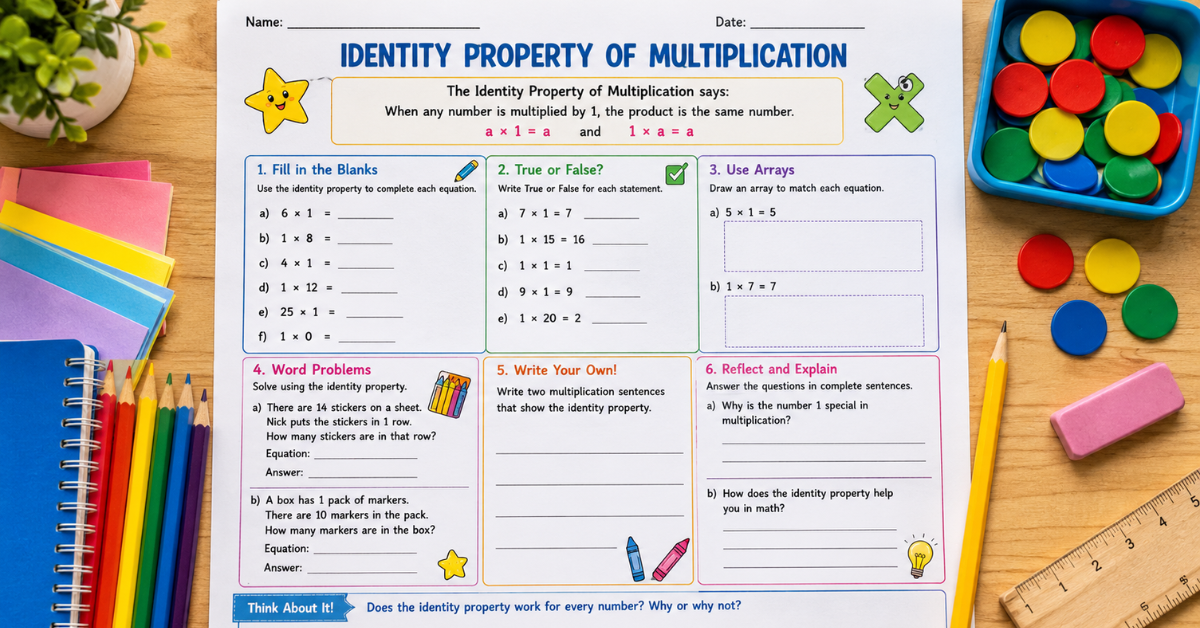
Worksheets that focus on the identity property of multiplication work best when they ask students to explain their thinking, not just fill in an answer. A strong worksheet might mix straightforward equations like 6 × 1 = 6 with word problems that put the property into context, such as counting the total in one group of seven counters. Including sentence frames on the page, prompts like “The number one is special in multiplication because…” gives students the mathematical language they need to justify their answers instead of guessing at what the page wants.
Good worksheets also build in room for misconceptions to surface naturally. A question that asks “What happens to the total when we only have one group?” invites a student to reason through the property rather than recall it from memory. Teachers working with third grade math and the Common Core standard 3.MD.C often find that worksheets combining equations, short word problems, and reflection questions do more for conceptual understanding than a page of repetitive drills ever could.
Identity Property of Multiplication Example
The clearest example of the identity property of multiplication is also the simplest: 5 × 1 = 5. The factor 1 sits in the equation, yet the number 5 comes out unchanged on the other side. Teachers often bring this example to life with counters, building one group of five objects so students can see, not just read, why the total matches the original number exactly.
A second useful example moves into fractions, since students eventually need to see that this property holds outside of whole numbers too. Multiplying ⁴⁄₇ by 1 still results in ⁴⁄₇, and that example becomes especially valuable once students start comparing it to multiplying by a fraction less than one, which can decrease the result, as in 8 × ½ = 4. Placing these examples side by side helps students separate two ideas that often get tangled together: multiplying by one preserves a number’s value, while multiplying by a number greater than one increases the total.
Identity Property of Addition
The identity property of addition works on the same logic as its multiplication counterpart, just with a different number doing the job. Instead of one, zero holds the identity role here: any number added to zero keeps its original value, shown as a + 0 = a and 0 + a = a. Students often pick this idea up faster than the multiplication version, since adding zero feels intuitive even before it gets a formal name.
Teaching this property alongside the identity property of multiplication helps students notice a pattern in how mathematics assigns special roles to certain numbers within certain operations. Using consistent rules and precise vocabulary when introducing both ideas together, rather than teaching them in separate units months apart, gives students a stronger foundation for later work with equations, where recognizing an identity element quickly becomes a genuine time saver.
Distributive Property of Multiplication Example
The distributive property lets a student break a multiplication problem into smaller, friendlier pieces. Take 6 × 13. Instead of multiplying that directly, a student can split thirteen into ten and three, then work out 6 × 10 plus 6 × 3, landing on 60 plus 18, which totals 78. That breakdown often feels far more manageable to a young learner than tackling the original problem head on.
This property pairs naturally with arrays and manipulatives during instruction, since students can physically separate a large array into two smaller ones and add the results together. Teaching strategies that lean on this kind of visual breakdown build mathematical reasoning that carries forward into algebra, where the same distributive logic appears again in expressions like a(b + c) = ab + ac.
Identity Property of Multiplication and Addition
Placing the identity property of multiplication next to the identity property of addition gives students a chance to compare two operations that behave differently but share a similar underlying structure. Multiplication protects a number’s value through one, while addition protects it through zero. Seeing both properties side by side, rather than in isolation, helps students recognize that mathematics often assigns a specific number a specific job within a specific operation.
This comparison also supports stronger word problems and number talks, since students can practice explaining why one operation needs zero to stay neutral while the other needs one. A student-friendly definition that covers both properties together tends to stick better than two separate definitions taught weeks apart, because the contrast itself becomes part of what makes each property memorable.
Zero Property of Multiplication
The zero property of multiplication states that any number multiplied by zero results in zero, no matter how large or small that number starts out. Written as a × 0 = 0, this rule can surprise students who assume multiplication always builds toward a bigger number. Demonstrating it with an array, zero rows or zero counters in every row, helps make the abstract rule visible and concrete.
This property also gives teachers a useful contrast when addressing misconceptions around the identity property of multiplication. Placing 5 × 1 = 5 next to 5 × 0 = 0 shows students two very different outcomes from two very similar looking equations, which sharpens their attention to precise vocabulary and pushes them to read equations carefully rather than assume a pattern that isn’t actually there.
What Is Commutative Property of Multiplication
The commutative property of multiplication states that changing the order of the factors doesn’t change the product, written as a × b = b × a. A student multiplying 4 × 3 will land on the same answer as one multiplying 3 × 4, and building both arrays side by side makes that equivalence easy to see rather than just easy to state.
This property gives students useful flexibility once they start solving more complex equations, since they can rearrange factors to make a problem simpler without changing the outcome. Teaching it alongside other properties of operations, including the identity property of multiplication, helps students build a fuller picture of how consistent rules govern multiplication and why those rules make mental math strategies reliable rather than accidental.
Frequently Asked Questions
What are the 12 identities in maths?
These are the standard algebraic identities students use to expand or factor expressions, like (a+b)² = a² + 2ab + b² and a² − b² = (a+b)(a−b). They cover squares, cubes, and product patterns that show up again and again in algebra.
What is an example of a multiplicative identity?
The number 1 is the multiplicative identity, since 7 × 1 = 7 shows the value staying exactly the same.
What are examples of identity property?
5 × 1 = 5 shows the identity property of multiplication, while 5 + 0 = 5 shows the identity property of addition.
What is the identity property for multiplication?
It states that multiplying any number by one leaves that number unchanged, written as a × 1 = a.
What is the formula for identities?
Algebraic identities follow set formulas, such as (a+b)² = a² + 2ab + b², that hold true for every value of the variables involved.
Conclusion
The identity property of multiplication may look simple on the surface, but it carries real weight in how students come to understand numbers and operations. Once a student truly grasps that multiplying by one preserves a number’s value, that understanding quietly supports everything from fractions and reciprocals to algebraic equations down the road. The number one stops being “just small” and becomes a number with a genuine mathematical role, which changes how students approach multiplication as a whole.
Teaching this property well takes more than showing an equation once and moving on. It takes precise language, hands on practice with counters and arrays, and room for students to work through their own misconceptions out loud. When teachers build in that kind of practice, students walk away with reasoning they can apply well beyond a single lesson, and that’s exactly what makes the identity property of multiplication worth teaching carefully rather than rushing through.

