

The cringe meaning is connected with a strong feeling of embarrassment, discomfort, awkwardness, or secondhand embarrassment. When something makes a person feel uncomfortable because it looks awkward, forced, silly, or embarrassing, people often describe it as cringe.
The word can work as a verb, adjective, or informal exclamation. In its traditional verb form, to cringe can mean moving back because of fear or feeling embarrassed about something. Modern internet culture often uses cringe meaning in a shorter way to describe a post, video, joke, comment, behavior, or situation that feels embarrassing or awkward.
Understanding cringe meaning becomes easier when we look at real-life conversations and social media examples. A person may say, Cringe Meaning That video is so cringe, after watching an awkward performance. Someone may also say, I cringe when I remember my old posts, when talking about embarrassing memories.
What Is the Cringe Meaning?
The simplest cringe meaning is something that causes embarrassment, awkwardness, discomfort, or secondhand embarrassment.
For example:
- That speech was so cringe.
The speaker means that the speech felt embarrassing, awkward, or uncomfortable to watch.The word can also describe a personal reaction:
- I cringe whenever I watch my old videos.
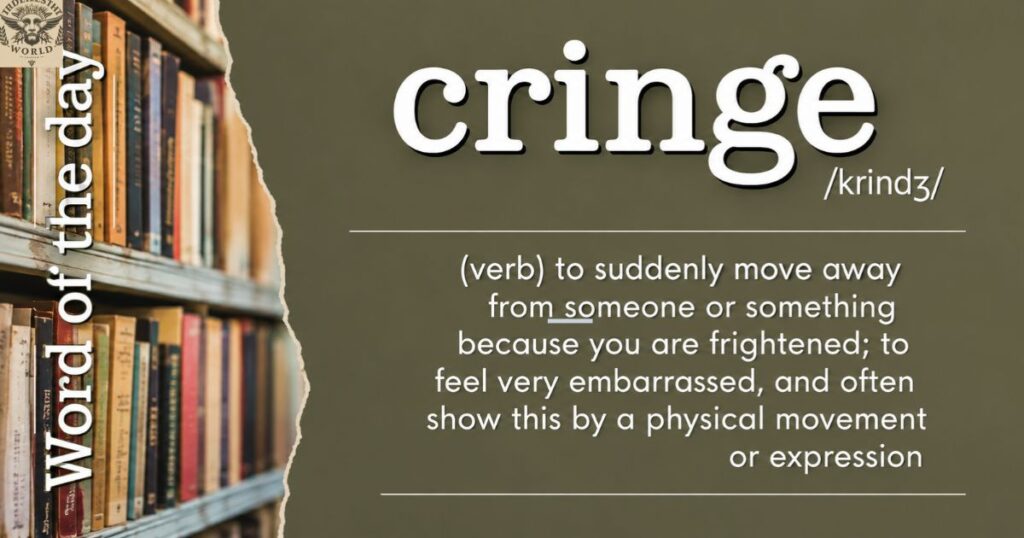
Here, the person feels embarrassed while remembering or watching their previous behavior.Cambridge explains the verb cringe as feeling very embarrassed and often showing that feeling through a physical expression or movement. It also gives an older meaning connected with moving away because of fear.
Simple Definition
Cringe: Something that makes a person feel embarrassed, awkward, uncomfortable, or ashamed.
- Cringe Meaning in Simple English
In simple English, cringe meaning can be understood as:
- So embarrassing or awkward that it makes you feel uncomfortable.
The word does not always mean that something is objectively bad. It can describe a personal reaction. One person may find a joke funny while another person may find the same joke cringe.
Cringe Meaning in Dictionary English
The traditional dictionary meaning of cringe is slightly different from its modern social media use.As a verb, to cringe can describe physically shrinking away from something because of fear. It can also describe feeling embarrassed or uncomfortable.
Oxford gives both meanings and notes that the word can refer to moving away because of fear as well as feeling very embarrassed.Cambridge also separates the verb, adjective, and exclamation uses. The adjective is informal and describes something very embarrassing because it is bad or silly.
| Form | Meaning | Example |
| Cringe | Feel embarrassed or uncomfortable | I cringe at my old photos. |
| Cringed | Past form of cringe | I cringed when I heard the recording. |
| Cringing | Present participle | She was cringing during the speech. |
| Cringe | Informal adjective | That joke was cringe. |
| Cringeworthy | Very embarrassing | His performance was cringeworthy. |
| Cringey | Informal form of cringeworthy | That video feels cringey. |
What Does Cringe Mean in Slang?
In modern slang, cringe meaning usually refers to something that feels embarrassing, awkward, forced, unnatural, or socially uncomfortable.Social media has made the slang use extremely common. People may comment cringe under a video, meme, photograph, advertisement, or post when they think the content is embarrassing.
For example:
- Bro, that pickup line was cringe.
The sentence means that the pickup line sounded awkward or embarrassing.Another example is:
- This commercial is kind of cringey.
The speaker may feel that the advertisement is trying too hard to appear funny, trendy, or relatable.The slang meaning is flexible. It can be serious, playful, sarcastic, or humorous.
Cringe Meaning on Social Media
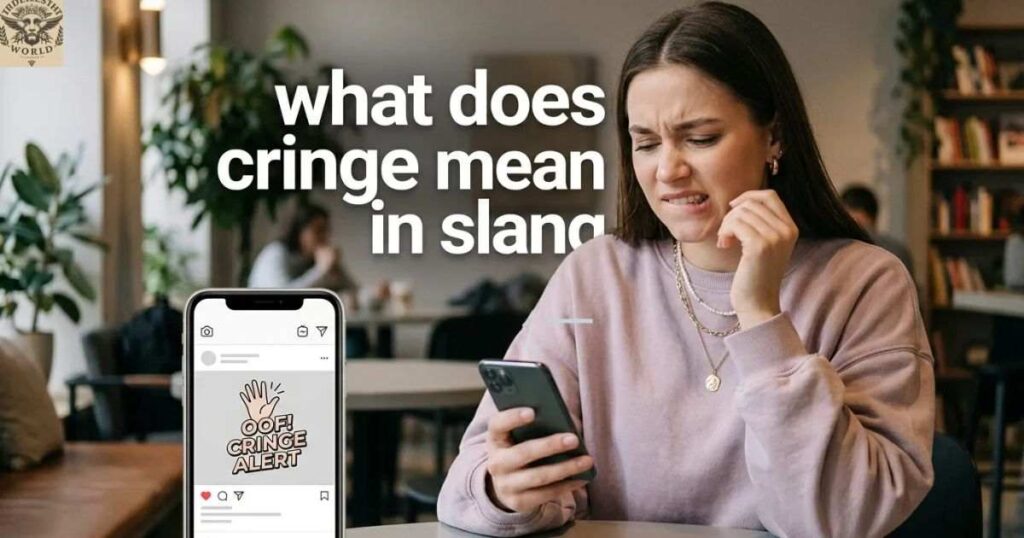
On social media, cringe meaning often describes content that creates secondhand embarrassment.
You may see comments such as:
- That is so cringe.
- Why did he post this? Cringe.
- I can’t watch this without cringing.
- The whole video is cringey.
- That caption is cringe.
- This is peak cringe.
These expressions are common because social platforms allow people to react instantly to videos, posts, comments, and trends.A person might upload a dramatic video expecting positive attention. Instead, viewers may think the performance looks forced. Someone may comment cringe to express that reaction.
Why Do People Call Posts Cringe?
A post may be called cringe when it:
- Looks overly forced.
- Tries too hard to appear cool.
- Uses outdated slang.
- Shows excessive bragging.
- Makes an awkward joke.
- Includes uncomfortable flirting.
- Copies a trend badly.
- Creates secondhand embarrassment.
- Uses an unnatural caption.
- Tries too hard to gain attention.
However, calling something cringe is subjective. What feels embarrassing to one audience may seem entertaining to another.
Cringe Meaning in Memes
Memes have played a major role in spreading the modern use of cringe A cringe meme usually presents an awkward situation, embarrassing behavior, Cringe Meaning failed joke, strange social interaction, or uncomfortable moment. The humor often comes from recognizing how uncomfortable the situation feels.
For example, imagine a meme showing someone confidently telling a joke in a group. Nobody laughs. The person continues explaining the joke while everyone becomes silent.
A caption might say:
- When you explain the joke because nobody laughed.
People may call the situation cringe because the person does not realize that the audience is uncomfortable.Another common meme structure involves an old social media post. Someone discovers a post they wrote years ago and reacts with:
- Why was I like this?
That reaction represents a form of personal cringe.
Social Media Meme Example
Imagine a short video where someone tries to impress friends by using extremely outdated slang.A viewer comments:
- Bro is trying way too hard. This is cringe.
The comment does not necessarily mean the person is a bad person. It means the behavior looks forced or embarrassing.
Real-Life Examples of Cringe
Understanding cringe meaning becomes much easier through everyday examples.
Example 1: Awkward Joke
Someone tells a joke during a serious meeting. Nobody laughs, but the person repeats it several times.
A colleague might say afterward:
That was pretty cringe.
The word describes the uncomfortable social situation.
Example : Forced Confidence
A person enters a room and loudly announces how successful they are.Instead of impressing everyone, the behavior makes people uncomfortable.
Someone might describe it as:
- That was a cringe way to introduce yourself.
Example : Old Photos
A person finds photographs from school and notices an old hairstyle and unusual outfit.
They might say:
- I cringe every time I see those photos.
Here, cringe describes the person’s emotional reaction.
Example : Public Flirting
Someone uses an exaggerated romantic line in front of a large group.
The line fails badly.
A friend might say:
- That was so cringe.
Example 5: Uncomfortable Speech
A student gives a presentation but repeatedly forgets the words and tries to cover the mistake with jokes. The audience may feel secondhand embarrassment. Cringe Meaning Someone could describe the presentation as:
- A little cringeworthy.
What Is Secondhand Embarrassment?
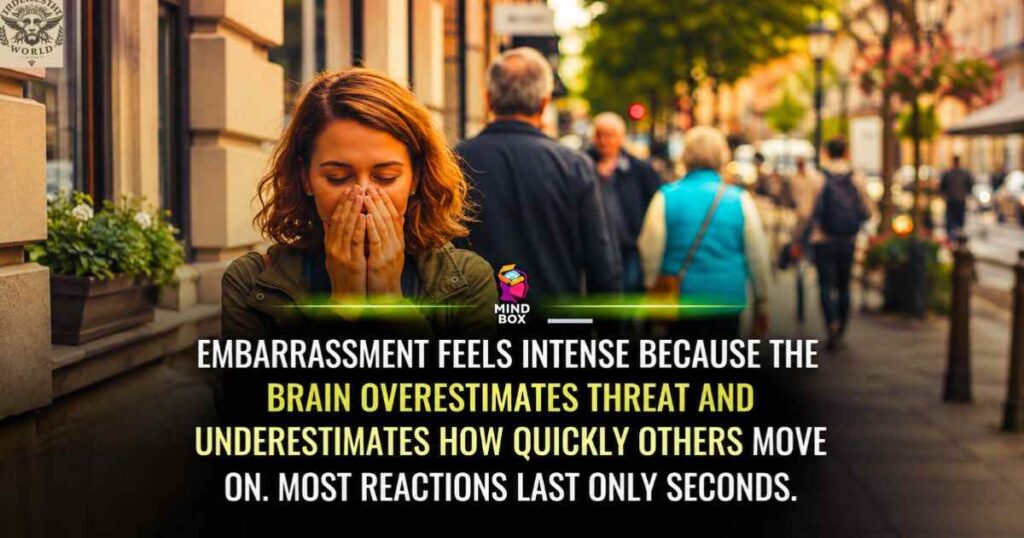
Secondhand embarrassment is one of the most important ideas behind modern cringe meaning.Secondhand embarrassment happens when another person’s behavior makes you feel embarrassed even though you did not do anything wrong.
For example, imagine watching a talent show where someone confidently performs but forgets the lyrics. You may feel uncomfortable while watching.
You might cover your face or look away.That emotional reaction is often described as cringing.
Why Does Cringe Feel So Strong?
Cringe can feel powerful because people naturally notice social mistakes. Humans often care about how they are viewed by others. When someone breaks a social expectation, viewers may experience discomfort.That is why awkward videos can make people physically react. They may laugh, look away, cover their face, or stop watching.
Cringe vs Embarrassing
Cringe and embarrassment are closely related, but they are not always identical.Embarrassing is a broad word. It can describe a mistake, accident, misunderstanding, or situation that causes shame.Cringe often carries an additional sense of awkwardness, forced behavior, or secondhand embarrassment.
For example:
- I forgot my presentation notes.
That situation is embarrassing.
But:
- He tried to impress everyone with a terrible joke and kept repeating it after nobody laughed.
That may be described as cringe.The second situation involves social awkwardness that makes other people uncomfortable.
Read More: Barter System Meaning: How People Traded Before Money Existed
Cringe vs Awkward
Awkward is another close synonym.An awkward situation may simply feel uncomfortable or difficult.A cringe situation usually has a stronger emotional reaction.
For example:
- There was an awkward silence.
That is normal English.
But:
- He tried to flirt with her in front of everyone and completely failed. It was so cringe.
The second sentence communicates stronger secondhand embarrassment.
Cringe vs Cringeworthy
Cringeworthy means something that causes embarrassment or discomfort.Cambridge defines cringeworthy as something that makes a person feel very embarrassed. Oxford gives a similar definition, describing it as something that makes people feel embarrassed or uncomfortable.
Examples:
- That was a cringeworthy performance.
- The interview became cringeworthy.
- His apology was cringeworthy.
Cringe is often more casual and shorter, especially online.
Cringe vs Cringey
Cringey is an informal adjective related to cringe.
Examples include:
- That post is cringey.
- The dialogue was really cringey.
- His attempt to look cool was cringey.
Both cringey and cringeworthy can describe something embarrassing.The difference is mostly style and sentence structure. Cringey sounds especially casual, while cringeworthy can sound slightly more descriptive.
What Does That’s Cringe Mean?
When someone says:
- That’s cringe.
- They usually mean:
That is embarrassing, awkward, forced, or uncomfortable to watch.
The phrase is especially common in online conversations.
For example:
- Person A: I posted a poem about my crush and tagged her.
- Person B: Bro, that’s cringe.
The second person is saying that the action may appear overly personal or embarrassing.The phrase can also be playful. Friends may call each other’s harmless behavior cringe without genuinely criticizing them.
What Does I’m Cringing Mean?
I’m cringing means that a person is currently feeling embarrassment or discomfort.
For example:
- I’m cringing while watching this video.
The speaker may be experiencing secondhand embarrassment.The expression can also describe a reaction to one’s own past behavior:
- I’m cringing at my old messages.
The person feels embarrassed when remembering what they previously wrote.
What Does Peak Cringe Mean?
Peak cringe is an informal internet expression.It means that something represents an extreme or especially obvious example of cringe behavior.
For example:
- He posted ten selfies with the same caption. Peak cringe.
The phrase is often humorous and exaggerated.It does not necessarily represent a serious judgment.
What Does Cringe Culture Mean?
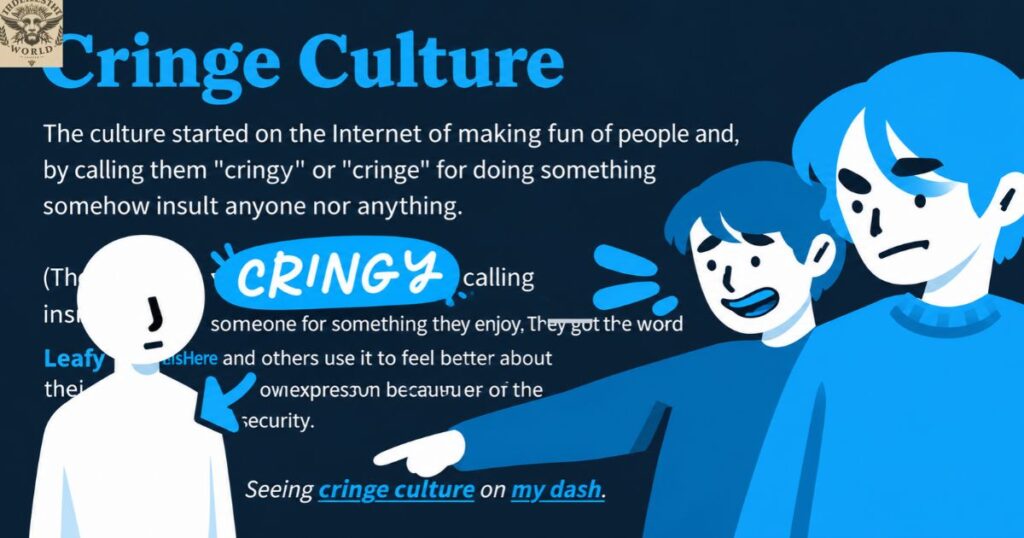
Cringe culture refers to online and social environments where people identify, share, mock, or discuss embarrassing behavior. Social media platforms have made cringe content easy to spread. A short video can reach millions of people, and viewers can react through comments, Cringe Meaning memes, stitches, reposts, or reaction videos.
Cringe culture can be funny, but it can also become unkind. Not every unusual behavior deserves public ridicule.A useful distinction exists between laughing at a harmless situation and attacking a real person.
Cringe Comedy Meaning
Cringe comedy is a type of humor based on embarrassment and uncomfortable situations.Cambridge describes cringe comedy as humor that makes people laugh at highly embarrassing situations. It also notes that the term is used in both UK and US English, with cringe humour common in the UK and cringe humor common in the US.
Cringe comedy often places characters in situations where they make poor social decisions.
For example, a character may:
- Say the wrong thing.
- Lie badly.
- Try to impress someone.
- Misunderstand a social situation.
- Continue talking after making a mistake.
- Act confident while clearly failing.
The audience laughs because the situation is uncomfortable but fictional or controlled.
Cringe Meaning in the UK
In the UK, cringe is widely understood as informal language for something embarrassing or uncomfortable.The adjective use is particularly casual.
For example:
- That was a proper cringe.
or:
- That advert is so cringe.
British speakers may also use related expressions such as cringeworthy, cringey, and cringe-making. Oxford labels the adjective cringe as especially British English and informal. The word can appear in everyday conversation, entertainment reviews, online comments, and social media.
Cringe Meaning in the USA
In the United States, cringe is also common in informal speech and internet culture.American social media users may say:
- That’s so cringe.
or:
- This video is cringey.
The word is especially common among younger internet users, although people of different ages understand it.American English also uses cringeworthy for something embarrassing or uncomfortable. Oxford’s American English dictionary records the term as informal.
Cringe Meaning in India
In India, cringe has become common in English-language social media conversations, meme pages, short-form videos, and online communities.
Young users may describe exaggerated acting, forced dialogue, copied trends, awkward romance content, or overly dramatic videos as cringe.
For example:
- That dialogue delivery was so cringey.
Another example:
- The video looks forced. It feels cringe.
The word can appear alongside Indian English, Hindi, regional languages, and internet slang.
The meaning remains broadly the same: Cringe Meaning something feels embarrassing, awkward, unnatural, or forced.
Cringe Meaning in China and Other Countries
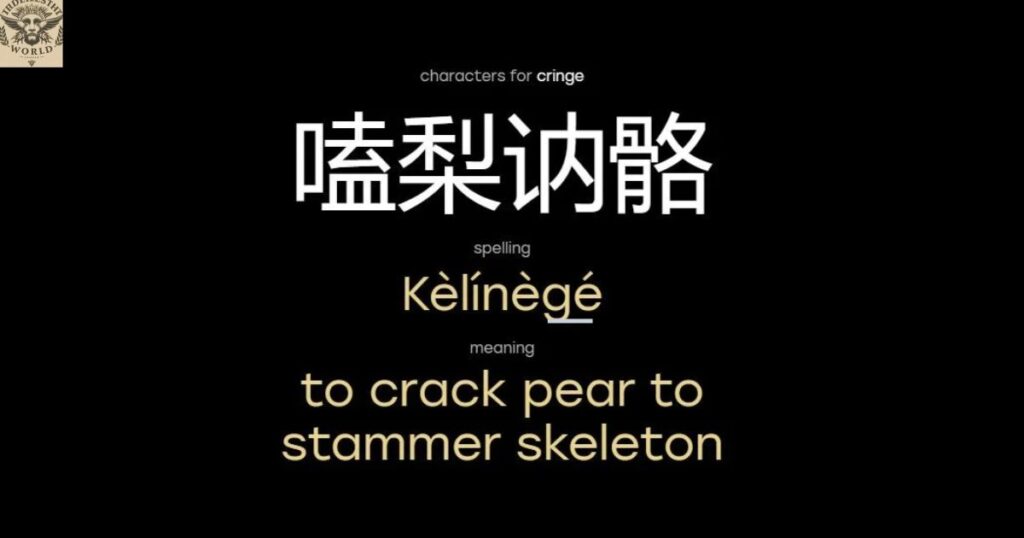
English internet slang often crosses language boundaries through global platforms, gaming communities, entertainment, Cringe Meaning memes, and short-form video culture. Users in China and other countries may encounter cringe through English-language content even when English is not their first language.
The exact way people use the word can vary by online community. Some users use cringe as a direct English adjective, while others translate the underlying idea into their local language.The international spread of the term shows how digital communication can turn an ordinary English word into a widely recognized internet expression.
How to Use Cringe in a Sentence
The word can appear in several grammatical patterns.
Cringe as a Verb
- I cringe when I see my old posts.
- She cringed at the awkward conversation.
- They were cringing during the performance.
Oxford and Cambridge both recognize the verb sense of feeling embarrassed or uncomfortable.
Cringe as an Adjective
- That video is cringe.
- His joke was cringe.
- The caption feels cringe.
The adjective is informal and especially common in modern speech and online communication.
Cringe as an Exclamation
Someone may simply say:
- Cringe!
The speaker is expressing immediate embarrassment or disapproval.
Cambridge recognizes cringe as an informal exclamation used to show that something is embarrassing or bad.
Common Cringe Examples
Here are some simple examples that show the meaning clearly.
- Old social media post: I can’t believe I wrote that caption. I cringe every time I read it.
- Bad pickup line: He used the cheesiest pickup line. It was so cringe.
- Forced joke: Nobody laughed, but he kept explaining the joke. That was cringe.
- Overconfident performance: Her confidence was high, but the performance became cringeworthy.
- Outdated slang: He used old internet slang to sound cool. Everyone found it cringey.
- Awkward video: I had to stop watching because the whole thing was so cringe.
- Embarrassing memory: Thinking about my school speech makes me cringe.
Social Media Cringe Examples
Social media provides many situations where people use the term.
Example : Forced Trend
A person copies a popular dance but clearly does not understand the trend.
Comment:
- This feels so forced. Cringe.
Example : Excessive Bragging
A person posts several pictures showing expensive items and repeatedly tells followers how successful they are.
Comment:
- The constant flexing is cringe.
Example : Awkward Romantic Post
Someone publicly writes a dramatic message to a person they barely know.
Comment:
- Bro, that’s cringe.
Example : Trying Too Hard
A brand uses slang incorrectly in an advertisement.
Users may respond:
- The marketing team tried too hard. This is cringe.
Example : Old Internet Trend
A person brings back a very old trend and treats it as new.
Someone may call the content:
- Cringe.
The reaction depends heavily on the audience.
Why Do Some Things Feel Cringe?
There is no single rule that makes something cringe.
However, several common factors can contribute.
Forced Behavior
People often notice when someone is trying too hard to appear funny, cool, romantic, or impressive.
Social Rule Breaking
A situation can feel cringe when someone ignores an expected social boundary.
Lack of Self-Awareness
A person may not realize that their behavior looks awkward to others.
Overconfidence
Extreme confidence combined with poor results can create secondhand embarrassment.
Inappropriate Timing
A joke may become cringe when it appears at the wrong moment.
Excessive Performance
Sometimes ordinary emotions become cringe when they appear exaggerated or unnatural.
Is Cringe Always an Insult?
No.
The word can be critical, but it can also be playful.
Friends often say:
That was cringe 😂
without intending serious harm.
In meme culture, cringe can even be used affectionately. A person might describe an old family photograph as cringe while still enjoying the memory.
The tone matters.
A serious insult, playful joke, meme comment, and friendly teasing can all use the same word differently.
Can Something Be Intentionally Cringe?
Yes.
Some creators intentionally make cringe content because audiences enjoy watching uncomfortable situations.
This idea appears strongly in comedy.
A comedian may deliberately create an awkward character. A video creator may exaggerate an uncomfortable situation. A meme creator may create deliberately awkward content.
The audience knows that the behavior is intentional.
That creates a different type of entertainment.
Cringe and Internet Humor
Internet humor changes quickly.
A phrase that sounds normal today may sound outdated later. A trend that feels funny can eventually become overused.
Once a trend becomes extremely common, people may start calling it cringe.
For example, a phrase can become popular because everyone uses it. Cringe Meaning After months of repetition, users may begin mocking people who still use it.
Therefore, cringe meaning often depends on social context and changing internet culture.
Cringe and Generational Differences
Different generations may have different ideas about what feels cringe.A teenager may find a certain meme outdated, while an older adult may see it as perfectly normal.Likewise, younger users may recognize internet references that older users do not understand.The meaning of cringe itself is relatively stable, but the things people label as cringe can change quickly.
Is Cringe the Same as Embarrassment?
Not exactly.
Embarrassment describes an emotional experience.
Cringe can describe:
- The emotional reaction.
- The behavior causing the reaction.
- The content itself.
- A person’s judgment about something.
For example:
I felt embarrassed.
describes an emotion.
That was cringe.
describes an evaluation of a situation or behavior.
This difference makes cringe especially useful in online conversations.
Cringe Synonyms
Several words can overlap with cringe meaning.
Common alternatives include:
- Embarrassing
- Awkward
- Uncomfortable
- Cringeworthy
- Cringey
- Shameful
- Mortifying
- Painful
- Unpleasant
- Forced
- Tacky
- Cheesy
- Silly
The best synonym depends on the context.
Mortifying suggests very strong embarrassment.
Awkward is broader and more neutral.
Cheesy often describes overly sentimental or predictable behavior.
Cringeworthy directly focuses on embarrassment.
Read More: Brat Meaning: Definition, Old Meaning, Modern Slang, and Examples
Antonyms of Cringe
There is no perfect opposite for every use of cringe, but several words can express the opposite idea.
These include:
- Cool
- Natural
- Comfortable
- Confident
- Appropriate
- Genuine
- Impressive
- Smooth
- Entertaining
- Charming
For example:
His speech felt natural, not cringe.
The word natural works as a useful contrast because forced behavior often creates a cringe reaction.
Cringe, Cheesy, and Corny
These terms can overlap, but they are not identical.Cringe often involves embarrassment or discomfort.Cheesy often describes something overly sentimental or predictable.
orny can describe an old-fashioned, predictable, Cringe Meaning or overly simple joke or expression.
For example:
That romantic line is cheesy.
does not necessarily mean the speaker feels deeply embarrassed.
But:
He said that romantic line in front of everyone. So cringe.adds a stronger sense of social discomfort.
Cringe in Text Messages
People often use cringe in short messages.
Examples include:
That was cringe.
So cringe 😭
I’m cringing.
Why is this so cringey?
Peak cringe.
That’s actually embarrassing.
Emoji can change the tone.
A crying-laughing emoji may make the comment playful. A skull emoji can signal humorous disbelief. The exact meaning depends on the conversation.
Cringe in Gaming Communities
Gaming communities also use the term.
A player may call a dramatic voice line cringe.
A streamer may describe an overly rehearsed reaction as cringe.
A player might write:
That victory speech was cringe.
Gaming memes often combine humor, sarcasm, Cringe Meaning and exaggerated reactions, making cringe a useful shorthand.
Cringe in School and College Life
School and college provide many everyday examples.
A student may give an overly dramatic speech in class.
Someone may attempt a joke that receives no response.
A student may accidentally send a personal message to a class group.
A person may later say:
That was so cringe.
These situations show that the word does not only belong to the internet. Cringe Meaning It describes ordinary human reactions too.
Cringe in the Workplace
The word can also appear in informal workplace conversations, Cringe Meaning although it may be better to use more professional language in formal communication.
For example, colleagues may privately describe an awkward presentation as cringe.
A marketing team might also review an advertisement and ask whether the tone feels natural or forced.
In professional writing, however, alternatives such as awkward, uncomfortable, forced, or unprofessional may communicate the concern more clearly.
How Brands Avoid Cringe Marketing
Brands increasingly use social media language to connect with younger audiences.
However, using slang incorrectly can make a campaign feel forced.
A brand can avoid cringe marketing by:
- Understanding its audience.
- Using natural language.
- Avoiding excessive slang.
- Not copying every trend.
- Keeping the message authentic.
- Testing content before publication.
- Understanding cultural context.
A company does not need to use every viral word to appear modern.
Authenticity often works better than forced internet language.
Search Intent Questions About Cringe Meaning
What is the simple meaning of cringe?
The simple meaning of cringe is feeling embarrassed, uncomfortable, or awkward, or describing something that creates that reaction.
What does cringe mean in texting?
In texting, cringe usually means that something feels embarrassing, Cringe Meaning awkward, forced, or uncomfortable.
What does cringe mean on TikTok?
On TikTok and similar social platforms, Cringe Meaning cringe commonly describes a video, behavior, joke, trend, or performance that viewers find embarrassing or awkward.
Is cringe a bad word?
Cringe is not normally a swear word or offensive word. It is an informal expression that can criticize something as embarrassing or awkward.
What does cringey mean?
Cringey means embarrassing, awkward, or uncomfortable to watch. It is an informal adjective related to cringe.
What does cringeworthy mean?
Cringeworthy describes something that makes people feel embarrassed or uncomfortable. Cambridge and Oxford both use the word for situations or behavior that cause embarrassment.
Why do people say cringe online?
People use cringe online because it is a short way to express that content feels embarrassing, forced, awkward, or uncomfortable.
Is cringe slang?
The modern adjective and internet use of cringe is informal slang-like language, Cringe Meaning while the verb has a much older place in standard English.
How to Use Cringe Correctly
Use cringe as a verb when describing the reaction:
- I cringe when I hear that song.
Use cringe as an informal adjective when describing something:
- That video is cringe.
Use cringeworthy when describing something that causes embarrassment:
- The interview was cringeworthy.
Use cringey for a casual description:
- The conversation became cringey.
Use cringe as an exclamation when reacting immediately:
- Cringe!
The correct choice depends on grammar and context.
Cringe Meaning: Quick Reference Table
| Question | Short Answer |
| What does cringe mean? | To feel embarrassed or describe something embarrassing. |
| Is cringe slang? | The modern adjective and internet use is informal. |
| What does cringe mean on social media? | Content that feels awkward, forced, or embarrassing. |
| What is cringey? | Informal adjective meaning embarrassing or uncomfortable. |
| What is cringeworthy? | Something that causes strong embarrassment. |
| What is cringe comedy? | Comedy built around embarrassing situations. |
| Can cringe be a verb? | Yes. |
| Can cringe be an adjective? | Yes, informally. |
| Can cringe be an exclamation? | Yes, informally. |
| Is cringe always negative? | Not always; it can be playful or humorous. |
Common Mistakes When Using Cringe
One common mistake is treating cringe as a synonym for every negative thing.Something can be bad without being cringe.
For example, a broken computer is bad, but it is not necessarily cringe.
Another mistake is assuming that everyone will agree about what cringe. Cringe is strongly influenced by personal taste, culture, Cringe Meaning age, social expectations, Cringe Meaning and context. A joke may be hilarious to one group and painfully awkward to another.
Another mistake is using too much slang in formal writing. In a professional email, The presentation was cringe may sound too casual. The presentation felt awkward may be more appropriate.
Can Cringe Be Positive?
Usually, cringe has a negative or uncomfortable meaning, but context can make the expression playful.Someone may intentionally create cringe content because it is entertaining.
A person might even say:
- I love how cringe this is.
Here, the speaker is acknowledging the awkwardness while enjoying it.
So the emotional meaning can shift depending on tone.
The History Behind the Word Cringe
The modern slang use has become highly visible through internet culture, but the verb itself is much older.Oxford traces the word to Middle English forms related to older Germanic words associated with bending, yielding, or falling in battle.
The older physical sense involved shrinking, bending, or moving away because of fear. Over time, the emotional sense became important too. Today, Cringe Meaning the word has developed another highly recognizable use as an informal adjective for something embarrassing. That gives cringe a useful example of how language changes over time.
Why Cringe Became Popular Online
Internet communication favors short, expressive words.
Cringe works well because one word can communicate a strong reaction.
Instead of writing:
- I find this behavior extremely awkward and embarrassing, and I feel uncomfortable watching it.
A user can simply write:
- Cringe.
That efficiency makes the word useful in comments, memes, captions, chats, gaming communities, and short-form video platforms.
Cringe and Cultural Context
What counts as cringe can differ between countries and communities. A romantic gesture that seems normal in one culture may feel excessive in another. A joke that works in the UK may not have the same effect in India, Cringe Meaning the USA, China, or another country.
Internet culture creates shared global vocabulary, but local cultural expectations still influence how people interpret behavior.
For international audiences, context matters.
That is especially important for brands, creators, teachers, and marketers working across different countries.
How to Respond When Someone Calls Something Cringe
The best response depends on the situation.
If the comment is playful, laughing it off can work:
- Fair enough 😂
If the comment is serious, Cringe Meaning ask what felt awkward.
If the person is simply being rude, there is no need to argue.
Remember that cringe is often an opinion rather than an objective fact.
Someone calling your content cringe does not automatically prove that the content is bad.
Five Useful Cringe Sentences
- I cringe whenever I remember that conversation.
- That video is really cringe.
- His attempt to sound cool was cringey.
- The whole interview became cringeworthy.
- That was an awkward moment, but not necessarily cringe.
These examples show how the word changes according to grammar and context.
Frequently Asked Questions :
What is the exact cringe meaning?
The cringe meaning refers to feeling embarrassed or uncomfortable, or describing something that causes embarrassment, awkwardness, or secondhand embarrassment.
What does cringe mean in social media slang?
In social media slang, cringe usually describes content, behavior, jokes, videos, captions, or comments that seem awkward, forced, embarrassing, or uncomfortable.
Is cringe the same as embarrassing?
They are closely related but not exactly identical. Embarrassing is a broad description, while cringe often emphasizes awkwardness, forced behavior, Cringe Meaning or secondhand embarrassment.
What is the difference between cringe, cringey, and cringeworthy?
Cringe can be a verb, informal adjective, or exclamation. Cringe Meaning Cringey is an informal adjective describing something embarrassing.
Is it okay to call someone cringe?
It is grammatically understandable in informal speech, but the phrase can sound insulting depending on the situation.
Conclusion
The cringe meaning has both traditional and modern uses. As a verb, cringe can describe moving away because of fear or feeling embarrassed and uncomfortable. In modern informal English, especially online, cringe commonly describes something awkward, forced, Cringe Meaning silly, or embarrassing.
Social media has made the word especially popular because cringe provides a quick way to describe secondhand embarrassment. Memes, videos, Cringe Meaning comments, advertisements, jokes, romantic posts, and everyday situations can all be described as cringe. Still, the label is subjective. What one person considers cringe may seem funny, normal, or entertaining to another.

