

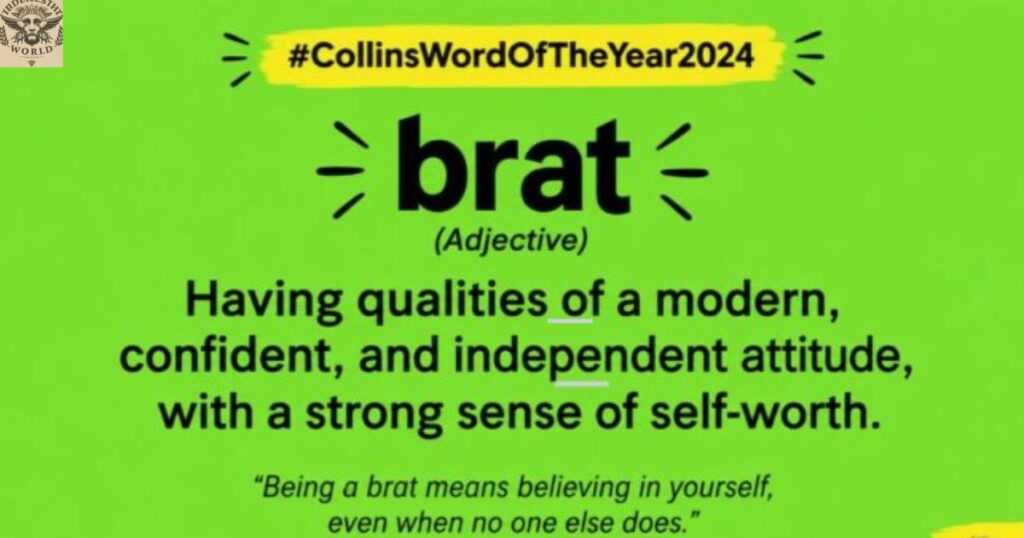
The word brat is a common English word used for a child or person who behaves badly, acts selfishly, or refuses to behave properly. In the traditional sense, it usually describes a badly behaved or annoying child. The word has been used in English for centuries, so its meaning is not new.
However, the brat meaning has become more interesting in modern informal English. On social media and in everyday conversations, people can use brat in a playful, humorous, or even positive way. Modern slang can describe someone who is demanding, confident, dramatic, fashionable, or openly expressive.
The exact meaning depends strongly on context. Calling a child a brat may be an insult, while calling a friend a brat can be teasing. In some modern cultural and social-media contexts, the word can even suggest a bold personality or a carefree attitude. Understanding both the traditional and modern uses makes the word much easier to interpret.
What Is the Brat Meaning?
The basic meaning is a badly behaved child. A brat may complain constantly, demand attention, refuse to follow rules, or behave in a spoiled way. The word is usually informal and often carries a negative tone.
For example, if a child keeps demanding expensive toys and becomes angry after hearing no, someone might call that child a brat. The speaker is not simply describing the child’s age. The word focuses on the child’s behavior.
The term can also describe an older person who behaves in an immature, selfish, or demanding manner. In that situation, brat is being used figuratively rather than literally.
Simple Definition of Brat
- A simple definition is:
Brat means a person, especially a child, who behaves badly, selfishly, or in an annoying way.
The word is informal, so it is more common in conversations, casual writing, social media, and entertainment than in highly formal situations.
Brat Meaning in Simple English
In simple English, brat meaning can be understood as a badly behaved or spoiled person.Consider a child who refuses to share toys, shouts when things do not go their way, and expects everyone to obey their wishes. A parent or another adult might describe that child as a brat.
The word does not necessarily mean that the child is permanently bad. It usually describes behavior at a particular moment or a repeated pattern of behavior.
For example:
- The child was acting like a brat.
- Don’t be such a brat.
- Her little brother can be a brat sometimes.
- He sounded like a spoiled brat.
The tone can range from serious criticism to friendly teasing.
The Old or Traditional Brat Meaning
The traditional brat meaning is closely connected with a badly behaved child. Historical dictionaries show that the word has a long history in English. Merriam-Webster lists its first known use as dating to 1505.The older sense developed around the idea of a child who was troublesome, annoying, or poorly behaved.
Over time, brat became a familiar informal insult for children who were considered rude or spoiled.This traditional meaning remains common today. A parent, teacher, relative, or friend may still use brat when talking about someone’s difficult behavior.
Traditional Meaning Example
Imagine a child visiting a shop with a parent. The child demands a toy, starts shouting after the parent refuses, and continues causing a scene. Someone might say:
- That child is behaving like a brat.
The word focuses on the child’s unacceptable behavior rather than simply saying the child is young.
Where Did the Word Brat Come From?
The history of brat is older than its modern slang use. Historical English sources connect the word with a sense referring to a child and later with a badly behaved child.The word has also appeared in different informal contexts over the centuries.
Its meaning developed gradually rather than appearing suddenly as modern slang. The historical background matters because today’s informal use is built on an older idea: someone who behaves in a troublesome, demanding, or immature way.
Read More: Barter System Meaning: How People Traded Before Money Existed
Brat Meaning in Modern Slang
The modern brat meaning can be broader than the traditional definition. In slang, brat may describe someone who is demanding, dramatic, playful, spoiled, bold, or intentionally difficult.The tone is extremely important.If someone says:
You’re such a brat!
they might genuinely be criticizing the person’s behavior. But a close friend could say exactly the same sentence while joking.Modern social media has also helped brat become a flexible personality label. In some contexts, a person may describe themselves as a brat without meaning that they are genuinely rude or badly behaved.
Instead, the word can communicate a playful attitude, confidence, independence, or a deliberately provocative personality.
Brat as a Modern Internet and Social Media Term
Social media has changed the way many informal English words are used, and brat is a good example.Online, people may use brat in captions, comments, memes, videos, and conversations. The word can describe someone who is acting spoiled, but it can also be used humorously.
The surrounding words, images, emojis, and tone often reveal the intended meaning.
For example:
- I’m being a brat today.
- She has such a bratty attitude.
- Stop acting like a brat.
- He’s a little brat, but we love him.
The first sentence may be a playful self-description. The third is more likely to be criticism.
Is Brat Always an Insult?
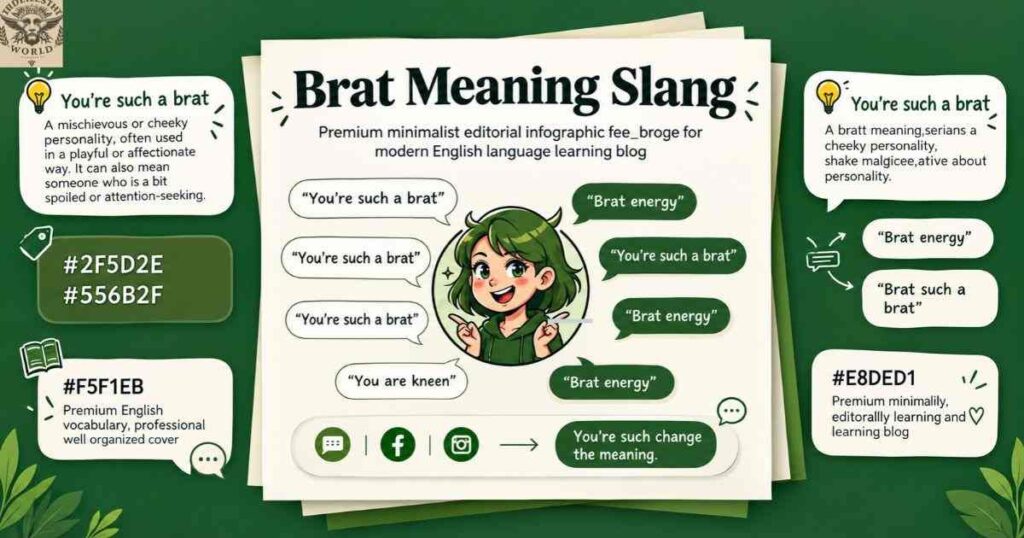
No. Brat meaning depends on context.
Traditionally, brat is generally negative because it describes bad behavior. However, informal speakers can use the word affectionately or jokingly.A parent might jokingly call a child a brat after the child makes a harmless demand. Friends may use the word to tease each other.
Compare these examples:
- Negative:
His behavior was rude and selfish. He was acting like a brat. - Playful:
You’re such a brat for stealing the last cookie!
The same word creates different meanings because the emotional context changes.
Brat Meaning in a Relationship
In relationships, brat can have a teasing or playful meaning. One partner may call the other a brat when they are being demanding, stubborn, dramatic, or mischievous.
For example:
- You know you’re being a brat, right?
Depending on the relationship, the sentence might be affectionate rather than offensive.Still, context matters. A stranger calling someone a brat can sound disrespectful, while a close friend or partner may use the word casually.
Brat Meaning for Adults
Although the traditional definition focuses on children, brat can describe adults too.An adult may be called a brat if they:
- complain excessively
- expect special treatment
- refuse to compromise
- behave selfishly
- become angry when they do not get what they want
- act immaturely
For example:
- He’s thirty, but sometimes he acts like a spoiled brat.
Here, brat does not refer to age. It describes behavior.
What Does Bratty Mean?
Bratty is the adjective related to brat. It describes behavior that resembles that of a brat.Someone can have a bratty attitude without literally being called a brat.
Examples include:
- She was being bratty about the new rules.
- His bratty behavior annoyed everyone.
- The child became bratty after being told no.
The word usually suggests demanding, spoiled, stubborn, or immature behavior.
Brat vs. Spoiled Child
The words brat and spoiled child are closely related, but they are not exactly identical.A spoiled child may have received too many privileges, gifts, or forms of special treatment. A brat is a person who behaves badly or annoyingly, often because of demanding or selfish behavior.
A child can be spoiled without constantly behaving badly. Similarly, a child may behave like a brat during a particular situation without generally being spoiled.
| Term | Basic Meaning | Typical Tone |
| Brat | Badly behaved or annoying person | Negative or playful |
| Spoiled child | Child accustomed to special treatment | Usually negative |
| Bratty | Showing brat-like behavior | Informal |
| Mischievous | Playfully troublesome | Often mild or positive |
| Rude | Lacking good manners | Negative |
| Selfish | Caring mainly about personal wants | Negative |
Brat vs. Child
The word child is neutral. It simply identifies a young person.The word brat adds a judgment about behavior.
For example:
- Child: The child is playing in the garden.
- Brat: The child is behaving like a brat.
The first sentence provides information. The second expresses an opinion about behavior.That difference is important when learning the brat meaning.
Brat vs. Bratty
Brat is usually a noun.
Example:
- That boy is a brat.
Bratty is an adjective.
Example:
- That boy has a bratty attitude.
Both words refer to similar behavior, but they have different grammatical roles.
Brat Synonyms
Several words can have meanings similar to brat, although the exact tone differs.
Common synonyms include:
- spoiled child
- misbehaved child
- troublemaker
- nuisance
- pest
- rascal
- imp
- selfish person
- spoiled person
- immature person
Some alternatives are stronger or softer than brat. Rascal, for example, can be affectionate or playful, while a spoiled child is usually more critical.
Brat Antonyms
There is no single perfect opposite of brat, but several words express contrasting qualities.
Possible antonyms include:
- well-behaved child
- polite child
- obedient child
- respectful person
- considerate person
- mature person
- well-mannered person
For example:
- Instead of behaving like a brat, he was polite and respectful.
Examples of Brat in Everyday English
Understanding examples is one of the easiest ways to learn the brat meaning.
Example 1: A Demanding Child
- The little boy became a brat when his mother refused to buy him candy.
Here, brat describes demanding behavior.
Example 2: Friendly Teasing
- You’re a brat for hiding my phone!
The speaker may be teasing rather than seriously insulting the other person.
Example 3: An Immature Adult
- He acts like a brat whenever someone disagrees with him.
Here, the person is an adult, but brat describes immature behavior.
Example 4: A Spoiled Child
- The spoiled brat expected everyone to do everything for her.
The word has a strongly negative tone in this sentence.
Example 5: Self-Description
- I know I’m being a brat, but I really want that dessert.
Here, the speaker is recognizing their own demanding behavior, possibly in a humorous way.
Brat Meaning in American English
In the United States, brat is widely understood as an informal word for a badly behaved or spoiled child.American speakers may also use it for adults who behave immaturely or demand special treatment.
The expression is common in casual speech:
- Don’t be a brat.
It can sound serious when said by a parent to a child, but among friends it may simply be playful teasing.
Brat Meaning in British English
British English also uses brat to describe a badly behaved child.The word is familiar in everyday conversation and informal writing. As in American English, context determines whether the word sounds insulting or humorous.
The basic traditional sense remains understandable across both varieties of English.
Brat Meaning in India and Other English-Speaking Communities
English is used differently across countries, but brat generally keeps its standard meaning of a badly behaved or spoiled person.In India and other countries where English is widely used as a second language, the word can appear in conversations, entertainment, online posts, and English-language media.
The modern slang sense may be understood through social media and global pop culture, where informal words often spread quickly between countries.
Read More: Bigot Meaning: Definition, Examples, Synonyms, Antonyms, and How to Use It
Brat Meaning in Social Media Captions
On social media, brat can be used as a short personality description.
Someone might write:
- Brat energy today.
That does not automatically mean the person is genuinely badly behaved. It may suggest a playful, demanding, bold, dramatic, or carefree mood.
Likewise:
- Living my brat era.
The phrase can be humorous and self-aware. It can describe a chosen attitude rather than a literal claim of being a badly behaved child.
Why Context Matters So Much
The brat meaning cannot always be understood from the word alone.
Consider:
- My little brother is such a brat.
This is probably criticism or affectionate teasing.
Now consider:
- I am embracing my brat side.
The second sentence is more likely to be playful or self-expressive.Tone, relationship, situation, and surrounding language all influence the meaning.
Is Brat a Formal Word?
No. Brat is mainly an informal word.It is suitable for casual conversations, social media, fiction, entertainment, and informal messages. It may not be appropriate in professional writing when a neutral description is needed.
Instead of writing:
- The customer was a brat.
a professional report might say:
- The customer behaved in a demanding and disrespectful manner.
The second version is more neutral and professional.
How to Use Brat in a Sentence
The most common structure is:
Subject + be + a brat
Examples:
- That child is a brat.
- He is being a brat.
- Don’t be a brat.
- Her brother can be a brat.
- I was a brat when I was younger.
Another useful structure is:
act like a brat
Examples:
- Stop acting like a brat.
- He acted like a brat during dinner.
- She sometimes acts like a brat when she is tired.
Common Phrases With Brat
Several expressions appear frequently in informal English.
Don’t Be a Brat
This means:
- Stop behaving badly, selfishly, or immaturely.
Example:
- Don’t be a brat. Everyone has to wait their turn.
Spoiled Brat
A spoiled brat is someone who expects special treatment and behaves badly when they do not receive it.
Example:
- He behaves like a spoiled brat whenever he does not get his way.
Little Brat
Little brat is often used for a child. Depending on tone, it can be insulting or playful.
Example:
- That little brat took my cookies!
Acting Like a Brat
This expression focuses on behavior.
Example:
- You’re acting like a brat today.
It does not necessarily mean the person is always a brat.
Can Brat Be Used Affectionately?
Yes. In informal relationships, brat can sometimes be affectionate.Parents may use it jokingly with children. Friends may tease each other with the word. Romantic partners may also use it playfully.
However, affection cannot be assumed automatically. If the speaker and listener do not have a close relationship, brat may sound rude.The safest approach is to consider the relationship and tone before using it.
Is Calling Someone a Brat Rude?
It can be.Calling someone a brat directly usually expresses criticism of their behavior. Even when intended as a joke, the word can offend someone who does not understand the playful context.
With close friends, it may be harmless teasing. In professional settings or with strangers, a more neutral word is usually better.
Brat in Modern Culture
Modern culture has expanded the ways people use words such as brat. Social media allows informal expressions to spread rapidly, and users often reshape older words for new cultural contexts.As a result, brat meaning today can range from a traditional insult to a playful identity or personality label.
The older meaning has not disappeared. Instead, the newer slang sense exists alongside it.That is why dictionary definitions and social-media usage can sometimes seem different. A dictionary may focus on the established meaning, while online communities may give the word an additional cultural meaning.
Traditional Meaning vs. Modern Slang Meaning
The easiest way to understand the difference is to compare the two meanings directly.
| Feature | Traditional Meaning | Modern Slang Meaning |
| Main idea | Badly behaved child | Playful, demanding, bold, or dramatic person |
| Tone | Usually negative | Negative, humorous, playful, or self-aware |
| Common target | Usually a child | Children or adults |
| Context | Everyday speech | Social media, casual speech, pop culture |
| Meaning stability | Relatively established | More flexible |
| Example | The child is a brat. | I’m in my brat era. |
The traditional sense is the foundation of the word. The modern sense adds flexibility and cultural context.
Why the Modern Meaning Is Different
Language changes as people use it.Words that once had one clear meaning can develop additional meanings through humor, music, entertainment, online communities, and social media. Brat is an example of that process.
Modern speakers may take a traditionally negative word and use it in a self-aware or empowering way.That does not erase the original definition. Both meanings can exist at the same time.
Brat Meaning in Text Messages
In text messages, tone is often difficult to identify because the listener cannot hear the speaker’s voice.
For example:
- You’re such a brat 😂
The emoji may signal playful teasing.
Without such context:
- You’re such a brat.
may sound much more serious.
Texting therefore makes surrounding language especially important when interpreting brat meaning.
Brat Meaning in Memes
Memes frequently use brat for humor.
A meme may describe someone as a brat because they:
- want attention
- demand something
- refuse to compromise
- complain dramatically
- expect special treatment
- behave mischievously
The meme may exaggerate the behavior for entertainment.Therefore, a social-media post containing brat should not always be interpreted as a literal accusation.
Brat and Personality
Sometimes people use brat to describe personality rather than a single action.
A person may be called a brat because they are:
- demanding
- dramatic
- stubborn
- playful
- confident
- mischievous
- attention-seeking
- outspoken
Not all these qualities are equally negative.
That is one reason the modern brat meaning can be more flexible than the traditional definition.
Brat Meaning in Pop Culture and Modern Slang
Modern slang often turns ordinary words into broader cultural labels. Brat has followed a similar path.In contemporary online culture, the word can be associated with an unapologetic, playful, messy, confident, or rebellious attitude. The exact interpretation depends on the community and context.
A person describing themselves as a brat may be intentionally using the negative traditional word in an ironic or humorous way.This kind of language play is common online, where people often transform insults into identity labels.
How to Understand Brat When Reading Online
When you see brat online, ask three simple questions:
- Is the person talking about a child?
- Is the word being used as an insult or joke?
- Does the surrounding post suggest a modern slang or personality meaning?
If the subject is a misbehaving child, the traditional definition is probably intended.If the person is describing themselves, a friend, or an online personality, the word may have a playful or modern slang meaning.
Common Mistakes With the Word Brat
One common mistake is assuming that brat always means child.Although children are the traditional target, adults can also be called brats when they behave selfishly or immaturely.
Another mistake is assuming that the word is always highly offensive. Its tone can range from serious criticism to affectionate teasing.A third mistake is treating every social-media use as a dictionary definition. Online slang often adds meanings that depend heavily on culture and context.
Is Brat a Negative or Positive Word?
Traditionally, brat is negative. It describes undesirable behavior.In modern informal usage, however, it can be neutral, humorous, playful, or even positive depending on the context.
For example:
- He is such a brat.
It usually sounds negative.
But:
- I love my bratty little sister.
can be affectionate.
And:
- I’m embracing my brat energy.
may be playful or self-expressive.
The surrounding context determines the emotional meaning.
Brat Meaning: Quick Summary
The traditional meaning is a badly behaved or annoying child. It can also describe an adult who behaves in an immature, selfish, or demanding way.The modern slang meaning is broader. Online and casual speakers may use brat for someone who is playful, dramatic, demanding, bold, mischievous, or intentionally difficult.
The word is informal and highly dependent on tone. A close friend may use brat as a joke, while a stranger may use it as an insult.Understanding both meanings is important because the same word can communicate very different attitudes in different situations.
Frequently Asked Questions:
What does brat mean in simple English?
Brat means a badly behaved or spoiled person, especially a child. In modern informal speech, it can also describe someone who acts demanding, dramatic, playful, or immature.
What is the old meaning of brat?
The traditional meaning of brat refers mainly to a badly behaved or troublesome child. The word has been used in English for centuries and is much older than its modern slang uses.
What does brat mean in modern slang?
In modern slang, brat can describe someone who is demanding, dramatic, playful, bold, spoiled, or intentionally difficult.
Is calling someone a brat an insult?
Usually, brat has a negative meaning when used seriously. However, friends, family members, or partners may use it playfully or affectionately.
What is the difference between brat and bratty?
Brat is normally a noun for a person who behaves badly, while bratty is an adjective describing behavior or personality. For example, He is a brat and He has a bratty attitude.
Conclusion
The brat meaning has two important sides. The traditional meaning describes a badly behaved, annoying, or spoiled child, and the word has a long history in English. It can also describe an adult who behaves selfishly or immaturely. Modern slang has expanded the word. On social media and in casual conversations, brat can be playful, humorous, self-aware, or even a personality label.
The best way to understand the intended meaning is to examine the speaker’s tone, relationship, and surrounding context. Learning both meanings helps avoid confusion. A sentence about a misbehaving child will usually use the traditional sense, while an online caption about brat energy may express a completely different, more playful idea.

