

The cognitive meaning of a word relates to thinking, understanding, learning, remembering, and processing information. In simple English, cognitive refers to the mental processes used by the brain to understand what happens around us. These processes help people learn new information, solve problems, make decisions, and remember experiences.
The cognitive meaning can be useful in everyday conversations, education, psychology, health, and personal development. For example, reading a book requires attention and understanding, while solving a mathematics problem requires reasoning and problem-solving skills. Both activities involve cognitive processes.
Understanding the cognitive meaning also makes it easier to understand terms such as cognitive skills, cognitive development, cognitive ability, cognitive function, cognitive psychology, and cognitive behavioral therapy. Each term describes a different part of how people think and process information.
What Is the Cognitive Meaning?
The cognitive meaning refers to anything connected with mental activities such as thinking, knowing, learning, remembering, understanding, reasoning, and making decisions. The word “cognitive” comes from a root related to knowing and understanding.
In simple words, cognitive describes how the mind receives, processes, stores, and uses information. When a person listens to a teacher, remembers a name, compares two choices, or finds a solution to a problem, cognitive processes are involved.
The cognitive meaning can therefore be explained as “related to thinking and understanding.” It does not describe one single mental activity. Instead, it covers several abilities that work together.
For example, when someone learns a new language, the brain needs to pay attention to new words, understand their meanings, remember them, and use them correctly. These activities involve different cognitive skills.
Cognitive Meaning in Simple English
The simplest cognitive meaning is:
Cognitive means related to thinking, learning, understanding, remembering, and processing information.
For example:
- Reading involves cognitive processing.
- Remembering a phone number uses memory.
- Choosing between two products involves decision-making.
- Understanding a conversation requires attention and language processing.
- Solving a puzzle requires reasoning and problem-solving.
So, when the word “cognitive” appears before another word, it often indicates a connection with mental processes.
What Does Cognitive Mean in a Sentence?
Here are some simple examples:
- Reading can improve cognitive skills.
- Children develop cognitive abilities as they grow.
- Good sleep can support cognitive function.
- The activity requires strong cognitive processing.
- Learning a new skill can challenge cognitive abilities.
These examples show that “cognitive” generally describes something related to mental activity.
Cognitive Meaning in Psychology
In psychology, the cognitive meaning is closely connected with the way people think, interpret information, remember experiences, and make decisions.Cognitive psychology studies mental processes rather than focusing only on visible behavior. Researchers may examine attention, memory, perception, language, reasoning, learning, and problem-solving.
For example, two people may experience the same event but interpret it differently. One person may see a difficult task as an opportunity to learn, while another may see it as a reason to give up. Their different interpretations involve cognitive processes.
Cognitive psychology helps explain how thoughts influence feelings and actions. It also explores how people receive information from the environment and use that information to respond.
What Are Cognitive Processes?
Cognitive processes are mental activities that allow people to understand and interact with the world.Common cognitive processes include:
| Cognitive Process | Simple Meaning | Example |
| Attention | Focusing on information | Listening in class |
| Memory | Storing and recalling information | Remembering a name |
| Perception | Understanding sensory information | Recognizing a face |
| Learning | Gaining knowledge or skills | Learning a language |
| Reasoning | Using information logically | Solving a problem |
| Decision-making | Choosing between options | Selecting a career |
| Problem-solving | Finding an answer | Fixing a technical issue |
| Language | Understanding and producing words | Having a conversation |
| Planning | Organizing future actions | Preparing for an exam |
| Recognition | Identifying something familiar | Recognizing a song |
These processes often work together instead of operating separately.
Cognitive Skills Explained
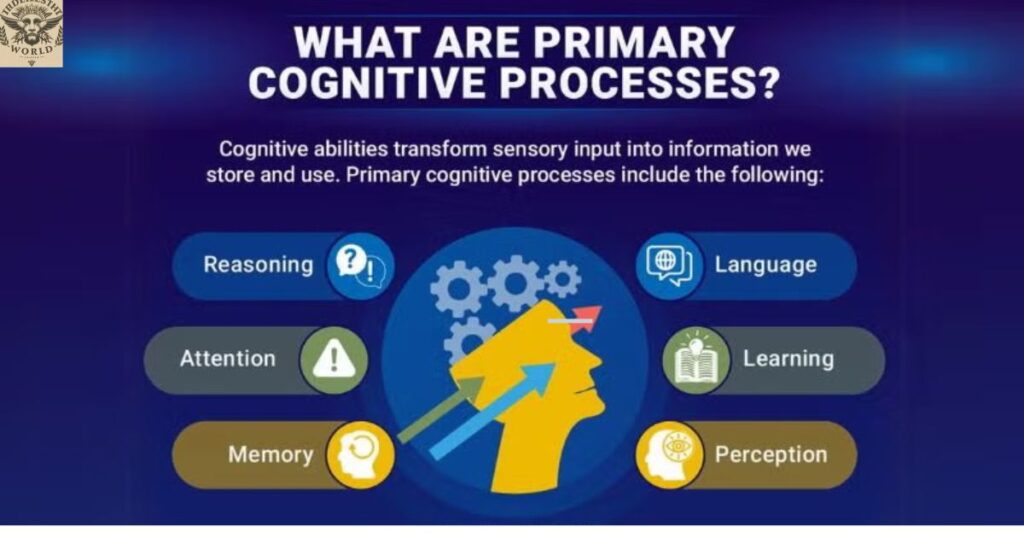
Cognitive skills are mental abilities used to process information and complete tasks. Strong cognitive skills can support learning, communication, work, and everyday decision-making.
Attention
Attention allows a person to focus on specific information while ignoring distractions.
For example, a student may need to listen to a teacher while other students are talking. The ability to concentrate on the lesson involves attention.
Memory
Memory allows people to store and retrieve information. It helps with everything from remembering a person’s name to recalling information for an exam.
Memory can include short-term and long-term processes.
Reasoning
Reasoning involves using information to reach a conclusion. People use reasoning when comparing options, understanding relationships, and solving problems.
For example, someone may compare the cost and quality of two products before making a purchase.
Problem-Solving
Problem-solving involves identifying an issue, considering possible solutions, and selecting an appropriate response.
Everyday examples include repairing a device, finding a different route to work, or figuring out how to complete a difficult assignment.
Language Processing
Language processing allows people to understand spoken and written communication and express their own ideas.
Reading a paragraph and understanding its message requires several cognitive processes working together.
Processing Speed
Processing speed refers to how quickly the brain can understand and respond to information.
For example, a person may quickly understand a simple question and provide an answer. More complex information may require additional processing time.
Executive Function
Executive functions help people organize thoughts and actions. They include planning, self-control, flexible thinking, working memory, and decision-making.
These abilities are important for school, work, relationships, and daily responsibilities.
Cognitive Meaning and Cognitive Ability
Cognitive ability refers to a person’s capacity to think, learn, understand, remember, reason, and solve problems.Different cognitive abilities can vary from person to person. Someone may have excellent memory but need more time to process complex information. Another person may be very strong at problem-solving but struggle to remember detailed instructions.
Cognitive ability is therefore not simply one skill. It involves several mental abilities that contribute to how people learn and respond to information.
Read More: Brat Meaning: Definition, Old Meaning, Modern Slang, and Examples
Cognitive Development Meaning

Cognitive development describes changes in thinking and mental abilities as a person grows.Children gradually develop abilities such as:
- Understanding language
- Remembering information
- Recognizing patterns
- Solving problems
- Understanding cause and effect
- Making decisions
- Controlling attention
- Developing logical thinking
Cognitive development continues throughout life. Learning, education, experience, social interaction, and the environment can all contribute to changes in thinking abilities.
Cognitive Development in Children
Children develop cognitive abilities rapidly during early life. They learn how objects work, recognize familiar people, understand language, remember experiences, and gradually develop more complex reasoning.
For example, a young child may initially learn through direct experience. Later, the child may begin to understand abstract ideas, follow complicated instructions, and solve more challenging problems.
Parents and teachers can support cognitive development by encouraging reading, conversation, creative activities, puzzles, age-appropriate games, and problem-solving tasks.
Cognitive Meaning in Education
The cognitive meaning is especially important in education because learning depends heavily on mental processes.When students study a subject, they need to pay attention, understand information, connect new ideas with existing knowledge, remember important facts, and apply what they have learned.
Teachers can support cognitive learning by asking questions, using examples, encouraging discussion, and giving students opportunities to solve problems.
For example, memorizing a mathematical formula may involve memory, while using the formula to solve a new problem requires understanding and reasoning.
Cognitive Learning
Cognitive learning focuses on gaining knowledge through mental processes such as understanding, thinking, remembering, and problem-solving.Instead of simply repeating information, cognitive learning encourages a person to understand how and why something works.
For example, a student who memorizes a grammar rule may remember it for a short period. A student who understands why the rule works may be better able to apply it in different situations.
Cognitive Meaning in Everyday Life
The cognitive meaning is not limited to classrooms or psychology textbooks. Cognitive processes are part of everyday life.Consider a simple morning routine. A person wakes up, remembers the day’s schedule, decides what to wear, reads messages, prepares breakfast, and plans the journey to work. Each activity involves different mental processes.
Shopping also requires cognitive skills. A customer may compare prices, remember previous experiences with a brand, read product information, and decide which option offers better value.Even conversations involve cognition. People listen to words, interpret meaning, remember previous statements, and prepare responses.
Cognitive vs Emotional
Cognitive and emotional processes are related but not identical.
Cognitive generally refers to thinking, understanding, memory, reasoning, and information processing.
Emotional refers to feelings and emotional responses such as happiness, sadness, anger, fear, excitement, or disappointment.
However, cognition and emotion can influence each other.
For example, a person may interpret a situation negatively and then experience worry. In another situation, a positive interpretation may lead to greater confidence.
This connection is important in psychology and especially relevant to cognitive behavioral therapy.
Cognitive Meaning and Behavior
Thoughts can influence behavior. A person’s interpretation of an event may affect how that person responds.
For example, imagine a student receives a lower grade than expected. One interpretation might be, “I can learn from my mistakes and improve.” Another interpretation might be, “I am not capable of learning.”
The two interpretations can lead to different behaviors. The first may encourage studying, while the second may lead to avoidance.This does not mean every behavior is caused by thoughts alone. Human behavior is influenced by many factors, including emotions, environment, physical conditions, social experiences, and habits.
What Is Cognitive Behavioral Therapy (CBT)?
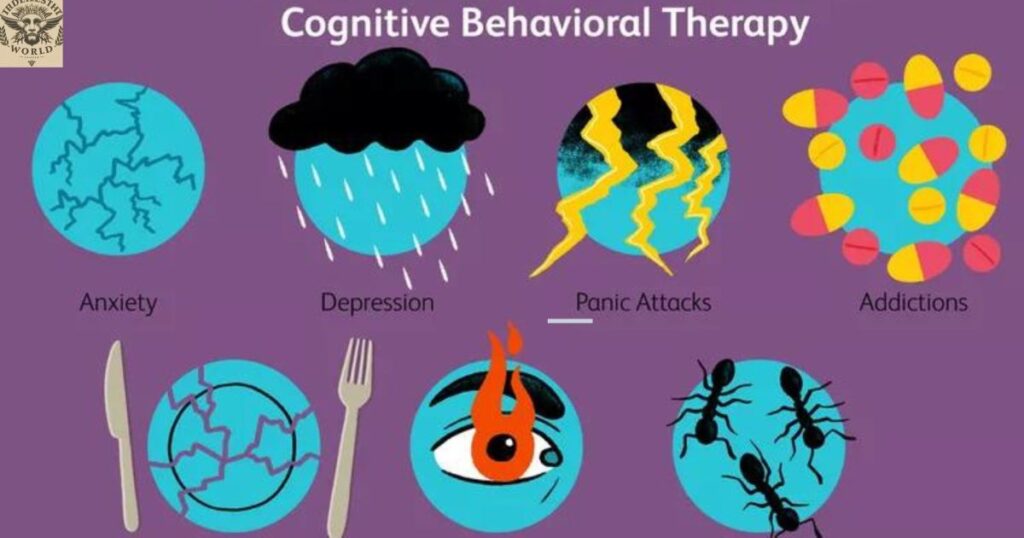
Cognitive behavioral therapy (CBT) is a structured form of talking therapy that focuses on the connection between thoughts, feelings, and behaviors.CBT can help people identify unhelpful thinking patterns and develop more balanced ways of responding to difficult situations. A therapist may work with a person to examine thoughts, recognize patterns, and practice healthier behaviors.
In simple terms, CBT looks at how the way a person interprets situations can influence feelings and actions. It can be used for several mental health concerns and is commonly discussed in psychology.The main idea connects strongly with the cognitive meaning because CBT focuses partly on thinking patterns and how they relate to behavior.
Cognitive Behavioral Therapy Example
Imagine someone makes a small mistake at work.
The person may think:
- “I made one mistake, so I am terrible at my job.”
That thought may produce embarrassment or anxiety. The person may then avoid speaking during future meetings.CBT may help the person examine the thought and consider a more balanced interpretation, such as:
- “I made a mistake, but one mistake does not define my entire ability.”
The goal is not to replace every negative thought with unrealistic positive thinking. Instead, CBT generally encourages more accurate and balanced thinking.
Cognitive Distortions
Cognitive distortions are patterns of thinking that may lead to inaccurate or unhelpful interpretations.
Examples include:
- All-or-nothing thinking
- Overgeneralization
- Catastrophizing
- Mind reading
- Jumping to conclusions
- Personalization
- Excessive negative filtering
For example, saying “I always fail” after one unsuccessful experience may be an example of overgeneralization.
Recognizing these patterns can help people examine their thoughts more carefully.
Cognitive Meaning and Memory
Memory is one of the most important areas connected with cognitive meaning.Memory allows people to encode, store, and retrieve information. It helps people learn from previous experiences and use past knowledge in new situations.
There are different types of memory, including:
- Working memory
- Short-term memory
- Long-term memory
- Episodic memory
- Semantic memory
- Procedural memory
For example, remembering a birthday is different from remembering how to ride a bicycle. Both involve memory but rely on different forms of stored information.
Cognitive Meaning and Perception
Perception involves how the brain organizes and interprets information received through the senses.
For example, the eyes receive visual information, but the brain must interpret that information to recognize an object.
Perception is influenced by previous knowledge, expectations, attention, and context. As a result, people can sometimes interpret the same situation differently.
Cognitive Meaning and Decision-Making
Decision-making is another important cognitive function.People make decisions throughout the day, from choosing food to selecting a career path. Simple decisions may require little conscious thought, while major decisions can involve extensive comparison and reasoning.
Good decision-making often involves identifying available information, considering possible consequences, comparing alternatives, and choosing an option.However, human decisions are not always perfectly logical. Emotions, habits, social pressure, previous experiences, and cognitive biases can influence choices.
Cognitive Bias Meaning
A cognitive bias is a predictable pattern that can influence judgment or decision-making.Some common examples include:
- Confirmation bias
- Availability bias
- Anchoring bias
- Halo effect
- Hindsight bias
Confirmation bias, for example, involves a tendency to give more attention to information that supports an existing belief.Understanding cognitive biases can help people become more aware of how they make decisions.
Cognitive Meaning and Critical Thinking
Critical thinking involves carefully examining information before accepting a conclusion.A person using critical thinking may ask:
- What evidence supports this claim?
- Is the source reliable?
- Are there alternative explanations?
- Is the conclusion based on facts?
- Could personal bias affect the judgment?
Critical thinking uses several cognitive skills, including reasoning, attention, analysis, and evaluation.
Cognitive Function Meaning
Cognitive function refers to the mental abilities involved in thinking and processing information.Common cognitive functions include:
- Attention
- Memory
- Language
- Reasoning
- Learning
- Planning
- Decision-making
- Problem-solving
People use cognitive functions throughout daily life, often without consciously thinking about them.
For example, following a recipe requires reading, attention, memory, sequencing, and decision-making.
Cognitive Health
Cognitive health refers to the ability to think, learn, remember, and perform mental tasks effectively.Several healthy lifestyle habits can support overall brain and cognitive health, including:
- Regular physical activity
- Adequate sleep
- A balanced diet
- Social engagement
- Mental stimulation
- Learning new skills
- Managing stress
These habits do not guarantee perfect cognitive performance, but they can support general health and well-being.
Cognitive Activities
Cognitive activities challenge different mental skills.
Examples include:
- Reading
- Writing
- Learning a language
- Playing strategy games
- Solving puzzles
- Learning an instrument
- Doing mathematics
- Discussing complex topics
- Practicing memory exercises
- Learning new practical skills
Different activities challenge different cognitive processes. Reading may involve language and memory, while chess can involve planning and strategic reasoning.
Cognitive Meaning for Students
Students can benefit from understanding the cognitive meaning because learning is strongly connected with mental processing.
Instead of focusing only on memorization, students can improve learning by:
- Understanding concepts.
- Connecting new information with existing knowledge.
- Asking questions.
- Practicing active recall.
- Reviewing information regularly.
- Solving problems.
- Explaining ideas in their own words.
For example, explaining a science concept to another student can reveal whether the idea has actually been understood.
Cognitive Meaning at Work
Cognitive skills are important in almost every profession.A software developer may use logical reasoning and problem-solving. A teacher may use attention, memory, communication, and planning. A designer may use perception, creativity, decision-making, and visual processing.
Modern workplaces often require employees to process large amounts of information. Strong cognitive skills can help people prioritize tasks, understand instructions, solve problems, and adapt to new situations.
Cognitive Meaning in Social Situations
Social interactions also require cognitive processing.During a conversation, people listen to words, interpret tone, remember previous information, understand context, and decide how to respond.People also use social cognition to interpret the behavior and intentions of others.
For example, if a friend speaks quietly, a person may consider whether the friend is tired, upset, distracted, or simply speaking softly. The brain uses available information and previous experience to interpret the situation.
Cognitive Meaning and Language
Language is closely connected with cognition.People use cognitive processes to understand vocabulary, grammar, sentence structure, context, and meaning.Learning a new word requires attention and memory. Using the word correctly also requires understanding its context.
For example, the word “bright” can describe light, intelligence, or color depending on the sentence. Understanding the intended meaning requires language processing and context.
Cognitive Synonyms
The exact synonym for “cognitive” depends on the context.
Possible related words include:
- Mental
- Intellectual
- Reasoning
- Thinking
- Analytical
- Perceptual
- Psychological
- Rational
- Thought-related
However, these words are not always perfect replacements.
For example, “mental” has a broader meaning than “cognitive.” Cognitive usually focuses more specifically on mental processes related to knowledge, thinking, and information processing.
Read More: Clout Meaning Definition, Examples, Clout Chaser, and How to Use It
Cognitive Antonyms
There is no single perfect antonym for “cognitive” in every situation.
Depending on the context, contrasting ideas may include:
- Physical
- Motor
- Non-mental
- Automatic
For example, cognitive skills involve thinking and information processing, while motor skills involve physical movement and coordination.
Cognitive vs Motor Skills
Cognitive and motor skills are different but can work together.
Cognitive skills involve mental activities such as memory, attention, reasoning, and problem-solving.
Motor skills involve physical movement and coordination.
Driving provides a useful example. A driver needs cognitive skills to understand road signs and make decisions. At the same time, motor skills are required to control the steering wheel and pedals.
Cognitive vs Intellectual
The words “cognitive” and “intellectual” are related but not identical.Cognitive refers broadly to mental processes involved in understanding and processing information.Intellectual often describes mental ability, knowledge, reasoning, or academic thinking.
For example, memory is a cognitive function, while intellectual ability may refer more broadly to a person’s capacity for reasoning and learning.
Why Is Cognitive Understanding Important?
Understanding the cognitive meaning helps people recognize how the brain processes information.It can make psychology terms easier to understand and can also improve awareness of learning, memory, decision-making, and behavior.
Students can use the concept to understand how they learn. Professionals can use it to think about problem-solving and decision-making. Parents can use it to understand aspects of children’s development.The concept is broad, but its basic idea is simple: cognition is about how the mind works with information.
Frequently Asked Questions :
What does cognitive mean in simple words?
Cognitive means related to thinking, learning, understanding, remembering, reasoning, and processing information. Reading, problem-solving, decision-making, and memory are common examples of cognitive activities.
What is the cognitive meaning in psychology?
In psychology, cognitive refers to mental processes such as perception, attention, memory, learning, language, reasoning, and decision-making.
What is an example of cognitive behavior?
Studying for an exam, solving a puzzle, comparing two choices, remembering instructions, and planning a task are examples of activities involving cognitive processes.
What is cognitive behavioral therapy (CBT)?
Cognitive behavioral therapy, commonly called CBT, is a structured talking therapy that focuses on the relationship between thoughts, feelings, and behaviors.
What are the main cognitive skills?
Common cognitive skills include attention, memory, reasoning, language processing, problem-solving, decision-making, processing speed, planning, and executive function.
Conclusion
The cognitive meaning describes anything related to thinking, understanding, learning, remembering, reasoning, and processing information. Cognitive processes are involved in almost every part of daily life, from reading and studying to making decisions and communicating with other people.
Understanding cognition can also make related concepts easier to understand, including cognitive skills, cognitive development, cognitive function, cognitive psychology, cognitive biases, and cognitive behavioral therapy. Whether the topic is education, psychology, work, or everyday decision-making, cognition plays an important role in how people understand and respond to the world.

