

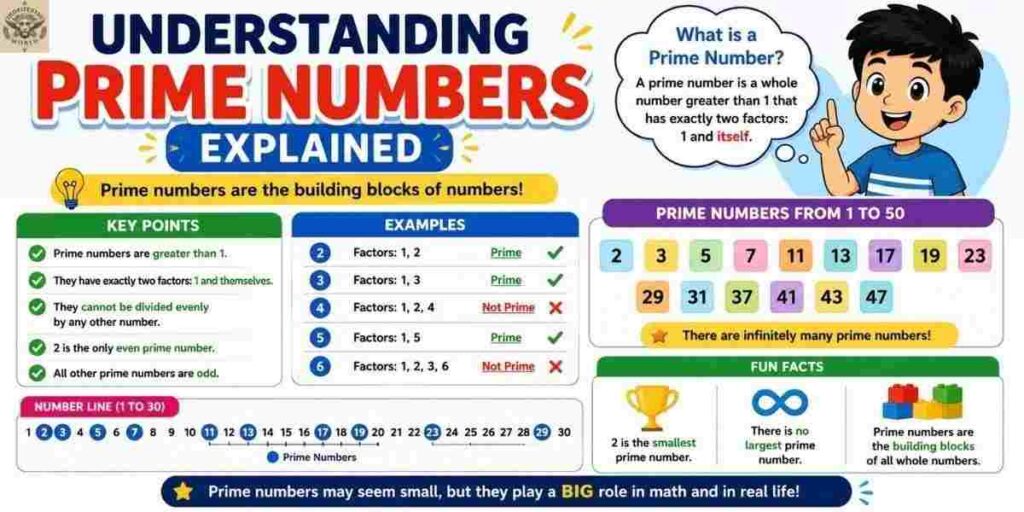
Prime numbers are among the simplest ideas in mathematics, yet they support many important concepts in arithmetic and number theory. A prime number has a special relationship with its factors: it can be divided evenly only by 1 and itself. Learning this idea makes it easier to understand multiplication, the difference between prime and composite numbers.
When students first meet prime numbers, how a large number can be checked efficiently. The key is to focus on divisibility and positive divisors rather than simply looking at whether a number is odd or even. Once the basic pattern becomes familiar, solve HCF and LCM problems, and understand why these numbers matter in mathematics and technology.
Composite numbers
A composite number is a whole number greater than 1 that has more than two positive divisors. For example, 12 has factors 1, 2, 3, 4, 6, and 12, so it is composite. A prime number, by comparison, has exactly two positive factors. This distinction gives us a simple way to understand the prime number definition and separate prime numbers from composite numbers.
Composite numbers can be created by multiplying smaller numbers together. For example, 18 equals 2 × 9 and also 3 × 6. These relationships make factors useful when learning prime numbers in math. The difference between prime and composite numbers also explains why every whole number greater than 1 belongs to one of these two categories.
Prime numbers 1 to 100
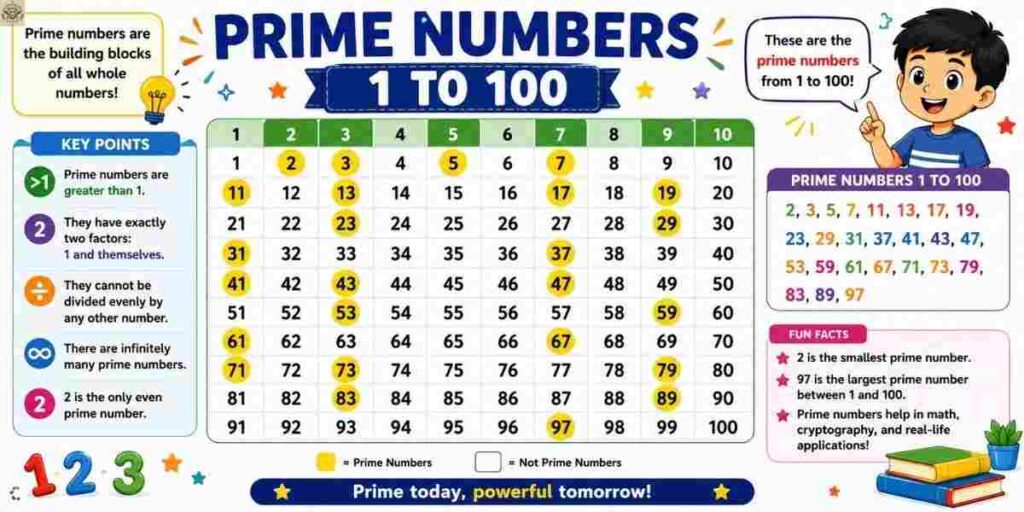
The prime numbers between 1 and 100 are:
2, 3, 5, 7, 11, 13, 17, 19, 23, 29, 31, 37, 41, 43, 47, 53, 59, 61, 67, 71, 73, 79, 83, 89, and 97.
This list of prime numbers contains 25 values. Notice that 1 does not appear because it has only one positive factor. The smallest prime number is 2, and it is also the only even prime number. Every other even number greater than 2 is divisible by 2 and therefore has more than two factors.
For students learning how to identify a prime number, checking small divisors is usually enough. A number such as 29 cannot be divided evenly by 2, 3, 5, or 7, so it is prime. In contrast, 35 is divisible by 5 and therefore composite. These examples of prime numbers make the basic rule easier to recognize.
Prime numbers and composite numbers
Prime versus composite numbers can be understood through factors. A prime number has exactly two factors, while a composite number has three or more. The phrase numbers with exactly two factors is therefore a useful shortcut for remembering what makes a number prime.
For example, 7 has factors 1 and 7, so it is prime. The factors of a prime number are always 1 and the number itself. On the other hand, 16 has factors 1, 2, 4, 8, and 16, making it composite. Looking at positive factors is more reliable than guessing from the appearance of a number.
Divisibility also provides a practical test. If a number greater than 1 can be divided by another whole number and the result has no remainder, that divisor can help prove the number is composite. However, being odd does not automatically make a number prime. Numbers such as 9, 15, 21, and 25 are odd numbers but composite.
Prime numbers 1 to 1000
As the range becomes larger, checking every possible divisor becomes inefficient. To identify prime numbers from 1 to 1000, mathematicians use systematic methods. A composite number must have at least one prime factor that is less than or equal to its square root. This means a number does not need to be tested against every smaller number.
For example, to test 997, its square root is a little less than 32. Therefore, checking divisibility by prime numbers up to 31 is sufficient. Since 997 is not divisible by 2, 3, 5, 7, 11, 13, 17, 19, 23, 29, or 31, it is prime.
The same principle helps when working with larger numbers. Instead of trying every possible divisor, focus on relevant prime factors. This approach improves divisibility testing and helps learners recognize prime numbers efficiently.
Read More:Understanding Whole Numbers and Their Type
Prime numbers in Python
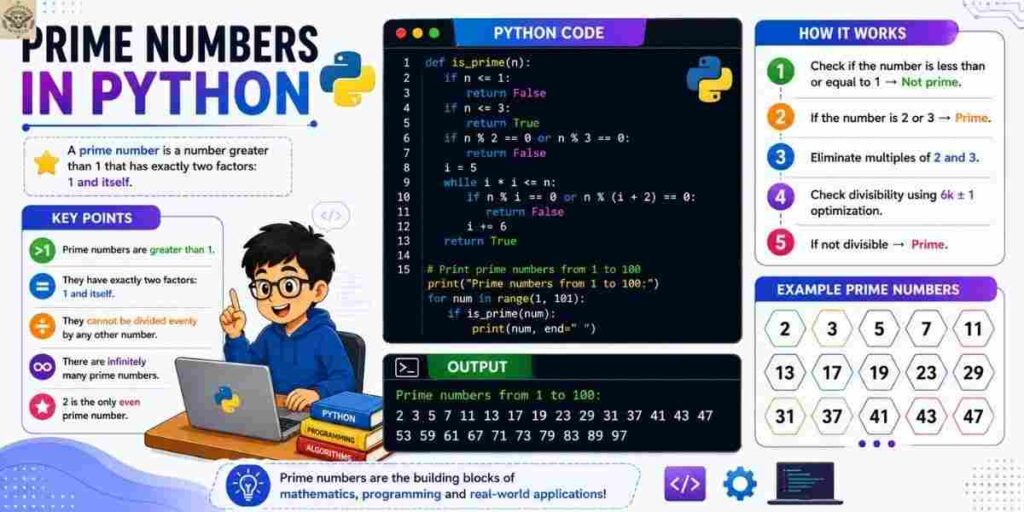
Prime numbers are also useful in programming because computers often need to determine whether a number is prime. A simple Python approach can test whether a number is divisible by integers from 2 through the square root of that number. If a divisor is found, the number is composite. If none is found, the number is prime.
A more efficient program can test only relevant prime candidates or use established primality testing algorithms. Programming exercises involving prime numbers help students connect mathematics with logical thinking, loops, conditions, and algorithms.
For example, a beginner might write a program that checks whether the remainder after division is zero. If the remainder is zero for a divisor other than 1 and the number itself, the number is composite. This demonstrates how the mathematical concept of divisibility can become a computer instruction.
Prime numbers list
A prime numbers list is useful for both students and programmers. The first several values are 2, 3, 5, 7, 11, 13, 17, 19, 23, and 29. Continuing the list gives 31, 37, 41, 43, 47, 53, 59, 61, 67, and 71.
The first prime number is 2. There is no largest prime number because there are infinitely many prime numbers. This is an important idea in mathematics number theory. Even though primes become less frequent as numbers grow, new ones continue to appear.
A common mistake is to assume that every number with no obvious small factor is automatically prime. Large numbers require a more careful test. For instance, a number may look unusual but still have a hidden factor. Systematic checking prevents this error.
Prime numbers 1 to 200
The prime numbers 1 to 200 extend the familiar list beyond 100. After 97, the next values include 101, 103, 107, 109, 113, 127, 131, 137, 139, 149, 151, 157, 163, 167, 173, 179, 181, 191, 193, 197, and 199.
This range is useful for practice because it includes two digit and three digit examples. When students practice prime number questions, they can begin by eliminating even numbers greater than 2, numbers ending in 5 other than 5, and numbers whose digits have a sum divisible by 3.
These shortcuts are examples of divisibility rules. They do not identify every prime automatically, but they quickly eliminate many composite candidates. The remaining candidates can then be tested using other factors.
Non prime numbers
Non prime numbers include both composite numbers and the number 1. It is important not to call 1 a composite number because it does not have more than two factors. It is also not prime because it has only one positive divisor.
The distinction becomes clearer when considering factor pairs. A composite number has additional factor relationships, while a prime number has only one factor pair: 1 and itself. For example, 11 has only 1 × 11, whereas 12 can be represented as 1 × 12, 2 × 6, and 3 × 4.
Even and odd numbers can provide useful clues, but they are not complete tests. The only even prime is 2. Odd numbers can be prime or composite, so students should always check divisibility rather than relying only on whether a number is odd.
How to identify a prime number
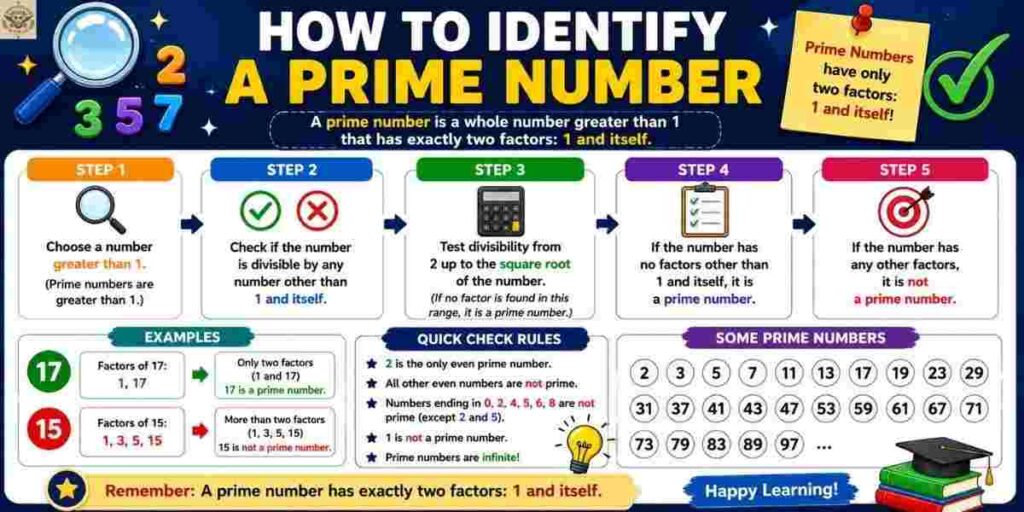
To identify a prime number, begin with a number greater than 1. Ask whether it can be divided evenly by any number other than 1 and itself. If such a divisor exists, the number is composite. If no suitable divisor exists, it is prime.
A practical method is:
- Check whether the number is 2. If it is, the number is prime.
- Check whether it is divisible by 2. If yes, it is composite.
- Check divisibility by 3 and 5.
- Continue with relevant prime divisors up to the square root.
- If no divisor produces a zero remainder, the number is prime.
For example, consider 47. It is not divisible by 2, 3, 5, or 7. Because the square root of 47 is less than 7, no larger prime divisor needs to be checked. Therefore, 47 is prime.
This process explains how to identify a prime number without unnecessary calculations. It also helps students recognize prime numbers when completing arithmetic exercises.
Prime factorisation and the Fundamental Theorem of Arithmetic
Prime factorisation means writing a composite number as a product of prime factors. For example, 60 can be written as 2 × 2 × 3 × 5, or 2² × 3 × 5. These prime factors are the basic building blocks of the original number.
The fundamental theorem of arithmetic states that every integer greater than 1 is either prime or composite, and every composite integer has a unique prime factorization apart from the order of its factors. This makes prime factorisation extremely useful in mathematics.
For example:
72 = 2 × 2 × 2 × 3 × 3
So the product of prime factors is 2³ × 3².
Prime factorisation can also help solve HCF and LCM problems. For HCF, common factors are selected with the smallest powers. For LCM, the relevant prime factors are selected with the greatest powers. This shows the connection between factors and multiples and everyday arithmetic procedures.
Applications of prime numbers
Prime numbers have important applications beyond classroom exercises. In number theory, they help explain how integers are structured. They also appear in algorithms, computer science, and security systems.
One major example is cryptography. Modern encryption and prime numbers are closely connected because some encryption systems use mathematical problems involving large prime factors. The RSA method, for example, depends on the difficulty of factoring very large numbers into their prime components.
Prime numbers in cryptography demonstrate why a basic mathematical idea can have practical technological importance. BBC News and educational resources such as brilliant.org may discuss mathematics, computing, and encryption in different contexts, but the underlying principle remains the same: prime factorization creates useful mathematical structure.
The idea also connects with other areas of mathematics. Topics such as roots of unity, modular arithmetic, and even the cone volume formula belong to different mathematical areas, but they show how mathematical concepts can interact across geometry, algebra, and number theory.
Largest and smallest prime numbers
The smallest prime number is 2. It has exactly two positive factors, 1 and 2. It is also the only even prime number. Every other prime is odd because every even number greater than 2 is divisible by 2.
There is no largest prime number. Euclid’s classic argument shows that prime numbers are infinite in quantity. If someone creates a list of all known primes, mathematics can still demonstrate that another prime must exist beyond that list.
This is different from asking for the largest known prime number, which can change as computational searches discover larger examples. Therefore, the phrase largest prime number has no finite answer, while largest known prime refers to the biggest one discovered at a particular time.
Prime numbers and divisibility
Divisibility is one of the easiest ways to understand whether a number is prime or composite. A number is divisible by another number when the division produces a whole number with no remainder.
For example, 18 is divisible by 2, 3, 6, and 9. Because it has several positive divisors, it is composite. The number 19, however, is divisible without remainder only by 1 and 19, so it is prime.
The remainder is especially useful when testing numbers. If dividing 23 by 2 leaves a remainder, and division by 3, 5, and 7 also leaves remainders, then the relevant tests have not found a factor. This simple process builds a strong foundation for later work in number theory.
Practice prime number questions
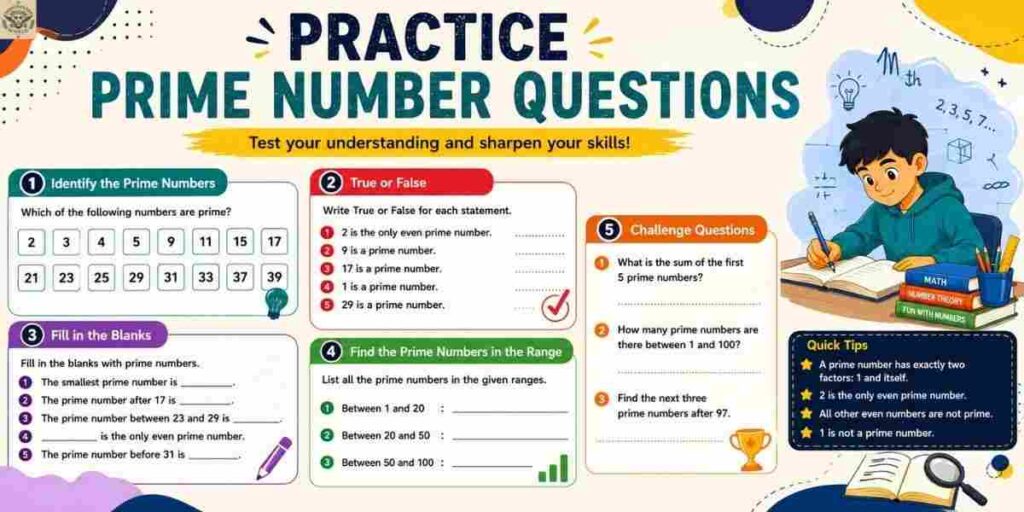
Practice helps students move from memorizing a definition to actually applying it. Try classifying these numbers as prime or composite: 13, 16, 21, 31, 39, 43, 51, and 59.
The answers are 13 prime, 16 composite, 21 composite, 31 prime, 39 composite, 43 prime, 51 composite, and 59 prime. Students can explain each answer by listing factors or applying divisibility rules.
Another useful exercise is to find the prime factors of 84. Start by dividing by 2:
84 = 2 × 42 = 2 × 2 × 21 = 2² × 3 × 7
This example demonstrates how prime factors can reveal the internal structure of a composite number and prepare students for HCF and LCM calculations.
Recommended articles
Students interested in related mathematics topics may also explore resources about metaphors, percentage reduction, divisibility, factors, and number theory. Although topics such as “What is a Metaphor?” are not mathematical, learning across subjects can strengthen vocabulary and communication skills.
Resources from Brilliant and brilliant.org can also provide additional mathematical practice. When exploring educational material, focus on explanations that show the reasoning behind an answer rather than simply providing a final result.
Uploaded by
Educational mathematics content can be prepared for learners who want a straightforward explanation of factors, divisibility, and number theory.
Share this document
Sharing a clear explanation can help students review prime numbers, compare examples, and practice identifying whether numbers are prime or composite.
You might also like
Readers may also enjoy lessons covering factors, multiples, HCF and LCM, divisibility rules, and basic number theory.
Footer menu
Use educational resources responsibly and check mathematical definitions carefully when studying.
Support
Support for mathematics learning can include worked examples, practice questions, visual explanations, and guided exercises.
Legal
Educational information should be used as a learning resource and checked against appropriate mathematical references when necessary.
Social
Mathematics learning can be shared through educational communities, study groups, and classroom discussions.
Get our free apps
Digital learning tools can make practice more convenient by providing exercises and immediate feedback.
Recommended articles
For further study, explore related topics involving factors, multiples, divisibility, prime factorization, and number theory.
What is a Metaphor?
A metaphor is a comparison in which one thing is described as another to communicate an idea more vividly. Although it is a language topic rather than arithmetic, it can improve students’ ability to explain mathematical ideas.
How To Work Out Percentage Reduction
Percentage reduction involves finding how much a quantity decreases relative to its original value. Understanding multiplication, division, fractions, and percentages can make these calculations easier.
Frequently ask question:
What is a prime number in maths?
A prime number in maths is a whole number greater than 1 with exactly two positive factors: 1 and itself. Examples include 2, 3, 5, 7, and 11.
How to explain prime numbers to a child?
Explain that a prime number can be shared evenly into groups only in two basic ways: one group containing the whole number or groups containing one item each. For example, 5 can be divided evenly only by 1 and 5.
What are the first 10 prime numbers?
The first 10 prime numbers are 2, 3, 5, 7, 11, 13, 17, 19, 23, and 29. These numbers are the beginning of the standard prime number sequence.
Which is prime number 1, 2, 3, 4, 5, 6?
Among 1, 2, 3, 4, 5, and 6, the prime numbers are 2, 3, and 5. Number 1 has only one factor, while 4 and 6 have more than two factors.
Why is 1 not a prime number?
The number 1 is not prime because a prime number must have exactly two positive factors. Number 1 has only one positive factor, which is 1 itself.
Conclusion
Prime numbers are whole numbers greater than 1 that have exactly two positive divisors: 1 and the number itself. The smallest prime number is 2, while 1 is neither prime nor composite. Understanding these rules makes it easier to distinguish prime numbers from composite numbers, use divisibility tests, and work with prime factorisation.
The importance of prime numbers extends far beyond simple arithmetic. They form a foundation of number theory, support HCF and LCM methods, and play an important role in cryptography and computer science. Once students understand how factors, multiples, divisibility, and remainders work together, prime number problems become much easier to solve.

