

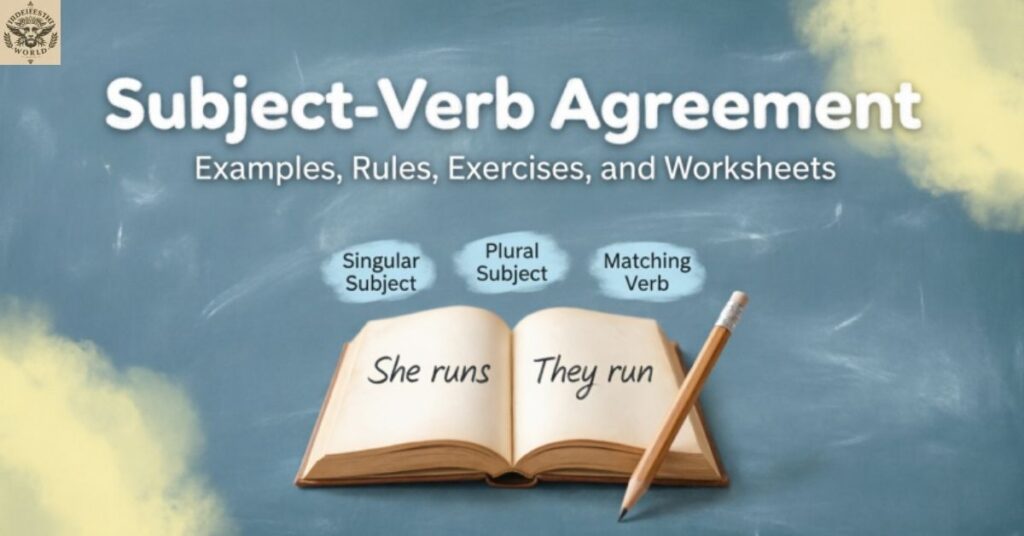
Subject-verb agreement is the grammar rule that requires a verb to match its subject in number. Singular subjects pair with singular verbs, and plural subjects pair with plural verbs. It sounds like a small detail, but it’s the backbone of clear, correct sentences in English. Get it wrong, and even a strong sentence can sound clumsy or confusing.
Here’s the part most grammar guides skip: this rule isn’t just something you memorize for a test, it’s the difference between writing that flows and writing that stumbles. One misplaced “is” instead of “are,” one “has” where “have” belongs, and readers notice, even if they can’t say why. Stick with us, because by the end of this guide you’ll be able to spot and fix these slip ups instantly. That skill carries into everything you write, from emails to exams.
Is Everyone Singular or Plural in Grammar
Before we go further, it helps to settle a related question: is everyone singular or plural? In standard English, “everyone” is treated as grammatically singular. You can remember this by noticing the word itself: “every-one” refers to each individual member of a group, one person at a time, not the group as a whole.
This is why we say:
- Everyone has his or her book. ✅
- Everyone have their book. ❌ (non-standard)
Because everyone is singular, in a plain statement it pairs with “has,” not “have.” This is also why “his or her agreement” shows up with singular indefinite pronouns; grammatically, you’re referring to one unspecified individual, not a group.
Read More: I am live in Ludhiana so when I come to lpu
Everyone Has or Have – The Core Rule
So if everyone is singular, why does “everyone has or have” sometimes flip depending on the sentence? The answer lies in whether you’re writing a statement or a question.
- Statement: Everyone has a book.
- Question: Does everyone have a book?
In both cases, the underlying subject “everyone” is singular. What changes is which word in the sentence is actually responsible for showing that agreement.
Why Indefinite Pronouns Like Everyone Take Singular Verbs
Everyone belongs to a group of singular indefinite pronouns that includes everyone, everybody, everything, anyone, someone, and no one. None of these words are collective nouns describing a group as a single unit; they’re indefinite pronouns referring to individuals within a group, considered one at a time. That distinction between collective noun and indefinite pronoun is exactly why they take singular verbs even though the meaning feels plural.
Has Everyone or Have Everyone – Understanding Question Formation

Now here’s where most confusion happens. People search “has everyone or have everyone” expecting a simple singular/plural answer, but English question formation works differently from statement formation.
The Do/Does Agreement Rule
In present simple questions, English uses an auxiliary verb, “do” or “does,” placed at the start of the sentence. This is the do/does agreement rule: “does” is used with third-person singular subjects (he, she, it, everyone, everybody), and “do” is used with everything else.
Once “does” appears, it already signals singular agreement. The main verb that follows it drops back to its base form.
Auxiliary Verb vs Main Verb Agreement
This is the heart of the auxiliary verb agreement rule, also called the helping verb rule: only one verb in the sentence carries the subject-verb agreement, and in a question, that job belongs to the auxiliary verb, not the main verb.
Compare:
- Jake runs fast. (no auxiliary verb; main verb carries agreement)
- Does Jake run fast? (auxiliary verb carries agreement; main verb reverts to base form)
Nobody says “Does Jake runs fast?” and by that same logic, nobody should say “Does everyone has his or her book?” The auxiliary “does” has already confirmed the singular subject. Adding “has” as well would be doubling up on agreement, which English doesn’t allow.
Everyone Has vs Everyone Have – Statement vs Question
Putting it together, here’s the full comparison in words:
- Everyone has, correct in a declarative statement, since there’s no auxiliary verb present.
- Everyone have, correct only right after “does” or another auxiliary, in a question.
- Does everyone have, correct, because “does” carries the agreement.
- Does everyone has, incorrect, because it agrees twice.
So when people ask about “everyone has vs everyone have,” the real answer depends entirely on sentence structure, not on whether “everyone” itself changes meaning.
Everybody Singular or Plural – Same Rule Applies
If you’re wondering whether “everybody singular or plural” follows a different pattern, it doesn’t. “Everybody” behaves exactly like “everyone”: grammatically singular, and subject to the same do/does agreement rule.
- Everybody has a chance at success.
- Does everybody have a chance at success?
The “everyone vs everybody” comparison shows the two words are interchangeable in formal usage; only “everyone” tends to sound slightly more formal.
His or Her Agreement with Singular Pronoun Rules
Because everyone and everybody are singular, formal English pairs them with singular possessive pronouns, “his or her,” rather than “their.” This is the classic “his or her agreement” pattern tested in formal writing and exams:
- Everyone should bring his or her own laptop.
In casual speech, “their” is now widely accepted as a gender-neutral singular (“Everyone should bring their own laptop”), but strict grammar and exam contexts still favor “his or her.”
American English vs British English Collective Nouns
One more nuance worth knowing is the American English vs British English collective nouns difference. In American English, collective and indefinite nouns like “everyone,” “team,” or “committee” are almost always treated as singular.
In British English, plural verbs are sometimes used with collective nouns when the group is thought of as individuals (“The team are arguing among themselves”). For exams based on American conventions, always default to singular treatment.
Does He Have vs Does He Has – More Examples
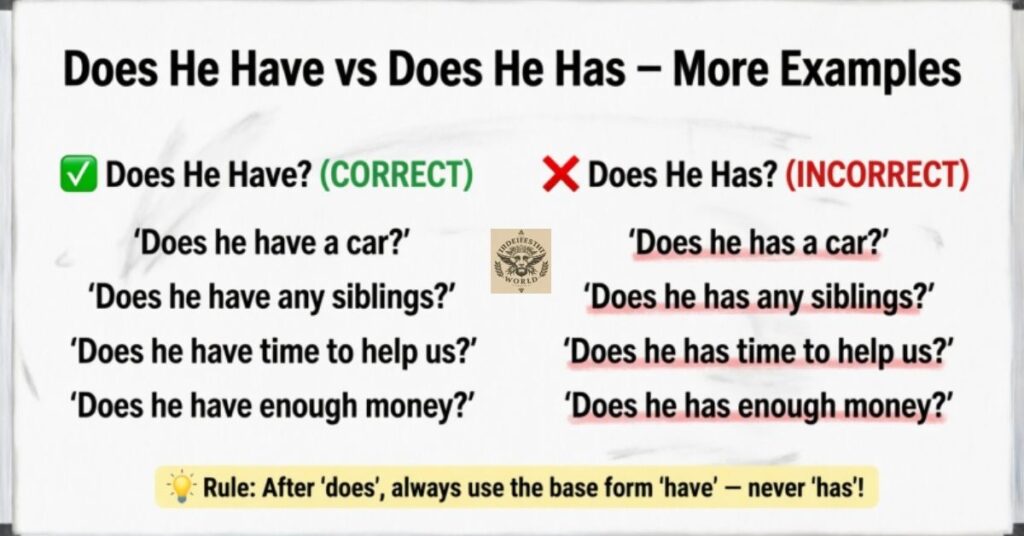
The same “does everyone have or has” logic extends to every singular subject:
- Does he have a car? ✅ / Does he has a car? ❌
- Does she have the report? ✅ / Does she has the report? ❌
- Does it have enough battery? ✅ / Does it has enough battery? ❌
Whenever you see “does he have vs does he has,” remember: “does” has already claimed the third-person singular verb form, so “have” stays in its base form no matter who the subject is.
GMAT Subject Verb Agreement Rules for Indefinite Pronouns
For students preparing for standardized tests, GMAT subject verb agreement rules treat everyone, everybody, everything, anyone, and someone strictly as singular. Sentence Correction questions frequently test whether a verb, pronoun, or possessive correctly matches these indefinite pronouns.
Why This Construction Won’t Appear in GMAT Sentence Correction
Interestingly, GMAT Sentence Correction questions are never written as actual interrogative sentences; the exam only tests declarative statements. So while understanding the present simple question rule is useful for general English grammar and competitive exam grammar rules broadly, the exact “Does everyone have” construction won’t appear as a testable GMAT SC item.
What the GMAT does test heavily is whether verbs, pronouns, and possessives correctly agree with singular indefinite pronouns in statements, for example catching an error like “Everyone should bring their own book” and correcting it to “his or her.”
Subject-Verb Agreement Examples
Seeing subject-verb agreement in action makes the rule click faster than any definition. Take “The dog barks loudly” versus “The dogs bark loudly,” and notice how the verb shifts with the subject. The same pattern shows up everywhere: “She writes every morning,” but “They write every morning.” Once you spot this shift, examples start appearing in emails, headlines, and everyday conversation.
Trickier examples involve indefinite pronouns, collective nouns, and compound subjects, where the obvious answer isn’t always correct. Consider “Neither of the students has finished,” where “neither,” not “students,” is the true subject. Or look at “The committee has voted,” where “committee” acts as one unit even though it’s made up of many people. These nuanced examples are exactly the kind tested in grammar exams, since they force writers to find the real subject.
Subject-Verb Agreement Exercises
Reading about grammar rules only gets you so far; real fluency comes from active practice. Exercises typically ask you to pick the correct verb form, spot and fix an error, or rewrite a sentence from singular to plural. This kind of repetition trains your ear to catch mismatches automatically. That’s especially valuable on timed tests like the GMAT, SAT, or IELTS, where speed and accuracy both matter.
Good exercises increase in difficulty gradually, starting with simple singular versus plural subjects and moving toward compound subjects, collective nouns, and indefinite pronouns like everyone or each. A well designed exercise set doesn’t just test whether you know the answer, it explains why that verb form is correct. This reinforces the underlying logic instead of encouraging guesswork. Practicing even ten minutes a day builds long term accuracy far better than memorizing rules in isolation.
Subject-Verb Agreement Rules
At its core, the rule states that a singular subject takes a singular verb, and a plural subject takes a plural verb. English complicates this with irregular verbs, indefinite pronouns, and subjects that look plural but function as singular, like “news” or “everyone.” Mastering these rules means learning the standard pattern along with the exceptions that trip up even confident writers.
Beyond the basic pairing, the rules also cover compound subjects joined by “and” (usually plural), subjects joined by “or” or “nor” (where the verb agrees with the closer one), and interrupting phrases that shouldn’t be mistaken for the true subject. In “The box of chocolates is on the table,” it’s “box,” not “chocolates,” that determines the verb. Understanding these layered rules turns agreement from a guessing game into a predictable, learnable system.
Subject-Verb Agreement Worksheet
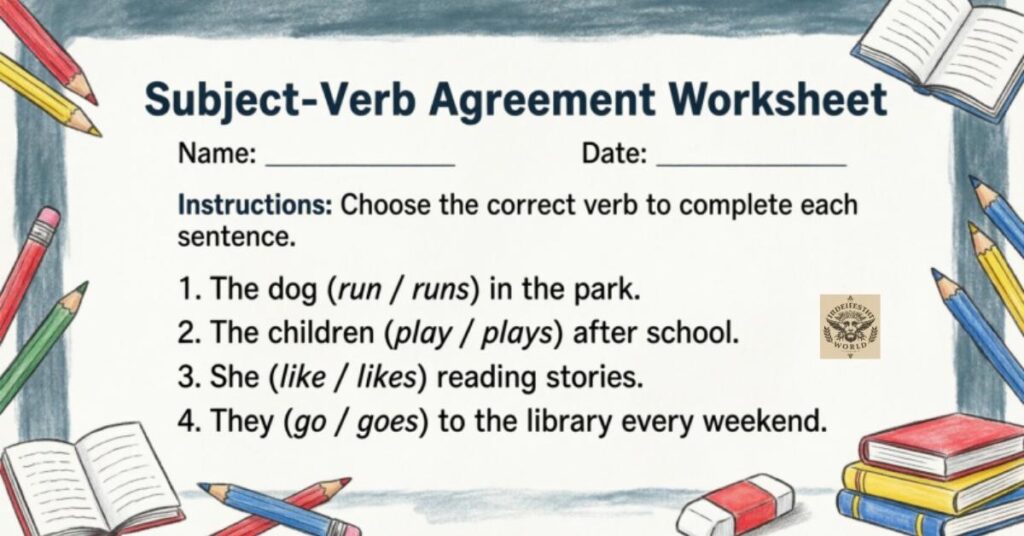
A well structured worksheet gives learners a hands on way to apply what they’ve studied, rather than just reading passively. Typical formats include fill in the blank sentences, multiple choice questions, and error correction tasks, often organized by difficulty level. Teachers use these in classrooms, while self learners rely on them for independent review before exams.
The most effective worksheet includes an answer key with brief explanations, not just correct answers, so learners understand the reasoning behind each choice. Combining worksheets that target specific problem areas, like indefinite pronouns or compound subjects, with regular review helps cement the rule permanently. For students preparing for competitive exams, mixing worksheets with timed exercises closely mirrors real test conditions. That makes exam day far less stressful.
Frequently Asked Questions
What is subject and verb agreement and examples?
The verb matches its subject in number, like “She writes” and “They write.”
What are the 10 rules of subject-verb agreement?
They cover singular vs plural subjects, ignoring interrupting phrases, “and” making subjects plural, “or/nor” matching the nearer subject, and singular indefinite pronouns.
What are the 6 rules of subject-verb agreement?
Singular subjects take singular verbs, plural subjects take plural verbs, collective nouns and indefinite pronouns stay singular, “and” makes subjects plural, and “or” agrees with the nearer subject.
What are the 12 rules of subject-verb agreement with examples?
It adds tricky cases like “Each of the boys plays” and “Neither of them is ready,” where the obvious verb choice is often wrong.
What are the 12 basic rules of grammar?
They cover agreement, tense, punctuation, parallel structure, and pronoun agreement, forming the base most style guides build on.
Conculsion:
Grammar rules feel confusing until you spot the one detail that explains everything, and with does everyone have or has, that detail is the auxiliary verb. Once “does” steps in to carry the singular agreement, “have” simply returns to its base form, and no double marking is needed. Writers who understand this stop guessing and start applying the rule with confidence, whether they’re checking a work email or reviewing a GMAT sentence.
Language rules feel demanding until you learn the one pattern that unlocks them, and with does everyone have or has, that pattern is the shift between statements and questions. Once you separate plain statements from auxiliary-led questions, “has” and “have” each find their proper place, and no ambiguity remains. Learners who grasp this stop second-guessing and start writing with clarity, whether they’re drafting a formal document or prepping for an exam.

