

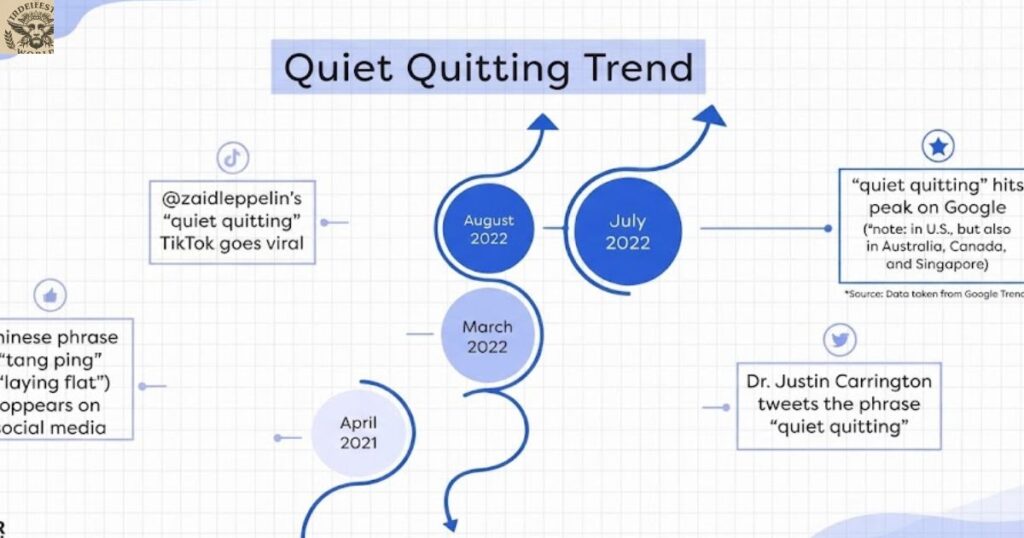
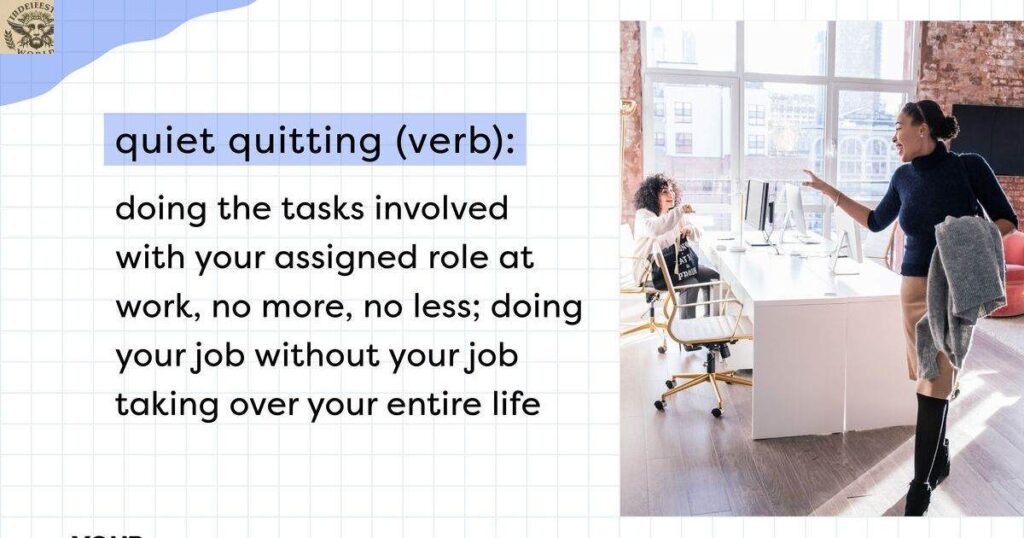
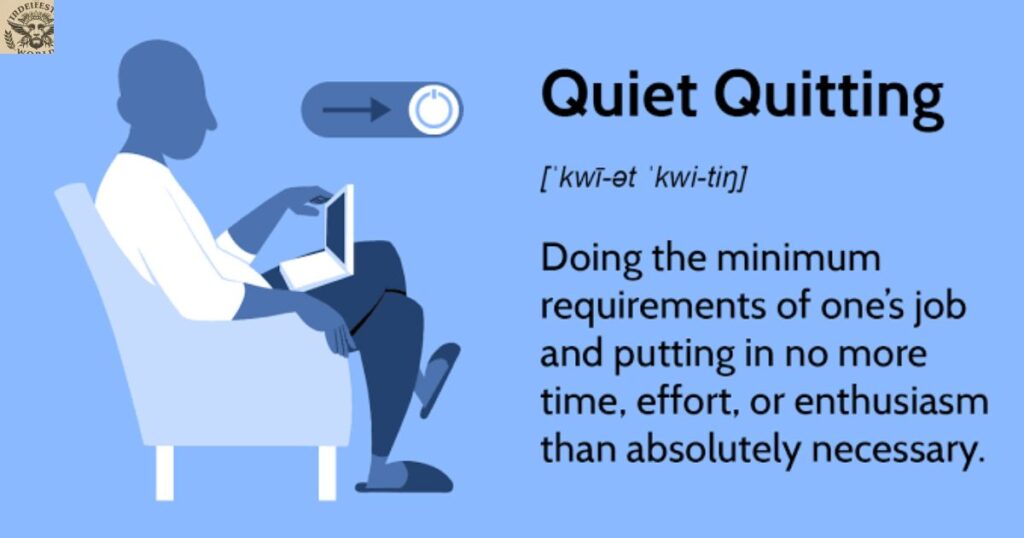
Quiet quitting means working within the main duties of a job without taking on constant extra work. An employee still comes to work, completes core tasks, and follows normal responsibilities. The idea focuses more on work boundaries than on leaving a job.The term became popular through social media and workplace discussions.
Many workers used it to describe a shift away from hustle culture. The focus moved toward fair working hours, personal time, employee well-being, and healthy workplace boundaries.Quiet quitting does not mean a formal resignation. A quiet quitter may still care about job quality and team goals. The main change involves limiting unpaid overtime, extra duties, and pressure to always go beyond the job description.
What Does Quiet Quitting Mean?
Quiet quitting mean completing the main responsibilities of a job without constantly adding extra effort. A worker follows the job description, completes required tasks, and works during agreed hours. Extra projects may not receive automatic acceptance.
The term also connects with employee engagement and workplace boundaries. A person may still produce good work while protecting personal time. Quiet quitting often appears after burnout, excessive workload, poor management, or a lack of recognition.
For example, an employee may finish all assigned tasks by 5 p.m. After work, the employee stops checking office messages. Such behavior can represent quiet quitting when the worker still completes core responsibilities during scheduled hours.
Quiet Quitting Mean in Simple English
In simple English, quiet quitting mean doing the job without treating work as every part of life. An employee performs required duties but avoids the idea that constant extra effort proves commitment. The approach creates a clearer line between work and personal life.
A quiet quitter may refuse unpaid overtime, skip optional projects, or avoid unnecessary after-hours communication. Such choices do not automatically show poor work performance. Context matters because healthy boundaries can look similar to disengagement.
Simple Example
Imagine a designer with a 9-to-5 schedule. Daily design tasks are completed carefully. At 5 p.m., work stops unless an urgent duty exists. Optional evening tasks are declined. Core job requirements still receive proper attention.
Does Quiet Quitting Mean Actually Quitting?
No. Quiet quitting does not mean submitting a resignation letter or leaving a company. An employee can remain in the same position for months or years. The person simply limits work to agreed duties and reasonable working hours.
Actual resignation creates a formal employment change. Quiet quitting usually creates a behavioral change inside an existing job. The employee stays, receives a salary, and completes core responsibilities.
| Quiet Quitting | Actual Resignation |
| Employee stays in the job | Employee leaves the job |
| Core duties continue | Employment ends |
| Work boundaries increase | Job search or transition may begin |
| No resignation letter is required | Formal notice is usually required |
| Personal time becomes a stronger priority | A new work situation may follow |
For example, an employee may stop answering messages during personal time but still complete every required task during office hours. That behavior differs from handing in a resignation letter.
How Did Quiet Quitting Become Popular?
Quiet quitting became widely discussed during the early 2020s. Social media helped spread the phrase. Workplace changes after the COVID-19 period also increased conversations about remote work, burnout, flexibility, and work-life balance.
The phrase gained strong attention through TikTok and other online platforms. Younger workers often discussed career expectations, personal time, and hustle culture. The topic then moved into business media and workplace management discussions.
The popularity also came from a simple workplace question: how much extra effort should an employee provide without extra recognition or compensation? That question helped the phrase connect with many workplace experiences.
Why Is Quiet Quitting Trending?
Quiet quitting remains a popular workplace topic because work expectations have changed. Remote work, hybrid work, flexible schedules, and digital communication can extend work into personal hours. Employees may receive messages long after a normal workday ends.
Burnout also plays a major role in workplace conversations. Heavy workloads can reduce motivation and job satisfaction. Employees may begin protecting personal time after feeling overworked or underappreciated.
Another reason involves changing career values. Some workers place greater importance on family, hobbies, health, education, and personal goals. A career can remain important without becoming the center of every waking hour.
What Does Quiet Quitting Look Like at Work?
Quiet quitting can appear through ordinary workplace behavior. A worker may complete assigned tasks, follow scheduled hours, and avoid optional duties. The person may also stop volunteering for repeated projects that fall outside the job description.
The behavior can appear in offices, remote teams, and hybrid workplaces. Examples include declining unnecessary meetings, refusing routine unpaid overtime, and disconnecting after working hours. Core job performance can still remain strong.
Read More:W Rizz Meaning: What Does W Rizz Mean in Gen Z Slang?
Workplace Examples
A customer support worker answers all assigned tickets during working hours. After the shift ends, personal time begins. An accountant completes monthly reports but stops accepting unrelated tasks from other departments.
A software developer finishes planned sprint work but does not regularly work late without compensation. A teacher completes school duties but avoids checking non-urgent messages late at night.
What Are the Common Signs of Quiet Quitting?
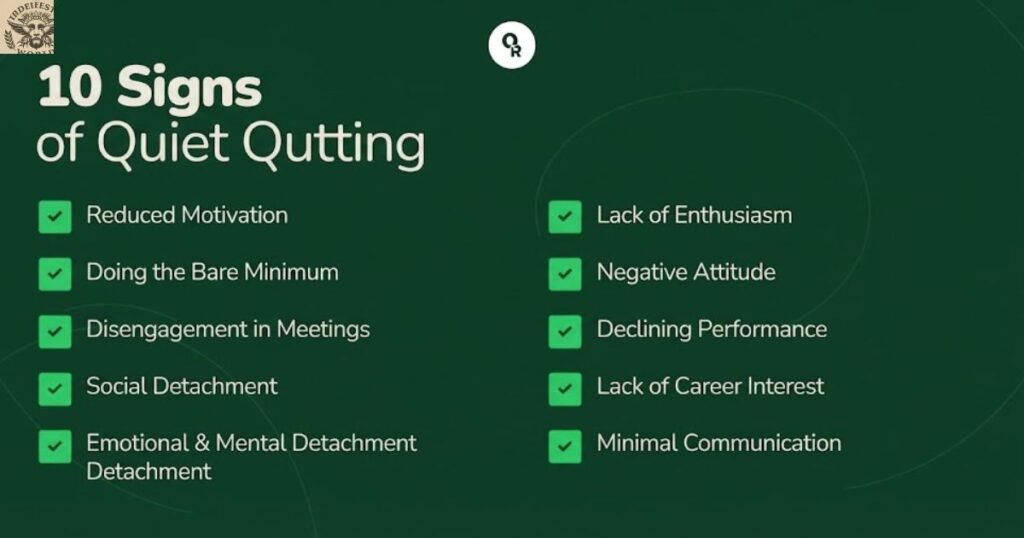
Signs of quiet quitting often involve reduced extra effort rather than complete job failure. An employee may stop volunteering for optional tasks. The person may also refuse frequent overtime or stop joining activities outside normal responsibilities.
Another sign can involve weaker initiative. An employee may perform core duties but show less interest in going above and beyond. After-hours communication may also decrease.
Common signs include:
- Refusing unnecessary overtime
- Avoiding extra projects
- Working only during scheduled hours
- Declining unrelated responsibilities
- Stopping unpaid after-hours work
- Taking normal breaks
- Avoiding unnecessary work calls
- Focusing on core job duties
- Reducing voluntary participation
- Protecting personal time
One sign alone does not prove employee disengagement. A worker may simply have strong professional boundaries. Managers need context before judging workplace behavior.
Why Do Employees Choose Quiet Quitting?
Employees may choose quiet quitting after long periods of stress. Excessive workload can reduce motivation. Poor management can also create frustration. A lack of recognition may make extra effort feel unrewarded.
Career problems can contribute too. Limited promotion opportunities, weak professional development, low compensation, and unclear expectations may reduce job satisfaction. Employees may decide that extra effort no longer creates meaningful career value.
| Common Cause | Possible Workplace Result |
| Heavy workload | Fatigue and reduced motivation |
| Poor management | Workplace dissatisfaction |
| Low recognition | Less willingness to give extra effort |
| Limited career growth | Lower career motivation |
| Low compensation | Frustration about added duties |
| Unclear expectations | Confusion about responsibilities |
| Burnout | Need for stronger boundaries |
| Toxic culture | Reduced employee engagement |
Quiet quitting can also develop after repeated promises fail to produce change. A worker may protect personal energy rather than continue an exhausting pattern.
How Does Burnout Lead to Quiet Quitting?
Burnout can reduce physical and emotional energy. Long working hours, constant pressure, and heavy workloads can make ordinary tasks feel difficult. Employees may respond by limiting extra work.A worker facing burnout may still complete core responsibilities. However, extra projects may become difficult to manage. After-hours messages may receive less attention. Personal time may become more important.
Quiet quitting can therefore act as a boundary response to workplace burnout. It does not always solve the underlying problem. Better workloads, communication, support, recognition, and recovery time may address deeper causes.
Example
A marketing employee works late for several months. Weekend messages become common. After reaching exhaustion, the employee returns to normal scheduled hours. Campaign duties remain complete, but unpaid evening work stops.
Quiet Quitting and Work-Life Balance
Work-life balance means giving suitable space to professional and personal responsibilities. Quiet quitting often connects with that idea. Employees may protect evenings, weekends, family time, hobbies, rest, and personal development.Healthy work-life balance does not mean ignoring job duties. Core responsibilities still matter. A balanced worker can remain productive while keeping professional time separate from personal time.
Remote work can make balance harder. A laptop at home can create a constant feeling of being available. Clear working hours can reduce that pressure.
For example, a remote employee may close work applications at the end of the scheduled day. Urgent matters can follow company procedures. Routine messages can wait until the next work period.
Quiet Quitting and Workplace Boundaries
Workplace boundaries define reasonable limits around time, communication, responsibilities, and availability. Quiet quitting often involves stronger boundaries around extra work.A worker may answer messages during scheduled hours but stop responding after the shift. Another employee may accept core assignments while declining repeated duties outside the job description.
Strong boundaries can support employee well-being. Poor boundaries can increase workplace stress. Managers can help by setting clear expectations about overtime, communication, availability, and responsibilities.
Healthy Boundary Example
An employee says, “The assigned project can be completed during normal hours. An urgent deadline may require a different schedule with prior discussion.”Such communication remains professional. It protects working time without rejecting the main job.
Quiet Quitting and Gen Z
Gen Z has often appeared in discussions about quiet quitting. Many workplace conversations among younger workers focus on flexibility, personal time, career development, and mental space. Social media helped make these discussions highly visible.Still, quiet quitting is not limited to one generation. Workers of different ages can experience burnout, poor management, low recognition, and excessive workloads.
Gen Z discussions often connect quiet quitting with changing views about career success. A stable job can matter, while personal life can matter too. The goal may involve balance rather than constant professional sacrifice.
Quiet Quitting in Remote and Hybrid Work
Remote and hybrid work can create new opportunities for workplace boundaries. Employees may avoid commuting and gain more control over daily schedules. Yet digital communication can also extend the working day.A remote worker may receive messages through email, chat apps, project tools, and video platforms. Without clear rules, work can enter personal time easily.
Quiet quitting in remote work may involve logging off at the scheduled time. A worker may stop checking office platforms after hours. Core tasks can still receive full attention during working periods.
Remote Example
A remote content writer completes four assigned articles during the agreed workday. After logging off, the writer does not monitor workplace chat. The next morning, normal communication resumes.
Quiet Quitting and Hustle Culture
Hustle culture often promotes constant productivity. Long hours can appear as proof of ambition. Extra projects can become expected rather than optional.Quiet quitting challenges that approach. Employees may question whether constant overtime creates real value. Some workers prefer a model based on clear duties, fair compensation, and sustainable performance.
A healthy career can include ambition without permanent overwork. Professional growth can happen through skill development, meaningful projects, mentoring, and planned career progression.Quiet quitting does not automatically reject ambition. It can reflect a decision to separate ambition from endless availability.
Is Quiet Quitting the Same as Doing the Bare Minimum?
Quiet quitting and doing the bare minimum can overlap, but the ideas are not always identical. Quiet quitting usually means completing core job duties while limiting extra effort. Bare minimum work can sometimes involve poor quality or low responsibility.
A responsible employee may follow the job description and still produce high-quality work. Such performance is different from careless work.
| Behavior | Meaning |
| Core duties completed well | Healthy professional performance |
| Extra unpaid tasks declined | Workplace boundary |
| Required tasks ignored | Performance problem |
| Work quality intentionally reduced | Possible disengagement |
| Scheduled hours respected | Normal boundary |
| Constant overtime accepted | High extra effort |
For example, an employee who completes every assigned report accurately but declines unrelated evening work is not automatically lazy.
Quiet Quitting vs. Disengagement
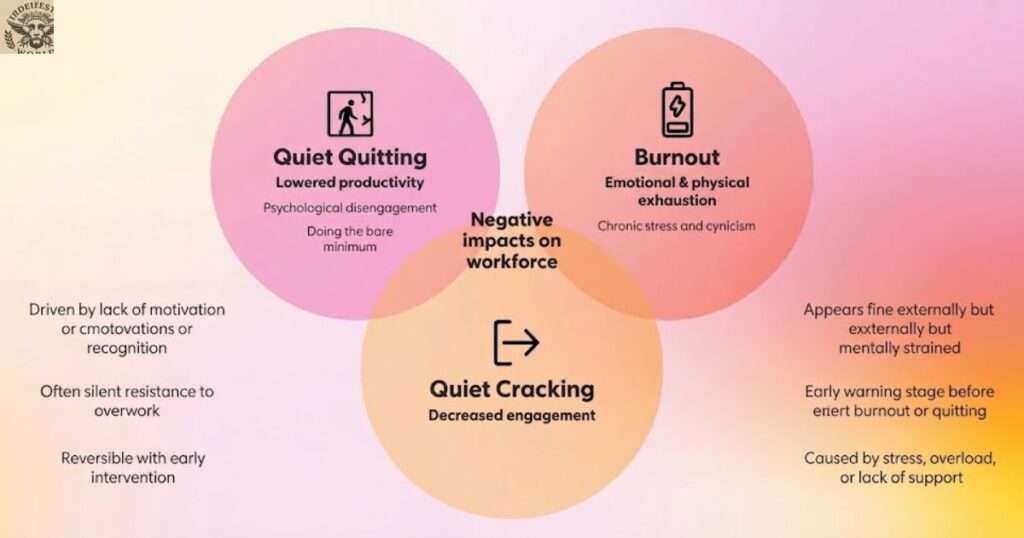
Employee disengagement involves a reduced emotional or professional connection with work. Quiet quitting can sometimes involve disengagement, but the two terms describe different ideas.A disengaged employee may lose interest in quality, teamwork, goals, and workplace relationships. A quiet quitter may still care about job quality while reducing extra effort.
The difference often appears in performance and motivation. Strong core performance with clear boundaries can reflect quiet quitting. Falling quality and repeated missed duties may suggest deeper disengagement.
Comparison
Quiet quitting focuses on limits around extra work. Disengagement focuses more on reduced connection, motivation, or interest in the job.
Quiet Quitting vs. Actual Resignation
Resignation ends an employment relationship. Quiet quitting does not. A worker who resigns normally follows a formal process and prepares for departure.A quiet quitter remains employed. The employee may still attend meetings, complete assignments, and work toward team goals. The main change concerns extra effort or availability.
For example, a worker can decline weekend work and continue normal weekday performance. A resigning worker may provide notice and leave the organization after the notice period.
Quiet Quitting vs. Quiet Firing
Quiet firing describes a situation where an employer gradually makes a role less attractive or provides less support, often without directly ending employment. Quiet quitting describes employee behavior.The direction of action differs. Quiet quitting moves from employee toward work expectations. Quiet firing moves from employer toward employee experience.
Quiet firing can involve reduced opportunities, weak communication, limited development, or exclusion from important work. Quiet quitting can involve reduced extra effort and stronger personal boundaries.
Simple Difference
Quiet quitting: employee limits extra effort.
Quiet firing: employer may gradually reduce support or opportunities.
Both situations can harm workplace relationships if communication remains weak.
Quiet quitting meaning in english
Quiet quitting meaning in English refers to staying employed while completing required work and limiting extra effort. The phrase does not describe formal resignation.
Quiet quitting examples
Examples include refusing unnecessary overtime, avoiding unpaid extra projects, stopping after-hours messages, and focusing on core job duties during scheduled hours.
Quiet quitting meaning in the workplace
In the workplace, quiet quitting refers to a work pattern where an employee performs assigned responsibilities but avoids constant extra duties, excessive hours, or pressure to always go beyond expectations.
Quiet quitting pronunciation
The pronunciation uses two familiar English words. “Quiet” begins with a clear /kw/ sound, while “quitting” has stress on the first syllable.
Quiet Quitting vs. Acting Your Wage
Acting your wage is a related workplace phrase. It usually means matching effort and responsibility with pay, job level, or formal role. The phrase can express resistance to unpaid labor or unreasonable expectationsQuiet quitting has a similar connection with boundaries. Yet acting your wage can focus more strongly on compensation and role value.
A worker may think, “Extra responsibilities need suitable recognition or pay.” Such thinking can lead to stronger limits around additional duties. Both ideas became popular during wider conversations about employee value, fair pay, career growth, and work-life balance.
Quiet Quitting vs. Work-to-Rule
Work-to-rule means following workplace rules and formal procedures very strictly. The approach can sometimes appear during labor disputes or organized workplace action.Quiet quitting usually describes an individual work pattern. It does not automatically involve protest or collective action.
A worker practicing work-to-rule may follow every formal procedure exactly. A quiet quitter may simply complete normal job duties and avoid optional extra work.
| Quiet Quitting | Work-to-Rule |
| Usually individual behavior | Can involve collective action |
| Focuses on work boundaries | Focuses on strict rule following |
| Often linked with work-life balance | Can relate to workplace disputes |
| May not involve protest | May involve protest or labor pressure |
Is Quiet Quitting a Sign of Laziness?
Quiet quitting is not automatically a sign of laziness. A person can complete all core responsibilities while declining unnecessary extra work. Healthy boundaries can support long-term performance.Laziness involves avoiding necessary effort. Quiet quitting often involves completing necessary duties while limiting additional effort.
Context matters. If work quality falls, deadlines are missed, and responsibilities are ignored, a performance issue may exist. If required duties remain strong, stronger boundaries may explain the behavior.
Example
A worker completes every assigned task on time and meets quality standards. The worker declines optional weekend work. Such behavior does not prove laziness.
Is Quiet Quitting Good or Bad?
Quiet quitting can have different effects depending on workplace conditions. Strong boundaries can reduce burnout and protect personal time. Yet excessive disengagement can reduce productivity, teamwork, and career opportunities.The effect also depends on job expectations. Some roles require flexibility during emergencies. Other roles have clearly defined schedules and responsibilities.
A balanced approach focuses on fair expectations. Employees need reasonable limits. Employers need reliable performance. Clear communication can reduce confusion between the two sides.
What Are the Benefits of Quiet Quitting?
One possible benefit involves stronger work-life balance. Employees may protect time for family, rest, hobbies, education, and personal goals.Another benefit involves reduced burnout risk. Constant extra work can drain energy. Clear boundaries can help workers recover and maintain sustainable routines.
Quiet quitting may also encourage companies to examine workplace expectations. If many employees stop giving unpaid extra effort, managers may review workloads, compensation, recognition, and staffing.
Potential Benefits
- Better work-life balance
- Clearer workplace boundaries
- Less unpaid overtime
- More personal time
- Lower pressure from hustle culture
- Better focus during working hours
- Greater awareness of employee well-being
- More realistic job expectations
Benefits are not guaranteed. Poorly managed quiet quitting can create different outcomes.
What Are the Negative Effects of Quiet Quitting?
Quiet quitting can create problems when core performance also falls. Missed deadlines, poor communication, weak teamwork, and reduced quality can affect colleagues.Career progression may also slow in some workplaces. Employees who avoid every optional opportunity may receive fewer chances to build skills or demonstrate leadership.
Employers can also face productivity concerns if disengagement becomes widespread. Team morale may fall when workload becomes uneven.
Potential negative effects include:
- Reduced initiative
- Lower teamwork
- Slower career development
- Fewer learning opportunities
- Lower employee engagement
- Reduced productivity
- Workplace communication problems
- Higher turnover risk
The outcome depends on the difference between healthy boundaries and genuine disengagement.
How Does Quiet Quitting Affect Productivity and Morale?
Productivity can remain stable when employees complete core duties efficiently. A worker who avoids unnecessary overtime may still deliver strong results during normal hours.Problems can appear when quiet quitting becomes deeper disengagement.
Lower initiative, weak communication, and reduced effort can affect team morale. Other employees may need to cover unfinished tasks.Managers can protect morale by setting clear responsibilities. Fair workloads and recognition also matter. Teams perform better when expectations remain realistic and communication stays open.
Workplace Example
A team has five employees. One person stops doing optional overtime but completes all assigned tasks. Productivity may remain stable. If assigned work also starts missing deadlines, the situation becomes more serious.
How Does Quiet Quitting Affect Career Growth?
Career growth can involve skills, networking, leadership, visibility, and professionaldevelopment. Some optional projects can create valuable learning opportunities.A worker who rejects every additional task may miss useful experiences. Yet accepting every extra responsibility can also cause burnout.
A balanced approach can protect both goals. Employees can choose extra projects that support career progression. Managers can explain how new responsibilities connect with promotion or development.
Career Example
A graphic designer wants a senior role. The designer accepts a useful branding project that builds leadership skills but declines unrelated weekend duties. Career development continues without constant overwork.
How Can Employers Prevent Quiet Quitting?
Employers can reduce quiet quitting by addressing workplace causes. Clear job descriptions help employees understand responsibilities. Realistic workloads reduce pressure. Recognition can also encourage healthy motivation.Career development matters too. Employees need opportunities to learn, improve, and progress. Fair compensation can also influence willingness to take on additional responsibilities.
Useful employer actions include:
- Set clear expectations.
- Review workloads regularly.
- Recognize strong performance.
- Offer career development.
- Provide fair compensation.
- Encourage open communication.
- Support reasonable flexibility.
- Respect working hours.
- Train managers.
- Monitor employee well-being.
Prevention works better when managers understand causes instead of simply labeling employee behavior.
How Can Managers Respond to Quiet Quitting?
Managers can begin with a calm conversation. Direct questions can reveal workload problems, career concerns, unclear expectations, or workplace dissatisfaction.A manager can review job responsibilities with the employee. The discussion can separate required duties from optional tasks. Such clarity can reduce conflict.
Managers can also check employee motivation and development goals. A worker may want a promotion, better compensation, flexible work, or stronger recognition.
Manager Example
A manager notices lower participation in optional projects. Instead of making accusations, the manager asks about workload and career goals. The employee explains that repeated unpaid overtime caused exhaustion. A revised schedule creates a clearer boundary.
How Can Employees Set Healthy Work Boundaries?
Employees can begin by understanding the job description. Core responsibilities need proper attention. Extra work can then receive a clear decision based on time, value, compensation, and career goals.Communication helps. A worker can politely explain working-hour limits. Clear messages reduce misunderstandings.
Healthy boundaries can include:
- Turning off work notifications after hours
- Taking scheduled breaks
- Declining unrelated tasks
- Asking about priorities
- Avoiding unnecessary overtime
- Using vacation time
- Keeping personal time separate
- Discussing workload concerns early
- Asking for career development
- Maintaining professional communication
Healthy boundaries do not require poor performance. Strong work quality can remain the main goal.
Quiet quitting relationship
In relationships, quiet quitting can describe emotional withdrawal or reduced effort. A person may remain present but stop investing in communication, affection, or shared activities.The relationship meaning differs from workplace usage. In both cases, the phrase suggests reduced effort without an immediate formal ending.
Quiet quitting meaning marriage
Quiet quitting in marriage can describe staying in the relationship while emotionally checking out. Communication may decline, shared activities may stop, and emotional investment may become weaker.Such a relationship pattern differs from the workplace definition. It can signal unresolved relationship problems that require honest communication.
Quiet quitting synonym
Related terms include silent quitting, soft quitting, acting your wage, and work-to-rule. These terms overlap but do not always carry the same meaning.
Is quiet quitting bad
Quiet quitting is not automatically bad. Healthy boundaries can protect well-being, while deep disengagement can create workplace problems. Context, performance, and job expectations matter.
Frequently Asked Questions
What does quitting mean?
Quitting means stopping a job, activity, or responsibility. In employment, quitting usually means leaving a job voluntarily.
How to quit a job?
Give formal notice according to the employment agreement, complete required duties, and communicate the departure professionally.
What are examples of quiet quitting?
Examples include declining unnecessary overtime, avoiding after-hours messages, and focusing on core job duties during scheduled working hours.
What does “quite” mean?
“Quite” can mean fairly, rather, or completely, depending on context. It differs from “quiet,” which relates to low noise.
Can you say “quite quiet”?
Yes. “Quite quiet” is grammatically correct. The phrase can mean fairly quiet or very quiet, depending on context.
Conclusion
Quiet quitting mean working within core job responsibilities while limiting constant extra effort. The concept does not describe a formal resignation. An employee can stay committed to quality while protecting personal time.The phrase became popular through social media and wider workplace conversations.
Burnout, hustle culture, remote work, poor management, low recognition, and changing career values helped increase discussion.Quiet quitting can support work-life balance when healthy boundaries remain in place. Yet deeper disengagement can affect productivity, morale, teamwork, and career growth. A balanced workplace needs clear duties, fair workloads, recognition, development, and open communication.

