

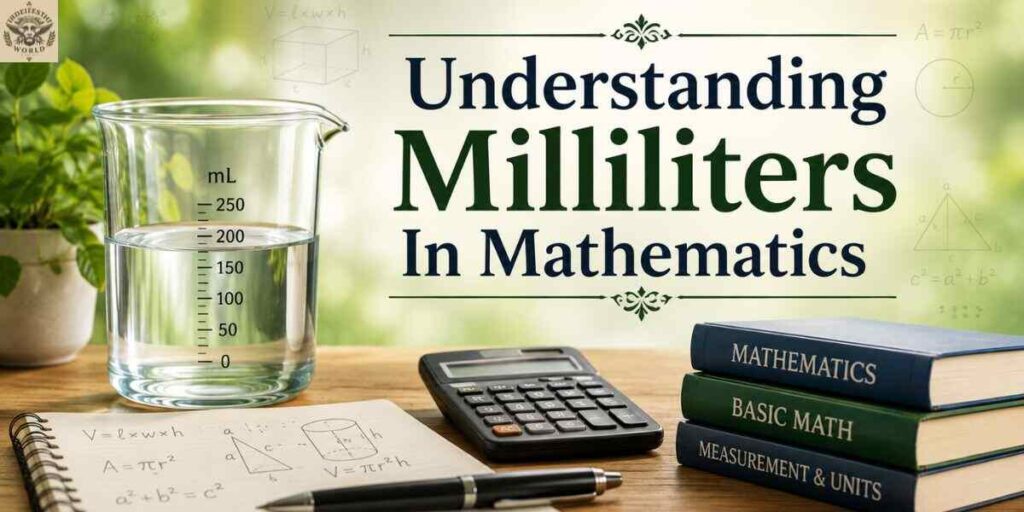
Milliliters in Mathematics refers to the use of a small metric unit to describe and compare liquid volume. A milliliter is one thousandth of a liter, so 1,000 milliliters make one liter. In Milliliters in Mathematics, students learn how numbers, units, fractions, decimals, and conversions work together to describe the amount of liquid in a container.
The idea behind Milliliters in Mathematics connects directly to the metric system, where units are organized around powers of ten. A milliliter is written with the mL abbreviation, and 1 milliliter has the same volume as 1 cubic centimeter. This relationship makes Milliliters in Mathematics but also for understanding volume measurement,and metric conversions
Why Understanding Milliliters Is Important
Learning Milliliters in Mathematics gives students a practical way to understand measurement, capacity, and volume. A bottle, medicine container, measuring spoon, or small drink can contain a quantity that is easier to describe in milliliters than in liters. Understanding Milliliters in Mathematics therefore helps learners choose appropriate metric units and recognize why a smaller unit is useful for precise liquid measurement.
Milliliters in Mathematics also supports mathematical reasoning. Students can compare 100 mL and 500 mL, add several quantities, subtract liquid amounts, or convert 750 mL into liters. These activities strengthen mathematical measurement, estimation, decimal understanding, and proportional reasoning. Since milliliters belong to the metric system of measurement, learners also gain experience with a consistent system of volume units and measurement units.
Mathematical Connections To Milliliters

The strongest connection in Milliliters in Mathematics is the relationship between 1 liter and 1,000 milliliters. Because 1 liter equals 1,000 milliliters, a learner can convert from liters to milliliters by multiplying by 1,000. For example, 2 liters equals 2,000 mL. To perform a milliliter to liter conversion, divide the number of milliliters by 1,000.
Milliliters in Mathematics also connects with fractions and decimals. Five hundred milliliters represents one half of a liter, or 0.5 L. Two hundred fifty milliliters represents one quarter of a liter, or 0.25 L. These examples show that metric volume units can represent whole quantities, fractions, and decimals. The relationship between a milliliter and a cubic centimeter also links metric volume to geometry because 1 mL = 1 cm³.
Teaching Strategies For Milliliters
Effective instruction about Milliliters in Mathematics should move from physical experience to pictures and then to numerical reasoning. Students often understand a measurement more easily when they can pour, compare, estimate, and record an actual quantity before solving a written problem. This approach makes Milliliters in Mathematics more meaningful and helps learners develop a realistic sense of scale.
Teachers can use water, containers, droppers, syringes, a measuring cup, and a graduated cylinder to demonstrate volume in milliliters. Learners can estimate the amount in a container and then measure it to check their prediction. These activities turn Milliliters in Mathematics into an active exploration of liquid capacity, measuring liquid volume, and metric measurement.
Concrete Exploration of Milliliters
A concrete lesson in Milliliters in Mathematics might begin with containers labeled 10 mL, 50 mL, and 100 mL. Students can fill each container with water and compare the quantities. They can record their observations and discuss why 100 mL is ten times 10 mL. This provides an intuitive understanding of ml measurement and the scale of a milliliter.
For a simple activity, ask students to predict how much water a small container can hold. They then use a graduated cylinder to test the prediction. Repeating this exercise develops confidence with measuring volume and helps students recognize that 1 milliliter is a very small quantity. It also introduces scientific measurement in a classroom friendly way.
Visual Exploration of Milliliters
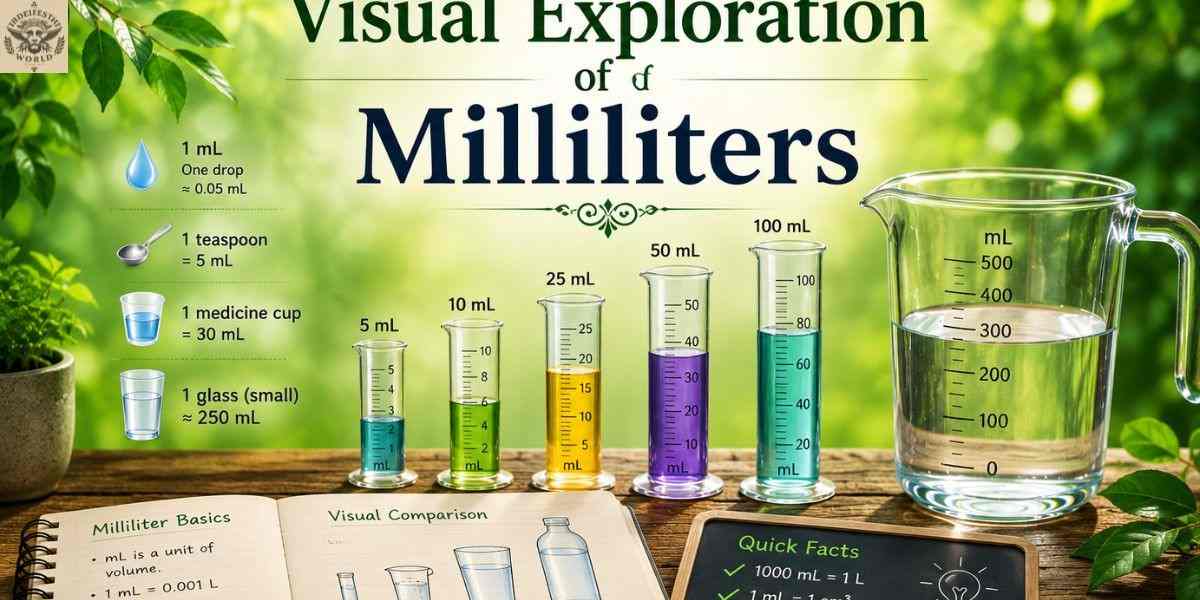
Visual models make Milliliters in Mathematics easier to understand because students can see relationships between quantities. Draw a container with marks at 100 mL intervals from 0 to 1,000 mL. Students can identify 200 mL, 500 mL, 750 mL, and 1,000 mL and connect those values to fractions of a liter. This supports everyday liquid measurements and volume conversion.
A 100 ml visual can be especially useful for beginners. Showing a transparent container with a 100 mL level gives students a reference point for estimating other amounts. Teachers can also compare a 250 mL container with a 500 mL container and ask students to explain which has greater liquid capacity and why.
Abstract Reasoning with Milliliters
After hands-on and visual work, students can solve numerical problems involving Milliliters in Mathematics. For example, if a container holds 350 mL and another holds 150 mL, the total is 500 mL. If 200 mL is poured from 700 mL, 500 mL remains. These problems connect measuring liquids with addition and subtraction.
More advanced Milliliters in Mathematics problems can involve decimals and conversions. If a recipe requires 1.5 liters of water, students can multiply 1.5 by 1,000 to find 1,500 mL. This type of milliliter conversion helps learners connect metric measurement with multiplication, division, decimals, and proportional thinking.
Common Misconceptions About Milliliters
One common difficulty with Milliliters in Mathematics is confusing volume with the appearance of a container. A tall narrow container may look as if it contains more liquid than a short wide container, but appearance alone does not determine the quantity. Accurate volume measurement requires an appropriate standard unit and a reliable measuring tool.
Another problem is confusing milliliters with millimeters. The terms sound similar, but they describe different quantities. Milliliters measure liquid volume, while millimeters measure length. Understanding this distinction is essential when learning measurement units, metric units, and mathematical notation.
Read More: Elapsed Time Meaning Explained: Learn How Time Passes,Meaning, Examples, and Practice
Misconception: Overestimating or Underestimating Milliliters
Students may initially think that a milliliter is much larger than it really is. Practical comparisons can correct this misunderstanding. A small spoonful of water may contain only a few milliliters, while a typical drink container can contain hundreds of milliliters. Repeated estimation followed by actual liquid measurement helps students develop a stronger sense of quantity.
Teachers can also ask students to rank 10 mL, 100 mL, 500 mL, and 1,000 mL before measuring them. This reinforces metric volume, place value, and the relationship between small amounts of liquid and larger quantities.
Related Terms
Important terms connected with Milliliters in Mathematics include liter, volume, capacity, measure, metric system, unit, cubic centimeter, and measurement. These concepts help learners understand how milliliters function within a larger system of mathematical measurement.
A liter is a larger metric volume unit, while a milliliter is used for smaller quantities. Capacity describes how much a container can hold, while volume describes the amount of three dimensional space occupied by a substance or object.
Related Resources
Useful learning materials for Milliliters in Mathematics include measuring containers, number lines, conversion charts, worksheets, classroom experiments, and visual models. These resources can help students practice volume measurement without treating conversions as isolated rules.
Teachers can combine cooking measurements, water measurement, and science activities with written problems. Such examples make Milliliters in Mathematics relevant beyond the classroom and show how liquid volume appears in ordinary situations.
3.OA.B Free Sample
A 3.OA.B style activity can connect Milliliters in Mathematics with multiplication and division. For example, students can determine how many 100 mL groups are contained in 500 mL. The answer, five groups, gives learners a concrete context for equal groups and multiplication.
Students can also reverse the problem by asking how much liquid is represented by six groups of 100 mL. This creates a direct connection between measurement, multiplication, and volume units.
3.MD.C Activities
Measurement activities can help students apply Milliliters in Mathematics to real situations. Learners can measure several containers, record their capacities, order them from least to greatest, and explain their reasoning.
These activities reinforce the meaning of a unit of measurement and help students distinguish between estimation and exact measurement. They can also practice liter to milliliter conversion after completing the hands-on work.
3.G.A Activities
Geometry provides another useful connection. Since 1 mL equals 1 cm³, students can explore how a one centimeter cube represents the same volume as one milliliter. This gives Milliliters in Mathematics a direct connection to three dimensional space.
Students can build models using centimeter cubes and then compare the resulting volume with liquid quantities. This activity makes the relationship between cubic centimeter, volume, and metric volume units easier to visualize.
Related Videos
Short educational videos can reinforce Milliliters in Mathematics by showing measurement tools, conversion examples, and visual demonstrations. A video showing a graduated cylinder can help learners see how liquid levels are read.
Videos about place value, fractions, decimals, and metric conversions can also support students who need additional practice with mathematical relationships.
Unit Fractions in a Set Model
Fractions can be introduced through Milliliters in Mathematics by treating 1,000 mL as one whole liter. Then 500 mL is one half, 250 mL is one fourth, and 100 mL is one tenth. This approach connects volume in milliliters with unit fractions.
The model also shows why converting between liters and milliliters is useful. Instead of memorizing a rule, students can see the relationship between a whole and its equal parts.
Language and Symbols of Non Unit Fractions
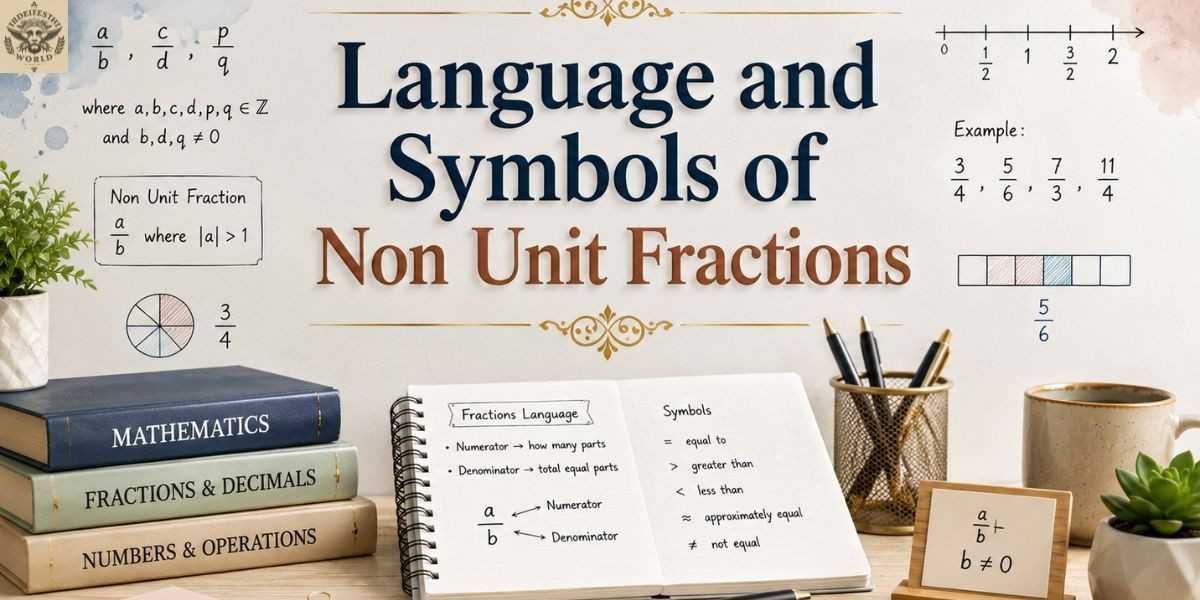
Correct mathematical language matters when discussing Milliliters in Mathematics. Students should learn to read 250 mL as two hundred fifty milliliters and recognize that 250 mL represents 0.25 L.
The milliliter abbreviation is mL. Writing the unit correctly helps students communicate measurement clearly and prevents confusion with other metric abbreviations.
Fraction Iteration
Fraction iteration can be explored by repeatedly adding equal quantities. For example, adding 250 mL four times gives 1,000 mL, which equals one liter. This provides a practical illustration of fractions, multiplication, and metric volume.
The activity also demonstrates how repeated units build a larger quantity. Students can use cups or cylinders to physically create the total and then express the answer numerically.
Related Workshop
A workshop on Milliliters in Mathematics can focus on estimation, mental calculation, measurement tools, and conversion. Learners can discuss strategies for deciding whether an answer is reasonable before checking it.
Number talks and practical measurement stations can encourage students to explain how they reached an answer rather than simply reporting a result.
Number Talks: A Routine to Build Mental Math Strategies
Number talks can make Milliliters in Mathematics more interactive. A teacher might ask, “How could you mentally find the total of 250 mL, 250 mL, and 500 mL?” Students can explain different strategies, such as grouping the two 250 mL quantities to make 500 mL.
This approach develops mental math while keeping liquid measurement connected to real quantities. Students learn that the same problem can often be solved in several valid ways.
Hands On Resources at Your Fingertips
Hands-on resources are especially valuable for Milliliters in Mathematics because volume is easier to understand when students can see and manipulate it. Measuring cups, droppers, bottles, cylinders, and marked containers provide immediate feedback.
Resources for Every Standard K 3
For younger learners, simple containers and water are enough to introduce milliliters in math. Older elementary students can work with conversion charts, decimals, fractions, and multi-step problems.
Content
Useful content should combine definitions, examples, visual models, practice questions, and real world applications. A good lesson should explain both what ml is and why the unit is useful.
Helpful Links
Reference materials can provide additional practice with metric units, volume units, and conversion relationships. Teachers should favor resources that use clear examples and age appropriate explanations.
Membership
Educational memberships may offer worksheets, lesson plans, videos, and classroom activities. Such resources can supplement direct teaching and provide additional practice.
Milliliters in Mathematics Table
| Measurement | Equivalent |
| 1 mL | 0.001 L |
| 100 mL | 0.1 L |
| 250 mL | 0.25 L |
| 500 mL | 0.5 L |
| 750 mL | 0.75 L |
| 1,000 mL | 1 L |
| 2,000 mL | 2 L |
This table provides a quick reference for Milliliters in Mathematics and makes volume conversion easier to visualize.
Milliliters in Mathematics Formula
The basic Milliliters in Mathematics formulas are simple:
Milliliters = liters × 1,000
Liters = milliliters ÷ 1,000
For example, 3 liters × 1,000 = 3,000 mL. Likewise, 4,000 mL ÷ 1,000 = 4 L. These formulas are useful for milliliter to liter conversion and liter to milliliter conversion.
How Many Milliliters in Mathematics
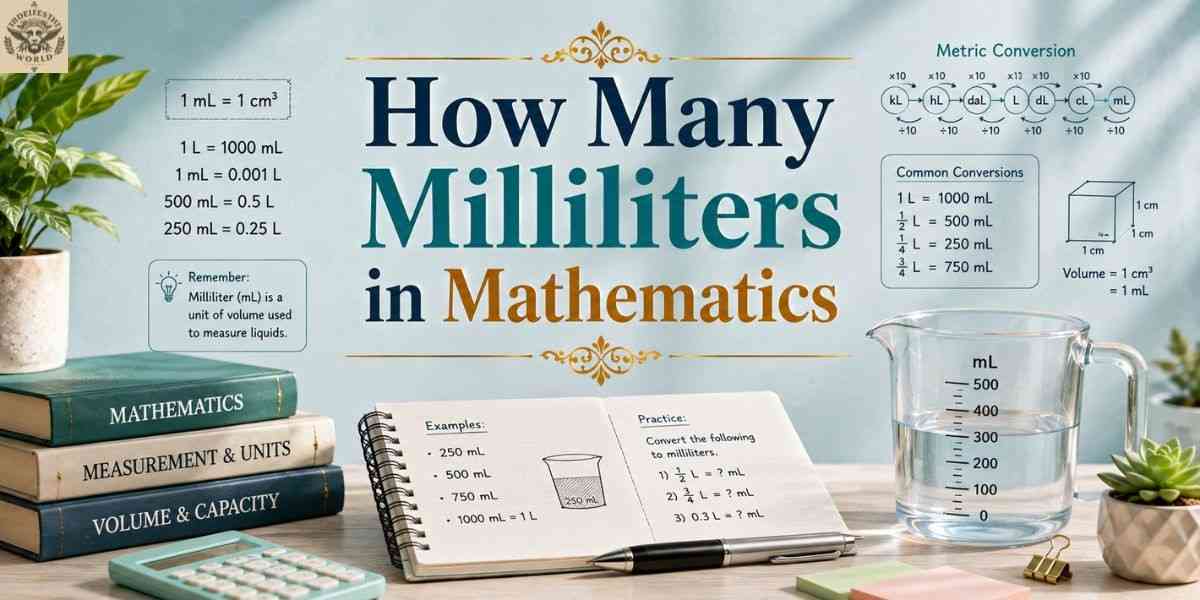
The answer depends on the quantity being converted. 1 liter equals 1,000 milliliters, while 1 mL equals 0.001 L. Therefore, 500 mL is half a liter, and 250 mL is one quarter of a liter.
When students ask how many milliliters are in a particular number of liters, multiplying by 1,000 provides the answer. This is one of the most important relationships in Milliliters in Mathematics.
Milliliters in Mathematics Examples
Here are several Milliliters in Mathematics examples:
- A bottle contains 750 mL. Express it in liters: 750 ÷ 1,000 = 0.75 L.
- A recipe needs 2 L of water. Express it in milliliters: 2 × 1,000 = 2,000 mL.
- A student pours 150 mL and then another 350 mL. The total is 500 mL.
- A container holds 1,000 mL. Its capacity is 1 liter.
These examples demonstrate measuring liquid volume, addition, division, multiplication, decimals, and metric measurement.
Milliliters in Mathematics Calculator
A Milliliters in Mathematics calculator can help check conversions, especially when learners are first practicing. To convert liters into milliliters, multiply the liter value by 1,000. To convert milliliters into liters, divide by 1,000.
For example, entering 1.25 L and multiplying by 1,000 gives 1,250 mL. Entering 2,500 mL and dividing by 1,000 gives 2.5 L. The calculator should support learning rather than replace understanding of the conversion relationship.
Milliliter Example
A simple milliliter example is a container holding 100 mL of water. If another 200 mL is added, the total becomes 300 mL. If 100 mL is removed, 200 mL remains.
This type of example shows how ml measurement can be used with ordinary addition and subtraction. It also demonstrates why a milliliter is useful for describing quantities that are too small to express conveniently in whole liters.
Milliliters Abbreviation
The standard milliliter abbreviation is mL. The capital L distinguishes liters from other uses of the letter, while the lowercase m represents the metric prefix milli. Therefore, ml is commonly understood informally, but mL is the preferred scientific notation.
Knowing the correct milliliter abbreviation is part of accurate scientific measurement and helps students write answers clearly.
Things Measured in Milliliters
Five common things measured in milliliters include:
- Water: Small quantities of water can be recorded precisely in mL.
- Medicine: Liquid doses are often expressed in milliliters.
- Cooking ingredients: Recipes may use milliliters for liquids.
- Juice and beverages: Small drink containers commonly show capacity in mL.
- Science samples: Experiments frequently require precise liquid quantities.
These examples show why Milliliters in Mathematics is useful beyond school. The same unit of measurement appears in cooking, science, health related contexts, and everyday liquid measurements.
Frequently Asked Questions
What is 1 milliliter equal to?
One milliliter equals one thousandth of a liter, or 0.001 L. It also has the same volume as one cubic centimeter, written as 1 cm³.
What is ML in math?
mL is the standard abbreviation for milliliter, a metric unit used to measure liquid volume and capacity. It represents one thousandth of a liter.
Is 1ml equal to 1000 mL?
No. 1 mL is equal to 0.001 L, while 1,000 mL equals 1 liter. The two quantities differ by a factor of 1,000.
What does millimeter mean in math?
A millimeter is a metric unit of length, not volume. It measures distance, while a milliliter measures liquid volume.
What is the mm formula?
There is no single universal “mm formula.” For length conversion, 1 centimeter equals 10 millimeters, so centimeters can be converted to millimeters by multiplying by 10.
Conclusion
Milliliters in Mathematics provides a practical foundation for understanding volume, capacity, measurement, fractions, decimals, and metric conversions. By learning that 1,000 milliliters equal one liter and that 1 mL equals 1 cm³, students can connect liquid measurement with broader mathematical ideas.
The most effective way to master Milliliters in Mathematics is to combine hands-on activities, visual models, estimation, and numerical problems. Whether measuring water, solving a recipe problem, reading a graduated cylinder, or converting liters, students can use Milliliters in Mathematics to develop accurate and useful measurement skills.

