

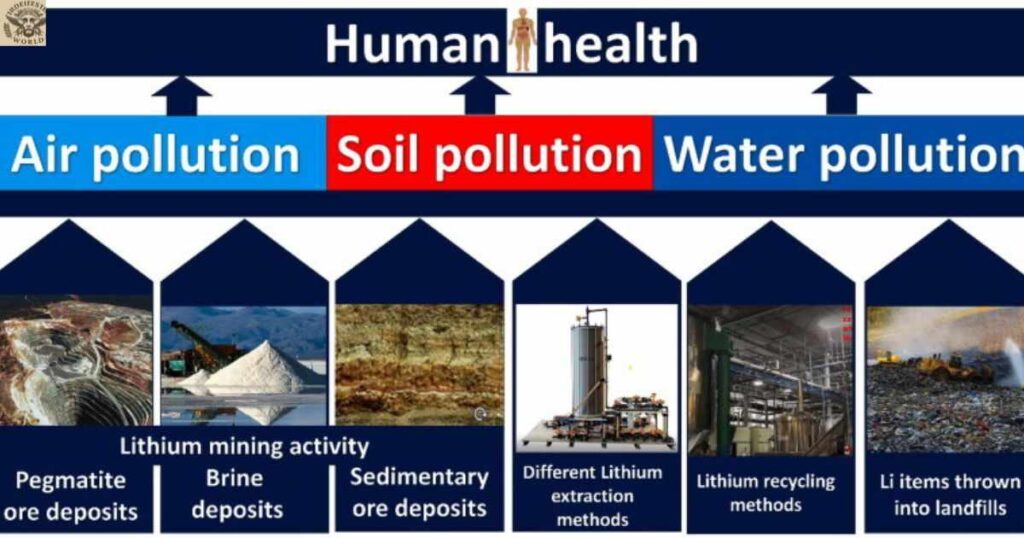
Lithium is the primary component in the production of batteries essential for alternative energy production and transport. The global increase in production of electric and hybrid vehicles and other electronics has resulted in increased demand for lithium and other minerals.There are several ways of extraction of lithium.
Hard-rock deposits and other sources of brines are the main sources of lithium extraction. Other sources such as geothermal brines and produced water are being explored.There are multiple factors that affect the supply of lithium and other minerals. These include the availability of energy and water, use of chemicals, greenhouse gas emissions, and waste.
Although there are benefits of increased extraction, an extensive exploration of new sources and better processing techniques need to be developed.Safeguarding the environment, using the best available techniques, and improving mine designs are essential for achieving the goal of sustaining the environment while benefiting from natural resources.
What Is Lithium Mining?
Lithium mining refers to the process of obtaining lithium-bearing material from natural deposits for later processing into usable lithium chemicals. Hard-rock mines remove minerals such as spodumene from geological formations. Brine operations recover dissolved lithium from underground salty water.
The term can include several stages. Mining may involve drilling, blasting, crushing, concentration, pumping, evaporation, chemical separation, and refining. The final products can include lithium carbonate, lithium hydroxide, and other lithium compounds.
Lithium mining does not follow one universal method. Deposit geology controls the extraction route. A spodumene deposit needs mineral processing, while a salar brine needs pumping and chemical treatment.
Why Is Lithium Mining Important Today?
Lithium supports rechargeable battery production. Electric cars use large battery packs, while grid storage systems help store electricity from renewable sources. Portable electronics also depend on rechargeable battery technology.
Global battery demand continues to grow. IEA data shows strong growth in EV and energy-storage battery demand, while lithium demand has also increased rapidly. USGS reported batteries as the dominant global end use for lithium in 2025.
Lithium mining environmental impact
Environmental effects depend on the resource and extraction method. Hard-rock operations can disturb land and generate waste rock. Brine operations can affect water systems and require careful hydrogeological monitoring.
Energy use also matters. Processing, transportation, chemical conversion, and refining can add greenhouse gas emissions. DLE may reduce some land requirements, but energy, chemicals, freshwater, and spent-brine management still require assessment.
Lithium mining companies
Lithium mining companies operate across several regions. Some companies focus on mine development, while others handle refining or battery materials. Large producers may operate integrated mining and processing facilities.
Company strategies can differ widely. Some projects use spodumene ores. Others use continental brines. New projects also explore clay, geothermal brines, and produced water.
Read More:Jane Doe Meaning: Definition, Origin, Uses, and Jane Doe vs. John Doe
Lithium mining countries
Australia, Chile, Argentina, China, Brazil, Canada, Zimbabwe, Mali, and several other countries contribute to global lithium supply. USGS reported major production from mineral operations in Australia and brine operations in Argentina and Chile, alongside important production in China and other countries.
Supply remains geographically concentrated. Different countries also possess different resource types. Australia relies strongly on hard-rock resources, while Chile and Argentina have major brine resources.
Lithium mining machine
Modern operations use many types of mining equipment. Excavators remove ore. Haul trucks transport material. Crushers reduce rock size. Drills prepare hard-rock deposits.
Brine projects use pumps, wells, pipelines, ponds, filters, and chemical-processing equipment. DLE facilities may use adsorption media, ion-exchange systems, membranes, or other selective separation technologies.
How Does Lithium Mining Work?
The lithium mining process begins with exploration. Geological surveys identify areas that may contain useful lithium deposits. Drilling then helps define the deposit size, grade, depth, and geological structure.
After resource evaluation, a company designs the mine or extraction facility. Hard-rock operations remove ore from the ground. Brine projects pump lithium-rich fluids through wells. Processing then separates lithium from unwanted minerals or dissolved salts.
A simplified process looks like the following:
| Stage | Hard-Rock Route | Brine Route |
| 1 | Exploration | Exploration |
| 2 | Mine development | Well development |
| 3 | Ore extraction | Brine pumping |
| 4 | Crushing | Concentration |
| 5 | Mineral concentration | Chemical separation |
| 6 | Chemical conversion | Lithium purification |
| 7 | Refining | Product refining |
| 8 | Battery-grade product | Battery-grade product |
Final processing converts concentrated lithium into compounds suitable for battery and industrial applications.
What Are the Main Lithium Mining Methods?
Three major pathways receive significant attention: hard-rock mining, conventional brine extraction, and direct lithium extraction. Each pathway has different resource requirements and environmental characteristics.Hard-rock mining extracts lithium-bearing minerals from solid rock.
Brine extraction recovers dissolved lithium from salty underground fluids. DLE uses selective technologies to separate lithium from brine without relying on long evaporation stages.Recent research finds meaningful differences among land, freshwater, and emissions footprints. DLE may lower some impacts under suitable conditions, but actual results depend on technology, energy source, reinjection practices, and local geology.
Hard-Rock Lithium Mining Explained
Hard-rock operations commonly target spodumene-bearing pegmatite deposits. Mining begins with drilling and blasting. Excavators and haul trucks then move ore to processing facilities.Crushing and grinding release valuable minerals from surrounding rock.
Separation techniques produce a lithium concentrate. Chemical conversion later turns the concentrate into lithium chemicals.Hard-rock lithium mining can offer predictable feedstock for chemical plants. However, the route can create waste rock and tailings. Energy use also occurs during mining, crushing, concentration, transport, and conversion.
How Is Lithium Extracted From Spodumene?
Spodumene is a lithium-bearing mineral. Processing starts by crushing and concentrating the ore. Concentration increases the lithium content before chemical treatment.A thermal conversion step can transform spodumene into a more reactive form. Chemical leaching then releases lithium.
Further purification produces lithium sulfate or related intermediate solutions. Final conversion can produce lithium carbonate or lithium hydroxide.Process efficiency depends on ore grade, mineral composition, reagent use, temperature, water demand, and recovery rate.
What Is Lithium Brine Extraction?
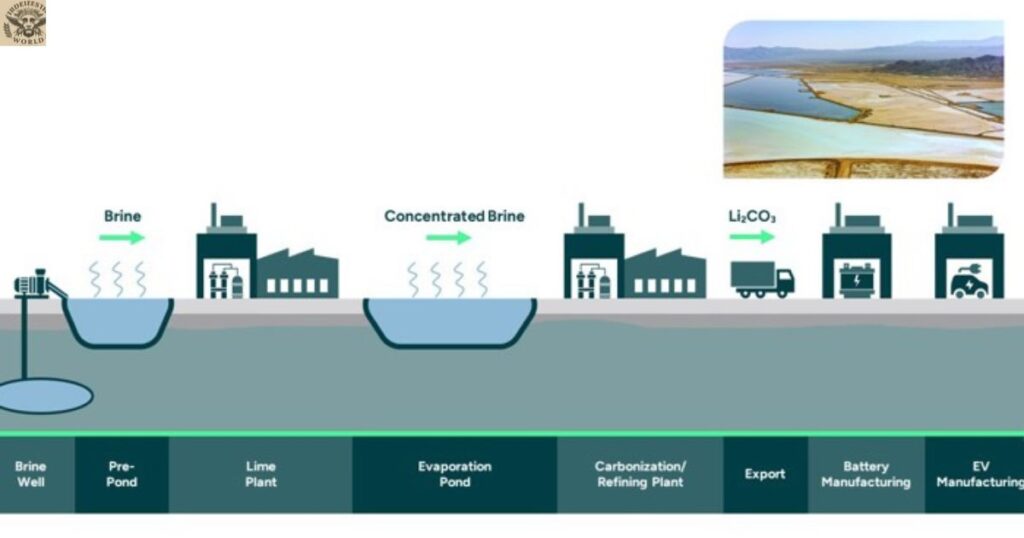
Lithium brine extraction obtains dissolved lithium from underground salty water. Large brine deposits occur in continental salt flats called Resalars. The Lithium Triangle of Argentina, Bolivia, and Chile contains major lithium-rich brine resources.Wells pump brine toward the surface.
Traditional operations often send brine through large evaporation ponds. Sunlight removes water over time and concentrates dissolved salts.Chemical processing then separates lithium from other elements. Magnesium, calcium, sodium, potassium, and other ions can complicate the process.
How Does Brine Lithium Mining Work?
Brine lithium mining starts with hydrogeological studies. Engineers identify underground brine reservoirs and surrounding freshwater systems. Production wells then pump brine toward processing areas.Traditional evaporation can require long periods. Concentrated brine moves through several ponds.
Chemical treatment follows concentration. Lithium compounds are then purified for industrial or battery applications.Brine chemistry strongly affects recovery. Local rainfall, evaporation, groundwater movement, mineral composition, and water balance also influence project performance.
Lithium Evaporation Ponds: How Do They Work?
Evaporation ponds use solar energy to remove water from lithium-rich brine. Brine moves through a series of ponds. Different salts precipitate at different stages as concentration increases.The concentrated liquid eventually reaches a processing plant.
Chemical treatment removes unwanted elements. Lithium then enters a purification and conversion stage.Evaporation technology can require large land areas and long processing periods. Research has also raised concerns about freshwater use and hydrogeological effects.
What Is Direct Lithium Extraction (DLE)?
Direct lithium extraction is a group of technologies designed to recover lithium directly from brine. DLE avoids dependence on large conventional evaporation ponds.Several approaches exist. Adsorption, ion exchange, membranes, ion sieves, solvent extraction, and electrochemical methods can selectively recover lithium ions.
DLE remains a developing field. Laboratory results can differ from industrial performance. Nature Reviews research notes that real-brine testing remains important because brine chemistry can strongly affect results.
How Does Direct Lithium Extraction Work?
A typical DLE system pumps lithium-rich brine into a treatment unit. A selective material captures lithium ions. Other brine components pass through or remain in solution.The captured lithium is then released into another solution. Purification follows. Final chemical conversion produces a concentrated lithium product.
DLE can reduce land requirements in suitable projects. Recent 2026 research estimated potential reductions in freshwater use, land conversion, and carbon emissions under certain future scenarios. Actual benefits depend on project design, energy supply, brine chemistry, and reinjection.
Geothermal Brine Lithium Extraction
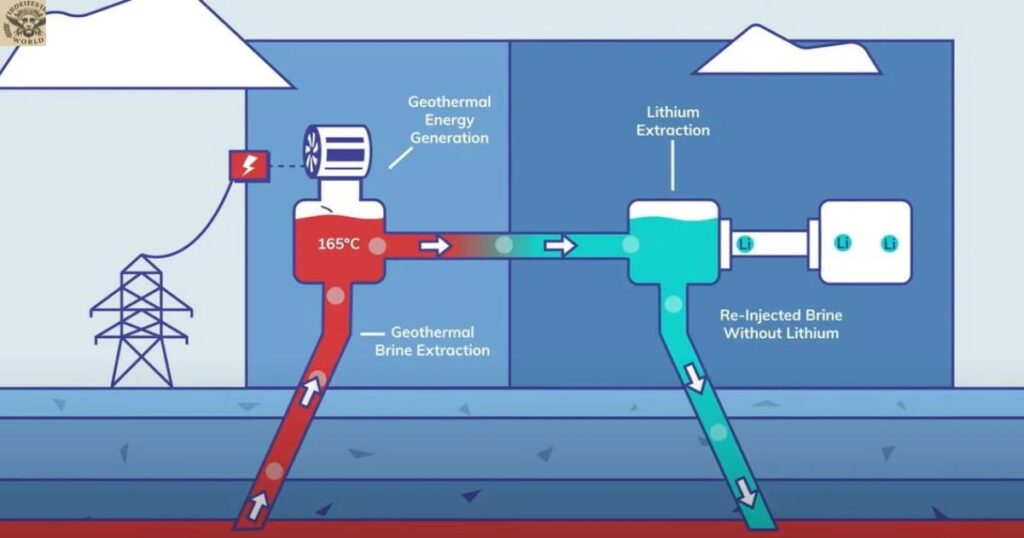
Geothermal brines can contain lithium along with other dissolved minerals. Geothermal projects already pump hot fluids from underground reservoirs for energy production.Lithium recovery could add value to geothermal operations.
A combined system may extract lithium while maintaining geothermal energy production.Careful reservoir management remains essential. Temperature, pressure, mineral chemistry, reinjection, and water balance can affect project performance.
Can Lithium Be Extracted From Produced Water?
Produced water comes to the surface during oil and gas production. Some produced waters contain lithium and other valuable dissolved minerals.Lithium recovery from produced water can create a secondary resource.
Such systems may reduce the need for new mining areas if commercial recovery becomes practical.Technical challenges remain. Lithium concentration can vary greatly. Other ions can interfere with separation. Treatment costs, energy demand, chemical use, and water management determine commercial viability.
Lithium Mining and the Processing Stage
Extraction alone does not create battery-grade material. Processing removes unwanted minerals and converts lithium into useful chemical forms.Hard-rock processing often begins with crushing and concentration.
Brine processing focuses on selective separation and purification. Both routes require chemical conversion before final refining.Quality control plays a major role. Battery manufacturers need consistent chemical purity. Small levels of impurities can affect battery material performance.
How Is Lithium Converted Into Lithium Carbonate and Hydroxide?
Lithium carbonate and lithium hydroxide are major lithium chemicals. Concentrated lithium solutions undergo purification before chemical conversion.Lithium carbonate can form through reactions that add carbonate ions to purified lithium solutions.
Lithium hydroxide can form through additional chemical conversion or causticization routes.Battery-grade production requires strict impurity control. Sodium, magnesium, calcium, sulfate, chloride, and other contaminants may need removal.
What Is Lithium Used For?
Batteries represent the largest global lithium use. USGS estimated batteries at about 88% of global lithium end use in 2025. Other applications include ceramics, glass, lubricating greases, air treatment, medical uses, and industrial products.
Lithium compounds also support specialty materials. Ceramic and glass industries use lithium minerals and compounds to modify melting behavior and thermal properties.
| Lithium Application | Main Purpose |
| EV batteries | Vehicle energy storage |
| Grid storage | Electricity storage |
| Electronics | Rechargeable power |
| Ceramics | Material processing |
| Glass | Thermal and chemical properties |
| Lubricating greases | High-performance lubrication |
| Medical uses | Selected pharmaceutical applications |
Lithium Mining for Electric Vehicle Batteries
Electric vehicles require large rechargeable battery packs. Lithium-ion chemistry provides high energy density and repeated charging capability.EV battery demand has grown alongside electric-car sales.
IEA reported EV batteries above 950 GWh of demand in 2024, while electric cars remained the main driver of EV battery demand.Battery chemistry continues to evolve. Lithium iron phosphate batteries now represent a large share of battery deployments, especially in energy storage.
Lithium mining problems
Lithium mining problems can involve water pressure, land disturbance, waste, energy use, chemical handling, and community concerns. Project location strongly affects risk.Supply concentration also creates commercial pressure. A disruption in one producing region can affect global supply chains.
Better planning can reduce risks. Recycling, improved recovery, cleaner electricity, responsible water management, and stronger environmental monitoring can support better outcomes.
Lithium mining health effects
Mining work can expose employees to dust, noise, heavy equipment, heat, chemicals, and physical hazards. Processing facilities add chemical and thermal risks.Strong occupational safety programs reduce workplace exposure.
Protective equipment, ventilation, training, equipment maintenance, emergency plans, and monitoring form key parts of mine safety.Public health concerns also require environmental monitoring. Water and air quality programs can detect unwanted changes near mining and processing areas.
Lithium mining jobs
Lithium projects create jobs across several stages. Exploration needs geologists, drilling teams, engineers, and field technicians.Mines need equipment operators, mechanics, electricians, safety staff, environmental specialists, and supervisors.
Chemical plants require process operators, laboratory staff, engineers, and maintenance teams.Indirect employment can also develop through transport, construction, services, equipment supply, and infrastructure.
Lithium Mining and Grid-Scale Energy Storage
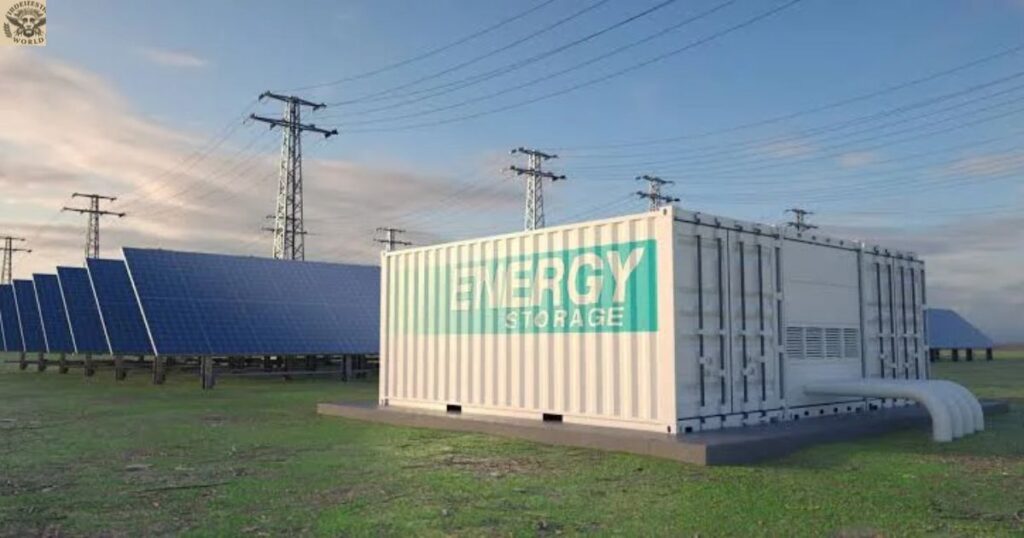
Grid-scale storage helps balance electricity supply and demand. Batteries can store electricity during periods of high renewable generation and release power later.
Lithium-ion batteries play a major role in modern storage markets. IEA reported 108 GW of new battery-storage capacity worldwide during 2025, showing rapid growth in battery deployment.
Growing storage demand adds another reason for lithium supply expansion. Battery recycling and alternative chemistries can also reduce pressure on primary mineral supply.
Where Is Lithium Mined Around the World?
Lithium production comes from several regions. Australia has major hard-rock production. Argentina and Chile have important brine operations. China operates both mineral and brine projects and has a major downstream processing industry.
USGS reported that 2025 production included four brine operations in Argentina, seven mineral operations in Australia, one mineral operation in Brazil, two mineral operations in Canada, two brine operations in Chile, nine mineral and six brine operations in China, two mineral operations in Mali, and five mineral operations in Zimbabwe.
The global resource base is broader than current mine production. USGS also lists lithium resources and projects across many additional countries.
What Are the World’s Major Lithium Mines?
Major lithium operations occur in Australia, Chile, Argentina, China, and other producing regions. Greenbushes in Western Australia is a well-known hard-rock operation. Salar de Atacama in Chile hosts major brine production.
Other significant projects operate in Argentina, Australia, China, Mali, Zimbabwe, Brazil, Canada, and the United States.
Mine size alone does not determine importance. Ore grade, lithium recovery, processing capacity, infrastructure, product quality, operating cost, and expansion potential also matter.
Why Is Global Lithium Supply Concentrated?
Geology explains part of the concentration. Certain regions contain large, high-quality lithium deposits. Infrastructure and processing capacity also influence commercial production.
Australia has extensive spodumene resources. South American salars contain major brine deposits. China combines domestic resources with substantial refining and chemical-processing capacity.
Supply concentration creates strategic concerns. Governments, battery producers, automakers, and mining companies increasingly seek diversified supply chains. USGS reports active project development across a broad group of countries.
What Are the Environmental Impacts of Lithium Mining?
Environmental impacts vary by extraction method. Hard-rock mines disturb land through pits, roads, waste-rock storage, and processing areas.
Brine extraction can alter underground fluid movement. Water balance requires detailed monitoring in arid regions. Chemical processing can generate waste streams that need controlled handling.
DLE can reduce some land requirements, but DLE does not remove every environmental issue. Energy, freshwater, chemicals, spent brine, and reinjection remain important factors.
How Does Lithium Mining Affect Water Resources?
Water is one of the most discussed issues in lithium production. Brine projects operate in areas where freshwater can already be limited.
Hydrogeological studies help separate freshwater systems from productive brine reservoirs. Monitoring wells can track water levels and changes over time.
DLE may avoid large evaporation ponds, but water demand does not automatically disappear. Nature Reviews research stresses the need to measure freshwater requirements across the complete DLE process.
A universal water figure does not fit every mine. Deposit type, climate, technology, processing route, electricity source, and local hydrology all affect water use.
Does Lithium Mining Cause Land and Habitat Damage?
Hard-rock mining can remove vegetation and alter landscapes. Roads, pits, waste-rock areas, processing facilities, and power infrastructure add to the land footprint.
Evaporation ponds can occupy large areas. DLE facilities may require less surface area, although well fields and supporting infrastructure still need land.
Recent research projects meaningful land savings under greater DLE adoption. Results remain dependent on project design and technology performance.
Lithium Mining, Energy Use, and Carbon Emissions
Energy consumption occurs during drilling, blasting, crushing, grinding, pumping, heating, chemical processing, transport, and refining. Electricity and fuel sources influence the final carbon footprint.
Hard-rock operations can require substantial mechanical and thermal processing. Brine operations can reduce some mining energy needs but may involve pumping and chemical treatment.
DLE performance depends strongly on the energy source. A 2024 life-cycle study found different emissions outcomes under diesel, grid, and solar electricity scenarios.
Lithium mining pdf
A lithium mining PDF can provide useful technical information about production, reserves, resources, processing, prices, and environmental studies. USGS Mineral Commodity Summaries provide annual lithium statistics and industry information.
Research PDFs can also explain hard-rock extraction, brine chemistry, DLE, water use, and life-cycle assessment. Reliable scientific and government documents offer stronger evidence than unsourced summaries.
For research work, publication date matters. Recent data can change production totals, prices, project status, and technology development.
How Can Lithium Mining Become More Sustainable?
Sustainable lithium production needs better resource planning. Companies can reduce waste, improve recovery rates, recycle processed water, and use cleaner electricity.
Environmental monitoring should begin before commercial extraction. Groundwater, surface water, biodiversity, air quality, and land conditions need baseline measurements.
Technology also matters. DLE may reduce land and water footprints in suitable conditions. Improved hard-rock processing can raise recovery and reduce waste. Recycling can recover lithium from used batteries and reduce pressure on primary resources.
What Challenges Does the Lithium Mining Industry Face?
The industry faces geological, technical, environmental, financial, and supply-chain challenges. New mines often require major infrastructure investment.Lithium prices can change quickly. Low prices may delay projects. High prices can encourage rapid expansion. Both situations can create planning challenges.
Water availability creates another major issue. Projects in dry regions need strong water accounting. Chemical supply, skilled labor, transport, electricity, permitting, community engagement, and processing capacity also affect project development.
Technology creates opportunities but also uncertainty. DLE needs reliable commercial-scale performance across different brine chemistries. Hard-rock projects need efficient processing and competitive operating costs.
What Is the Future of Lithium Mining?
Future supply will likely use a wider mix of technologies. Hard-rock mines and conventional brine operations will remain important. DLE may expand where geology and economics support commercial deployment.New resource types could also contribute.
Geothermal brines, produced water, clay resources, and other lithium-bearing materials may gain attention.Recycling will become increasingly important. Battery recycling can recover lithium and other valuable materials from end-of-life batteries. Recycling cannot replace primary supply immediately, but growing battery stocks can create a larger secondary resource.
Global lithium demand remains connected to EVs, battery storage, and wider electrification. IEA reports continued growth in energy-mineral demand, while USGS data shows expanding lithium production capacity across multiple countries.
Frequently Asked Questions:
Which country mines the most lithium?
Australia has been a leading lithium mine producer, mainly through hard-rock deposits.
How much is 1 ton of lithium?
A ton of lithium can have a very different market value depending on the product form.
How does lithium get mined?
Hard-rock mining removes lithium-bearing minerals, followed by crushing, concentration, and chemical conversion.
How much water does it take to mine 1 ton of lithium?
No single water figure applies to every lithium operation. Water demand varies by deposit, climate, technology, processing route, electricity source, and site conditions.
Conclusion
One major aspect of the battery industry that has developed in recent years are the mining and production processes of raw materials. There are several different ways of producing lithium today, for example from hard-rock deposits and from brines. Also, the demand for batteries that are used in electrical vehicles (EV) and in energy storage is still growing.
Each project is assessed on its environmental impacts and benefits. The main environmental challenges of a lithium project are management of water and other chemicals, control of greenhouse gas emissions and other air emissions, waste, land use and energy. Recycling can also help reduce environmental impacts.

