

Have you ever heard someone complain about having too much success, receiving too many compliments, or getting an unexpected promotion? Sometimes, the person may sound embarrassed, but the real purpose is to let others know about an achievement. This behaviour is called a humblebrag. The humble brag meaning is closely connected to showing off while pretending to be modest or making a complaint.
People use humblebrags in everyday conversations, at work, and on social media platforms such as Instagram, TikTok, Facebook, and LinkedIn. For example, someone might write, “I am so tired of winning awards every month!” The sentence sounds like a complaint, but it also draws attention to the person’s achievements. This is a common example of a humblebrag.
Understanding the humble brag meaning can help readers recognise indirect boasting and communicate more naturally in English. The expression is informal and often humorous, but people may also use it critically when they think someone is trying too hard to impress others. In the UK, USA, India, China, and other countries, the term is especially useful when discussing online behaviour, personal achievements, and social interactions.
What Is the Humble Brag Meaning?
The humble brag meaning refers to a statement in which someone boasts about an achievement, possession, or positive experience while pretending to be humble, embarrassed, or annoyed. Instead of openly saying that they are proud of something, they present it as a problem or an accidental detail. This makes the statement sound modest even though it draws attention to their success.
For example, imagine a person saying, “I cannot believe I have to attend another business meeting in New York. Travelling for work is exhausting!” The person appears to be complaining about travelling, but the statement also highlights an opportunity that might sound exciting or impressive to other people. Depending on the context, this could be a humblebrag.
The expression combines two English words: humble, which relates to modesty, and brag, which means talking too proudly about something. Together, they describe a form of indirect boasting. The humble brag meaning is therefore different from simply being proud of an achievement because the speaker presents the achievement in a way that appears modest or self-critical.
Humble Brag Meaning in Simple English
In simple English, a humblebrag means showing off while pretending not to show off. A person may mention a good result, expensive purchase, exciting opportunity, or personal achievement while acting as if it is inconvenient or embarrassing. The hidden message is often more positive about the speaker than the surface wording suggests.
For example, someone might say, “I hate having such a busy schedule because everyone wants my help.” The sentence sounds as if the person is tired, Humble Brag Meaning but it also suggests that many people depend on them. If the speaker intends to make others notice their importance, the comment can be described as a humblebrag.
Not every complaint about success is automatically a humblebrag. People can genuinely feel tired, stressed, These examples demonstrate that the expression depends on the way information is presented. Mentioning an achievement is not automatically a humblebrag. The defining feature is the appearance of modesty or complaint combined with indirect self-promotion.
or uncomfortable even when something good has happened. The meaning depends on the wording, the situation, and the speaker’s intention. Recognising this difference helps readers understand the expression without making unfair assumptions about others.
Humble Brag Meaning in Urdu
The Urdu meaning of humblebrag is فخر کو عاجزی یا شکایت کے انداز میں ظاہر کرنا. It can also be explained as بظاہر انکساری دکھاتے ہوئے اپنی تعریف یا کامیابی کا اظہار کرنا. In everyday Roman Urdu, it means apni tareef ya kamyabi ko is tarah bayan karna ke baat zahiri taur par shikayat ya saadgi lage, lekin asal mein doosron ko impress karne ka pehlu bhi ho.
For example, a person might say, “Mujhe samajh nahi aata ke log meri itni tareef kyun karte hain.” If the person says this mainly to make others notice how popular or talented they are, it may be a humblebrag. However, These examples demonstrate that the expression depends on the way information is presented. Mentioning an achievement is not automatically a humblebrag. The defining feature is the appearance of modesty or complaint combined with indirect self-promotion.
the same sentence could be genuine if the speaker is honestly confused or uncomfortable with receiving attention.
Here are some useful translations:
| English Expression | Urdu Meaning |
| Humblebrag | عاجزی کے انداز میں اپنی تعریف کرنا |
| Humblebragging | به ظاهر انکساری کے ساتھ شیخی بهارنا |
| Humblebrag post | ایسی پوسٹ جو عاجزی کے پردے میں اپنی کامیابی دکھائے |
| Humblebrag comment | بظاہر شکایت یا انکساری والا خود ستائشی تبصرہ |
| Stop humblebragging | عاجزی کے انداز میں اپنی شیخی بگھارنا بند کرو |
These translations explain the idea rather than providing a single fixed Urdu word. The best wording depends on whether the person is talking about success, money, popularity, appearance, or professional achievements.
Humble Brag Examples in Everyday Conversations
Everyday conversations provide many opportunities to understand the humble brag meaning. People sometimes mention positive experiences in a way that sounds like a complaint. The following examples show how the expression can appear in ordinary situations.
Example 1: Academic success
“I only studied for two hours, and somehow I got the highest marks in the class.”
This statement may sound surprised or modest, but it also highlights an excellent result. If the speaker intends to impress classmates by emphasising how little they studied, the comment may be a humblebrag.
Example 2: Workplace achievement
“My manager keeps giving me important projects. I barely have time to relax!”
The person appears to complain about having too much work, but the statement also suggests that the manager trusts them with important responsibilities. Context determines whether it is a genuine complaint or indirect boasting.
Example 3: Popularity
- “I cannot go anywhere without someone asking for a photograph with me.”
This sentence describes an inconvenience,Humble Brag Meaning but it also suggests that the speaker is popular or well known. If the main intention is to highlight that popularity, it can be a humblebrag.
Example 4: Expensive purchases
- “I accidentally bought another designer bag. I really need to stop shopping!”
The speaker seems to criticise their spending habits while drawing attention to owning an expensive item. This is a familiar form of humblebragging.
Example 5: Fitness achievement
- “My trainer says I am getting too strong for the beginner classes.”
This sounds like a problem with the training programme, but it also communicates physical progress. If the speaker uses the comment mainly to show off, it fits the meaning of a humblebrag.
These examples demonstrate that the expression depends on the way information is presented. These examples demonstrate that the expression depends on the way information is presented. Mentioning an achievement is not automatically a humblebrag. The defining feature is the appearance of modesty or complaint combined with indirect self-promotion.
Mentioning an achievement is not automatically a humblebrag. The defining feature is the appearance of modesty or complaint combined with indirect self-promotion.
Humble Brag Meaning on Social Media

Social media has made humblebragging easy because users can choose photographs, captions, and stories that highlight selected parts of their lives. A person may share a picture of an expensive holiday while complaining about being exhausted from travelling. Another might post about receiving an award while pretending to be surprised that anyone noticed their work.
The humble brag meaning is especially relevant to Instagram, TikTok, Facebook, and LinkedIn because users often share carefully selected moments. A caption may appear casual, funny, or self-deprecating while still communicating success, wealth, beauty, popularity, or professional status.
For example, a person might upload a photograph of a business-class flight with the caption, “Another long flight. I really need a holiday from all these holidays!” The statement presents travel as tiring while also drawing attention to an experience that many people would consider a luxury.
On LinkedIn, a user might write, “I never expected my small project to receive so much attention from senior leaders.” If the post mainly highlights professional recognition while appearing modest, readers may interpret it as a humblebrag. However, Humble Brag Meaning sharing genuine professional news is not necessarily bragging. The intention and presentation matter.
Humble Brag Examples for Instagram, TikTok, and Facebook
Understanding humblebragging is easier when readers see how it appears in social media captions. These fictional examples demonstrate common patterns without referring to any real person’s post.
| Platform | Fictional Caption | Why It May Be a Humblebrag |
| “Another beautiful holiday. I am exhausted from all this travelling!” | Highlights frequent holidays through a complaint. | |
| TikTok | “I did not expect this video to get a million views. Now my phone will not stop buzzing!” | Shows popularity while appearing overwhelmed. |
| “Everyone keeps asking for my cake recipe. I suppose I will have to bake again!” | Highlights a skill while pretending it is inconvenient. | |
| “I never imagined my work would receive another industry award.” | Draws attention to professional recognition. | |
| X | “Apparently, getting promoted twice in a year is stressful!” | Mentions career success through a complaint. |
These examples illustrate possible humblebrags, not proof of the speaker’s intentions. A person may genuinely be tired, surprised, or overwhelmed. Readers should consider the surrounding conversation before deciding that a post is an attempt to show off.
A Fictional Story Explaining Humble Bragging
Imagine a student named Sara who receives the highest marks in her college examination. Her friends congratulate her and ask how she prepared for the test. Instead of simply saying that she is pleased with her result, Sara replies, “I am so tired of everyone calling me a genius. I barely had time to study because I was busy with other things!”
Her statement appears to be a complaint about attention and studying. At the same time, it highlights her excellent marks and suggests that she performed exceptionally well without much preparation. If Sara deliberately uses the comment to impress her friends while appearing modest, it is an example of a humblebrag.
Now imagine that Sara says, “I am happy with my result, and I worked hard for it.” This is a straightforward statement of achievement rather than a humblebrag. She expresses pride honestly without disguising it as a complaint.
Use case: This fictional story can help English learners understand the difference between honest pride and indirect boasting. Teachers can use similar examples to discuss communication, confidence, and social behaviour. The story is imaginary, but the situation reflects a type of conversation that may occur in real life.
Humble Brag vs Bragging
Although humblebragging and ordinary bragging both involve drawing attention to personal achievements, they differ in presentation. A person who brags usually expresses pride openly, Humble Brag Meaning whereas a person who humblebrags disguises that pride through modest language, embarrassment, or a complaint.
| Feature | Humblebrag | Bragging |
| Style | Indirect or apparently modest | Direct and openly proud |
| Main presentation | Complaint, surprise, or false modesty | Clear statement of success |
| Example | “I am tired of receiving so many awards.” | “I have won several awards.” |
| Possible intention | To gain attention while appearing modest | To make an achievement known |
| How it may sound | Subtle, ironic, or attention-seeking | Confident, boastful, or proud |
For example, someone who says, “I am lucky that my business is growing so quickly; I can hardly keep up with the orders,” might be humblebragging if the statement is intended to highlight success indirectly. Someone who says, “My business has grown by 50% this year,” is presenting a direct claim about achievement.
Neither style tells the whole story about a person’s character. People can share achievements for useful reasons, Humble Brag Meaning and a direct statement of success is not always arrogant. The distinction concerns how the information is presented.
Humble Brag vs Being Humble
Being humble means showing modesty and recognising that personal achievements do not make someone more important than other people. Humblebragging, by contrast, involves appearing modest while indirectly drawing attention to something impressive about oneself.
A genuinely humble person might say, “I am grateful to my team because their support helped me complete the project.” This statement acknowledges success while recognising other people’s contributions. It does not necessarily attempt to disguise a boast.
A humblebrag might sound like, “I cannot believe my team depends on me for every difficult project. I never get a quiet day!” The comment may be a real complaint, Humble Brag Meaning but if the main purpose is to highlight the speaker’s importance, Humble Brag Meaning it can be interpreted as indirect boasting.
The difference is not always obvious. People can be both proud and humble, and they can share good news without humblebragging. A useful approach is to communicate achievements honestly, acknowledge others when appropriate, and avoid disguising self-promotion as a complaint.
Humble Brag vs Sarcasm
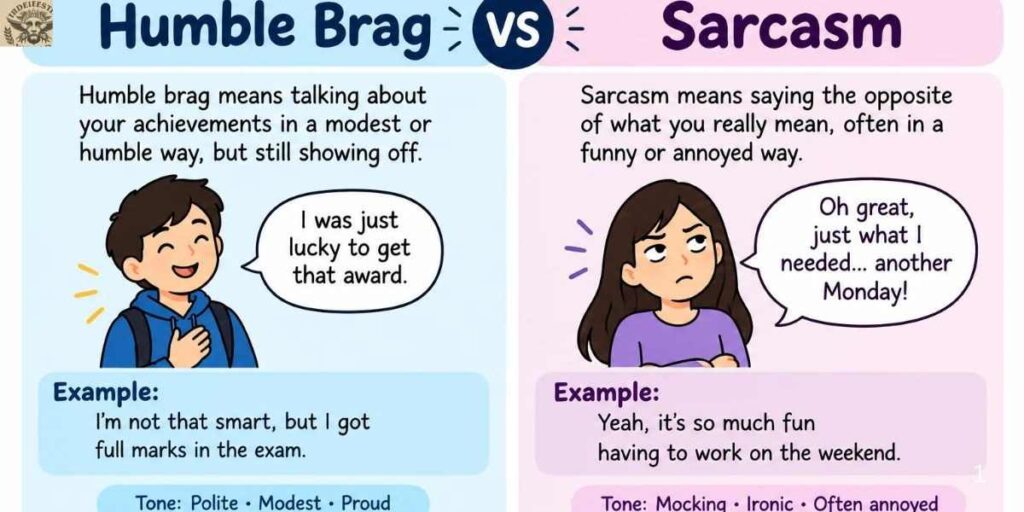
Humblebragging and sarcasm can sometimes sound similar, but they are not the same. A humblebrag disguises a boast as a complaint or a modest statement. Sarcasm uses language that often means the opposite of what the speaker literally says, usually to express humour, irritation, criticism, or mockery.
For example, “I am so unlucky that I won another holiday competition” may be a humblebrag if the person wants others to notice their good fortune. In contrast, “Wonderful, another meeting that could have been an email!” is sarcastic because the speaker is criticising the meeting through ironic praise.
A statement can contain both sarcasm and humblebragging, depending on the speaker’s intention. However, one should not label every ironic sentence a humblebrag. The key question is whether the speaker is indirectly promoting their own achievement or simply using irony for another purpose.
Common Signs of a Humblebrag
A humblebrag often follows recognisable patterns. Learning these signs can help readers understand the expression and identify possible examples in conversation without assuming that every complaint is insincere.
- A complaint about something desirable: The person complains about expensive gifts, frequent holidays, awards, or attention from others.
- False modesty: The person claims to be ordinary or undeserving while drawing attention to an impressive result.
- Self-deprecating language: The speaker criticises themselves in a way that still highlights a positive quality.
- Unnecessary details: The statement includes information about money, status, popularity, or success that may not be relevant to the complaint.
- A focus on recognition: The comment seems designed to make other people notice an achievement.
For instance, saying, “I hate having so many people ask for my advice,” may suggest that others value the speaker’s knowledge. It becomes a possible humblebrag when the complaint is mainly a way to highlight that recognition.
These signs are clues rather than definite proof. Someone may genuinely dislike public attention or feel overwhelmed by work. It is better to understand the context before judging the statement.
Synonyms of Humble Brag
Synonyms are words or expressions with similar meanings. Humblebrag is an informal expression, so some alternatives describe boasting generally, while others more closely capture the idea of appearing modest while showing off.
| Synonym or Related Expression | Meaning | Example |
| False modesty | Pretending to be modest | Her comment sounded like false modesty. |
| Bragging | Talking proudly about achievements | He kept bragging about his new job. |
| Boasting | Expressing excessive pride in something | The conversation turned into boasting. |
| Showing off | Trying to impress others | He was showing off his expensive watch. |
| Self-promotion | Drawing attention to one’s abilities or achievements | The post included some professional self-promotion. |
| Indirect boasting | Showing pride without stating it openly | Her complaint sounded like indirect boasting. |
| Concealed bragging | Hiding a boast within another statement | The remark was a form of concealed bragging. |
False modesty and indirect boasting are especially useful expressions when explaining the humble brag meaning. However, bragging, boasting, Humble Brag Meaning and showing off can also refer to direct self-promotion, so they are not exact synonyms in every situation.
Antonyms of Humble Brag
There is no single perfect antonym for humblebrag in every context. Humble Brag Meaning However, expressions such as genuine modesty, sincere gratitude, Humble Brag Meaning straightforward communication, and honest self-expression contrast with the idea of disguising a boast.
| Opposite or Contrasting Expression | Meaning | Example |
| Genuine modesty | Being modest without pretending | She accepted the award with genuine modesty. |
| Sincere gratitude | Honestly expressing appreciation | He thanked his colleagues for their support. |
| Honest self-expression | Communicating feelings directly | She openly explained how proud she felt. |
| Straightforward statement | Saying something clearly without disguise | He described his achievement directly. |
| Selflessness | Focusing on others rather than personal gain | Her actions showed selflessness. |
For example, “I worked hard for this award, and I am proud of the result” is a straightforward expression of pride. “I cannot believe I have to make room for another award” may be a humblebrag if it is intended to highlight success through a complaint.
How to Use Humble Brag in a Sentence
The term humblebrag can be used as a noun or a verb in informal English. As a noun, it refers to the statement itself. As a verb, humblebrag or humblebragging describes the act of making such a statement. The related word humblebragger refers to a person who humblebrags.
Here are some useful sentence examples:
- That post about receiving another award sounds like a humblebrag.
- He made a humblebrag about his expensive new car.
- She was humblebragging about how many followers she had gained.
- His comment about working with famous clients seemed like a humblebrag.
- I do not want to humblebrag, but I am pleased with my exam results.
- People sometimes use humour when they humblebrag on social media.
- Her complaint about receiving too many invitations sounded like a humblebrag.
- The caption was written as a humblebrag rather than a direct announcement.
- He realised that his comment could come across as humblebragging.
- Sharing an achievement honestly is not necessarily a humblebrag.
These sentences show how the word can describe comments, posts, and conversational behaviour. Because humblebrag is informal, Humble Brag Meaningit is generally more suitable for everyday conversation, blogs, and social media than for highly formal academic writing.
Humble Brag Meaning in British and American English
The term humblebrag is understood in both British and American English. Its central meaning remains the same: a statement that appears modest or self-critical but also communicates pride in an achievement, possession, or experience.
In the UK, someone might describe a comment as a humblebrag when a colleague complains about receiving another promotion or a friend mentions an expensive holiday as if it were an inconvenience. In the USA, the term is also commonly used when discussing social media captions, celebrity comments, workplace achievements, and personal success.
The expression is informal rather than a formal technical term. Readers may see it written as humblebrag or humble brag. Both forms are used, although dictionaries commonly list the single-word form. The related verb forms include humblebrags, humblebragged, and humblebragging.
English learners in India, China, and other countries can use the term in similar contexts, especially when discussing online communication. However,Humble Brag Meaning not every language or culture expresses modesty in exactly the same way. A comment that sounds like a humblebrag to one reader may be interpreted differently by another.
Why Do People Humblebrag?
People may humblebrag for several reasons. Some want recognition but worry that openly expressing pride will make them appear arrogant. Humble Brag Meaning Others use hum our to talk about an achievement or try to make a personal success sound more casual.
Social media can encourage this behaviour because users often share selected details of their lives. A person may want to announce a promotion, a high exam score, a luxury purchase, or a popular post without appearing to seek praise. Framing the news as a complaint may seem like an easier way to attract attention.
In professional settings, someone may use a humblebrag to highlight their experience or importance. For example, an employee might complain about having too many invitations to speak at industry events. The comment may communicate professional recognition while pretending that the attention is a burden.
However, not every indirect statement is deliberately calculated. People sometimes use self-deprecating hum our out of habit or struggle to talk comfortably about success. The humble brag meaning describes how a statement comes across,Humble Brag Meaning but it does not automatically reveal the speaker’s true motivation.
Read More:Gimmick Meaning: Definition, Examples, Synonyms, and How to Use It
How to Respond to a Humblebrag
When someone makes a humblebrag, the best response depends on the relationship and the situation. A friendly conversation may not require any criticism. You can acknowledge the achievement politely without encouraging a long exchange about the person’s status or success.
For example, if a friend says,Humble Brag Meaning “I am exhausted from all the awards I have been receiving,” you might reply, “Congratulations on your achievements. It sounds like you have been busy.” This response recognises the positive news without focusing on the complaint.
If the comment feels uncomfortable, a neutral response can help move the conversation forward. You do not need to accuse the person of humblebragging unless there is a genuine reason to discuss their communication style. In workplaces, it may be more productive to focus on the facts and the task rather than judging the way someone talks about their accomplishments.
People can also avoid humblebragging by communicating more directly. Saying, “I am pleased that my project received recognition” is clear and honest. It allows someone to express pride without pretending that the achievement is a problem.
Is Humblebragging Bad?
Humblebragging is not automatically harmful, but it can sometimes create an impression of insincerity. When people repeatedly disguise achievements as complaints, listeners may feel that the speaker is seeking praise without openly acknowledging it. This can make conversations seem less genuine.
For example, repeatedly complaining about expensive gifts, constant promotions, or large numbers of followers may frustrate friends or colleagues if the underlying purpose appears to be showing off. In professional environments, indirect boasting can also distract from teamwork when it places too much emphasis on individual status.
On the other hand, a single comment may simply be a joke or an awkward attempt to share good news. People should not judge someone’s character based on one sentence without considering the wider context. The important distinction is between sharing a genuine experience and repeatedly using false modesty to attract attention.
A balanced approach is to be honest about achievements, show gratitude when appropriate, and recognise the contributions of others. This allows people to celebrate success without relying on humblebragging.
Frequently Asked Questions
What does humble brag mean in simple words?
Humblebrag means showing off while pretending to be modest or complaining. For example, saying, “I am tired of winning so many awards,” may be a humblebrag if the main purpose is to highlight success.
What is the Urdu meaning of humblebrag?
Humble Brag means بظاہر عاجزی یا شکایت کے انداز میں اپنی تعریف کرنا. It describes indirect boasting in which someone mentions an achievement while appearing embarrassed, modest, or annoyed.
What is an example of a humblebrag on social media?
A fictional example is, “I cannot believe another company has offered me a promotion. I barely have time to relax!” If the person is using the complaint to draw attention to career success, it may be a humblebrag.
What is the difference between humblebragging and bragging?
Bragging involves openly talking proudly about an achievement. Humblebragging disguises that pride as modesty, embarrassment, or a complaint. Both can draw attention to personal success, but they use different styles.
Is humblebrag a real English word?
Yes. Humblebrag is an established informal English word used as both a noun and a verb. Dictionaries such as Cambridge and Oxford include it, and it is commonly used when discussing indirect boasting, especially on social media.
Conclusion
The humble brag meaning describes a form of indirect boasting in which someone appears to be modest, embarrassed, or unhappy while drawing attention to a personal achievement, possession, or positive experience. It combines the ideas of humility and bragging, creating a statement that can sound like a complaint but also functions as self-promotion.
Humblebragging can appear in everyday conversations, workplace discussions, Humble Brag Meaning interviews, and social media posts. Examples include complaining about receiving too many awards, travelling frequently,Humble Brag Meaning or attracting a large audience. However, context matters because people may genuinely feel tired or uncomfortable even when discussing something positive.

