
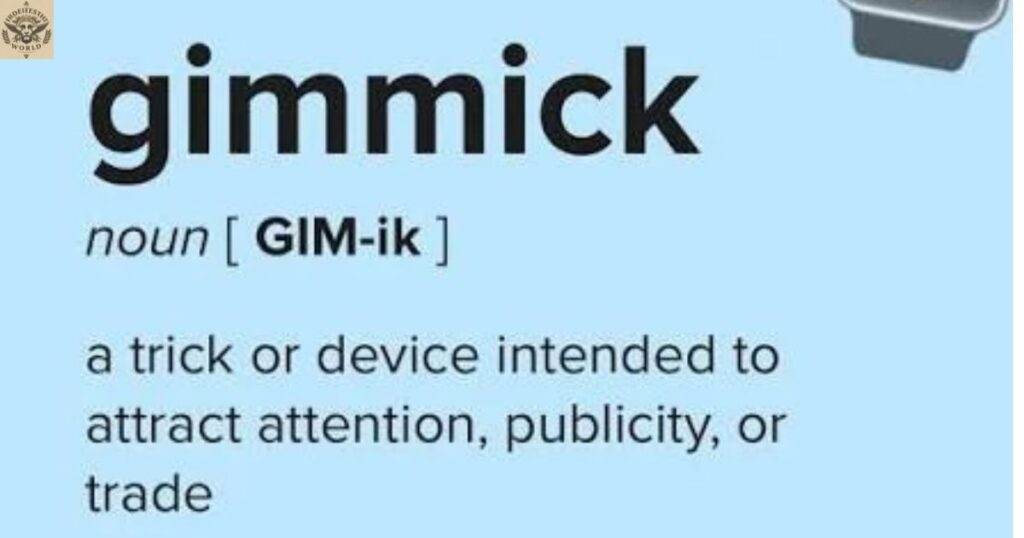
The word gimmick is commonly used in everyday conversations, advertising, business, entertainment, and social media. It describes a special trick, unusual feature, or creative idea that attracts attention. Sometimes a gimmick makes a product more interesting, but it may also be used to make something look better than it really is. Understanding the gimmick meaning helps explain why companies, influencers, and businesses use special techniques to attract customers or audiences.
A gimmick can be funny, clever, entertaining, or even misleading. For example, a restaurant might serve a drink in a glowing glass to make customers curious. The glowing glass is a gimmick because it creates excitement beyond the drink itself. Similarly, a company might advertise a phone with a feature that looks impressive but offers little practical value. In that situation, people may describe the feature as a marketing gimmick.
The meaning of gimmick depends on the situation in which the word appears. It can describe a harmless creative idea or suggest that someone is trying too hard to gain attention. Learning how to use the word correctly makes it easier to understand product reviews, advertisements, news articles, online discussions, and everyday English.
What Is the Gimmick Meaning?
The word gimmick means a special trick, unusual idea, or attention-grabbing feature used to attract interest. It often describes something designed to make a product, service, performance, or person stand out from others. The idea may be useful and entertaining, or it may be mainly intended to create excitement without offering much real value.
For example, a toy company might add flashing lights and sound effects to a simple toy to make it more attractive to children. These features can be called a gimmick if their main purpose is to grab attention. The word does not always mean that something is dishonest. It simply suggests that a special technique is being used to create interest.
In simple English, the gimmick meaning is an unusual trick or feature that attracts attention. In Urdu, it can be understood as توجہ حاصل کرنے کا خاص طریقہ، چال، یا دکھاوے کی ترکیب. The most suitable translation depends on whether the situation is positive, neutral, or negative.
Gimmick Meaning in Simple English
In simple English, a gimmick is something unusual that makes people notice or become interested in something. It might be a clever design,Gimmick Meaning a surprising activity, a promotional offer, or a special feature. Businesses often use gimmicks to make their products different from competing products.
For example, a café may offer coffee with a colourful design on top. The design attracts customers and encourages them to take photographs. If the design is mainly intended to make the café popular, it can be described as a gimmick.
However, a gimmick is not necessarily a bad thing. A creative idea can improve the customer experience and make an ordinary product memorable. The important question is whether the gimmick adds genuine value or simply creates temporary excitement.
Gimmick Meaning in Urdu
The Urdu meaning of gimmick changes slightly according to the context. It can mean a trick, a special technique, a showy feature, or a clever way to attract attention. In negative situations, it may suggest a misleading tactic designed to influence people.
| English expression | Urdu meaning |
| Marketing gimmick | تشہیر کے لیے توجہ حاصل کرنے کی ترکیب |
| Cheap gimmick | سستی یا سطحی چال |
| Clever gimmick | توجہ حاصل کرنے کا ذہین طریقہ |
| Advertising gimmick | اشتہار میں لوگوں کو متوجہ کرنے کا طریقہ |
| Political gimmick | سیاسی فائدے کے لیے اختیار کیا گیا دکھاوے کا طریقہ |
| Promotional gimmick | فروخت بڑھانے کے لیے استعمال ہونے والی خاص ترکیب |
For instance, a shop might announce a limited-time discount to encourage people to buy products quickly. If the offer is genuine, it is simply a promotion. If the discount is exaggerated or misleading, people may call it a marketing gimmick.
Gimmick Meaning in Hindi
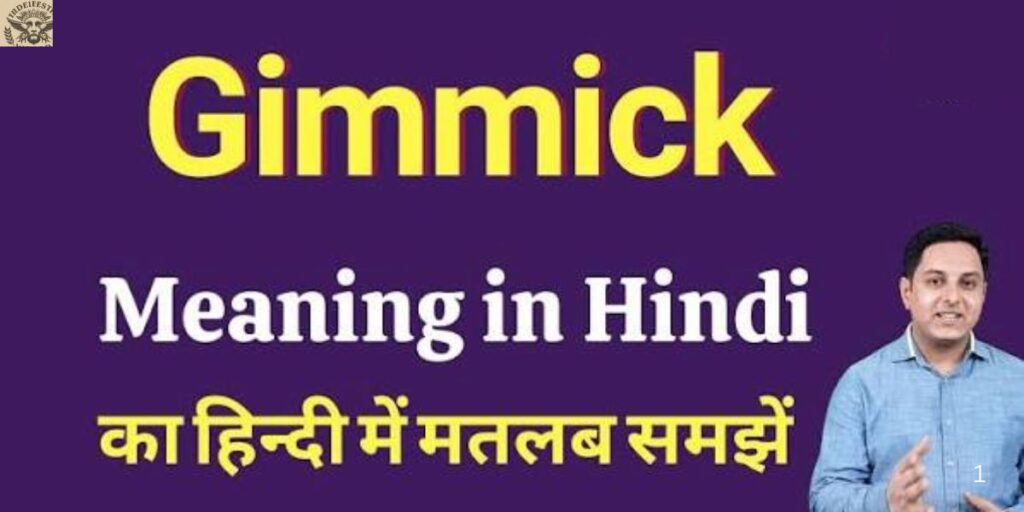
In Hindi, gimmick can mean चाल, दिखावटी तरकीब, या ध्यान आकर्षित करने का खास तरीका. The exact meaning depends on how the word is used. A creative feature that makes a product memorable may be described neutrally, while an unnecessary or misleading feature may be criticised as a gimmick.
For example, a company might introduce a phone with colourful lights around its camera. If the lights attract attention but do not improve the phone’s main functions, some customers may consider them a gimmick.
The word is commonly used in conversations about advertising, entertainment, products, politics, and social media. Its meaning is close to a trick or attention-grabbing technique, but it does not always imply deception.
What Is the Origin of the Word Gimmick?
The exact origin of the word gimmick is uncertain. It became established in American English during the early twentieth century and was often associated with tricks, devices,Gimmick Meaning or techniques used by performers and people trying to attract attention. Over time, its meaning expanded into advertising, business, entertainment,Gimmick Meaning and everyday conversation.
Today, people use the word to describe anything from a clever promotional idea to a feature that appears unnecessary. A magician’s unusual method, a restaurant’s surprising presentation, or a company’s eye-catching advertisement may all be called a gimmick.
The word has also become popular in online discussions because people frequently question whether new products and trends offer real benefits. When an idea seems designed mainly to generate publicity, the term is often used critically.
How the Meaning Has Changed Over Time
In earlier usage, the word was associated with tricks and unusual devices, particularly in performance and entertainment settings. As advertising and consumer culture developed, businesses began using creative techniques to attract attention and distinguish their products. The word gradually became common in discussions about promotional strategies.
Modern technology has created even more examples. Smartphone features, viral marketing campaigns, influencer promotions, and unusual product designs may all be described as gimmicks. Some are successful because they provide entertainment or practical value, while others lose popularity once the initial excitement disappears.
The modern gimmick meaning therefore includes both the idea of attracting attention and the possibility that the attention-grabbing feature lacks lasting value.
What Is a Gimmick in Everyday Life?
A gimmick can appear in ordinary situations without involving a large company or expensive product. People may use unusual methods to make an event memorable,Gimmick Meaning persuade others to notice something, or encourage participation in an activity. These methods can be harmless and creative,Gimmick Meaning depending on their purpose.
Imagine a school organising a reading competition where students receive colourful badges for completing books. The badges are an attention-grabbing feature that motivates participation. Someone might describe them as a gimmick, although they can also serve a useful purpose by encouraging students to read.
Similarly, a shop might place a giant model of its main product outside the entrance. The unusual display attracts passers-by and encourages them to enter. In this case, the display works as a promotional gimmick.
Everyday Examples of Gimmicks
Here are several examples that show how the word is used in different situations.
- A restaurant serves dessert in an unusual container to attract attention.
- A school uses a reward chart to encourage students to complete assignments.
- A shop displays a giant product model outside its entrance.
- A mobile game offers colourful badges to encourage players to return.
- A clothing brand creates a surprising packaging design to make its products memorable.
Each example involves a special feature that encourages people to notice, remember, or interact with something. Whether the feature deserves criticism depends on its usefulness and purpose.
Is a Gimmick Always a Bad Thing?
No, a gimmick is not always negative. The word can describe a clever and entertaining technique that improves an experience. A creative presentation may help a small business attract customers, while an unusual event activity may make an occasion more enjoyable.
The word becomes more negative when the special feature hides poor quality, exaggerates benefits, or distracts people from important information. For example, a product may have impressive packaging but fail to perform its main function.
The difference lies in the value provided. A useful gimmick supports the product or experience, while a weak gimmick depends mainly on temporary excitement.
Read More:hearsay-meaning-definition-examples-synonyms-and-urduhindi-translation
What Is a Marketing Gimmick?

A marketing gimmick is a promotional technique designed to attract attention, create interest, or encourage customers to purchase a product or service. Companies use creative packaging, unusual advertisements, limited-time offers,Gimmick Meaning competitions, Gimmick Meaning and memorable slogans to make their products stand out in crowded markets.
For example, a coffee brand might print customers’ names on its cups to create a personal experience. This technique encourages customers to share photographs online and discuss the brand with friends. It can be considered a marketing gimmick because it attracts attention through a special feature rather than through the coffee alone.
Marketing gimmicks can be effective when they support a good product and provide a positive customer experience. However, they may damage trust if the promotion makes promises that the product cannot fulfil.
Common Types of Marketing Gimmicks
Businesses use different methods to attract customers, depending on their audiences and goals.
| Type | Example | Main purpose |
| Limited-time offer | A genuine weekend discount | Encourage timely purchases |
| Eye-catching packaging | A colourful product box | Make a product noticeable |
| Free gift | A small gift with a purchase | Increase customer interest |
| Unusual demonstration | A surprising product display | Show a product in an entertaining way |
| Viral campaign | A challenge shared on social media | Encourage people to discuss a brand |
| Celebrity promotion | A famous person endorses a product | Increase public awareness |
These methods are not automatically misleading. A promotion becomes questionable when its claims are dishonest, its terms are unclear, or its main purpose is to distract customers from a lack of value.
Marketing Gimmick Examples
Suppose a company launches a new water bottle with a built-in light that changes colour when the bottle is moved. The feature attracts attention and may appeal to customers who enjoy unusual designs. However, buyers who mainly need a reliable bottle may consider the light unnecessary.
Another company might advertise a product as having a massive discount, although its original price was artificially increased shortly before the sale. Customers may describe this as a marketing gimmick because the promotion creates a misleading impression of savings.
These examples show why it is important to look beyond the advertisement. Customers should compare product quality, actual prices, useful features, and customer reviews before deciding whether a promotional offer provides real value.
What Is a Gimmick in Advertising?
In advertising, a gimmick is a special technique used to make an advertisement more noticeable or memorable. It can include humour, surprising visuals, unusual slogans, dramatic demonstrations,Gimmick Meaning or interactive activities. The main goal is to make people pay attention to a message that might otherwise be ignored.
For example, a car advertisement might show a vehicle driving through an imaginary city made entirely of chocolate. The unusual visual attracts viewers,Gimmick Meaning even though it does not explain the car’s practical features. The visual concept may be called an advertising gimmick.
An advertising gimmick can help a brand communicate creatively. However, it is less effective when people remember the unusual presentation but cannot remember the product or understand its benefits.
How Advertising Gimmicks Influence Customers
Advertising gimmicks often use curiosity, humour, surprise, excitement, or social participation. These elements encourage people to stop scrolling, watch a video,Gimmick Meaning visit a website, or discuss a brand with friends. When a campaign creates a memorable experience, it may also help customers recognise the brand later.
However, attention does not always lead to trust or sales. A funny advertisement might receive millions of views while producing little interest in the actual product. Companies need to connect the creative idea with clear information about quality, price, usefulness, and customer needs.
For consumers, the best approach is to ask whether an advertisement explains a real benefit or mainly uses excitement to influence a decision.
What Is a Gimmick in Business?
In business, a gimmick is an unusual strategy, feature, or promotional idea used to attract customers, increase visibility, or distinguish a company from competitors. Businesses may use special loyalty rewards, unusual product demonstrations, creative store designs, or memorable customer experiences.
A new bakery, for example, might sell cakes decorated to look like everyday objects. The unusual appearance encourages customers to visit, take photographs, and share their experiences online. This can help the bakery become more recognisable in its local market.
However, a business cannot rely on gimmicks alone. Customers are more likely to return when products are reliable, prices are fair,Gimmick Meaning and service is helpful. An attention-grabbing idea may bring customers through the door, but long-term success usually depends on delivering genuine value.
Read More:Hostage Meaning: Definition, Examples, Sentences, and Urdu/Hindi Translation
Business Gimmicks That Work
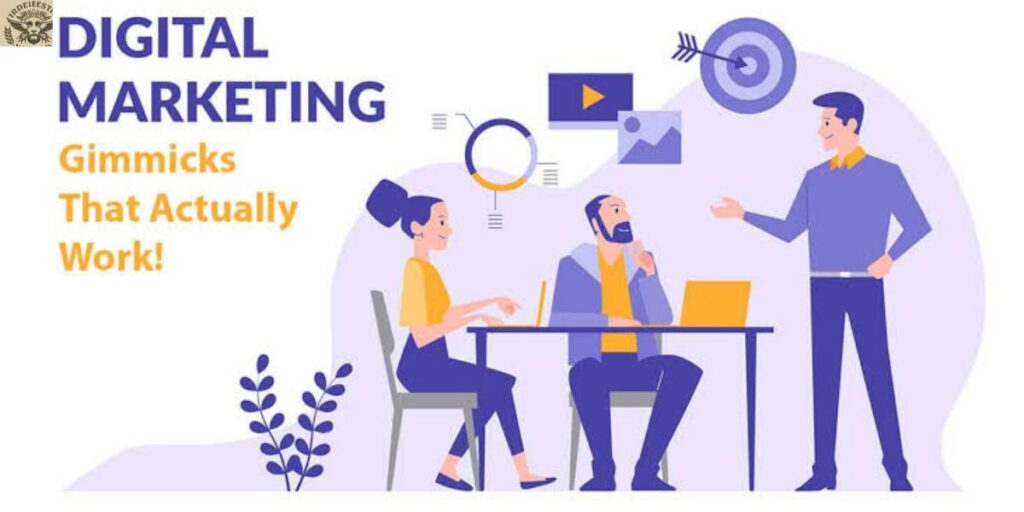
A useful business gimmick supports the company’s main offering instead of replacing it. A bookstore might organise a mystery-book event in which customers choose a wrapped book based on a short description. This unusual shopping experience adds entertainment to the purchase and can help the store build customer relationships.
A small clothing brand might also use personalised packaging or offer a creative way to present gifts. These features can make the buying experience memorable, particularly when the underlying product meets customer expectations.
The key is to evaluate whether the idea improves customer satisfaction, communicates the brand’s identity, or encourages useful engagement. If the feature adds no value and exists only to generate attention, its impact may be short-lived.
What Is a Gimmick in Technology?
In technology, a gimmick is a feature or design element that attracts attention but may have limited practical usefulness. New phones,Gimmick Meaning computers, televisions, gaming devices, and smart-home products sometimes include unusual features to distinguish them from competing models.
For example, a smartphone might include animated lights around its camera module. Some users may enjoy the visual effect, while others may consider it unnecessary if it does not improve photography, battery life, or everyday performance.
Calling a feature a gimmick is often a matter of personal preference. A feature that appears unnecessary to one customer may be valuable to another. Buyers should therefore consider their own needs instead of assuming that every unusual feature is useless.
Examples of Technology Gimmicks
Technology provides many situations in which people debate whether a feature is genuinely useful.
- A phone includes a decorative light pattern that adds little practical benefit.
- A television offers a visual effect that most viewers rarely use.
- A smart-home device includes a novelty sound that does not improve its main function.
- A gaming accessory has an elaborate design but provides little improvement in comfort or control.
These examples are illustrative rather than claims about specific products. Whether a feature qualifies as a gimmick depends on how well it meets real user needs.
How to Identify a Technology Gimmick
Start by identifying the main purpose of the device. If a phone is primarily intended for communication and photography, evaluate call quality,Gimmick Meaning camera performance, battery life, software support, and reliability before considering decorative extras.
Next, determine whether the unusual feature solves a real problem. Read independent reviews, compare specifications, and check whether customers use the feature regularly. A feature may be impressive during a demonstration but offer little value during everyday use.
Finally, compare the price with the benefits. If a special feature substantially increases the price without providing a meaningful improvement, it may be reasonable to treat it as a gimmick.
What Is a Gimmick in Social Media?
On social media, a gimmick is a technique used to attract views, followers, comments, or shares. Content creators may use unusual challenges, dramatic introductions, surprising edits, catchy phrases, or visually distinctive formats to make their posts more noticeable.
For example, a creator might begin every video by revealing a surprising object before explaining the topic. This repeated opening can become a recognisable gimmick that encourages viewers to keep watching. It may be entertaining when the content delivers on the initial promise.
However, social media gimmicks can become annoying when they repeatedly exaggerate information or delay the main point. A creator who promises a shocking revelation but provides nothing meaningful may lose audience trust.
Social Media Gimmick Examples
Common examples include unusual video transitions, recurring jokes, exaggerated reactions, distinctive backgrounds, and creative audience challenges. These techniques can help creators develop a recognisable style and encourage people to interact with their content.
A cooking creator, for instance, might present each recipe using a colourful overhead camera setup. The presentation style could become a gimmick that makes the videos easy to recognise. If the recipes are useful and accurate, Gimmick Meaning the creative style can complement the content.
By contrast, a creator who uses misleading thumbnails to suggest something that never appears in the video may be criticised for relying on a gimmick. The difference is whether the technique supports the content or misleads the audience.
What Is a Political Gimmick?
A political gimmick is an action, announcement, slogan, or public event that appears designed mainly to attract attention or gain political support. The term is usually critical because it suggests that the action may prioritise publicity over meaningful results.
For example, a politician might organise a highly publicised event around a small project while giving little attention to the project’s long-term impact. Critics may describe the event as a political gimmick if they believe it is intended mainly to improve public image.
However, the label alone does not prove that an action is dishonest or ineffective. To evaluate a political claim fairly,Gimmick Meaning people should examine the policy details, available evidence, costs, expected benefits, and actual results.
Political Gimmick Examples
A politician might introduce a catchy slogan to make a complicated policy easier to remember. The slogan is not necessarily a gimmick in a negative sense, but it may be criticised if it oversimplifies the issue without explaining how the policy would work.
Similarly, a public campaign may focus heavily on dramatic photographs while providing little information about its objectives. Observers may question whether the campaign offers genuine public value or mainly seeks favourable publicity.
The term is therefore best understood as an expression of criticism rather than as a neutral factual description of every political event.
Gimmick Meaning in a Sentence
Understanding the word becomes easier when it appears in complete sentences. A gimmick can describe a product feature, promotional technique, unusual design, or attention-grabbing action. The following examples demonstrate how the word works in ordinary English.
- The restaurant’s glowing drinks were an interesting gimmick.
- Customers thought the product’s special feature was just a gimmick.
- The company used a marketing gimmick to attract new buyers.
- The advertisement relied on a clever gimmick to gain attention.
- The shop introduced a promotional gimmick during the holiday season.
- Some viewers considered the television show’s unusual format a gimmick.
- The new phone’s decorative lights seemed like a gimmick.
- The campaign used humour as a gimmick to make people remember the brand.
- The discount looked attractive, but customers suspected it was a gimmick.
- The café’s creative presentation was a gimmick that helped it stand out.
These examples show that the word often appears with expressions such as marketing gimmick, clever gimmick, cheap gimmick, and just a gimmick. The surrounding words help communicate whether the speaker approves of the idea or considers it unnecessary.
Positive Sentences Using Gimmick
A gimmick can describe something creative or entertaining without suggesting dishonesty.
- The shop’s mystery gift was a fun gimmick that attracted families.
- The festival used a clever gimmick to encourage visitors to participate.
- The restaurant’s unusual dessert presentation became a popular gimmick.
- The brand created a memorable gimmick that helped customers recognise its products.
In these sentences, the word describes a feature that attracts attention and adds interest. The tone is generally positive or neutral because the examples do not suggest that customers are being misled.
Negative Sentences Using Gimmick
The word can also express criticism when a feature appears unnecessary, misleading, or designed mainly to attract attention.
- The product’s flashy packaging was nothing more than a gimmick.
- Customers criticised the advertisement as a cheap gimmick.
- The company used a misleading gimmick to create false excitement.
- The new feature looked impressive but felt like an unnecessary gimmick.
In negative sentences, the word often suggests that the idea lacks genuine value. Expressions such as cheap gimmick and nothing more than a gimmick make the criticism stronger.
Gimmick Synonyms and Related Words
Several English words have meanings similar to gimmick, but they are not interchangeable in every situation. A synonym may emphasise deception, creativity, publicity, or the method used to attract attention. Choosing the right word makes a sentence more accurate.
| Word | Meaning | Example |
| Trick | A method used to achieve an effect, sometimes dishonestly | The advertisement used a trick to attract attention. |
| Tactic | A planned method for achieving a goal | The company adopted a new sales tactic. |
| Device | A method or technique used for a particular purpose | Humour was an effective literary device. |
| Ploy | An action intended to influence someone, often deceptively | The offer seemed like a ploy to increase sales. |
| Stunt | An unusual action designed to attract attention | The publicity stunt attracted media coverage. |
| Scheme | An organised plan, sometimes with a negative implication | Customers questioned the unusual scheme. |
| Novelty | Something new, unusual, or interesting | The novelty soon wore off. |
| Attraction | Something that draws attention or interest | The giant display became a tourist attraction. |
| Promotion | An activity designed to publicise or sell something | The store launched a summer promotion. |
| Strategy | A broader plan designed to achieve an objective | The business developed a long-term strategy. |
The best synonym depends on the intended meaning. Ploy often sounds more suspicious than gimmick, while strategy is usually more neutral and may refer to a much broader plan. Novelty focuses on the unusual quality of something rather than on the technique used to attract attention.
Gimmick vs Trick
A trick is a method used to create an effect, Gimmick Meaning solve a problem, or deceive someone. It can refer to a magic performance, a clever shortcut, or a dishonest action. A gimmick, by comparison, usually refers to a distinctive feature or technique intended to attract attention.
For example, a magician may use a trick to make an object appear to disappear. A toy company may use flashing lights as a gimmick to make a product more noticeable. Both words can involve something unusual, but their typical purposes differ.
Gimmick vs Ploy
A ploy is a deliberate action intended to influence someone or gain an advantage. It often carries a more negative tone because it can suggest manipulation or deception. A gimmick may be harmless, entertaining, or simply unusual.
For instance, a shop might use colourful packaging as a gimmick. If the shop invents a false emergency to pressure customers into buying products, that action could be described as a ploy.
Gimmick vs Stunt
A stunt is an unusual or dramatic action that attracts public attention. It may be performed for entertainment, publicity, or a specific purpose. A gimmick can be a repeated feature or technique rather than a single dramatic event.
For example, a company might arrange a giant public display as a publicity stunt. It might also use a special logo animation in every advertisement as a recurring gimmick.
Common Phrases That Use the Word Gimmick
The word frequently appears in common English expressions. Learning these phrases can help readers understand reviews, news stories, advertisements, and everyday conversations.
| Phrase | Meaning | Example |
| Marketing gimmick | A promotional technique used to attract customers | The campaign was criticised as a marketing gimmick. |
| Advertising gimmick | An attention-grabbing feature in an advertisement | The advert used a humorous advertising gimmick. |
| Cheap gimmick | A low-quality or unimpressive attention-seeking technique | The reviewer called the feature a cheap gimmick. |
| Clever gimmick | An inventive way to attract interest | The interactive display was a clever gimmick. |
| Just a gimmick | Something considered to have little real value | The extra feature was just a gimmick. |
| Gimmick-free | Without unnecessary attention-grabbing features | The company promoted a simple, gimmick-free design. |
| Gimmick product | A product whose appeal relies heavily on an unusual feature | Buyers questioned whether the item was a gimmick product. |
These expressions are especially common in consumer reviews and discussions about business. They allow speakers to explain whether a special feature adds value, attracts attention, or appears unnecessary.
How to Use Gimmick Correctly in English
The word gimmick is a noun. It can refer to a particular feature, technique, idea, or action. It is commonly used with articles such as a and the, and it can be modified by adjectives such as clever, cheap, unusual, or marketing.
For example, a person might say, “The company introduced a clever gimmick to promote its new product.” The word identifies the special technique, while clever describes its nature. Another sentence might be, “I think the feature is just a gimmick.” In this case, the speaker suggests that the feature has little practical value.
The plural form is gimmicks. For example, “The advertisements used several gimmicks to attract viewers.” Although the word is commonly used in informal discussions, it also appears in professional writing about advertising, marketing, politics, and consumer behaviour.
Grammar Rules for Gimmick
Use gimmick when referring to one attention-grabbing feature or technique. Use gimmicks when referring to more than one. The phrase a gimmick usually refers to a particular idea, while the gimmick refers to a feature already identified or understood.
Examples:
- The product has a clever gimmick.
- The company introduced several promotional gimmicks.
- The reviewer called the feature a gimmick.
- The advertisement relies on a simple gimmick.
- The shop uses creative gimmicks during special events.
A common mistake is to assume that the word always means a dishonest trick. Although it often carries a critical tone, the context determines whether the meaning is negative, neutral, or positive.
How to Identify a Gimmick
Recognising a gimmick requires looking at the purpose of an unusual feature and the value it provides. An attention-grabbing design or promotion is not automatically bad. The important question is whether it supports a useful product, communicates honest information, or simply distracts people from weaknesses.
Start by examining the main benefit being offered. If a company promotes a decorative feature more heavily than the product’s actual performance, consider whether the feature is relevant to the purchase. Next, compare the claims with independent information, product specifications, and reliable customer feedback.
Finally, think about whether the feature would still matter after the initial excitement disappeared. If it continues to provide enjoyment or practical benefits, it may be a worthwhile addition. If its only purpose is to create temporary attention, describing it as a gimmick may be reasonable.
Questions to Ask Before Buying a Product
Consumers can use a few simple questions to evaluate an unusual product feature.
- Does the feature solve a real problem?
- Is the product worth its price without the special feature?
- Are the advertised benefits supported by evidence?
- Do independent reviews confirm the company’s claims?
- Will the feature remain useful after the novelty wears off?
These questions can help customers make informed decisions without rejecting every creative idea. A product may include a gimmick and still be excellent, but the gimmick should not distract buyers from quality, safety, reliability, and value.
Why Do Companies Use Gimmicks?
Companies use gimmicks because markets are crowded and customers often encounter many similar products. An unusual feature can help a brand stand out, attract media coverage, encourage social sharing, or give customers a memorable experience. When a company has a limited advertising budget, a creative idea may also help it reach people without relying entirely on expensive campaigns.
For example, a small bakery may introduce a cake that changes colour under special lighting. The unusual presentation may encourage customers to visit and share photographs. If the cake tastes good and offers fair value, the gimmick can support the bakery’s reputation.
However, attention is only one part of a successful business strategy. Companies also need to provide reliable products, transparent prices, helpful service, and consistent quality. A gimmick may encourage an initial purchase, but it cannot guarantee repeat customers.
Benefits of Using a Gimmick
A well-planned gimmick can make a product easier to recognise and remember. It can encourage customers to discuss a brand, participate in an event, or explore a product they might otherwise overlook. Creative promotional ideas may also help businesses communicate their personality.
For example, a bookshop that wraps mystery books with short descriptions can make shopping more entertaining. Customers may enjoy the experience and return for future purchases. In this case, the gimmick contributes to customer engagement rather than relying on attention alone.
Disadvantages of Using a Gimmick
A weak gimmick can distract customers from a product’s real benefits. If a business spends too much money on flashy promotions, it may have fewer resources for product quality, customer support, or fair pricing. Customers may also become disappointed when an exciting feature fails to deliver what they expected.
Repeated use of exaggerated promotions can damage trust. Once customers begin to associate a brand with empty promises, future advertisements may become less convincing. Businesses should therefore use creative techniques responsibly and ensure that the underlying product provides genuine value.
Gimmick Meaning in Different Contexts
The meaning of gimmick can vary according to the topic being discussed. In marketing, it usually refers to a promotional technique. In technology, it often describes a feature that may have limited usefulness. In entertainment, it can refer to a distinctive performance style or attention-grabbing effect.
In social media, the term may describe a repeated format that attracts viewers. In politics, it often expresses criticism of an action believed to prioritise publicity over results. In ordinary conversation, it can refer to almost any unusual technique used to get people’s attention.
Understanding the context prevents confusion. A feature described as a gimmick in a negative product review may be considered creative and enjoyable in an entertainment review. The word alone does not establish whether an idea is useful or misleading.
Gimmick in British and American English
The word gimmick is widely understood in both British English and American English. Its basic meaning remains the same: a special feature, trick, or technique used to attract attention. There is no major difference in the spelling between the two varieties.
In the UK, a reviewer might describe an unnecessary product feature as “a bit of a gimmick.” In the USA, someone might say that a promotional offer is “just a marketing gimmick.” Both expressions suggest that the feature may attract attention without providing enough value.
The word is also understood in international English, including business and online discussions in India, China, and other English-speaking or English-learning markets. Its tone depends more on context than on regional differences.
Frequently Asked Questions
What does gimmick mean in simple words?
A gimmick is a special trick, feature, or creative idea used to attract attention. It may be entertaining or useful, but sometimes it offers little real value. The meaning depends on the situation.
What is the Urdu meaning of gimmick?
The Urdu meaning of gimmick can be چال، دکھاوے کی ترکیب، یا توجہ حاصل کرنے کا خاص طریقہ. In advertising, it often means a technique used to attract customers or create excitement.
Is a gimmick a good thing or a bad thing?
A gimmick can be positive, neutral, or negative. A clever gimmick may improve an experience or help a product stand out. A misleading gimmick may exaggerate benefits or distract customers from poor quality.
What is an example of a marketing gimmick?
A company might use colourful packaging, a special promotional offer, or an unusual product demonstration to attract customers. These techniques can be useful when the offer is honest and the product provides genuine value.
What are the synonyms of gimmick?
Common synonyms and related words include trick, tactic, ploy, stunt, device, and novelty. Each word has a slightly different meaning, so the best choice depends on the sentence.
Conclusion
The word gimmick describes a special trick, feature, or technique used to attract attention. It commonly appears in discussions about marketing, advertising, business, technology, entertainment, and social media. A gimmick can make an ordinary experience more interesting, help a company stand out, or encourage people to explore a product.
However, the word often carries a negative meaning when the special feature appears unnecessary or misleading. Customers may question a gimmick if it creates excitement without providing genuine benefits. The best way to understand the word is to consider the purpose of the feature and the value it offers.
Learning the gimmick meaning also makes it easier to understand phrases such as marketing gimmick, cheap gimmick, and just a gimmick. With the examples and sentences in this guide, English learners can recognise the word in everyday conversations and use it more confidently.

