

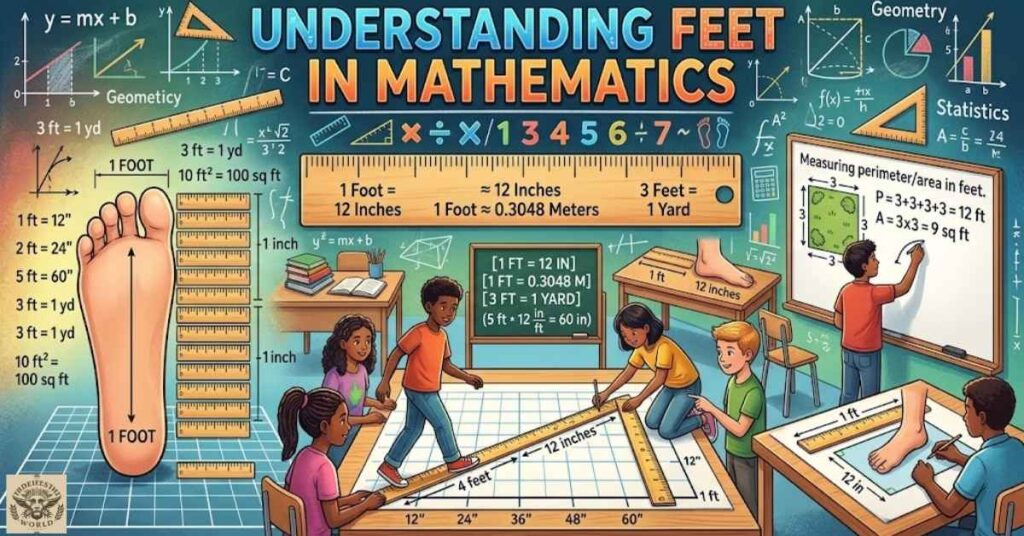
The foot is one of the most commonly used units in the U.S. customary measurement system, especially for everyday lengths and short distances. If you’ve ever wondered how long is a foot, the answer is simple: 1 foot equals exactly 12 inches, making it a natural bridge between smaller units (inches) and larger ones (yards). Whether you’re measuring a table, a doorway, or a person’s height, understanding feet and inches together is one of the most practical measurement skills a student can learn.
This unit shows up constantly in real life from furniture dimensions to room sizes to sports fields which makes mastering feet measurement far more than just a classroom exercise. This guide walks through how feet are written, why units matter, and practical strategies for teaching this essential concept with confidence.
Representing Feet In Writing
Recording measurements accurately means always pairing a number with its correct unit, and feet are no exception. The standard abbreviation for feet is “ft.” for example, 5 feet is written as 5 ft. In many technical and everyday contexts, a single apostrophe symbol is also used to represent feet, so 5 feet can also appear as 5′.
This shorthand is especially common in construction drawings, real estate listings, and height measurements, where quick, compact notation is preferred. Teaching students both formats early on prepares them to read measurements confidently in real-world settings, not just textbooks.
Why Including Units of Measure is Important When Using Feet
Attaching a clear unit to every measurement isn’t just a formality it’s what makes a number meaningful. Without a unit, a value like “5” is ambiguous: it could mean 5 feet, 5 inches, 5 meters, or something else entirely, depending on context. Consistently labeling measurements with units teaches students precision and removes room for misinterpretation.
This habit also mirrors professional standards; in fields like construction, architecture, and engineering, a missing or incorrect unit can lead to expensive, sometimes dangerous, mistakes. Reinforcing this early builds a foundation of careful, detail-oriented mathematical thinking that carries into more advanced problem-solving later on.
Read More: 25+ Other Ways to Say Wish You All the Best in Your Future Endeavours (With Examples)
Why Understanding Feet Is Important
Learning to work confidently with feet introduces students to the broader idea of standardized measurement a concept that makes communication about size and distance consistent across people, places, and professions.
From a mathematical standpoint, feet-based problems strengthen several key skills:
- Numerical fluency: Converting between feet, inches, and yards gives students regular practice with addition, subtraction, multiplication, and division.
- Proportional reasoning: Understanding how feet relate to inches and yards (for instance, that 1 yard is three times as long as 1 foot) helps students grasp multiplicative relationships between units.
- Estimation skills: Knowing roughly how long a foot is allows students to make sensible guesses about real-world lengths before ever picking up a ruler.
Teaching Strategies For Feet

Solid teaching of feet relies on combining visual tools, hands-on practice, and guided questioning so students internalize the unit rather than just memorizing conversion numbers.
Connecting Feet By Incorporating Visuals And Manipulatives
Manipulatives turn an abstract idea like “12 inches equals 1 foot” into something students can see and touch. Using one-inch square tiles, students can physically build a foot by lining up 12 tiles end-to-end, then extend that model to show that three sets of 12 tiles form 3 feet, which equals 1 yard.
This kind of visual modeling reinforces skip-counting by 12 and helps students internalize the multiplicative relationship between units. Extending the activity to real classroom objects “How many tiles long is this table? How many feet does that equal?” turns an abstract unit into something concrete and memorable.
Connecting Feet To Hands-On Experiences
Nothing builds understanding faster than direct measurement of familiar objects. Have students measure items like a desk, a bookshelf, or a section of classroom floor using a tape measure or ruler. Recording each measurement in both feet and inches encourages students to compare formats and notice how the two units relate.
Extending the activity with comparison questions “Which objects are longer than 3 feet? Which are shorter?” pushes students to reason critically about size and apply their measurement skills to practical, everyday scenarios.
Exploring the Relationship Between Feet and Inches
A clear grasp of how feet and inches relate to each other sets the stage for smooth unit conversions and stronger proportional reasoning overall. Since 1 foot always equals 12 inches, students can practice straightforward conversions by asking, “How many inches are in 2 feet? In 3 feet?” Reversing the process with division-based prompts, such as “If something is 24 inches long, how many feet is that?”, reinforces the inverse relationship.
As students grow more comfortable, introduce mixed measurements like 1 foot 6 inches, which naturally connects this topic to fractions and mixed numbers.
Practice Estimation With Feet
Estimation sharpens both spatial awareness and numerical confidence. Encourage students to guess the length of classroom objects in feet before measuring them, then compare their estimate to the actual result. Using a known reference such as a classroom door that measures roughly 7 feet gives students a mental benchmark for estimating other lengths around them. Over time, this practice builds intuition for feet as a practical, everyday unit rather than an abstract number on a ruler.
Connecting Feet To Larger Units
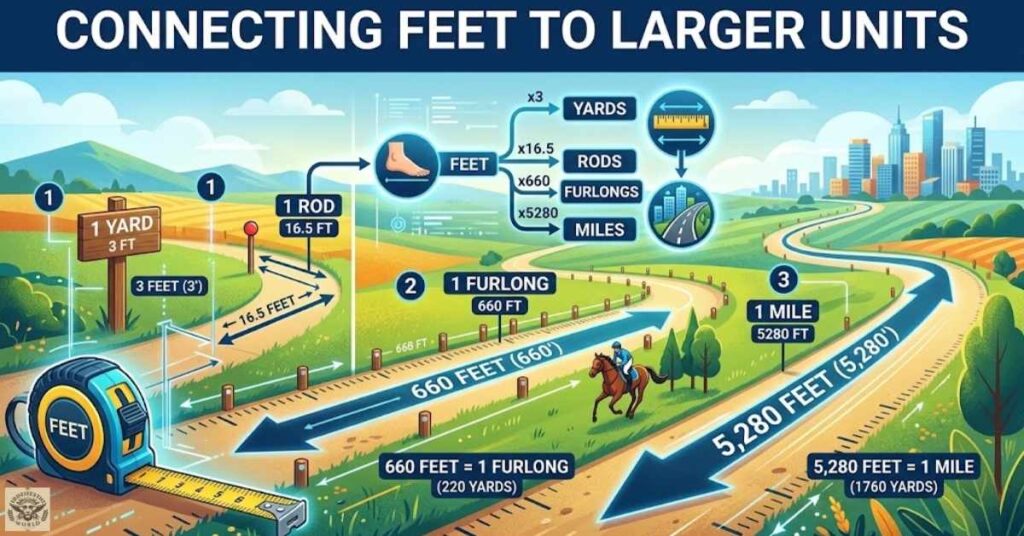
Understanding how feet relate to yards and miles introduces students to the layered structure of the measurement system as a whole. Visual tools like a yardstick make it easy to demonstrate that 1 yard equals 3 feet, while comparing familiar objects in both units builds proportional thinking. This step naturally prepares students for later topics involving larger distances and more complex unit conversions.
Feet in Mathematics Formula
The core formula every student needs is simple: 1 foot = 12 inches, and 1 yard = 3 feet. From these two relationships, most feet-based conversions can be solved. To convert feet to inches, multiply the number of feet by 12. To convert inches back to feet, divide the number of inches by 12. These two formulas form the backbone of nearly every measurement problem involving feet.
How Many Feet in Mathematics
In mathematics problems, “how many feet” questions typically ask students to convert from another unit inches, yards, or miles into feet. For example, since 1 yard equals 3 feet, a length of 5 yards equals 15 feet. Similarly, since 5,280 feet make up 1 mile, longer distance problems often require multiple conversion steps combined together.
Feet in Mathematics Examples
Practical examples make the concept stick. A standard door is about 7 feet tall. A typical car is roughly 15 feet long. A basketball hoop stands 10 feet above the ground. Using these everyday references alongside worksheet problems helps students connect abstract numbers to objects they already recognize.
Feet in Mathematics Calculator

For quicker classroom checks, online feet calculators allow students to input a value in inches, yards, or meters and instantly see the equivalent in feet. While these tools are useful for verifying answers, students should still practice manual conversions first to build genuine number sense before relying on a calculator.
Feet Unit Symbol
The official symbol for feet is a single apostrophe or prime mark ( ‘ ), while the abbreviation “ft.” is used in written text. For example, a height of six feet may be written as 6’ or 6 ft., depending on the context.
1 Feet or 1 Foot: Which Is Correct?
Grammatically, the singular form is always “1 foot,” not “1 feet.” The word “feet” is reserved for plural quantities, such as 2 feet or 10 feet. This small distinction is a common point of confusion but an important one for clear written communication.
How to Measure 1 Feet by Foot
To measure a length using feet, place the zero end of a ruler or tape measure at the starting point of the object and read the value where the object ends, rounding to the nearest foot if needed. For longer distances, a standard 12-inch ruler can be used repeatedly, or a tape measure marked in feet can capture the full length in a single reading.
Difference Between Feet and Foot in Height
When describing height, “foot” is used for a single unit (as in “one foot tall”), while “feet” is used for any value greater than one, such as “five feet eight inches.” Height is commonly written using both units together, like 5’8″, combining feet and inches into a single, easily understood measurement.
Frequently Asked Questions
What is 1 foot equal to?
1 foot is equal to exactly 12 inches, making it a standard reference unit in the U.S. customary system.
Why is the unit called feet?
The unit is named “feet” because early measurements were historically based on the average length of a human foot.
How do you write 4 ft?
4 feet is written as “4 ft.” or using the symbol as 4′.
How do I calculate feet?
To calculate feet from inches, divide the total number of inches by 12.
How to calculate feet formula?
The basic formula is feet = inches ÷ 12, or feet = yards × 3 when converting from yards.
Conclusion
Mastering the foot as a unit of measurement gives students a practical, everyday tool that connects mathematics to the real world. From understanding that 1 foot equals 12 inches to confidently converting between feet and inches, this knowledge builds numerical fluency, proportional reasoning, and estimation skills that extend far beyond the classroom. Clear feet measurement practices including proper notation, hands-on activities, and real-object comparisons help students internalize the unit rather than simply memorizing conversion rules.
Whether measuring a desk, estimating a room’s length, or reading a height in feet and inches, this foundational skill supports countless everyday and professional tasks. With consistent practice through visuals, manipulatives, and real-world application, students move from uncertain guesswork to genuine, confident command of one of the most widely used units in measurement.

