


Understanding the benevolent meaning can make everyday English easier and more expressive. The word describes a person, action, attitude, or organisation that shows kindness, goodwill, generosity, and a genuine desire to help others. A benevolent person often acts with good intentions and cares about the welfare of other people.
In simple English, the benevolent meaning is closely connected with being kind and helpful. Someone who gives support to a struggling neighbour, donates money to a good cause, or helps people without expecting anything in return can be described as benevolent. The word is often used in formal English, literature, news writing, and discussions about character.
The benevolent meaning also carries a stronger sense than ordinary kindness in some situations. A kind person may offer friendly words or a small favour, while a benevolent person may actively work to improve another person’s situation. Benevolence can appear through generosity, compassion, charity, protection, support, or thoughtful actions.
What Is the Benevolent Meaning?
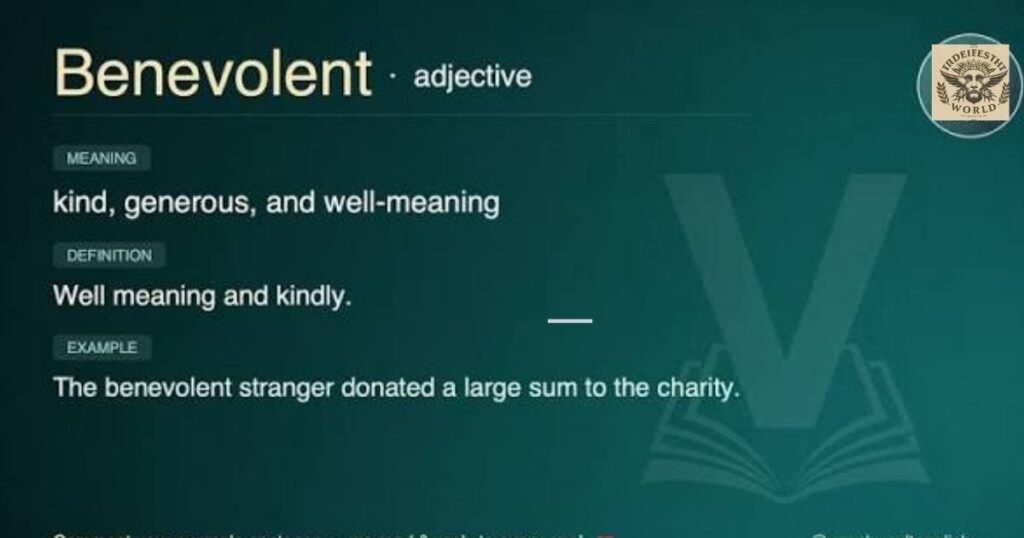
The basic benevolent meaning is kind, generous, caring, and well-intentioned toward others. The word describes a positive attitude in which someone wants to do good or provide help.
For example, a wealthy person who regularly funds education for children from low-income families may be called benevolent. A leader who makes decisions based on the welfare of the community may also be described as benevolent.
The word comes from Latin roots associated with wishing well. In modern English, benevolent commonly refers to a person or action that has a good purpose and aims to benefit others.
Simple Definition of Benevolent
A simple definition of benevolent meaning is:
Benevolent means kind, generous, and willing to help others.
The word can describe people, organisations, actions, attitudes, decisions, gestures, and intentions.
For example:
- A benevolent person helps people in need.
- A benevolent organisation supports poor families.
- A benevolent gesture can bring comfort to someone.
- A benevolent leader thinks about public welfare.
- A benevolent act may involve charity or voluntary support.
Benevolent Meaning in Simple English
In very simple English, the benevolent meaning can be understood as wanting to do good for other people.
Suppose a neighbour notices that an elderly resident needs help carrying groceries. The neighbour offers assistance without asking for payment. Such behaviour can be described as benevolent.
Another example involves charity. A person who gives money to a shelter because of genuine concern for homeless people may be described as benevolent. The important idea is not simply giving something. The intention behind the action also matters.
A benevolent attitude usually includes kindness, compassion, generosity, and goodwill.
Read More: Bankruptcy Meaning: Definition, Types, Process, Effects and UK vs USA Guide
Benevolent Meaning in Urdu
The benevolent meaning in Urdu can be explained through words such as:
- مہربان
- رحم دل
- نیک دل
- خیر خواہ
- فیاض
- دوسروں کا بھلا چاہنے والا
In Roman Urdu, benevolent can be understood as meharban, nek dil, khair khwah, aur doosron ki madad karne wala.
For example:
He was a benevolent man who helped poor families.
Roman Urdu:
Woh aik nek dil aur khair khwah aadmi tha jo ghareeb khandanon ki madad karta tha.
The exact translation can change according to context. In some sentences, “kind” may be the closest translation. In other situations, “generous,” “charitable,” or “well-meaning” may communicate the idea more accurately.
Benevolent Meaning and the Word Kind
One of the most important points about the benevolent meaning is its connection with Kind.
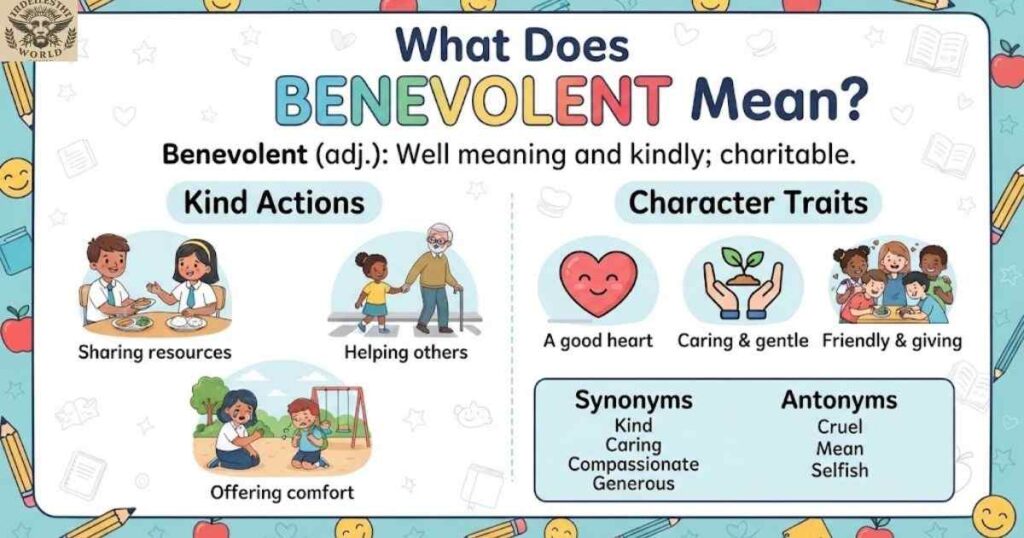
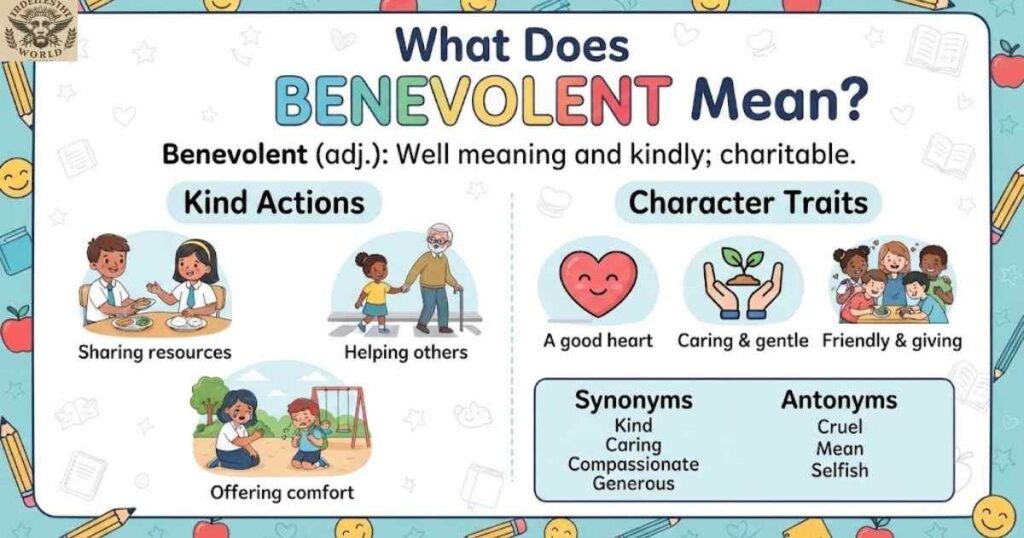
Kind is a common synonym for benevolent. Both words describe a positive attitude toward other people. A kind person treats others with care, respect, and friendliness. A benevolent person also wishes good for others and may actively provide help or support.
However, the words do not always have exactly the same strength.
Kind is very common in everyday English:
- She is a kind person.
- He was kind to his neighbour.
- Thank you for your kind help.
Benevolent sounds more formal:
- The benevolent donor supported the hospital.
- The organisation provides benevolent assistance.
- The king was remembered as a benevolent ruler.
Therefore, Kind is the key synonym to remember when learning the benevolent meaning.
Benevolent Meaning: Synonym Is Kind
The main synonym requested for benevolent is Kind.
| Word | Meaning |
| Benevolent | Kind, generous, and well-intentioned |
| Kind | Caring, friendly, and helpful |
| Generous | Willing to give or share |
| Charitable | Giving help to people in need |
| Compassionate | Showing concern for suffering |
| Caring | Showing concern for others |
| Helpful | Providing assistance |
| Good-hearted | Having a kind nature |
| Considerate | Thinking about other people’s needs |
| Altruistic | Caring about the welfare of others |
Among these terms, Kind is one of the easiest and most familiar ways to understand the benevolent meaning.
Benevolent Meaning and Malevolent Antonym
The main antonym of benevolent is Malevolent.
Malevolent means having or showing a desire to cause harm, suffering, or trouble. Therefore, benevolent and malevolent represent almost opposite attitudes.
| Benevolent | Malevolent |
| Kind | Harmful |
| Good-hearted | Bad-intentioned |
| Helpful | Harmful |
| Caring | Cruel |
| Generous | Hostile |
| Well-meaning | Ill-intentioned |
| Protective | Destructive |
| Compassionate | Malicious |
For example:
- The benevolent leader wanted peace.
The opposite idea would be:
- The malevolent ruler wanted to cause suffering.
Learning benevolent meaning alongside malevolent makes the vocabulary easier to remember because the two words create a strong contrast.
What Does Benevolent Mean?
What does benevolent mean in everyday communication? It means showing kindness, generosity, goodwill, or a desire to improve the lives of others.
A benevolent person does not necessarily need to be wealthy. Benevolence can appear through small actions as well as major charitable efforts.
A person who listens to someone experiencing a difficult day can show benevolence. A teacher who gives extra support to a struggling student can act benevolently. A business that provides financial assistance to a local community can also be described as benevolent.
The central idea remains doing good or wishing good for others.
Benevolent Meaning in a Sentence
The easiest way to understand the benevolent meaning is through sentence examples.
- The benevolent woman donated food to the local shelter.
- The organisation has a benevolent mission.
- A benevolent neighbour helped the family during a difficult time.
- The king was known for his benevolent nature.
- The doctor showed a benevolent attitude toward every patient.
- The charity received support from several benevolent donors.
- His benevolent actions inspired others to help the community.
- The company created a benevolent fund for employees.
- The teacher had a benevolent approach toward struggling students.
- Her benevolent gesture brought comfort to the elderly resident.
These examples show that benevolent can describe people, actions, organisations, attitudes, and programmes.
Examples of Benevolent Behaviour
Benevolent behaviour can take many forms. Some examples are obvious, while others are small acts of kindness.
Helping Someone in Need
Helping a person who is struggling is a common form of benevolent behaviour. Assistance may involve food, money, transportation, advice, or emotional support.
Donating to Charity
Charitable donations are often described as benevolent acts. A donor may support hospitals, schools, shelters, disaster relief programmes, or community projects.
Supporting Education
Providing scholarships or educational resources can be a benevolent action. Such support may give students better opportunities for the future.
Caring for Vulnerable People
Helping elderly people, children, disabled individuals, or people experiencing hardship can demonstrate benevolence.
Giving Without Expecting a Reward
A benevolent action often comes from goodwill rather than personal gain. The person may help because helping feels morally right.
Benevolent Person Meaning

A benevolent person is someone who genuinely wants good things for other people and is willing to help when possible.
Such a person may be generous with time, money, knowledge, attention, or emotional support. Benevolence does not require a person to solve every problem. Even a thoughtful action can demonstrate a benevolent character.
For example, a manager who creates a supportive workplace can be described as benevolent. A neighbour who regularly checks on an elderly resident can also demonstrate benevolent behaviour.
The phrase often describes character rather than one isolated action.
Benevolent Person Examples
Consider the following situations:
- A woman regularly provides meals for homeless people.
- A teacher gives extra lessons to students who need support.
- A doctor volunteers medical services for disadvantaged communities.
- A business owner creates a fund to support employees during emergencies.
- A neighbour helps an elderly couple with household tasks.
Each situation involves concern for other people’s welfare. Such behaviour can therefore be called benevolent.
Benevolent Nature Meaning
A benevolent nature refers to a person’s natural tendency toward kindness, generosity, compassion, and goodwill.
A person with a benevolent nature may notice problems affecting others and feel motivated to help. Such people often show patience and understanding.
For example:
- Sarah has a benevolent nature and always helps new students feel welcome.
The sentence suggests that kindness is part of Sarah’s character rather than merely a single action.
Benevolent Attitude Meaning
A benevolent attitude means approaching people and situations with kindness and goodwill.
Someone with a benevolent attitude may try to understand another person’s circumstances before judging them. Such an attitude can be valuable in families, workplaces, schools, communities, and public institutions.
For example:
- The manager took a benevolent approach toward employees facing financial difficulties.
The sentence suggests understanding, compassion, and helpfulness.
Benevolent Gesture Meaning
A benevolent gesture is an action intended to show kindness or provide help.
Examples include:
- Giving food to someone in need
- Paying for someone’s essential medicine
- Helping a neighbour repair a damaged home
- Donating school supplies
- Offering support after a natural disaster
A gesture does not need to be large to be benevolent. The intention and positive effect can make a small action meaningful.
Benevolent Act Meaning
A benevolent act is an action performed to benefit another person or group.
Examples include volunteering, donating, mentoring, protecting vulnerable people, and providing assistance during emergencies.
A benevolent act can be private or public. Some people prefer anonymous charity because the goal is simply to help rather than receive recognition.
Benevolent Society Meaning
A benevolent society is an organisation created to provide support, assistance, or charitable services to people in need.
Historically, benevolent societies have helped members deal with illness, poverty, unemployment, accidents, and other difficult circumstances.
Modern charitable organisations can also perform similar functions. They may provide food, housing assistance, medical support, education, or emergency relief.
Benevolent Fund Meaning
A benevolent fund is money set aside to provide financial assistance to people experiencing hardship.
Many workplaces, professional organisations, schools, and community groups may establish such funds.
For example:
- The company created a benevolent fund to help employees facing serious financial emergencies.
The phrase therefore combines the idea of financial support with goodwill toward others.
Benevolent Meaning in Business
The benevolent meaning can also apply to business.
A business may demonstrate benevolence by supporting employees, customers, communities, or charitable causes. Examples include employee assistance programmes, community donations, scholarships, disaster relief, and ethical community projects.
However, benevolence in business does not necessarily mean giving money away. A company can also show a benevolent approach through fair treatment, responsible decisions, community investment, and support for vulnerable groups.
For example:
- The company adopted a benevolent policy to support employees during difficult economic conditions.
Benevolent Meaning in Leadership

A benevolent leader is someone who uses authority with concern for the welfare of others.
Such leadership can involve listening to employees, protecting vulnerable people, supporting professional development, and making fair decisions.
A benevolent leader does not necessarily mean a weak leader. Kindness and strong decision-making can exist together.
For example, a manager may maintain clear workplace standards while also understanding that employees can face personal challenges. A balanced approach can create trust and respect.
Benevolent Meaning in Literature
The word benevolent appears frequently in literature because writers use it to describe characters with generous or caring personalities.
A benevolent character may act as a protector, mentor, guardian, ruler, parent, teacher, or helper.
Literary descriptions often contrast benevolent characters with cruel, selfish, or malevolent characters. Such contrasts help readers understand the moral qualities of different characters.
For example, a story may describe a ruler as benevolent because the ruler protects the poor and promotes peace. Another character may be presented as malevolent because of harmful intentions.
Benevolent Meaning in Religion and Philosophy
Benevolence is an important concept in many discussions about morality, ethics, compassion, and human behaviour.
In philosophical writing, benevolence can refer to a concern for the welfare of others. Philosophers may discuss whether people have a moral responsibility to help others and how far such responsibility extends.
Religious discussions may also use ideas related to benevolence, charity, mercy, generosity, and compassion.
The exact interpretation depends on the religious or philosophical tradition. However, the central concept remains concern for the good of others.
Benevolent vs Kind
Although Kind is a major synonym for benevolent, the two words have slightly different uses.
| Benevolent | Kind |
| More formal | More common |
| Often describes goodwill and generosity | Often describes friendly behaviour |
| Common in formal writing | Common in everyday speech |
| Can describe organisations and policies | Usually describes people and behaviour |
| Often suggests a desire to benefit others | Often suggests friendly or considerate treatment |
For example:
- She is kind to her classmates.
- This sounds natural in everyday English.
- The foundation is benevolent toward disadvantaged communities.
- This sounds more formal and focuses on broader goodwill.
Benevolent vs Generous
Generous means willing to give more than expected, particularly money, time, resources, or assistance.
Benevolent is broader. It focuses on goodwill and the desire to benefit others.
A person can be generous with money but not necessarily benevolent in every part of life. Benevolence often describes an overall attitude or intention.
Example:
- The generous donor gave £10,000 to the school.
- The benevolent donor supported several community projects.
Both sentences are positive, but the second one highlights broader concern for community welfare.
Benevolent vs Compassionate
Compassionate means showing concern for people who are suffering.
Benevolent means showing goodwill and a desire to do good.
Compassion often begins with understanding another person’s suffering. Benevolence can include compassion but also covers generosity, support, charity, and positive intentions.
For example:
- A compassionate nurse understands a patient’s pain.
- A benevolent organisation may provide medical treatment, food, housing, and financial support.
Benevolent vs Altruistic
Altruistic refers to caring about the welfare of others, sometimes even at a personal cost.
Benevolent focuses on kindness, generosity, and goodwill.
The terms overlap strongly, but altruism often highlights selflessness, while benevolence can describe a broader charitable or kind attitude.
Benevolent vs Charitable
Charitable often relates directly to giving help, money, resources, or services to people in need.
Benevolent has a wider meaning.
A charitable donation can be benevolent. However, a benevolent attitude does not always involve financial charity.
For example, showing patience toward a struggling student may be benevolent without being charitable.
Antonyms of Benevolent
The strongest and most important antonym of benevolent is Malevolent.
Other antonyms include:
- Cruel
- Unkind
- Hostile
- Malicious
- Selfish
- Harmful
- Heartless
- Callous
- Spiteful
- Ill-intentioned
Malevolent Meaning
Malevolent means having or showing a desire to cause harm, suffering, or trouble.
The contrast is easy to remember:
Benevolent = wants to do good.
Malevolent = wants to cause harm.
For example:
- The benevolent character protected the villagers.
- The malevolent character tried to destroy the village.
Learning both words together provides a useful vocabulary connection.
Benevolent and Malevolent: A Simple Comparison
| Feature | Benevolent | Malevolent |
| Basic idea | Wants to do good | Wants to cause harm |
| Attitude | Positive | Negative |
| Character | Kind and caring | Cruel or malicious |
| Intention | Helpful | Harmful |
| Typical behaviour | Supports others | Hurts others |
| Main synonym | Kind | Malicious |
| Main opposite | Malevolent | Benevolent |
How to Pronounce Benevolent
The word benevolent is commonly pronounced approximately as:
buh-NEV-uh-luhnt
The stress generally falls on the second syllable.
Learning pronunciation alongside the benevolent meaning can make the word easier to use confidently in conversation.
Benevolent Pronunciation in Simple Form
A simple pronunciation guide is:
Benevolent: /bəˈnevələnt/
The exact pronunciation can vary slightly between British and American English, but the main stress remains around the NEV sound.
Is Benevolent a Positive Word?
Yes. Benevolent is a strongly positive word.
It normally describes kindness, goodwill, generosity, compassion, or a desire to help others.
For example:
- The benevolent doctor provided free treatment to people who could not afford it.
The sentence presents the doctor in a positive way.
Is Benevolent Formal or Informal?
Benevolent is generally a formal or moderately formal English word.
In everyday conversation, people are more likely to say:
- Kind
- Helpful
- Caring
- Generous
- Good-hearted
In formal writing, words such as benevolent, charitable, and compassionate can sound more precise.
For example:
Informal:
She is very kind.
Formal:
- She is known for her benevolent nature.
When Should Benevolent Be Used?
The word benevolent works well when describing:
- A person’s character
- A charitable donor
- A leader
- An organisation
- A policy
- A gesture
- An action
- A fund
- An attitude
- A social programme
- A charitable institution
It is especially useful when the goal is to emphasise goodwill and concern for other people.
Common Collocations With Benevolent
Learning common word combinations can make the benevolent meaning easier to use naturally.
Benevolent Person
A person who is kind and caring toward others.
Benevolent Leader
A leader who considers the welfare of people.
Benevolent Donor
Someone who gives resources to support a good cause.
Benevolent Organisation
An organisation that provides help or charitable support.
Benevolent Fund
Money reserved for helping people facing hardship.
Benevolent Gesture
A kind action intended to benefit someone.
Benevolent Nature
A naturally kind and generous personality.
Benevolent Act
An action performed for another person’s benefit.
Benevolent Society
An organisation established to provide assistance.
Benevolent Attitude
A positive and caring approach toward others.
Benevolent Meaning in Different Contexts
The word can change slightly depending on context.
In Personal Relationships
Benevolent can describe someone who consistently shows kindness and support.
In Business
It can describe companies or leaders that support employees and communities.
In Politics
It can describe a ruler or government that is presented as caring about public welfare.
In Charity
It can describe donors, organisations, funds, and actions that provide assistance.
In Literature
It can describe characters with good intentions or protective personalities.
In Philosophy
It can refer to concern for the welfare of others and moral goodness.
Real-Life Examples of Benevolence
Benevolence can be found in many ordinary situations.
A person may purchase food for a hungry stranger. A student may help a classmate understand difficult coursework. A company may provide emergency assistance to employees. A community may collect money after a natural disaster.
None of these actions requires a particular social position. Benevolence can be practised by ordinary people.
The benevolent meaning therefore applies to everyday kindness as well as major acts of charity.
Why Benevolence Matters
Benevolence can strengthen communities because helpful behaviour encourages trust and cooperation.
When people support one another, difficult situations can become easier to manage. Kindness can also create positive social connections.
A benevolent approach can be valuable in schools, workplaces, families, charities, hospitals, and public institutions.
For example, a workplace that encourages employees to support colleagues may develop a stronger sense of community.
How to Become More Benevolent
Benevolence does not require wealth or special resources. Small choices can make a meaningful difference.
Listen Carefully
Giving someone time and attention can be a simple act of kindness.
Offer Practical Help
Help with everyday tasks when someone is struggling.
Share Knowledge
Teaching a useful skill can benefit someone for a long time.
Give When Possible
Financial donations are useful, but time and effort can also be valuable.
Avoid Unnecessary Judgement
Understanding someone’s circumstances can create a more compassionate response.
Support Community Causes
Volunteering or contributing to local projects can demonstrate goodwill.
Encourage Others
Positive words can help someone who is facing a difficult situation.
Benevolent Meaning in Workplace English
In workplace communication, benevolent may describe an employer, manager, policy, or programme that prioritises employee welfare.
For example:
- The company introduced a benevolent policy for employees experiencing financial hardship.
Another example:
- The benevolent manager provided flexible working arrangements during a family emergency.
The word can make professional writing sound more precise, although “supportive” may be more natural in casual business conversation.
Benevolent Meaning in British English
In British English, benevolent carries the same basic meaning of kind, charitable, generous, and well-intentioned.
British writing may use the word in formal contexts such as charities, institutions, historical descriptions, and public discussions.
Example:
- The benevolent organisation provides assistance to vulnerable families across the community.
Benevolent Meaning in American English
American English also uses benevolent to describe kindness, generosity, goodwill, and charitable intentions.
It can appear in formal writing, literature, business communication, religious discussions, and descriptions of charitable work.
Example:
- The foundation was established by a benevolent donor who wanted to improve educational opportunities.
The meaning remains essentially the same in both British and American English.
Common Mistakes With Benevolent
Several mistakes can occur when learning the word.
Mistake 1: Thinking Benevolent Only Means Rich
Benevolent does not mean wealthy. A person can be benevolent without having significant financial resources.
Mistake 2: Using Benevolent as a Direct Synonym for Generous in Every Situation
Generous often focuses on giving. Benevolent focuses more broadly on goodwill and the desire to benefit others.
Mistake 3: Confusing Benevolent With Malevolent
These words have opposite meanings.
Benevolent = kind and helpful.
Malevolent = harmful and malicious.
Mistake 4: Assuming Benevolent Is Always Informal
The word is generally more formal than “kind” and often appears in serious or formal writing.
Benevolent Synonyms
Here is a broader list of synonyms related to the benevolent meaning:
- Kind
- Caring
- Helpful
- Generous
- Charitable
- Compassionate
- Good-hearted
- Warm-hearted
- Considerate
- Altruistic
- Selfless
- Humane
- Merciful
- Sympathetic
- Gracious
- Big-hearted
- Thoughtful
- Supportive
- Giving
- Well-meaning
The closest everyday synonym is Kind.
Benevolent Antonyms
Important antonyms include:
- Malevolent
- Cruel
- Malicious
- Unkind
- Hostile
- Harmful
- Selfish
- Heartless
- Callous
- Spiteful
- Ruthless
- Mean
- Aggressive
- Ill-intentioned
- Destructive
Among these, Malevolent is the clearest direct antonym for vocabulary learning.
Benevolent Meaning: Noun, Adjective, and Related Forms
The word benevolent is an adjective.
Related forms include:
Benevolence — the quality of being kind or well-intentioned.
Benevolently — in a benevolent manner.
For example:
Her benevolence helped many families.
The organisation acted benevolently toward people in need.
Understanding related forms can help expand vocabulary around the benevolent meaning.
What Is Benevolence?
Benevolence is the noun form of benevolent.
It refers to kindness, goodwill, generosity, or a desire to help others.
Example:
- His benevolence was appreciated by the entire community.
Here, benevolence describes the quality or practice of helping others.
Benevolent vs Benevolence
| Word | Part of Speech | Meaning |
| Benevolent | Adjective | Kind and well-intentioned |
| Benevolence | Noun | Kindness and goodwill |
| Benevolently | Adverb | In a kind or charitable manner |
Example:
- The benevolent woman supported the shelter.
- Her benevolence helped many families.
- She acted benevolently toward people in need.
Short Benevolent Sentences
For quick vocabulary practice:
- The benevolent man helped a stranger.
- She has a benevolent nature.
- The charity received support from a benevolent donor.
- The leader was known for benevolent policies.
- His benevolent action inspired others.
- The organisation has a benevolent purpose.
- Her benevolent gesture made everyone feel welcome.
- The doctor showed a benevolent attitude.
- The foundation supports benevolent causes.
- Benevolent people often care about community welfare.
Long Benevolent Sentence Examples
- The benevolent businessman donated a significant amount of money to improve educational facilities for children in disadvantaged communities.
- The organisation adopted a benevolent approach by providing food, temporary accommodation, and financial support to families affected by the disaster.
- The king was remembered as a benevolent ruler because he focused on public welfare and supported people facing poverty.
- Her benevolent nature became clear when she spent her weekends helping elderly residents with shopping and household tasks.
- The charity depends on benevolent donors who are willing to contribute resources to improve the lives of vulnerable people.
Benevolent Meaning for Students
Students can remember the word through a simple formula:
Benevolent = Kind + Helpful + Good intentions
For example:
A benevolent teacher helps struggling students.
The opposite formula is:
Malevolent = Harmful + Bad intentions
Using simple contrasts can make difficult vocabulary easier to remember.
Benevolent Meaning for English Learners
English learners can connect benevolent with familiar words such as kind, helpful, and generous.
When reading formal English, seeing the word benevolent should immediately suggest a positive character or intention.
A useful memory trick is:
Benevolent → good intentions → kindness → helping others.
Then remember:
Malevolent → bad intentions → harm → hurting others.
Benevolent Meaning in Social Life
Social relationships often depend on kindness and goodwill.
A benevolent attitude can encourage people to help neighbours, support friends, and cooperate with communities. It can also reduce unnecessary conflict.
For example, a person who responds to a mistake with patience rather than anger may demonstrate a benevolent attitude.
Benevolence does not mean accepting harmful behaviour. A person can remain firm while still acting with kindness and respect.
Benevolent Meaning and Empathy
Empathy and benevolence are related but different.
Empathy involves understanding or sharing another person’s feelings.
Benevolence involves wishing good for others and often acting to help them.
A person may understand another person’s pain without taking action. Benevolent behaviour often goes one step further by offering support.
For example:
Empathy: Understanding that a friend feels lonely.
Benevolence: Understanding loneliness and making time to support the friend.
Benevolent Meaning and Generosity
Generosity is an important part of benevolence, but the two concepts are not identical.
Generosity often involves giving resources, money, time, or attention.
Benevolence includes generosity but can also involve protection, compassion, understanding, and good intentions.
Therefore, a person may show benevolence through words, decisions, actions, or financial support.
Benevolent Meaning and Goodwill
Goodwill is another important concept connected with benevolence.
Goodwill means friendly or positive feelings and intentions toward others.
A benevolent person generally acts with goodwill.
For example:
- The organisation acted with goodwill by helping families affected by the flood.
The action demonstrates both goodwill and benevolence.
Is Benevolent the Same as Nice?
Not exactly.
Nice is a broad and informal word that can describe pleasant behaviour, friendliness, or agreeable qualities.
Benevolent has a more specific meaning connected with kindness, generosity, goodwill, and helping others.
Therefore:
Nice: pleasant or friendly.
Benevolent: kind and genuinely concerned about the welfare of others.
Can an Organisation Be Benevolent?
Yes. An organisation can be described as benevolent when its activities focus on helping people or improving social welfare.
Examples include:
- Charities
- Community foundations
- Relief organisations
- Educational trusts
- Humanitarian groups
- Employee assistance organisations
For example:
The benevolent foundation provides scholarships for students from low-income families.
Can a Government Be Benevolent?
The adjective can describe a government or ruler that is presented as caring about the welfare of citizens.
For example:
The king was portrayed as a benevolent ruler who invested in public education.
However, whether a government is genuinely benevolent can depend on evidence and perspective. The word can describe an intended quality or public image rather than prove that every decision was beneficial.
Can a Gift Be Benevolent?
Yes. A gift given to help someone or support a good cause can be described as a benevolent gift.
For example:
- The hospital received a benevolent gift from a local foundation.
In such usage, the word highlights the generous and helpful purpose of the gift.
Can an Action Be Benevolent?
Yes. A benevolent action is an action that benefits another person or group.
Examples include:
- Providing food
- Offering shelter
- Giving financial assistance
- Volunteering
- Supporting education
- Helping during emergencies
- Protecting vulnerable people
Can Benevolent Describe an Animal?
In some contexts, yes. Writers may describe an animal as benevolent if it appears gentle, protective, or unusually caring.
For example:
The story portrays the old dog as a benevolent guardian of the children.
However, the word is more commonly applied to people, organisations, leaders, actions, and intentions.
Benevolent Meaning: Quick Reference Table
| Question | Answer |
| What does benevolent mean? | Kind, generous, caring, and well-intentioned |
| Main synonym | Kind |
| Main antonym | Malevolent |
| Part of speech | Adjective |
| Noun form | Benevolence |
| Adverb form | Benevolently |
| Tone | Positive and often formal |
| Common use | People, actions, leaders, organisations, policies |
| Simple meaning | Wanting to do good for others |
| Opposite idea | Wanting to cause harm |
Frequently Asked Questions :
What is the simple benevolent meaning?
The simple benevolent meaning is kind, generous, caring, and willing to help others. A benevolent person generally wants good things for other people and may take action to support them.
What is the synonym of benevolent?
The main synonym of benevolent is Kind. Other synonyms include generous, charitable, compassionate, caring, helpful, considerate, altruistic, and good-hearted.
What is the antonym of benevolent?
The main antonym of benevolent is Malevolent. Malevolent means having harmful, hostile, or malicious intentions.
What is the noun form of benevolent?
The noun form is benevolence. Benevolence means the quality or practice of showing kindness, goodwill, generosity, or concern for others.
Can benevolent describe a person?
Yes. A benevolent person is someone who shows kindness, generosity, goodwill, or concern for the welfare of others.
Conclusion
The benevolent meaning is simple at its core: kind, generous, caring, and willing to do good for others. The word can describe a person, action, attitude, organisation, leader, policy, gesture, or charitable programme. Although Kind is the most familiar synonym, benevolent often sounds more formal and can suggest broader goodwill.
Remember the strongest vocabulary connection: Benevolent means kind and helpful, while Malevolent means harmful or malicious. Understanding both words together makes the contrast easy to remember. In everyday English, “kind” may be the natural choice, while “benevolent” works especially well in formal writing, literature, charity discussions, and descriptions of positive intentions.

