


Arrogant meaning describes a person who acts as though they are superior to others. People with an arrogant nature often believe they are better and more important than others, and therefore, they are deserving of more respect and consideration than the average person.
Simple English describes arrogant meaning as excessive pride and the belief of one’s superiority. These people usually boast about themselves, and speak in a manner to imply they are not in need of guidance, and therefore, may ignore or act without consideration of others’ opinions.
Arrogant is usually a good description of the attitude and behavioral manner of a person. It may be used in describing various situation occurring in the family, in the classroom and at the workplace, and in the community at large.
Arrogant Meaning in Simple English
The easiest arrogant meaning is thinking that you are better than other people and showing that attitude openly.
For example, a person may have excellent skills and still remain polite and respectful. Having confidence does not automatically make someone arrogant. Arrogance appears when confidence becomes excessive and a person starts treating others as less important.
Simple definition of arrogant
Arrogant = having an exaggerated sense of your own importance, abilities, or value.
An arrogant person may believe that their ideas are always better. Such a person may also find it difficult to accept criticism, admit mistakes, or appreciate another person’s success.
What Is the Arrogant Meaning in Urdu?
The arrogant meaning in Urdu can be expressed through words such as:
| English Word | Urdu Meaning |
| Arrogant | مغرور |
| Arrogant | متکبر |
| Arrogant | خود پسند |
| Arrogance | تکبر |
| Arrogantly | غرور سے |
In simple Roman Urdu, arrogant meaning can be explained as maghroor, takabbur karne wala, ya apne aap ko doosron se behtar samajhne wala.
For example, if someone refuses to listen to others because they believe their opinion is always superior, that behavior can be described as arrogant.
Arrogant Meaning With Examples
Understanding arrogant meaning becomes easier through everyday examples.
- He sounded arrogant during the meeting.
- Her arrogant attitude upset her classmates.
- The manager was criticized for being arrogant.
- His arrogant behavior made teamwork difficult.
- She became arrogant after winning several competitions.
- The student seemed arrogant because he refused to accept advice.
The examples show that arrogant usually describes behavior rather than simply describing success, intelligence, wealth, or confidence.
Arrogant Meaning in a Sentence
The word arrogant works as an adjective. It describes a person, attitude, action, voice, expression, or behavior.
Examples:
- He is too arrogant to accept criticism.
- The arrogant student ignored the teacher’s advice.
- Her arrogant tone made the conversation uncomfortable.
- The actor was described as arrogant by some critics.
- His arrogant behavior affected the whole team.
A useful sentence pattern is:
Subject + be + arrogant + description
Example:
- He is arrogant because he never listens to other people.
Arrogant vs Confident
One of the most important parts of arrogant meaning is understanding the difference between arrogance and confidence.
Confidence means believing in your abilities while still respecting other people. Arrogance involves an exaggerated belief in personal importance or superiority.
| Confident | Arrogant |
| Believes in personal abilities | Thinks personal abilities are superior |
| Respects other people | May look down on others |
| Accepts useful feedback | Often rejects criticism |
| Can admit mistakes | May avoid admitting mistakes |
| Celebrates personal success | May use success to feel superior |
| Listens to others | May ignore other opinions |
For example, saying “I worked hard and I believe I can do it” can show confidence. Saying “Nobody here can do it as well as I can” may sound arrogant.
Arrogant vs Proud
The words arrogant and proud are related, but they do not always have the same meaning.
Being proud can describe a positive feeling about an achievement. A parent can feel proud of a child’s success. A student can feel proud after completing difficult work.
Arrogant, on the other hand, usually has a negative meaning because it suggests an exaggerated sense of superiority.
Read More: Accountability Meaning: Definition, Examples, Uses, and Why It Matters
Example:
- Proud:
“She is proud of her academic achievement.” - Arrogant:
“She is arrogant because she believes everyone else is less intelligent.”
Arrogant vs Self-Confident

Self-confidence means trusting your own abilities. It does not require putting other people down.
An arrogant person may use confidence as a reason to dismiss others. That is why arrogant meaning often carries a negative emotional tone.
A self-confident employee might say:
- “I have experience with this project, so I can help.”
An arrogant employee might say:
- “Nobody here understands this project better than I do.”
The first statement expresses confidence. The second can communicate superiority.
Common Signs of an Arrogant Person
Knowing common behaviors can make arrogant meaning easier to recognize.
Constantly Talking About Achievements
An arrogant person may repeatedly mention awards, money, education, skills, popularity, or professional success to appear superior.
Ignoring Other Opinions
Such a person may believe that their ideas are automatically better. They may listen only to confirm their own views.
Difficulty Accepting Criticism
An arrogant person can take normal feedback as an attack because admitting mistakes may feel uncomfortable.
Looking Down on Others
Treating other people as less intelligent, less successful, or less valuable is a common sign of arrogance.
Interrupting Conversations
Constantly interrupting others can show a lack of respect for their opinions and experiences.
Refusing to Admit Mistakes
Everyone makes mistakes. An arrogant attitude may appear when a person always finds someone else to blame.
Expecting Special Treatment
A person may believe that their position, money, education, popularity, or achievements deserve special treatment.
Arrogant Behavior in the Workplace
The arrogant meaning becomes especially clear in professional situations.
An arrogant coworker may reject suggestions from teammates, interrupt meetings, take credit for group work, or refuse to acknowledge mistakes.
Such behavior can create communication problems. It may also reduce trust within a team.
A confident professional can share knowledge without making others feel inferior. Healthy workplace communication usually requires respect, listening, cooperation, and openness to feedback.
Arrogant Meaning in Relationships
In relationships, an arrogant attitude can create distance between people.
An arrogant partner may believe that their opinions matter more. They may dismiss another person’s feelings or refuse to apologize after making a mistake.
For example:
- “I know better than you, so there is no reason to discuss it.”
Such a statement can sound arrogant because it dismisses the other person’s perspective.
Healthy relationships usually involve mutual respect. Confidence can exist in a relationship, but superiority can make communication difficult.
Arrogant Meaning in Social Situations
Social behavior can also reveal arrogance.
Someone may appear arrogant if they constantly talk about their wealth, education, appearance, career, connections, or achievements while showing little interest in other people.
However, one confident statement does not automatically make someone arrogant. Context matters. A person may simply be excited about an achievement.
The meaning depends on the overall attitude, behavior, tone, and treatment of other people.
Arrogant Meaning on Social Media

Social media can sometimes make arrogant behavior easier to notice.
People may post achievements, expensive purchases, professional success, travel experiences, or opinions online. Sharing such content does not automatically mean a person is arrogant.
The word arrogant becomes more appropriate when a person repeatedly uses success or status to suggest that other people are inferior.
For example, a post that celebrates personal achievement can be normal. A post that mocks people who have less money or success can communicate arrogance.
Is Arrogant Always a Negative Word?
In normal English, arrogant usually has a negative meaning.
Calling someone arrogant often suggests that the speaker believes the person behaves with excessive pride or superiority.
For example:
- “He is very confident.”
This can be positive.
- “He is very arrogant.”
This usually communicates criticism of his attitude.
The difference is important when choosing words in professional or personal communication.
Synonyms of Arrogant
Several English words have meanings similar to arrogant.
| Synonym | Simple Meaning |
| Conceited | Having an overly high opinion of yourself |
| Proud | Feeling strong satisfaction or superiority |
| Haughty | Acting as if others are less important |
| Egotistical | Thinking excessively about personal importance |
| Self-important | Believing you deserve more attention |
| Snobbish | Acting as if certain people are socially inferior |
| Pompous | Speaking or behaving with exaggerated importance |
| Overbearing | Controlling or forceful toward others |
| Superior | Acting as if you are above others |
| Vain | Having excessive pride in appearance or abilities |
The closest synonym depends on the sentence. Conceited, haughty, self-important, and egotistical are often close to the common arrogant meaning.
Antonyms of Arrogant
Antonyms are words with opposite meanings.
Common antonyms of arrogant include:
- Humble
- Modest
- Respectful
- Polite
- Considerate
- Unassuming
- Courteous
- Down-to-earth
For example:
- Arrogant: He believes everyone is below him.
- Humble: He recognizes his achievements but respects other people.
Arrogance Meaning
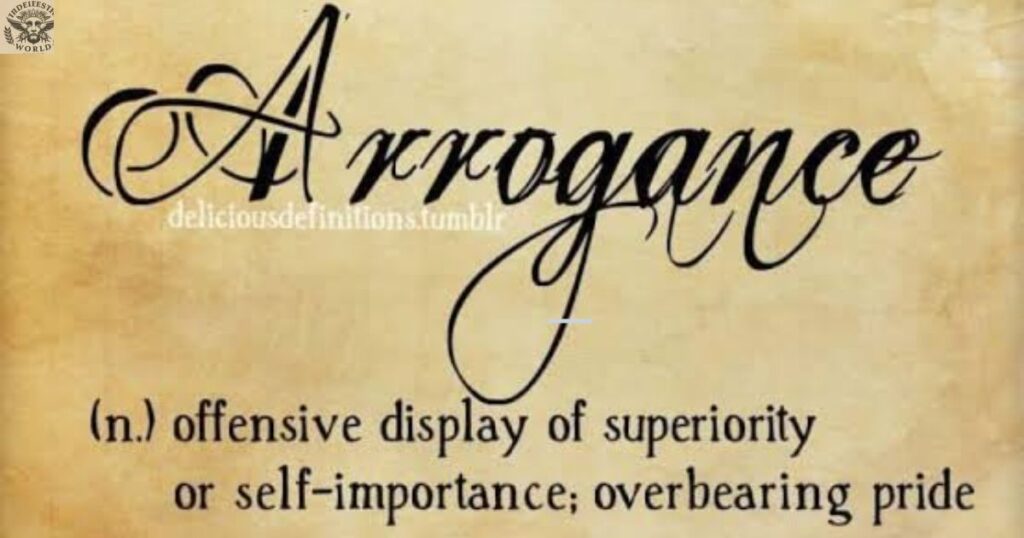
Arrogance is the noun form related to arrogant.
It describes an attitude of excessive pride or superiority.
Example:
- “His arrogance made it difficult for the team to work with him.”
Here, arrogance refers to the attitude, while arrogant describes the person or behavior.
Word family
| Word | Part of Speech | Meaning |
| Arrogant | Adjective | Showing excessive pride |
| Arrogance | Noun | Excessive pride or superiority |
| Arrogantly | Adverb | In an arrogant manner |
Arrogantly Meaning
Arrogantly means behaving in a way that shows excessive pride or superiority.
Example:
- “He spoke arrogantly to the new employees.”
The word describes how someone speaks or behaves.
Another example:
- “She arrogantly dismissed the suggestion.”
The sentence suggests that the person rejected the suggestion in a superior or disrespectful manner.
How to Use Arrogant Correctly
Use arrogant when describing someone who shows an exaggerated sense of importance or superiority.
Correct examples:
- His arrogant attitude caused problems.
- She sounded arrogant during the interview.
- The arrogant manager ignored the team’s suggestions.
- His comments came across as arrogant.
- The character appears arrogant at the beginning of the story.
Incorrect idea:
A person is not automatically arrogant simply because they are successful, wealthy, talented, attractive, educated, or confident.
The word focuses on attitude and behavior, not achievement alone.
Arrogant Meaning in Different Contexts
| Context | Example of Arrogant Behavior |
| Workplace | Refusing every suggestion |
| School | Mocking classmates |
| Relationships | Ignoring a partner’s opinion |
| Sports | Looking down on opponents |
| Social media | Constantly showing superiority |
| Business | Treating customers disrespectfully |
| Leadership | Refusing useful feedback |
| Everyday life | Acting as if others are inferior |
The central arrogant meaning stays similar across these situations: an exaggerated sense of superiority that affects behavior toward others.
Why Do People Seem Arrogant?
People can display arrogant behavior for different reasons. Sometimes a person has a strong belief in personal abilities. In other cases, social status, professional success, money, education, or repeated praise can affect behavior.
It is also important not to judge someone from a single sentence or short interaction. A direct communication style may sometimes sound arrogant even when the person does not intend to appear superior.
Context, repeated behavior, tone, and treatment of other people provide more useful information.
How to Deal With an Arrogant Person

Dealing with an arrogant person can become easier with calm and clear communication.
First, avoid turning the conversation into a competition. Respond to the specific behavior rather than attacking the person’s character.
For example, instead of saying:
- “You are an arrogant person.”
A clearer approach can be:
- “I would like everyone to have a chance to share an opinion.”
The second statement focuses on behavior and creates room for productive discussion.
Arrogant Meaning: Quick Comparison
| Term | Meaning |
| Arrogant | Acting superior to others |
| Confident | Believing in your own abilities |
| Proud | Feeling satisfaction about an achievement |
| Humble | Not showing excessive pride |
| Conceited | Having an overly high opinion of yourself |
| Haughty | Showing superiority toward others |
| Self-important | Believing you deserve special importance |
Frequently Ask Questions :
Is arrogant a positive or negative word?
Arrogant is generally a negative word because it describes excessive pride and a sense of superiority.
What is the opposite of arrogant?
Common opposites include humble, modest, respectful, polite, courteous, and unassuming.
Can a successful person be arrogant?
Yes, but success alone does not make someone arrogant. Arrogance relates to how a person behaves and treats others.
What does arrogant behavior mean?
Arrogant behavior means acting with excessive pride or treating others as if they are less important, capable, or intelligent.
What does arrogant tone mean?
An arrogant tone is a way of speaking that can sound superior, dismissive, or overly proud.
Conclusion
The arrogant meaning is closely connected with excessive pride, superiority, and an inflated sense of personal importance. An arrogant person may believe their ideas, abilities, achievements, or status make them better than others. The word normally carries a negative meaning.
Understanding the difference between arrogance and confidence is important. Confidence can help people grow and perform well, while arrogance can create communication problems and damage relationships. A person can recognize personal strengths while still remaining respectful, humble, and open to other opinions.

