

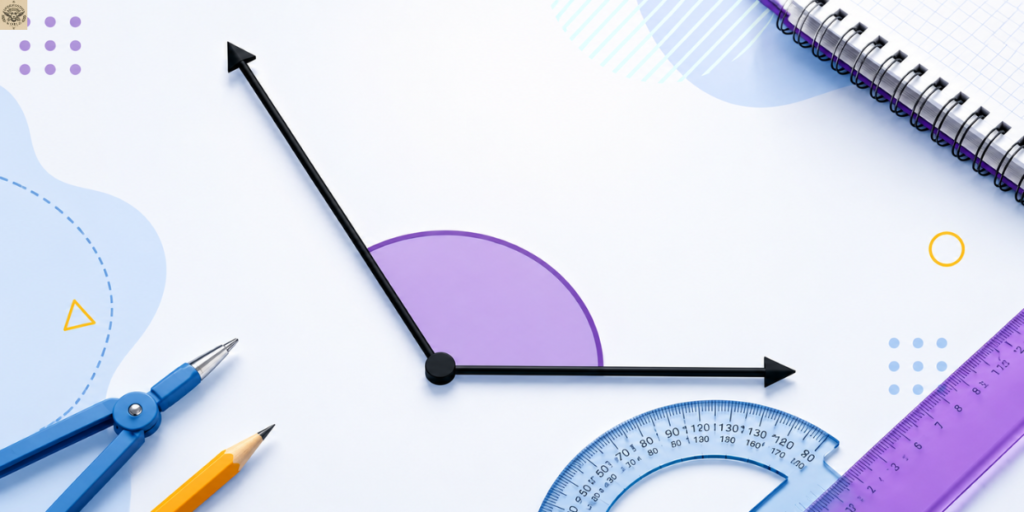
Ever looked at a wide open angle and wondered what is an obtuse angle, exactly? An Obtuse Angle is any angle that measures more than 90 degrees but less than 180 degrees, sitting right between a right angle and a straight angle on the degree measure scale. Pictures of obtuse angles show up all around us, from a partly opened door to the slant of a ladder leaning against a wall, and once students grasp the obtuse angle geometry definition, spotting one becomes second nature.
This guide walks through what’s an obtuse angle in plain terms, covering everything from obtuse angle shapes and real obtuse angle examples to how it compares with an acute angle, a straight angle, and a reflex angle. Along the way, students will build stronger angle classification skills, learning to sort the different types of angles with confidence and connect an Obtuse Angle to bigger ideas like the obtuse triangle. By the end, classifying angles and understanding angle measure will feel like second nature rather than a guessing game.
Understanding Obtuse Angles In Mathematics
An angle forms when two rays share a common endpoint called the vertex. The space between the rays represents the amount of turn, and mathematicians measure that turn in degrees (°). Using the obtuse angle geometry definition, an Obtuse Angle measures greater than 90 degrees and less than 180 degrees. That places it between a right angle, which measures exactly 90 degrees, and a straight angle, which measures exactly 180 degrees.
Because an Obtuse Angle sits in that middle zone, it represents a bigger turn than a right angle without ever becoming a straight line. What’s an obtuse angle in practice? Picture a partly opened book, a reclined chair back, or the letter Y. Each shows two rays opening past a square corner while still keeping a visible bend rather than a flat line.
Understanding what an obtuse angle looks like also means understanding what it is not. An Obtuse Angle is not an acute angle, since acute angles measure less than 90 degrees. It is not a right angle, since right angles measure exactly 90 degrees. And it is not a reflex angle, since reflex angles measure more than 180 degrees. Placing the Obtuse Angle correctly among these categories builds a foundation for angle classification that students will use throughout geometry.
Why Understanding Obtuse Angles Is Important
Obtuse angle shapes show up constantly in mathematics and in daily life, so learning to recognize an Obtuse Angle supports much bigger ideas in geometry, including shapes, symmetry, measurement, and transformations. Students who can confidently name an Obtuse Angle also tend to reason more flexibly about other angle types.
- Comparing and classifying angles: Learning to sort an angle as acute, right, or obtuse sharpens a student’s ability to analyze shapes and predict how they behave.
- Triangle properties: A triangle containing one Obtuse Angle is called an obtuse triangle, and recognizing this connection helps students reason about triangle families more broadly.
- Estimation and spatial reasoning: Comparing angles by sight before reaching for a protractor builds flexible thinking about size, rotation, and space, all of which support proportional reasoning later on.
- Real world connections: Roofs, scissors, open doors, and folding fans all involve an Obtuse Angle, giving students concrete obtuse angle examples they can point to outside the classroom.
Identifying And Measuring Obtuse Angles
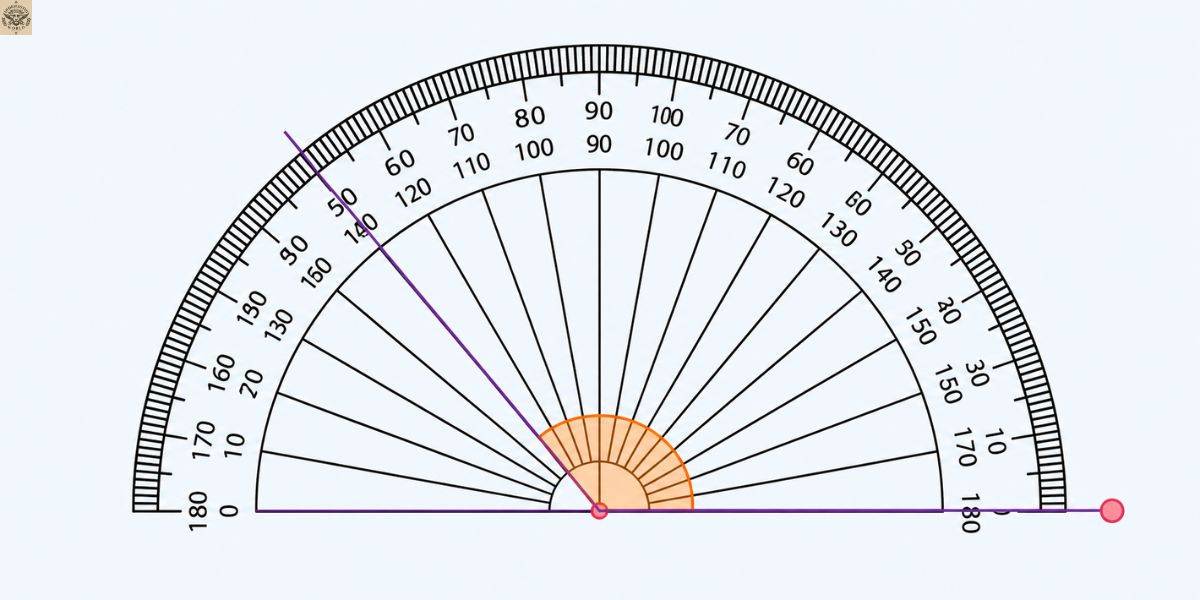
Spotting an Obtuse Angle starts with a good eye and ends with a solid measurement. Students build that skill by comparing an angle to a trusted benchmark first, then confirming their hunch with a protractor.
Using A Right Angle As A Benchmark
Most students learn to identify an Obtuse Angle by comparing it to a right angle they already know well, since this is one of the fastest ways to recognize an Obtuse Angle without any tools at all. Since a right angle measures exactly 90 degrees, any angle that opens wider than that benchmark angle qualifies as obtuse. This benchmark strategy strengthens spatial sense and gives students an early estimation skill they can rely on before they ever touch a protractor.
Comparing by sight is a useful starting point, but measurement brings accuracy. A protractor settles the question for good: if the reading falls somewhere greater than 90 degrees and less than 180 degrees, the angle is obtuse. Practicing angle measurement this way turns a visual guess into a confirmed classification.
Read More: Meter – Meaningful Math
Building A Right Angle Tool
A simple right angle tool, made from the corner of an index card or a folded piece of paper, gives students a portable benchmark angle they can carry to any angle they want to test. Holding the tool against an angle template shows immediately whether the angle fits inside the corner, matches it exactly, or spills past it, which signals an Obtuse Angle. This simple check turns any classroom into a place where spotting an Obtuse Angle becomes second nature.
Teaching Strategies For Obtuse Angles
Students grasp an Obtuse Angle best when they get to sort, test, and measure it with their own hands, not just read a definition. The strategies below move students from a rough visual guess to a confident, provable classification.
Sorting and Comparing Angles
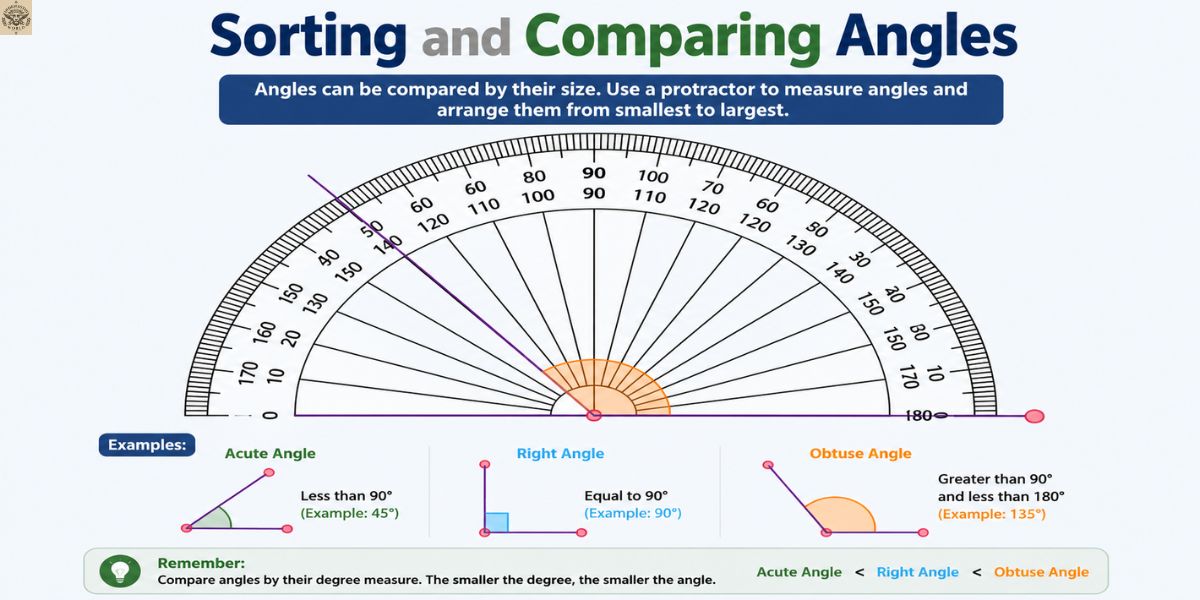
Before introducing formal definitions, invite students to build an intuitive sense of what makes an angle obtuse. Provide a mixed set of angles through drawings, cutouts, or physical manipulatives that include acute, right, and Obtuse Angle examples together. Ask students to examine each one and sort it into a group, explaining their reasoning out loud as they go.
A student might say something like, “This angle looks really wide, so I think it belongs in the Obtuse Angle group,” or “This one is narrower than a corner, so it must be acute.” As students sort, have them sketch each grouping and label what the angles in each pile share. Follow up by asking, “How do you know this angle belongs with the other obtuse angles?” and “What looks different about it compared to a right angle?” These conversations build a relational understanding that an Obtuse Angle is visibly distinct from both acute and right angles, well before students memorize the numeric definition.
Using A Right Angle Tool To Classify Angles
Once students can sort angles by general appearance, guide them toward greater precision using a homemade right angle tool. Have them fold or cut a right angle template from paper, then return to the angles they already sorted and test each one: does it extend beyond the template, fit neatly inside it, or match it exactly?
Ask students to record their findings next to their earlier sketches, noting whether the tool confirms each angle as acute, right, or obtuse. A useful follow up question is, “Did any of your original groupings change once you checked with the tool? What did the template reveal that you had not noticed before?” To stretch their thinking further, present angles in unfamiliar orientations, rotated, tucked inside shapes, or drawn at odd positions on the page, and ask, “Is this still an Obtuse Angle? How can you prove it?” This reinforces that angle orientation never changes an angle’s actual measure, only its position on the page.
Estimating and Measuring Obtuse Angles
As comfort with the right angle tool grows, connect that benchmark thinking to numerical measurement. Before handing out protractors, ask students to estimate whether a given angle sits closer to 90 degrees or 180 degrees. Have them sketch the angle, record an estimate, and explain their thinking: “I think this is about 120 degrees because it opens past a right angle but does not reach a straight line.”
Then bring in protractors so students can measure the same angles and compare their estimate to the actual measurement. Ask, “How close was your estimate? What clues helped you guess well?” Have students measure a variety of obtuse angles drawn in different orientations and compare results, asking, “These angles point in different directions. Did the measurements change?” Rotating the page and re-measuring helps confirm that the degree measure of an Obtuse Angle stays fixed no matter which way it faces.
Common Misconceptions About Obtuse Angles
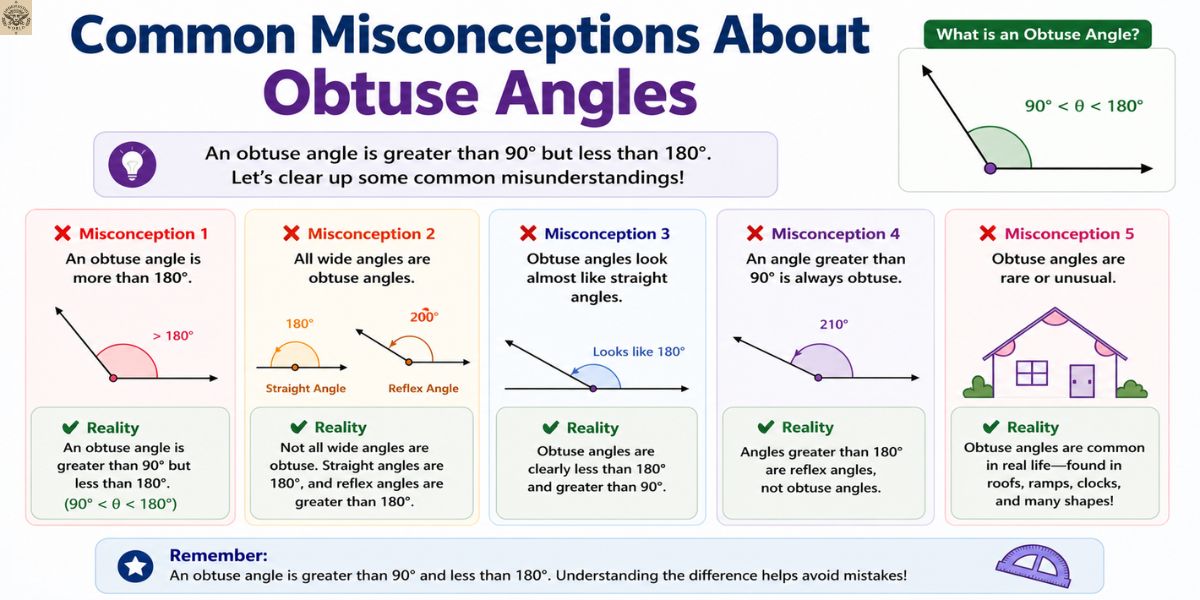
Students often judge an angle by how it looks instead of by its actual measure, and that habit trips them up in a few predictable ways. Clearing up these mix-ups early helps students name an Obtuse Angle with confidence instead of relying on a guess.
Misconception: Rotating An Angle Changes Its Measure
Many students assume that flipping, spinning, or redrawing an angle in a new position changes how big it is. This misconception grows out of judging an angle by its appearance rather than by its actual turn. Encourage students to rotate their paper and re-measure with a protractor to see firsthand that an Obtuse Angle keeps the same degree measure regardless of orientation.
Misconception: Confusing Obtuse Angles With Reflex Angles
Because both look wide at a glance, students sometimes mistake a reflex angle for an Obtuse Angle. A reflex angle measures more than 180 degrees, while an Obtuse Angle always stays below that mark. Teaching 180 degrees as a firm boundary, a straight angle, helps students separate the two categories with confidence instead of guessing based on how big the angle looks.
Misconception: All Wide Angles Are The Same
Some students treat every wide looking angle as an Obtuse Angle, without noticing the specific range that truly defines an Obtuse Angle. Reinforcing the numeric range, greater than 90 degrees and less than 180 degrees, alongside visual sorting activities helps students internalize precise angle classification rather than relying on a rough impression of size.
Obtuse Angle Quick Recap
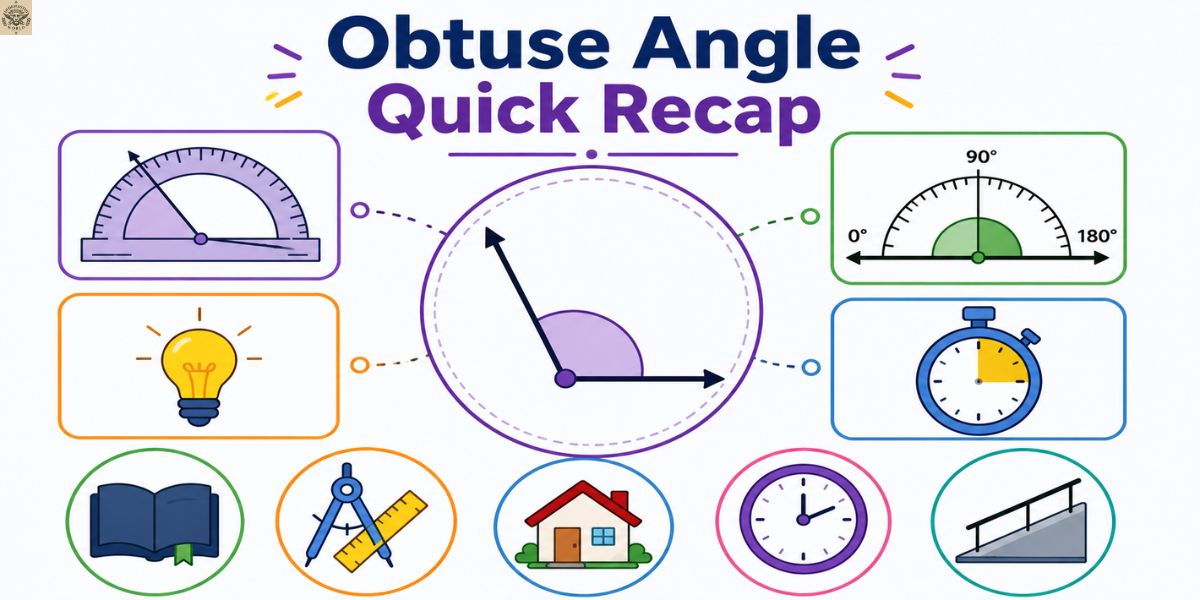
An Obtuse Angle always measures somewhere between 90 degrees and 180 degrees, never touching either boundary. Whether students meet an Obtuse Angle while sorting cutouts, testing a homemade right angle tool, or measuring with a protractor, the same rule holds true every time. Keeping that range in mind helps students confidently name an Obtuse Angle no matter how it is drawn, rotated, or presented. With enough practice sorting, testing, and measuring, spotting an Obtuse Angle becomes an easy, everyday skill rather than a guessing game, and students carry that comfort with the Obtuse Angle into more advanced geometry topics.
Obtuse Angle Pronunciation
Say it as “ob-TOOSE angle,” with the stress landing on the second syllable of obtuse. Many students stumble on the word the first time they see it, since it looks nothing like how it sounds, so hearing it out loud a few times before diving into the obtuse angle definition helps it stick.
Once the pronunciation feels natural, students stop hesitating every time the word comes up in a lesson. That small comfort matters, because a student who can say the word confidently is more likely to raise a hand and ask a real question about angle classification instead of staying quiet.
Obtuse Angle Example
A partly opened laptop screen, a reclining chair back, and the hands of a clock at ten past ten all show an everyday Obtuse Angle. Pictures of obtuse angles like these give students something concrete to picture whenever the term comes up, rather than a bare number on a page.
In a geometry classroom, a solid obtuse angle example might be two rays drawn 120 degrees apart, or one arm of a triangle spreading out wider than a square corner. Pairing a real-world image with a drawn example helps students connect what an obtuse angle looks like to the actual degree measure behind it.
Obtuse Angle Acute Angle
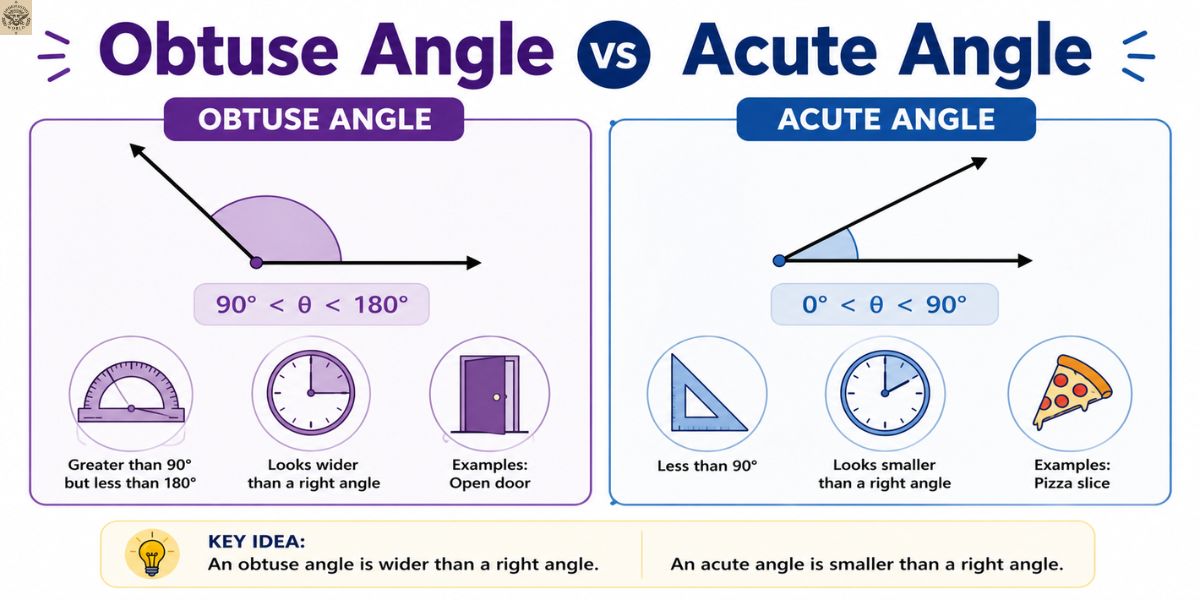
An Obtuse Angle and an acute angle sit on opposite ends of the same measuring scale, which makes comparing them a natural teaching move. An acute angle measures less than 90 degrees, while an Obtuse Angle measures greater than 90 degrees and less than 180 degrees, so the right angle sits right between the two as a clear dividing line.
Placing an Obtuse Angle next to an acute angle during a sorting activity sharpens angle comparison skills fast. Students notice right away that one angle looks narrow and pinched while the other looks open and wide, and that visual contrast makes the numeric obtuse angle definition much easier to remember.
Acute Angle
An acute angle measures less than 90 degrees, making it the narrowest of the common angle types students learn early in geometry. Because it always looks tighter than a right angle, it gives students a useful reference point whenever they try to classify a new angle by sight.
Acute angle shapes show up just as often as obtuse angle shapes, from the tip of a slice of pizza to the peak of a steep roofline. Learning to recognize an acute angle alongside an Obtuse Angle rounds out a student’s ability to sort any angle they encounter with confidence.
Obtuse Angle Degree
By definition, an Obtuse Angle covers every degree measure greater than 90 degrees and less than 180 degrees, which gives it a fairly wide range compared to other angle types. A protractor confirms this instantly, since any reading that falls inside that window locks the angle in as obtuse.
Understanding the obtuse angle degree range also helps students avoid mixing it up with a straight angle or a reflex angle. Practicing measuring angles at different points along that range, say 95 degrees, 130 degrees, and 175 degrees, builds a stronger, more flexible sense of the whole obtuse category rather than just one fixed image.
Obtuse Angle Opposite
The direct opposite of an Obtuse Angle is an acute angle, since one measures less than 90 degrees while the other measures more. A right angle acts as the exact midpoint between them, sitting at precisely 90 degrees and marking the boundary where acute ends and obtuse begins.
On the other side of the scale, a reflex angle stands beyond an Obtuse Angle, picking up wherever 180 degrees leaves off. Seeing all these angle types lined up on one continuum, acute, right, obtuse, straight, and reflex, helps students grasp angle classification as one connected system rather than a list of unrelated terms.
Obtuse Angle Shape
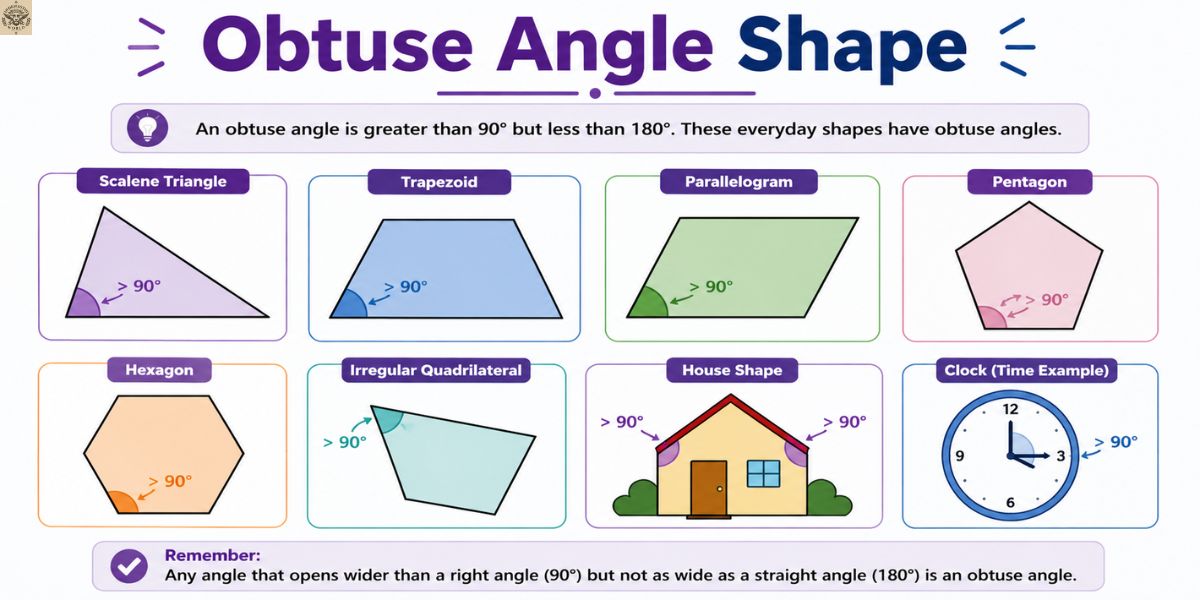
Obtuse angle shapes appear the moment a figure includes a corner that opens wider than a right angle, and plenty of everyday shapes fit that description. An obtuse triangle is the clearest example, since it contains exactly one Obtuse Angle among its three interior angles.
Beyond triangles, quadrilaterals and other 2D shapes can include an Obtuse Angle at one or more corners, which affects how the whole shape looks and behaves. Recognizing an obtuse angle shape within a larger figure builds toward stronger geometry skills, since students start reading shapes by their angles rather than just their outlines.
Obtuse Angle Triangle
An obtuse triangle is any triangle that contains one Obtuse Angle among its three angles, while the other two angles stay acute to keep the total at 180 degrees. This single wide angle gives the triangle a noticeably stretched, leaning appearance compared to a right triangle or an acute triangle.
Spotting an obtuse triangle becomes much easier once students can already identify an Obtuse Angle on its own. That connection between a single angle and the whole triangle it shapes is a great entry point into deeper geometry topics like triangle classification, symmetry, and transformations.
Frequently Asked Questions
Which is an obtuse angle?
Any angle that opens wider than a right angle but stops short of a straight line counts as an Obtuse Angle. So if you measure it and get a number between 90 and 180 degrees, you’ve found one.
What are 7 types of angles?
The main types are acute, right, obtuse, straight, reflex, full, and zero angles. Each one covers a different range on the same 0 to 360 degree scale.
Is an angle over 180 obtuse?
No, once an angle passes 180 degrees it becomes a reflex angle instead. An Obtuse Angle always stays below that 180 degree mark.
Why is it called obtuse?
The word comes from a Latin root meaning blunt or dull, which fits since these angles look wider and less sharp than an acute angle. Mathematicians kept the name to describe that blunt, open shape.
What is a 0 degree angle called?
An angle that measures exactly 0 degrees is called a zero angle. It forms when both rays point in the exact same direction, so there’s no visible turn or gap between them at all.
Conclusion
An Obtuse Angle turns out to be a lot simpler once you break it into pieces: how to say it, what it looks like, how it compares to a right angle or an acute angle, and where it shows up in shapes like an obtuse triangle. Once students can measure it with a protractor, spot it in everyday objects, and place it correctly among the other angle types, the whole idea stops feeling abstract and starts feeling familiar.
That familiarity is really the goal. A student who can say the word with confidence, picture a real example, and explain why it sits between an acute angle and a reflex angle has built a genuine understanding of angle classification, not just a memorized definition. From there, recognizing an Obtuse Angle in any shape, orientation, or context becomes second nature.

