

Fifths are one of the first fractions students meet once a whole gets split into more than a couple of pieces, and they’re worth slowing down for. A fifth is simply one out of five equal parts, written as the unit fraction ⅕, where the denominator shows how many equal-sized pieces make up the whole and the numerator counts how many of those pieces are in play. From a single ⅕ to a full fifths fraction like ⅗, this small denominator opens the door to bigger ideas: equivalent fractions, comparing fractions, and reading a 5 fraction as confidently as any other.
What makes fifths especially useful for teaching is their close relationship with the base-ten system. Because fifths convert to tenths, decimals, and percentages in a single clean step unlike thirds or sevenths, which trail off into repeating decimals they’re a natural fraction for practicing conversions, like knowing how many fifths are equivalent to 6/10 or working out 5% as a fraction. Paired with fraction strips, number line fractions, and simple shaded fractions, fifths give students a hands-on, visual way to build real number sense before the symbols ever start to feel abstract.
Understanding Fifths In Mathematics
Fifths show up the moment you split a whole into five equal parts. Cut a pizza into five identical slices, and each slice is a fifth one out of five, or ⅕. Because ⅕ names just one part of that whole, it counts as a unit fraction, and every other fifths fraction builds outward from it. In any fraction written over a denominator of 5, that denominator tells you the whole has been split into five equal sections, while the numerator tells you how many of those sections you’re counting. Take ⅗: the denominator says “five equal parts,” and the numerator says “we’re looking at three of them.” Once students can read a fifths fraction this way, they start seeing the pattern behind every 5 fraction they meet, not just memorizing the shape of the symbol.
Fifths also travel well between representations. A student who understands ⅕ as “one piece out of five equal pieces” can move that same reasoning to money (a nickel is one-fifth of a quarter… well, almost closer to a fifth of a quarter’s cousin, but the intuition transfers), time, and measurement. That flexibility is part of what makes fifths such a useful stepping stone fraction in elementary math.
Fifths and Their Relationship to the Base-Ten System
Fifths have a built-in shortcut most other fractions don’t get: a direct, clean link to the base-ten system. Multiply both the numerator and denominator of any fifths fraction by 2, and the denominator becomes 10 instantly turning the fraction into tenths.
- ⅕ × 2/2 = 2/10, which converts to the decimal 0.2
- ⅗ × 2/2 = 6/10, which converts to the decimal 0.6
That second line answers a question students ask constantly: how many fifths are equivalent to 6/10? The answer is ⅗ three fifths equal six tenths, because multiplying ⅗ by 2/2 produces exactly 6/10. Flip the multiplication around, and every fifths fraction becomes a percentage just as easily, since percentages are simply parts out of 100:
- ⅕ = 20/100 = 20%
- ⅗ = 60/100 = 60%
That first line is also the cleanest way to answer 5% as a fraction 5% equals 5/100, which simplifies down to 1/20, a fraction closely related to the fifths family and a useful contrast point when teaching how percentages, fractions, and fifths interact.
This tenths-and-hundredths pipeline is what separates fifths from trickier denominators like 3 or 7. Thirds and sevenths produce repeating decimals that never resolve cleanly, but fifths convert to decimals and percentages in one or two clean steps. That reliability is exactly why fifths make such a strong bridge fraction when teaching students to move fluidly between fractions, decimals, and percentages.
Read More: Thirds – Meaningful Math
Teaching Strategies For Fifths
Teaching fifths well means giving students more than one way to picture equal parts
visual models, fraction strips, and number line fractions each turn an abstract fifths fraction into something concrete. Paired with comparing fractions and benchmark fractions, these strategies build the kind of fraction fluency that carries straight into decimals and percentages.
Use Visual Models When Working With Fifths

Visual models turn an abstract fifths fraction into something students can see and touch. Give students a shape: a rectangle, a circle, a strip of paper and have them partition it into five equal-sized pieces. Shading builds the connection fast: shade one section and label it ⅕; shade three and label it ⅗. Students quickly notice that as the numerator climbs, the shaded area grows, which cements the idea that equal parts must stay equal parts for the fraction models to mean anything.
Fraction strips are especially powerful for comparing fractions. Lay a fifths strip next to a tenths strip, and students can physically confirm that two ⅒ sections equal one ⅕ section a hands-on version of the same equivalent fractions reasoning used in the decimal conversions above. Lining up fifths strips against halves, thirds, and tenths strips also builds toward benchmark fractions, since students can see exactly where ⅗ falls relative to ½ just by looking at the aligned bars.
Use Number Lines When Working With Fifths
Number lines push fifths from “shaded shapes” toward “precise numbers.” Mark the space between 0 and 1, split it into five equal-sized segments, and students get five exact points: ⅕, ⅖, ⅗, ⅘, and 1. Unlike a partitioned shape, a number line forces students to treat each fifth as a specific location and magnitude, not just a slice of area.
Placing other fractions ¼, ⅛, or tenths on the same number line turns it into a comparison tool. Students can reason about benchmark fractions directly: is ⅗ closer to ½ or to 1? (It’s greater than ½ and less than 1.) This kind of number line fraction work sharpens estimation skills and grows genuine number sense, because students start predicting where a fifths fraction should land before they even calculate it.
Together, visual models and number lines give students two complementary paths into fifths, one rooted in area and equal parts, one rooted in position and magnitude and both paths reinforce fraction fluency and the conceptual understanding that K-3 math standards are built around.
Fifths and Their Relationship to the Base-Ten System
Fifths have a built-in shortcut most other fractions don’t get: a direct, clean link to the base-ten system. Multiply both the numerator and denominator of any fifths fraction by 2, and the denominator becomes 10 instantly turning the fraction into tenths.
- ⅕ × 2/2 = 2/10, which converts to the decimal 0.2
- ⅗ × 2/2 = 6/10, which converts to the decimal 0.6
That second line answers a question students ask constantly: how many fifths are equivalent to 6/10? The answer is ⅗ three fifths equal six tenths, because multiplying ⅗ by 2/2 produces exactly 6/10. Flip the multiplication around, and every fifths fraction becomes a percentage just as easily, since percentages are simply parts out of 100:
- ⅕ = 20/100 = 20%
- ⅗ = 60/100 = 60%
That first line is also the cleanest way to answer 5% as a fraction 5% equals 5/100, which simplifies down to 1/20, a fraction closely related to the fifths family and a useful contrast point when teaching how percentages, fractions, and fifths interact.
This tenths-and-hundredths pipeline is what separates fifths from trickier denominators like 3 or 7. Thirds and sevenths produce repeating decimals that never resolve cleanly, but fifths convert to decimals and percentages in one or two clean steps. That reliability is exactly why fifths make such a strong bridge fraction when teaching students to move fluidly between fractions, decimals, and percentages.
Teaching Strategies For Fifths
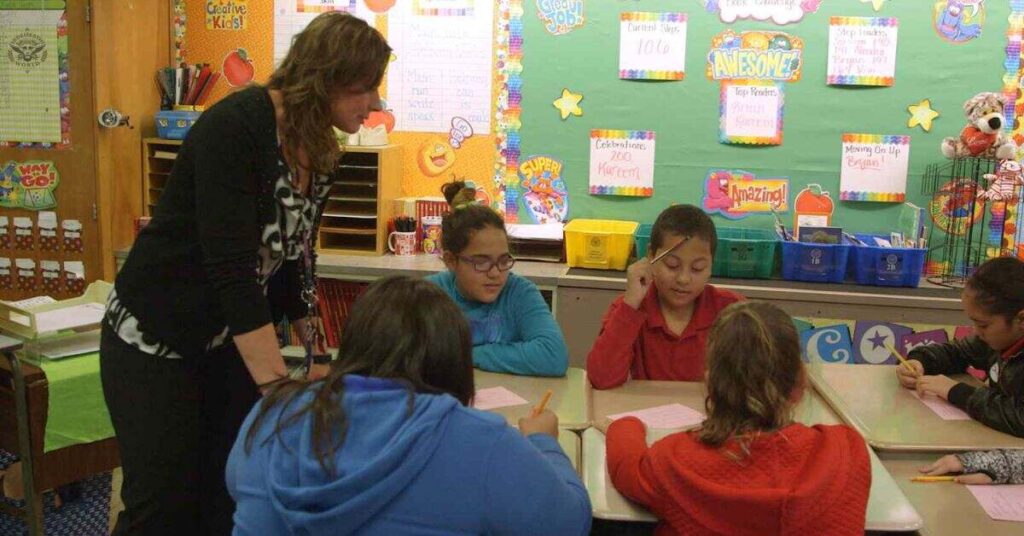
Teaching a fifths fraction well means moving past denominator and numerator definitions and letting students build, shade, and compare equal parts for themselves. Visual models, fraction strips, and number line fractions each turn ⅕ into something concrete, making equivalent fractions, benchmark fractions, and even the jump from a base-ten system into decimals and percentages far easier to grasp.
Use Visual Models When Working With Fifths
Visual models turn an abstract fifths fraction into something students can see and touch. Give students a shape: a rectangle, a circle, a strip of paper and have them partition it into five equal-sized pieces. Shading builds the connection fast: shade one section and label it ⅕; shade three and label it ⅗. Students quickly notice that as the numerator climbs, the shaded area grows, which cements the idea that equal parts must stay equal parts for the fraction models to mean anything.
Fraction strips are especially powerful for comparing fractions. Lay a fifths strip next to a tenths strip, and students can physically confirm that two ⅒ sections equal one ⅕ section a hands-on version of the same equivalent fractions reasoning used in the decimal conversions above. Lining up fifths strips against halves, thirds, and tenths strips also builds toward benchmark fractions, since students can see exactly where ⅗ falls relative to ½ just by looking at the aligned bars.
Use Number Lines When Working With Fifths
Number lines push fifths from “shaded shapes” toward “precise numbers.” Mark the space between 0 and 1, split it into five equal-sized segments, and students get five exact points: ⅕, ⅖, ⅗, ⅘, and 1. Unlike a partitioned shape, a number line forces students to treat each fifth as a specific location and magnitude, not just a slice of area.
Placing other fractions ¼, ⅛, or tenths on the same number line turns it into a comparison tool. Students can reason about benchmark fractions directly: is ⅗ closer to ½ or to 1? (It’s greater than ½ and less than 1.) This kind of number line fraction work sharpens estimation skills and grows genuine number sense, because students start predicting where a fifths fraction should land before they even calculate it.
Together, visual models and number lines give students two complementary paths into fifths, one rooted in area and equal parts, one rooted in position and magnitude and both paths reinforce fraction fluency and the conceptual understanding that K-3 math standards are built around.
Fifths Examples
A fifths fraction shows up anywhere a whole gets split into five equal-sized pieces, and once students spot the pattern, examples appear everywhere. Five friends sharing one pizza each get ⅕ of it. A ruler marked off in five equal segments turns each segment into a fifth of the total length. A jar holding five identical scoops of rice means each scoop represents ⅕ of the jar, and if someone eats three scoops, they’ve eaten ⅗ three fifths of the total.
These same examples double as a natural bridge into decimals and percentages, since every fifths fraction converts cleanly using powers of 10. Two fifths of a $10 bill is $4, which matches 2/5 = 4/10 = 0.4 = 40%. This kind of concrete, money-based or object-based example builds real conceptual understanding, because students see the fraction, the decimal, and the percentage all describing the exact same amount rather than three unrelated skills to memorize.
Fifths Meaning
At its core, “fifths” simply means the equal-sized pieces you get when you divide one whole into five parts. The word doubles as both a noun for the pieces themselves (“she ate two fifths of the sandwich”) and a way of naming a fraction where 5 sits in the denominator. Any unit fraction written as ⅕ represents exactly one of those five parts, and every other 5 fraction ⅖, ⅗, ⅘ simply counts more of those same equal-sized pieces.
The meaning sharpens further once fifths get compared to fractions with different denominators. Halves split a whole into two pieces, thirds into three, and fifths into five so a fifth is always smaller than a half or a third, since the whole gets divided into more pieces overall. Understanding that “more pieces means smaller pieces” is one of the core ideas fifths help teach, and it’s part of why fifths so often anchor early lessons on fraction magnitude and number sense.
Fifth In Words
Written out, “5” as a fraction denominator becomes the ordinal word “fifth,” the same word used when counting position first, second, third, fourth, fifth. That dual role is worth pointing out explicitly, since students often meet “fifth” first as an ordinal number (finishing fifth in a race) before meeting it as a fraction (one out of five equal parts).
Spelling and usage stay consistent across both meanings: “one-fifth” or “a fifth” describes the fraction ⅕, while “fifths” (plural) describes either multiple fifth-sized pieces (three fifths, or ⅗) or the general category of five-part fractions. Writing the word out fully, rather than only using the symbol, helps younger students connect the abstract ⅕ notation to language they already use every day.
How To Pronounce Fifth
“Fifth” is pronounced as one syllable “fifth,” rhyming with “sixth” and “width,” with the “f” sounds landing close together (FIFTH, not “fith” or “fiveth”). It’s a word that trips up plenty of speakers, largely because English rarely stacks that many consonant sounds f, th back to back at the end of a single syllable.
When the word turns plural, “fifths” adds one more sound cluster on top, making it one of the more tongue-twisting words in elementary math vocabulary. Reading fraction names aloud during a lesson one-fifth, two-fifths, three-fifths gives students repeated, low-stakes practice with the pronunciation while simultaneously reinforcing what each fifths fraction actually represents.
Fifth In Number
As a number, “fifth” most often appears as an ordinal (5th) marking position in a sequence the fifth row, the fifth grade, the fifth day of the week. In math specifically, “fifth” also names the fraction ⅕, so context decides which meaning applies: “she finished fifth” refers to position, while “she ate a fifth of the pie” refers to the fraction.
Both uses share the same root idea of “five,” which makes them useful to teach side by side. Once students see that the ordinal “fifth” and the fraction ⅕ both connect back to the number 5, the fraction stops feeling like an arbitrary symbol and starts feeling like a natural extension of counting they already know.
Fifths Meaning In Math
In mathematics, fifths belong to the broader family of fractions, and specifically to unit fractions when written as ⅕. The denominator, 5, states how many equal-sized pieces make up the whole, while the numerator states how many of those pieces are being counted or shaded. This is the same numerator-over-denominator logic that governs every fraction, so fifths serve as a clean, teachable example of the rule.
Fifths earn extra attention in math instruction because of how smoothly converting fractions to percentages works multiplying by powers of 10 turns any fifths fraction into tenths, hundredths, decimals, or percentages in a single clean step, unlike thirds or sevenths, which produce repeating decimals that never fully resolve. That reliability is exactly why fifths show up so often in early teaching strategies built around K-3 math standards, using visual models, shaded fractions, and fraction bars to build lasting fraction fluency.
Frequently Asked Questions
What is fifths in fractions?
Fifths are what you get when a whole is split into five equal parts, with each part written as ⅕.
How do I spell 5th?
“5th” is spelled out as “fifth” F-I-F-T-H.
What is the meaning of fifths?
Fifths refers to the equal-sized pieces formed by dividing a whole into five parts, or to a fraction with 5 as its denominator.
What is the 5th called?
5th is called “fifth,” the ordinal form of the number five.
What is 1st, 2nd, 3rd, 4th, 5th, 6th in words?
Written out, these are first, second, third, fourth, fifth, and sixth.
Conclusion
Fifths turn out to be one of the friendliest fractions a student can learn, precisely because they don’t stay locked in one form. A single ⅕ can be shaded on a shape, placed on a number line, stretched into a fraction strip, or rewritten as a decimal and a percentage and every version points back to the same simple idea of five equal parts. That flexibility is what makes fifths such a strong entry point into fractions overall, not just another denominator to memorize.
By the time a student can explain what a fifth means, pronounce it correctly, spot it in everyday examples, and convert it fluently between fractions, decimals, and percentages, they’ve picked up far more than one fraction fact. They’ve built the kind of number sense and conceptual understanding that carries straight through into halves, thirds, tenths, and every other fraction still ahead of them.

