

Shopping deals often come with percentages attached, aur numbers ko skim kar dena aasan hai bina exact price samjhe. Agar $6.99 ka item 75 percent off hai, andaza lag jata hai ke sasta hoga, lekin real final price janne ke liye proper calculation chahiye hoti hai, sirf guess kaafi nahi.
Breaking down 75% off $6.99 step by step so there’s no guesswork involved. You’ll see how the $5.24 savings is calculated, how it brings the price down to $1.75, and how the same formula applies whether you’re comparing this deal to another discount or just double checking the math yourself.
20 Percent off 40 Dollars Calculator
Twenty percent off $40 saves $8, leaving a final price of $32. Multiplying the original price by 0.20 gives the discount amount, and subtracting that from $40 gives the sale price.
A percentage discount calculator handles this instantly, which is useful when you’re comparing several deals at once, say a 75% off 6.99 item against a smaller 20 percent markdown on a $40 purchase. Running both through the same calculator keeps the comparison quick and accurate.
What Is 75% off $6.99?
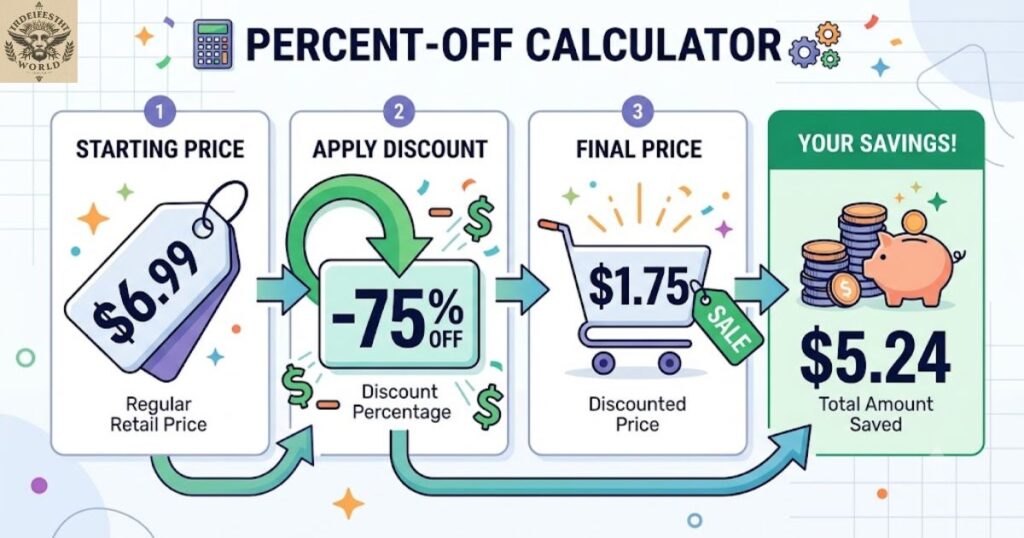
Figuring out 75% off $6.99 is easier than it looks once you break it into two quick steps. Take the original price of $6.99, work out what 75 percent of that amount comes to, then take that number away from the starting price. Do that and you land on a final price of $1.75, meaning you pocket $5.24 in savings. That’s the whole idea behind 75% off $6.99 in a nutshell.
Percent Off Calculator
Use the fields below to run your own numbers. Enter any original price, adjust the discount percentage, and even stack a second markdown on top if the deal comes with an extra reduction.
Original price: 6.99
Discount percentage: 75%
Discount amount: $5.24 (amount you save)
Final price: $1.75 (price you actually pay)
Savings breakdown: You save 75%, you pay the remaining 25%.
How the Discount Formula Works
Every percentage discount calculator, this one included, relies on two straightforward formulas.
Formula 1: Amount Saved = Original Price × Discount % ÷ 100
Formula 2: Sale Price = Original Price − Amount Saved
Walking Through 75% off $6.99 Step by Step
Here’s how those formulas play out when you’re solving for 75% off $6.99:
Step 1: Find the amount saved.
Amount Saved = $6.99 × 75 ÷ 100
Amount Saved = $6.99 × 0.75
Amount Saved = $5.24
Step 2: Subtract that from the original price.
Sale Price = $6.99 − $5.24
Sale Price = $1.75
So when someone asks what 75% off $6.99 comes out to, the answer is a final price of $1.75 after a discount of $5.24.
A Faster One Step Route
If you’d rather skip straight to the sale price without calculating the discount amount separately, multiply the original price by whatever percentage remains after the discount is applied.
Sale Price = Original Price × (1 − Discount % ÷ 100)
For 75% off $6.99, that looks like:
Sale Price = $6.99 × (1 − 0.75)
Sale Price = $6.99 × 0.25
Sale Price = $1.75
Relevant Post…………MM Meaning in Text: The Complete Beginner’s Breakdown
How to Calculate Percent Off
Working out a percent off deal comes down to one simple idea: take a fraction of the original price away from itself. Multiply the price by the discount percentage, divide by 100, and that gives you the amount you save. Subtract that figure from the starting price and you’re left with what you’ll actually pay at the till.
This same logic sits behind every calculation on this page, including 75% off $6.99. Once you understand the two step process, you can apply it to any price tag, whether you’re checking a small everyday purchase or a bigger ticket item, without needing to look anything up.
25% off of 50 Dollars

A 25 percent discount on $50 saves you $12.50, which brings the final price down to $37.50. You get there by multiplying $50 by 0.25 to find the savings, then subtracting that amount from the original $50.
It’s the same three step process used to work out 75% off $6.99, just with different starting numbers. Whether the original price is $50 or something smaller like £6.99, the formula for discount amount and final price never changes.
How to Calculate 10 Percent Off a Price
Ten percent is one of the easiest discounts to figure out in your head, since it’s just a tenth of whatever the original price happens to be. Move the decimal point one place to the left and you’ve got your savings, then subtract that from the price to land on the sale price.
That mental shortcut works well for round numbers, but larger discounts like 75% off $6.99 usually call for a proper percentage discount calculator to keep the numbers accurate. Either way, the underlying formula for amount saved and final price stays the same no matter how big or small the percentage is.
30 Percent off 50 Dollars Calculator
Thirty percent off $50 works out to $15 in savings, leaving a final price of $35. Multiply $50 by 0.30 to get the discount amount, then take that away from the original price to reach the sale price.
A discount calculator makes quick work of numbers like these, and the same tool handles trickier combinations too, from small everyday totals like 6.99 + 6.99 to steeper markdowns such as 75% off $6.99. Plugging in the original price and percentage is usually faster than doing the subtraction by hand.
40 Percent off 20

Forty percent off $20 saves you $8, bringing the sale price down to $12. The math follows the standard discount formula: multiply the original price by the percentage, then subtract that result from the starting amount.
Smaller totals like this one are easy to check mentally, but the same steps scale up to bigger discounts too, including 40% off 6.99 or a steeper cut like 75% off $6.99. The percentage might change, but the two step formula behind it doesn’t.
30 Percent off 25
A 30 percent discount on $25 comes to $7.50 in savings, which puts the final price at $17.50. As with any percentage discount, you find the amount saved first, then subtract it from the original price to get what you’ll pay.
This kind of calculation shows up constantly in everyday shopping, sitting alongside searches like 75% off of 6.99 or straightforward markdowns on a single item. The formula stays consistent, so once you’ve worked out one discount, the rest follow the same pattern.
30 off 25
Applying a straight 30 percent reduction to $25 gives the same result as above: $7.50 saved and a final price of $17.50. Some searches phrase the discount as “30 off 25” without the percent sign, but the calculation and the formula behind it don’t change.
Whether the discount is written as “30 off 25” or spelled out in full, a sale price calculator reads it the same way. That consistency is what makes it easy to jump between different examples, from small round number deals to something more specific like 75% off $6.99.
Frequently Asked Questions
How to calculate 75% off of a price?
Multiply the original price by 0.75 to find the amount you save, then subtract that from the price to get the final amount you pay.
How much is 75% off $5?
75% off $5 saves you $3.75, leaving a final price of $1.25.
How much is 75% off of $1?
75% off $1 saves you $0.75, bringing the final price down to $0.25.
What is 12.99 with 75% off?
75% off $12.99 saves you $9.74, so you’d pay $3.25 at checkout.
What’s 75% off 90 dollars?
75% off $90 saves you $67.50, leaving a final price of $22.50.
Conclusion:
Working out 75% off $6.99 really just takes two quick steps: find 75 percent of the price, then subtract that amount from the original. Once you know the discount comes to $5.24, the math practically does itself, leaving a final price of $1.75. That same formula applies no matter what number you’re starting with, so there’s no need to guess or round when a calculator can give you the exact figure in seconds.
Whether you’re checking a single item or comparing a few different deals side by side, understanding how 75% off $6.99 breaks down makes it easier to spot real savings before you buy. The formula stays the same across every price tag, so once it clicks, you can apply it confidently to any discount you come across, big or small.

