


The phrase’s de facto meaning is important for understanding situations that exist in real life, even when they are not officially recognized by law. It comes from Latin and is commonly used in English, law, politics, business, and everyday conversations. For example, someone may manage a company and make all its important decisions without officially holding the highest position. That person may be described as the de facto leader.
Understanding this phrase becomes easier when it is compared with de jure, which refers to something established or recognized by law. Although both expressions describe authority, status, or arrangements, they do not mean the same thing. This guide explains their definitions, differences, pronunciation, origins, synonyms, and practical examples in simple English.
What Is the De Facto Meaning?
The de facto meaning is something that exists in practice or reality, even if it has not been officially established, legally recognized, or formally approved. It describes the actual situation rather than what official documents or rules say.
For instance, a team member might make most of the decisions in a workplace, even though another employee officially holds the manager’s title.De Facto Meaning In that situation, the team member could be considered the de facto leader. The expression helps explain how things actually work in real life.
De Facto Meaning in English
In English, de facto means in fact, in practice, or in reality. It is often used as an adjective before a noun, such as in de facto leader or de facto government. It can also be used as an adverbial expression, as in The arrangement exists de facto.
The phrase is useful when actual circumstances differ from formal rules, official titles, or legal recognition. However,De Facto Meaning de facto does not automatically mean illegal, unofficial in every respect, or temporary. Its exact meaning depends on the context in which it appears.
De Facto Meaning in Urdu
Roman Urdu mein, iska matlab hai ke koi cheez haqeeqat mein ya amli taur par maujood ho, chahe uski official position ya legal recognition mukhtalif ho.
- Example: A person controls the organization without officially being its director.
Urdu explanation: Woh shakhs officially director nahi hai, lekin amli taur par organization ke faislay karta hai.
De Facto vs. De Jure: What Is the Difference?
The most important distinction is between what happens in practice and what is officially established or recognized by law.De Facto Meaning Both expressions are used in legal, political, and other formal contexts.
| Feature | De Facto | De Jure |
| Basic meaning | In reality or in practice | By law or as a legal matter |
| Main focus | Actual circumstances | Legal or formal status |
| Authority | Authority exercised in practice | Authority recognized under the relevant law |
| Example | Someone acts as the leader in practice | Someone legally holds the leadership position |
| Key question | What is actually happening? | What is legally established? |
De Facto Example
A person makes the major decisions in a family business, even though another person is officially registered as its director. The first person may be the de facto decision-maker.
Read More: Depreciation Meaning: Definition, Examples, Synonyms, and Accounting Explained
De Jure Example
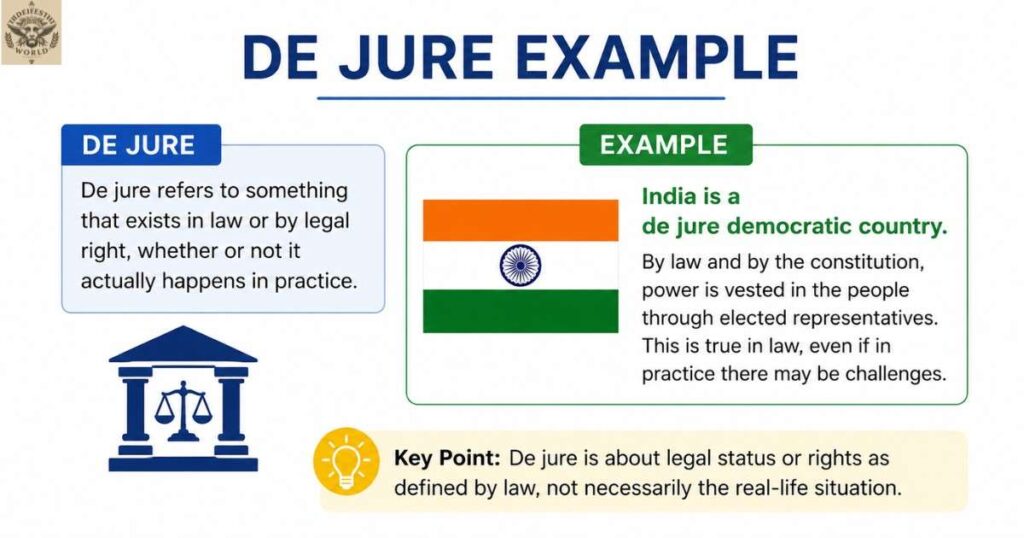
A person is legally appointed as the director of a company and holds that position under the applicable rules. That person is the de jure director.
Can Something Be Both De Facto and De Jure?
Yes. A person can hold a position legally and also exercise its responsibilities in practice. In that case, the position may be both de jure and de factoDe Facto Meaning.A difference between the two does not always indicate wrongdoing. The legal consequences depend on the facts and the relevant jurisdiction.
De Facto Meaning in Law
In legal writing, de facto describes a situation, status, or exercise of authority that exists in practice. The expression can help distinguish actual conduct from formal legal recognition.
For example, a person may exercise control over an organization without holding its officially recognized leadership position.
De Facto Meaning Whether that control creates legal rights or responsibilities depends on the applicable law and the circumstances. Describing someone as a de facto leader does not, by itself, establish that the person has legal authority.
De Facto Meaning in Politics
In politics, a de facto leader is someone who exercises real political power, even if another individual officially holds the position of head of state or government. Actual power and formal constitutional authority may belong to different people.
Similarly, a government may exercise effective control over a territory without receiving universal international recognition. In such cases, the distinction between practical control and formal recognition can be important. The precise legal and diplomatic status depends on the circumstances.
De Facto Meaning in Business
In business, the phrase can describe a person,De Facto Meaning process, standard, or arrangement that operates as the accepted reality without necessarily being formally designated.
For example, an experienced employee may become the de facto team leader because colleagues regularly depend on that person’s decisions. Similarly, a widely used product may become the de facto industry standard even when no law requires companies to use it.
These examples show why the phrase is useful in workplace discussions, business reports, and technology articles.
De Facto Relationship Meaning
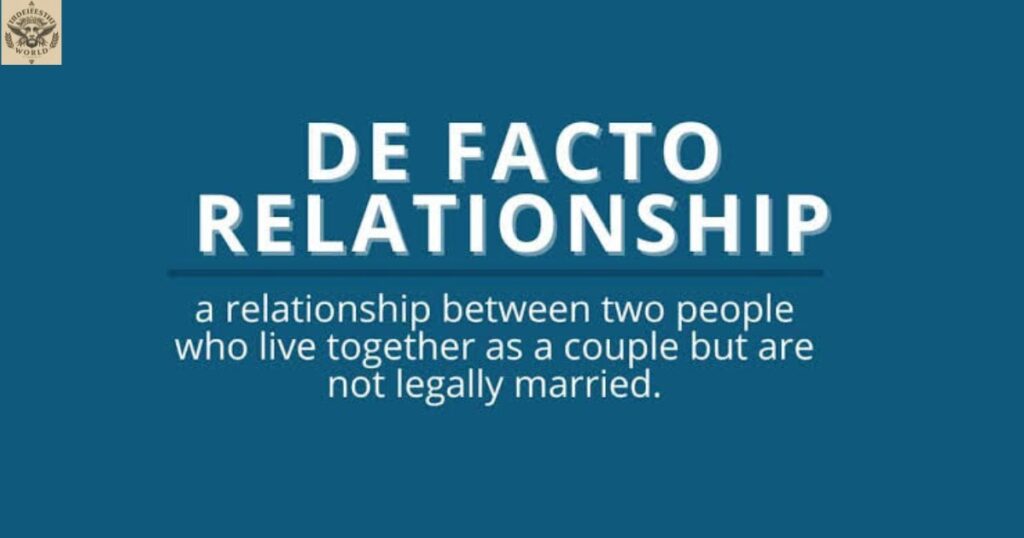
A de facto relationship generally refers to a relationship in which two people live together as partners without being legally married. The exact definition and legal consequences vary by country and jurisdiction.
In some places, a qualifying de facto relationship may provide certain legal rights or obligations. In others, different rules apply. Therefore, the expression should not be treated as having one universal legal definition.
De Facto Examples in Everyday English
Here are five examples that show how the phrase can be used naturally.
She became the de facto leader of the group.
She guided the group even though she did not officially hold the leadership position.
English is the de facto working language of the office.
People commonly use English at work, although it may not be formally designated as the official language.
The senior employee is the de facto manager.
The employee handles most management duties in practice.
The software became the de facto industry standard.
Many organizations adopted the software, making it the usual choice.
The arrangement became the de facto policy.
People followed the arrangement as a normal practice,de facto meaning even though it might not have been formally written into policy.
De Facto Synonyms
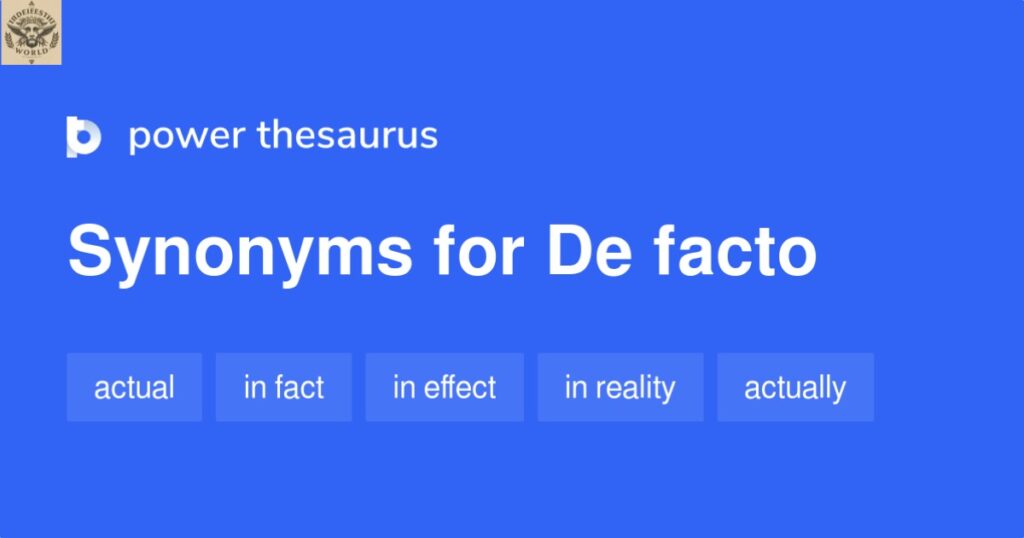
The best synonym depends on the sentence. Common alternatives include:
- In practice: Describes what actually happens.
- In reality: Focuses on the real situation.
- In fact: Emphasizes what is true.
- Actual: Refers to something that exists or happens.
- Unofficial: Describes something without formal approval or designation, where appropriate.
- Effective: Can describe control or authority that works in practice.
These terms are not always interchangeable. de facto meaning For example, unofficial does not capture every meaning of de facto, because a situation can exist in practice and still have legal recognition.
De Facto Antonym
De jure is the closest contrasting expression when the discussion concerns actual circumstances versus legal status. Depending on the sentence,de facto meaning other alternatives may include formal, official, or legally recognized.
However,de facto meaning of these words have different meanings. A situation described as de facto is not necessarily the opposite of something official; both practical reality and formal recognition can exist at the same time.
De Facto Pronunciation and Origin
The phrase comes from Latin and literally means from the fact or from the deed. In modern English,de facto meaning it is commonly pronounced dee FAK-toh.
It is used in formal writing, legal discussions, politics, business, de facto meaning and general English. Because it is a Latin expression, it is often written in italics in formal publications, although many English style guides allow it to appear in ordinary type.
Common Mistakes When Using De Facto

One common mistake is assuming that de facto always means illegal. It does not. The phrase describes what exists in practice and does not independently determine whether that situation is lawful.Another mistake is treating de facto and de jure as identical. The first emphasizes actual circumstances, while the second emphasizes legal status. Finally, readers should avoid assuming that every unofficial arrangement has the same legal consequences across different countries.
Frequently Asked Questions
What is the simple meaning of de facto?
It means something exists in reality or works that way in practice, even if it has not been formally established.
What is the difference between de facto and de jure?
De facto describes what happens in practice, while de jure describes what is established or recognized by law.
Is de facto the same as illegal?
No. A de facto situation is not automatically illegal. Its legal status depends on the circumstances and applicable law.
What is an example of a de facto leader?
A person who makes the main decisions and exercises leadership in practice, despite not officially holding the leadership title, may be called a de facto leader.
What does de facto mean in a relationship?
It can describe two people living together as partners without being legally married. The legal definition varies by jurisdiction.
Conclusion
The phrase de facto describes what exists in reality or operates in practice. It is useful when actual circumstances differ from official titles, written rules, or legal recognition. The clearest way to understand it is to compare it with de jure, which concerns legal or formal status. Once this distinction is understood, de facto readers can recognize the expression in everyday English, de facto meaning business discussions, political reporting, and legal writing.

