

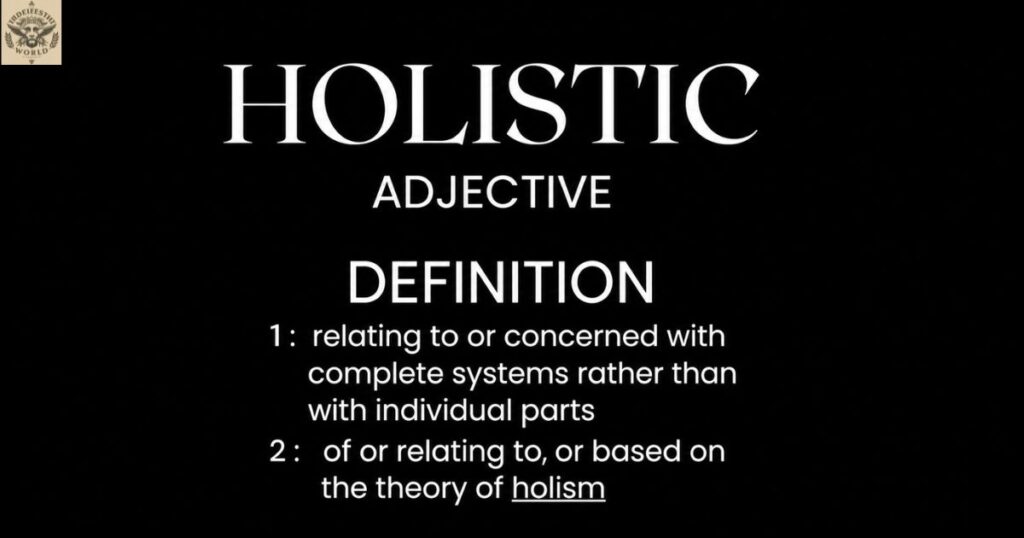
The word holistic describes an approach that considers the whole thing rather than focusing on only one part. It is commonly used in health, Holistic Meaning education, business, psychology, and personal development. A holistic approach looks at how different parts connect and influence one another to understand the complete situation.
For example, a holistic approach to health does not focus only on physical symptoms. It also considers mental well-being, emotional balance, daily habits, sleep, nutrition, and social relationships. The goal is to understand the bigger picture instead of treating every issue separately.
Understanding the holistic meaning helps people use this word correctly in everyday conversations and professional settings. This guide explains its definition, examples, synonyms, Urdu and Hindi translations, and practical applications in different areas of life.
What Is the Holistic Meaning?
Holistic means considering a person, system, problem, or situation as a complete whole rather than examining its individual parts separately. It emphasizes the connections between different elements and how they work together.
For example, a teacher using a holistic approach does not judge a student only by exam scores. The teacher may also consider creativity, communication, emotional development, teamwork, confidence, and practical skills. This gives a broader understanding of the student’s abilities and needs.
The main idea behind holistic thinking is that individual parts often make more sense when viewed in relation to the whole.Holistic Meaning It does not mean ignoring specific problems. Instead, it means understanding those problems within their wider context.
Simple Definition of Holistic
The simplest definition of holistic is looking at the whole picture and considering how different parts work together.
Here are a few examples:
- A holistic health plan considers physical and mental well-being.
- A holistic education system supports academic, emotional, and social development.
- A holistic business strategy considers employees, customers, finances, and long-term goals.
- A holistic lifestyle includes balanced nutrition, regular exercise, good sleep, and emotional well-being.
In each example, the focus is on the complete situation rather than one isolated factor.
Holistic Meaning in English
In English, holistic is an adjective used to describe an approach that considers the whole system, person, or situation. It is often associated with comprehensive thinking, interconnectedness, and overall well-being.
For example, a company may adopt a holistic strategy to improve employee performance. Instead of focusing only on productivity, it may also examine workplace culture, training, communication, management,Holistic Meaning and employee satisfaction.
The word is especially useful when explaining methods that address multiple related factors. It encourages people to understand how different parts influence the final outcome.
Read More:Hyperbole Meaning: Definition, Examples, Types, and Uses
Holistic Meaning in a Sentence
The following examples show how to use holistic correctly in everyday English.
| Sentence | Meaning |
| The doctor recommended a holistic approach to health. | The doctor suggested considering overall well-being. |
| Our school follows a holistic education model. | The school supports several areas of student development. |
| The company needs a holistic business strategy. | The company should consider all important business factors. |
| Meditation supports a holistic approach to wellness. | Meditation may contribute to overall well-being. |
| The team conducted a holistic review of the project. | The team examined the project from several connected perspectives. |
| Parents play an important role in holistic child development. | Parents support children’s overall growth. |
| The organization adopted a holistic approach to environmental protection. | It considered multiple connected environmental issues. |
These examples demonstrate that holistic can describe a wide range of approaches, plans, and systems.
Holistic Meaning in Urdu and Hindi
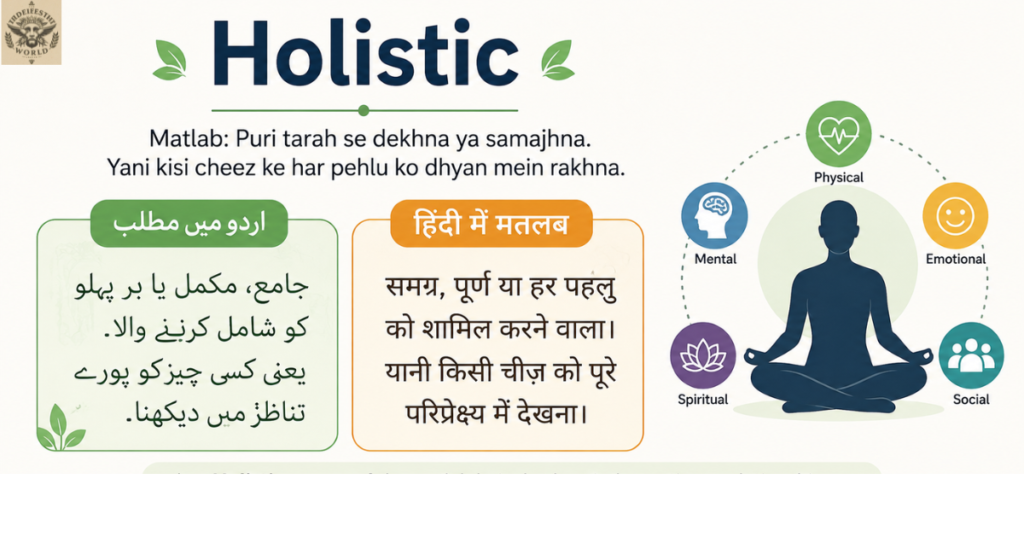
The meaning of holistic is closely related to completeness, an overall perspective, and understanding the connections between different parts.
Holistic meaning in Urdu
- جامع، مجموعی یا کلی نقطۂ نظر
Roman Urdu: Kisi shakhs, maslay ya surat-e-haal ko mukammal taur par dekhna aur us ke tamam mutaliqa pehluon ko samajhna.
- Example: Doctor ne mareez ki sehat behtar banane ke liye holistic approach apnayi.
Meaning: Doctor ne sirf bimari nahi, balkay mareez ki overall sehat aur lifestyle ko bhi madde nazar rakha.
Holistic meaning in Hindi
- समग्र या समग्र दृष्टिकोण
- Example: शिक्षक ने बच्चों के समग्र विकास पर ध्यान दिया।
Meaning: शिक्षक ने बच्चों की पढ़ाई के साथ उनके सामाजिक, भावनात्मक और व्यक्तिगत विकास को भी महत्व दिया।
In simple words, holistic ka matlab sirf ek hissa dekhna nahi, balkay poori tasveer ko samajhna hai.
Holistic Approach Meaning
A holistic approach is a way of understanding or solving a problem by considering all important and connected factors. Instead of treating each issue as completely separate, this approach examines how different elements affect one another.
For example, if a student is struggling at school,Holistic Meaning a holistic approach may consider study habits, sleep, family circumstances, confidence, teaching methods, and emotional well-being. Looking at these factors together may help identify the reasons behind the student’s difficulties.
A holistic approach can be useful in personal development, healthcare, education, business, and community planning. However, the exact factors considered depend on the problem being addressed.
Examples of a Holistic Approach
- Health: Considering physical condition, mental well-being, nutrition, sleep, and lifestyle.
- Education: Supporting academic achievement, creativity, social skills, and emotional development.
- Business: Evaluating employees, customers, operations, finances, and long-term sustainability.
- Parenting: Supporting a child’s physical, emotional, social, and intellectual growth.
- Environmental planning: Considering wildlife, water, soil, communities, and economic effects together.
The common principle is to understand the relationships between different factors before deciding what action to take.
Holistic Meaning in Health and Wellness
In health and wellness, holistic refers to considering multiple aspects of a person’s well-being rather than concentrating exclusively on one symptom or body part. These aspects may include physical health, mental health, emotional well-being, lifestyle, and social support.
For example, a healthcare professional may discuss sleep, physical activity, nutrition, stress, and medical history when helping a patient manage a health concern. These factors can influence one another and may affect the person’s overall quality of life.
A holistic approach does not automatically mean alternative medicine. It can be used alongside evidence-based medical care. People should not replace prescribed treatment with unproven remedies simply because a product or service is described as holistic.
Holistic Health Examples
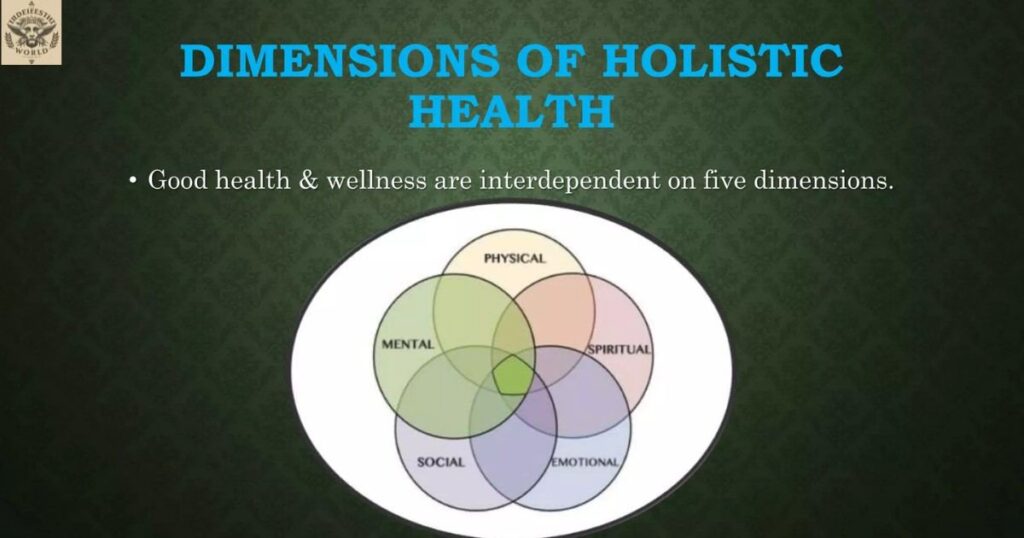
- Balanced nutrition: Eating a varied diet that supports general health.
- Physical activity: Staying active to support physical fitness and overall well-being.
- Sleep habits: Maintaining a consistent sleep schedule where possible.
- Stress management: Using suitable methods to manage everyday stress.
- Social connections: Maintaining supportive relationships with friends and family.
These examples illustrate how different areas of life may contribute to overall wellness. Individual health needs vary, so professional medical advice remains important when treating health conditions.
Holistic Meaning in Education
Holistic education focuses on developing the whole student rather than measuring success only through grades and examinations. It recognizes that learning involves intellectual, social, emotional, physical, and creative development.
For example, a school using a holistic education model may combine academic lessons with sports, arts, teamwork, communication activities,Holistic Meaning and problem-solving exercises. Students have opportunities to develop different abilities rather than focusing exclusively on test performance.
This approach can help educators recognize that students have different strengths, learning needs, and interests. It also encourages a supportive learning environment where personal development matters alongside academic achievement.
Benefits of Holistic Education
- Encourages creativity and critical thinking.
- Supports social and communication skills.
- Promotes emotional awareness and confidence.
- Recognizes different learning styles and abilities.
- Connects classroom knowledge with practical experiences.
Holistic education does not mean academic achievement is unimportant. Instead, it treats academic learning as one part of a broader educational experience.
Holistic Meaning in Business
In business, a holistic approach means considering how different departments, people, processes, and goals influence the organization as a whole. It helps businesses avoid making decisions based on one metric while overlooking other important consequences.
For example, a company that wants to increase sales might examine marketing, product quality, customer service, employee training, pricing, and customer feedback. Increasing advertising alone may not solve the problem if the underlying issue is poor product quality or slow service.
A holistic business strategy connects short-term actions with long-term objectives. It also considers how decisions affect customers, employees,Holistic Meaning finances, and the organization’s reputation.
Holistic Business Examples
- Reviewing customer feedback alongside sales figures.
- Improving employee training and workplace communication.
- Considering environmental effects when selecting suppliers.
- Coordinating marketing, product development, and customer support.
- Evaluating long-term growth rather than focusing only on immediate profit.
This wider perspective can support better planning, although business decisions still need reliable evidence and clear priorities.
Holistic Meaning in Psychology
In psychology, a holistic perspective considers how different aspects of human experience interact. These may include thoughts, emotions, behaviour, relationships, personal history, and environmental influences.
For example, a person’s difficulty concentrating may be connected to several factors, such as lack of sleep, stress, an uncomfortable learning environment, or other personal circumstances. A holistic perspective encourages careful consideration of the wider context rather than immediately assuming a single cause.
This does not mean every psychological issue has multiple causes or that a holistic approach replaces specialized assessment. It simply highlights the importance of considering relevant circumstances when trying to understand human behaviour.
Holistic Meaning in Personal Development

Holistic personal development focuses on improving different areas of life in a balanced and connected way. Instead of measuring success only through income, career achievements, or physical appearance, it also considers relationships, emotional well-being, learning, habits, and personal values.
For example, someone who wants to improve their life might set goals for professional skills, physical activity, family relationships, Holistic Meaning financial responsibility, and time management. These goals can support different aspects of personal growth.
A holistic lifestyle does not require perfect balance every day. Different priorities may need more attention at different times. The main purpose is to recognize that long-term well-being involves more than a single achievement.
Holistic vs. Wholistic
The words holistic and holistic are closely related in meaning, but their usage differs.
| Word | Explanation |
| Holistic | The standard and widely accepted spelling in formal English. |
| Wholistic | An alternative spelling is sometimes used to emphasize the word whole. |
Holistic is generally the best choice for academic writing, professional communication, and SEO articles.Holistic Meaning Although holistic appears in some contexts, it is much less common.
For example:
- Standard: “The organization developed a holistic strategy.”
- Alternative: “The organization developed a holistic strategy.”
For most writing purposes, use holistic.
Holistic vs. Comprehensive
Holistic and comprehensive are related words, but they emphasize slightly different ideas.Holistics focus on the whole system and the relationships between its parts. Comprehensive means covering a wide range of relevant information, topics,Holistic Meaning or details.
For example, a comprehensive report may provide detailed information about every department in a company. A holistic report may additionally explain how those departments affect one another and contribute to the organization’s overall performance.
A plan can be both holistic and comprehensive, but the words are not always interchangeable.
Holistic Synonyms and Related Words
Several words have meanings similar to holistic. The most suitable synonym depends on the context.
| Synonym | Meaning |
| Comprehensive | Covering a wide range of relevant aspects. |
| Whole | Considered as a complete unit. |
| Overall | Relating to the general picture or total situation. |
| Integrated | Combining different parts into a connected system. |
| Complete | Including all necessary parts. |
| Broad-based | Considering or involving a wide range of areas. |
| Systemic | Relating to a whole system and its internal connections. |
| All-encompassing | Including or covering nearly everything relevant. |
- These terms are related but not identical.
For example, integrated emphasizes bringing parts together, while comprehensive emphasizes broad coverage.
Holistic Antonyms
Antonyms are words with opposite or contrasting meanings. Depending on the context, the following words may contrast with holistic.
- Fragmented: Divided into disconnected parts.
- Partial: Covering only a part of something.
- Narrow: Limited in scope or perspective.
- Isolated: Considered separately from other factors.
- Reductionist: Explaining a complex system mainly by breaking it into simpler components.
For example, a holistic review considers the wider system, whereas a narrow review may focus on only one specific factor.
However, examining individual parts is not always wrong. Detailed or specialized analysis can be useful when combined with an understanding of the wider picture.
Holistic in a Sentence: More Examples

Here are additional examples that demonstrate how the word can be used in different situations.
- The hospital introduced a holistic approach to patient care.
- Parents can support holistic development by encouraging learning and independence.
- The company needs a holistic review of its operations.
- Holistic education considers more than examination results.
- The project requires a holistic understanding of environmental challenges.
- Her personal development plan includes a holistic view of health and career goals.
- The team adopted a holistic strategy to improve customer satisfaction.
- A holistic assessment considers the student’s strengths and learning needs.
- The organization believes in a holistic approach to community development.
- Effective planning often requires a holistic understanding of the situation.
These sentences show that holistic is particularly useful when discussing plans, approaches, assessments, development, and care.
Common Misunderstandings About Holistic
Although the word is widely used, people sometimes misunderstand its meaning.
Misunderstanding 1: Holistic means alternative medicine. Not necessarily. The word describes a whole-picture approach and can be used in healthcare, education, business, and many other fields.
Misunderstanding 2: Holistic means treating everything equally. A holistic approach considers relevant factors together, but some factors may require more attention than others.
Misunderstanding 3: Holistic means ignoring individual details. It does not. Specific details remain important; the difference is that they are understood within the wider context.
Misunderstanding 4: Holistics guarantees better results. No approach guarantees success. A holistic method can help broaden understanding, but its effectiveness depends on the quality of the evidence, decisions, and actions involved.Understanding these distinctions helps readers use the word more accurately.
Frequently Asked Questions:
What does holistic mean in simple words?
Holistic means looking at the whole picture instead of focusing on only one part. It considers how different elements connect and influence one another.
What is the holistic meaning in Urdu?
Holistic ka Urdu meaning جامع، مجموعی یا کلی نقطۂ نظر hai. Roman Urdu mein iska matlab kisi shakhs, maslay, ya situation ke tamam mutaliqa pehluon ko dekhna hai.
What is an example of a holistic approach?
A holistic approach to education considers academic performance, creativity, emotional development, social skills, and practical abilities instead of judging a student only by examination marks.
What is the difference between holistic and comprehensive?
Holistics emphasize how different parts work together as a whole. Comprehensive emphasizes covering a wide range of relevant information or details.
What are the synonyms of holistic?
Common related words include comprehensive, integrated, overall, complete, whole, and all-encompassing. The best synonym depends on the sentence and context.
Conclusion
The word holistic describes an approach that considers the complete picture and the relationships between its different parts. Holistic Meaning It is widely used in healthcare, education, business, psychology, and personal development because many situations cannot be fully understood by examining just one factor.
The holistic meaning is not limited to alternative medicine or wellness practices. It can describe any suitable method that considers relevant elements together to develop a broader understanding of a person, problem, or system.
Learning how to use holistic correctly helps improve English vocabulary and communication. Whether discussing holistic health,Holistic Meaning holistic education, or a holistic business strategy, the central idea remains the same: understand the whole, including how its parts work together.

