

Hyperbole is a common English language technique used in everyday conversations, books, poems, and social media. It makes a statement sound stronger by exaggerating something beyond its normal limits. People often use it to express emotions, create humor,Hyperbole Meaning or make an idea more memorable.
Understanding hyperbole helps readers recognize figurative language and understand what a speaker really means. For example, when someone says, I am so hungry I could eat a horse, the person does not mean they will literally eat a horse. They are simply expressing extreme hunger.
In this guide, readers will learn the hyperbole meaning in English, its types, common examples, synonyms, literary uses, and translations in Urdu and Hindi. The article also explains how hyperbole differs from metaphors and similes.
What Is the Hyperbole Meaning?
Hyperbole means a deliberate exaggeration used to emphasize a feeling, situation, description, or idea. It is a type of figurative language in which a speaker makes something sound much bigger, smaller, better, worse, or more extreme than it really is.
For example, the sentence My school bag weighs a ton is a hyperbole. A school bag cannot usually weigh an actual ton, but the exaggeration helps communicate that the bag feels very heavy.
Writers and speakers use this technique to make their words more powerful. It can express happiness, sadness, frustration, excitement,Hyperbole Meaning surprise, or humor. Hyperbole is not usually intended to deceive someone because the exaggeration is understood as a figure of speech.
Simple Definition of Hyperbole
The simplest definition of hyperbole is an intentional exaggeration used to make a point or create a strong impression.
Here are a few easy examples:
- I have a mountain of homework. This means there is a lot of homework.
- I waited forever. This means the wait felt very long.
- She cried a river. This means she cried a great deal.
- This box weighs a million pounds. This means the box feels extremely heavy.
These sentences are not meant to be taken literally. Their purpose is to make ordinary statements more expressive and memorable.
Hyperbole Meaning in English
In English, hyperbole is a figure of speech that exaggerates a fact or situation for emphasis. It is commonly used in spoken English and written communication to make descriptions more interesting.
For example, someone might say, I have told you a thousand times to close the door. The speaker probably has not repeated the instruction exactly one thousand times. Instead, the statement shows frustration and emphasizes that the instruction has been repeated many times.
Hyperbole is useful because it allows people to communicate emotions in a vivid way. It also adds personality to conversations, stories, advertisements, and creative writing.
Hyperbole Meaning in a Sentence
The following sentences demonstrate how hyperbole works in everyday English.
| Hyperbole sentence | Actual meaning |
| I am dying of laughter. | I am laughing very hard. |
| This room is as cold as Antarctica. | The room is extremely cold. |
| I have a million things to do. | I have many tasks to complete. |
| He runs faster than the wind. | He runs very fast. |
| Her smile lights up the world. | Her smile is very beautiful or cheerful. |
| I could sleep for a hundred years. | I am extremely tired. |
| That joke took ten years off my life. | The joke was shocking or stressful. |
| My phone battery dies every second. | The battery drains very quickly. |
These examples show that the literal words are exaggerated, while the intended meaning remains easy to understand.
Hyperbole Meaning in Urdu and Hindi
Hyperbole is a literary and conversational technique that uses exaggeration to express an idea more strongly.
Hyperbole meaning in Urdu
- مبالغہ آرائی — کسی بات کو اثر انگیز بنانے کے لیے بڑھا چڑھا کر بیان کرنا۔
Roman Urdu: Kisi baat, jazbaat ya haalat ko zor dene ke liye usay asal se zyada barha kar bayan karna.
Example: Main ne tumhein hazaar baar kaha hai.
- Meaning: Iska matlab literally hazaar baar kehna nahi, balkay baar baar samjhana hai.
- Hyperbole meaning in Hindi
- अतिशयोक्ति — किसी बात को प्रभावशाली बनाने के लिए बढ़ा-चढ़ाकर कहना।
- Example: मैंने तुम्हें हज़ार बार बताया है।
- Meaning: वक्ता यह बताना चाहता है कि उसने बात कई बार समझाई है, न कि ठीक एक हज़ार बार।
Read More: Hedge Fund Meaning: Definition, Examples, Strategies, and Risks
Hyperbole Examples in Everyday Life
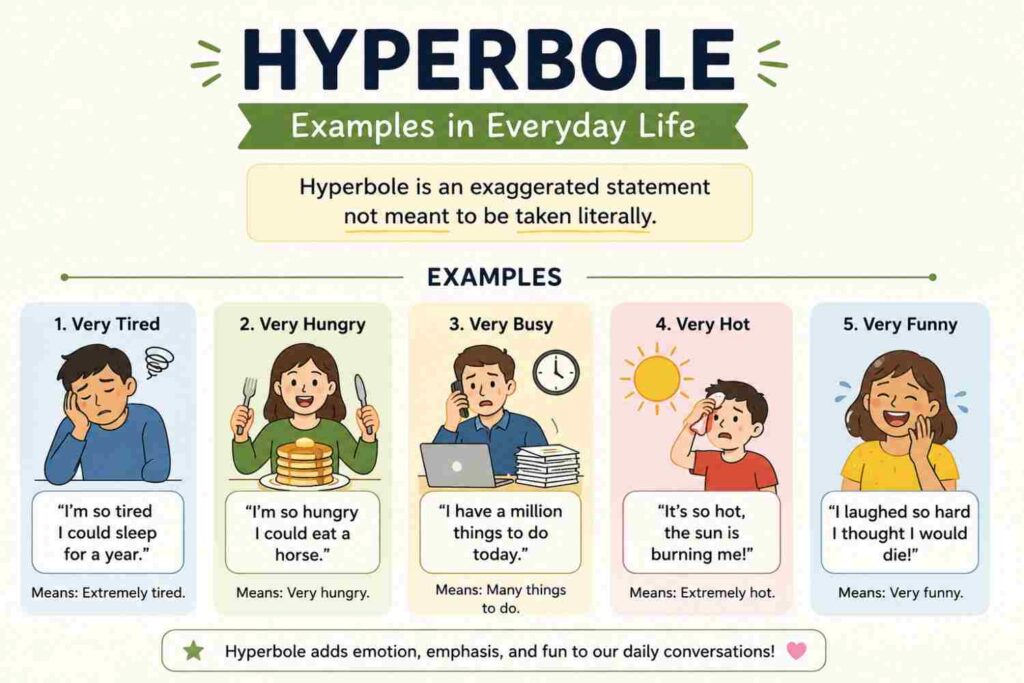
People use hyperbole more often than they realize. Many common expressions in English contain exaggeration, even when speakers do not think about their literary meaning.
Hyperbole in Daily Conversations
Everyday conversations are full of exaggerated statements. Friends and family members often use hyperbole to express feelings in a memorable way.
Examples include:
- I am so tired I could sleep for a week.
- This traffic is taking forever.
- I have called you a million times.
- My little brother talks nonstop.
- It is so hot that I am melting.
These statements are not literal descriptions. They help listeners understand the speaker’s emotions, such as exhaustion, impatience, frustration, or discomfort.
Hyperbole in School and Education
Students often use exaggeration when talking about schoolwork, exams, teachers, and deadlines. This makes their complaints sound humorous or dramatic.
Examples:
- This homework will take me a thousand years.
- I studied all night for the exam.
- The teacher gave us a mountain of assignments.
- I have a million chapters to revise.
- My brain is going to explode from studying.
These sentences communicate that a student feels overwhelmed or stressed. They are examples of figurative language rather than factual measurements.
Hyperbole in Relationships
Hyperbole can also express love, affection, sadness, or disappointment. People frequently use exaggerated language in romantic messages, Hyperbole Meaningfriendship conversations, and emotional discussions.
Examples:
- I love you more than anything in the universe.
- I have missed you a million times.
- You are the best person in the whole world.
- My heart broke into a thousand pieces.
- I could wait forever to see you again.
Such statements can sound romantic or emotional. Their purpose is usually to communicate strong feelings rather than describe a measurable fact.
4. Hyperbole on Social Media
Social media users regularly use hyperbole in captions, memes, comments, and messages. Exaggeration can make a reaction funnier, more dramatic, or easier to relate to.
Examples:
- This is the funniest video in human history.
- I have been waiting for this update for centuries.
- My phone is literally dead.
- I am obsessed with this song.
- That outfit costs a million dollars.
The intended meaning depends on context. For example, saying that a phone is dead often means its battery has run out, not that the device is physically dead.
Types of Hyperbole
Hyperbole can appear in several forms. The categories below are practical ways to understand how exaggeration works in communication. Hyperbole MeaningThey are not a single universally fixed classification.
Numerical Hyperbole
Numerical hyperbole uses exaggerated numbers to communicate a large amount, a long duration, or a strong reaction.
Examples:
- I have a million emails to answer.
- We waited for a thousand years.
- I have read that book a hundred times.
The numbers are not meant to be accurate. They emphasize quantity, repetition, or duration.
Emotional Hyperbole
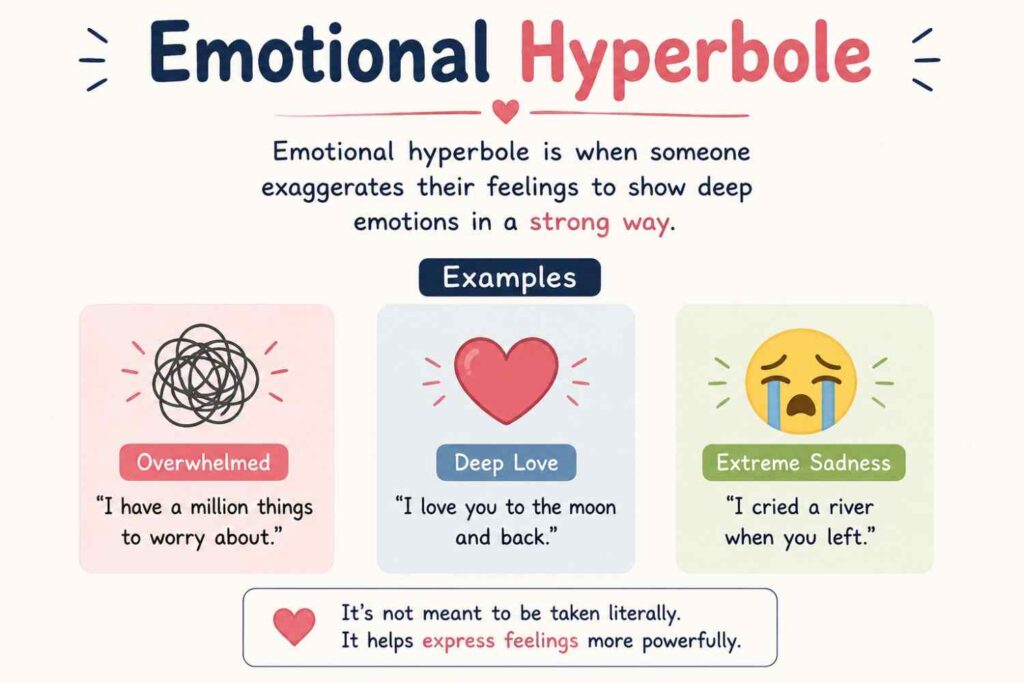
Emotional hyperbole exaggerates feelings to show how strongly someone reacts to a situation. It is common in conversations, romantic messages,Hyperbole Meaning stories, and poems.
Examples:
- My heart is bursting with happiness.
- I am so embarrassed I could disappear.
- I am heartbroken beyond words.
- I was scared to death.
These expressions make emotions easier to imagine. They do not necessarily describe physical events.
Physical Hyperbole
Physical hyperbole exaggerates size, strength, speed, weight, temperature, or bodily sensations.
Examples:
- His hands are as big as houses.
- This bag weighs a ton.
- She ran faster than a rocket.
- I am freezing to death.
The statements emphasize a physical experience rather than providing exact measurements.
Humorous Hyperbole
Humorous hyperbole uses extreme exaggeration to make people laugh. It often appears in jokes,Hyperbole Meaning comedy, casual conversation, and memes.
Examples:
- My alarm clock is the most hated object on Earth.
- My dog has enough energy to power a city.
- I ate so much that I needed a new stomach.
- My little sister can talk for ten centuries without stopping.
The exaggeration makes ordinary situations seem ridiculous, which creates humor.
Literary Hyperbole
Literary hyperbole appears in poetry, novels, plays, and other creative writing. Authors use it to make scenes dramatic, express characters’ feelings, or emphasize an important theme.
For example, a writer might describe a character as having a thousand worries in his mind. This expression communicates intense anxiety rather than an exact number of worries.
Literary hyperbole helps readers imagine experiences more vividly and understand the emotional significance of a scene.
Hyperbole Meaning in Literature
In literature, hyperbole is a rhetorical device that writers use to intensify descriptions and communicate powerful emotions. It can make a character seem desperate, a situation feel dangerous, or a moment appear extraordinary.
Writers often use exaggeration in poetry, fiction, drama, and speeches. For example, describing someone’s sadness as an ocean of tears creates a vivid mental picture. The reader understands that the character is deeply upset, even though the person has not produced an actual ocean of tears.
Hyperbole can also help develop a character’s personality. A dramatic character may regularly exaggerate, Hyperbole Meaningwhile a humorous narrator might use impossible comparisons to entertain readers.
Why Do Writers Use Hyperbole?

Writers use hyperbole for several reasons:
- Emphasis: To make an important idea stand out.
- Emotion: To express strong happiness, anger, sadness, or excitement.
- Humor: To make an ordinary situation funny.
- Imagery: To help readers visualize an exaggerated scene.
- Character development: To show how a person thinks, speaks, or reacts.
- Persuasion: To make a message sound more powerful, although excessive exaggeration may weaken credibility.
Hyperbole works best when readers can recognize the intended exaggeration. If a statement is interpreted as a factual claim, it may cause confusion.
Hyperbole Meaning in Poetry
Poets use hyperbole to express emotions and create striking images. Poetry often explores love, grief, hope, fear, nature, and human experiences. Exaggeration allows poets to communicate these feelings with greater intensity.
For example, a poet might write, I would cross a thousand oceans to find you. This does not necessarily mean the speaker intends to cross exactly one thousand oceans. It communicates devotion and a willingness to overcome great obstacles.
Another example is, The stars wept when you left. Stars do not literally cry, but the image creates a sense of sadness and loneliness.
Hyperbole can make poetry more memorable because it transforms ordinary emotions into dramatic pictures. It also helps establish tone, rhythm, and emphasis when used carefully.
Hyperbole in Figurative Language
Figurative language communicates ideas beyond the literal meanings of words. It includes techniques such as metaphor, simile, personification, irony, and hyperbole.
Hyperbole is different because its main purpose is deliberate exaggeration. It makes something seem more extreme than it actually is.
Consider the sentence,Hyperbole Meaning I have a mountain of laundry. The speaker is not claiming that the laundry forms a geological mountain. Instead, the exaggeration emphasizes how much laundry needs to be washed.
Figurative language helps people communicate ideas in creative ways. Hyperbole is especially useful when a literal statement feels too plain to express the speaker’s emotions or reaction.
Hyperbole vs. Metaphor vs. Simile
Hyperbole, metaphor, and simile can all make language more expressive, but they work in different ways.
| Figure of speech | Meaning | Example |
| Hyperbole | Deliberate exaggeration | I have a million things to do. |
| Metaphor | Describing one thing as another | Time is a thief. |
| Simile | Comparing things using like or as | He is as brave as a lion. |
A sentence may contain more than one figure of speech. For instance, My love is an ocean without an end can be interpreted as a metaphor, while its suggestion of endless love may also create a hyperbolic effect.
The key difference is the main purpose.Hyperbole Meaning Hyperbole emphasizes through exaggeration, metaphor makes an implied comparison, and simile makes an explicit comparison using words such as like or as.
Hyperbole vs. Exaggeration
Hyperbole and exaggeration are closely related, but they are not always interchangeable in context.
Exaggeration is a broad term for making something appear greater, smaller, more important, or more extreme than it really is. Hyperbole is a specific rhetorical or literary form of deliberate exaggeration used for emphasis or effect.
For example, The room was a little warmer than usual is a mild description, while The room was hot enough to melt the sun is an obvious hyperbole.
In everyday speech, Hyperbole Meaning the words are sometimes used in similar ways. However, in literary analysis, hyperbole specifically refers to exaggeration functioning as a figure of speech.
Common Hyperbole Examples and Their Meanings
The following examples can help English learners recognize hyperbole in different contexts.
| Example | Meaning |
| I am starving. | I am extremely hungry. |
| It took forever to finish. | It took a very long time. |
| She has a heart of gold. | She is very kind. |
| I laughed my head off. | I laughed very hard. |
| The whole world is against me. | I feel that many people oppose me. |
| He is older than the hills. | He is very old. |
| This suitcase weighs a ton. | The suitcase is very heavy. |
| I have told this story a thousand times. | I have told the story many times. |
| I could eat a horse. | I am extremely hungry. |
| Her voice can shatter glass. | Her voice is extremely loud or high-pitched. |
Some examples, such as a heart of gold, are also conventional metaphors or idioms. Figurative expressions can overlap, so context matters when identifying their primary function.
Hyperbole Meaning for Kids
Hyperbole is a way of saying something in an exaggerated manner to make it sound funny, exciting, or important. Children encounter hyperbole in cartoons,Hyperbole Meaning children’s books, classroom conversations, and everyday jokes.
For example, a child might say, My backpack is heavier than an elephant’s. The backpack is not actually heavier than an elephant. The child is explaining that carrying it feels difficult.
Here are some child-friendly examples:
- I am so hungry I could eat ten pizzas.
- My room is bigger than the whole school.
- I ran a million miles today.
- My dad snores louder than a thunderstorm.
- I have a mountain of toys to clean up.
Hyperbole helps children understand how language can express feelings and create funny pictures in the imagination. Teachers can ask children to identify which parts of a sentence are exaggerated and explain what the speaker really means.
Hyperbole Synonyms and Related Words
Hyperbole is associated with words that describe exaggeration, overstatement, or dramatic expression. However, these words may differ slightly in meaning and usage.
| Word | Meaning |
| Exaggeration | Making something seem more extreme than it is |
| Overstatement | Expressing something more strongly than the facts support |
| Embellishment | Adding details that make a story more interesting or impressive |
| Magnification | Making something appear larger or more important |
| Amplification | Increasing the strength or impact of a message |
| Overemphasis | Giving something more importance or attention than necessary |
Important distinction: Hyperbole is a figure of speech, while exaggeration is the broader concept. An overstatement can be intentional or misleading, depending on the context. Embellishment often involves adding details to a story, which is not necessarily the same as hyperbole.
Hyperbole Word Origin and Etymology
The word hyperbole comes from the Greek word hyperbolē, associated with the idea of excess or going beyond a limit. It entered English through Latin and French forms.
The Greek elements are commonly explained as hyper, meaning over or beyond, and ballein, meaning to throw. Together, they convey the idea of going beyond what is normal or expected.
The term has long been used in rhetoric and literature to describe deliberate overstatement. Today, hyperbole remains a common part of everyday English, advertising, comedy, poetry, and online communication.
Understanding its origin can help learners remember the basic concept: hyperbole pushes a description beyond literal reality to create a stronger effect.
How to Identify Hyperbole in a Sentence
Recognizing hyperbole becomes easier when readers ask whether a statement is intended literally or figuratively.
Follow these steps:
- Look for extreme words or quantities. Expressions such as a million times, forever, or the loudest sound ever may signal exaggeration.
- Check whether the statement is realistic. A person cannot literally wait forever or eat an entire mountain.
- Consider the context. A dramatic expression in a casual conversation is likely figurative.
- Identify the intended emotion. The exaggeration may communicate frustration, excitement, love, fear, or humor.
- Rewrite the statement literally. I have a million tasks can become I have many tasks.
Not every strong statement is hyperbole. Sometimes a large number or an extreme description is factually accurate. The intended meaning and surrounding context help determine whether exaggeration is being used.
When Should You Use Hyperbole?
Hyperbole can make communication more expressive when used appropriately. It works well in informal conversations, creative writing, poetry, comedy, captions, and personal messages.
For example, a social media caption such as Best day of my life! can express excitement without being a literal comparison of every day the person has experienced.
However, hyperbole may be unsuitable in situations where accuracy is important. Medical advice, scientific reports, legal documents,Hyperbole Meaning and formal business communication generally require precise language rather than dramatic exaggeration.
Writers should also consider their audience. A humorous exaggeration that works among friends may sound unprofessional in a formal email. Effective communication depends on choosing language that suits the situation.
Frequently Asked Questions :
What is the simple meaning of hyperbole?
Hyperbole means using deliberate exaggeration to emphasize an idea or express a strong feeling. For example, I have a mountain of work means that a person has a lot of work to complete.
What is an example of hyperbole?
I am so hungry I could eat a horse is a common example. The speaker is not planning to eat a horse but is expressing extreme hunger through exaggeration.
What is the difference between hyperbole and a metaphor?
Hyperbole exaggerates something to create emphasis, while a metaphor describes one thing as another to create a comparison. For example, I waited a million years is hyperbole, whereas Time is a thief is a metaphor.
What is hyperbole called in Urdu and Hindi?
In Urdu, hyperbole is called مبالغه آرائی (mubalagha aarai). In Hindi, it is called अतिशयोक्ति (atishyokti). Both refer to expressing something in an exaggerated way.
Why do writers use hyperbole?
Writers use hyperbole to emphasize ideas, Hyperbole Meaning express strong emotions, create humor, and make descriptions more memorable. It can also help readers understand a character’s feelings or the importance of a particular situation.
Conclusion
Hyperbole is an important figure of speech that makes language more expressive through deliberate exaggeration. It appears in everyday conversations, social media posts, poetry, stories, advertisements, and other forms of communication.
Understanding the hyperbole meaning helps English learners recognize when a statement is not meant literally. Expressions such as I have a million things to do or I waited forever to communicate strong feelings without providing exact measurements.
By learning common examples, synonyms, literary uses, and differences between hyperbole, metaphors, and similes, Hyperbole Meaning readers can improve their English comprehension and writing skills. The key is to recognize the intended message behind the exaggerated words.

