

Have you ever imagined what might happen if a situation were different from reality? For example, what would happen if everyone could fly, or if a student studied for five hours every day? These are examples of hypothetical situations. Understanding the hypothetical meaning helps people discuss possibilities, imagine different outcomes, and explore situations that may or may not happen.
The word hypothetical is commonly used in everyday conversations, education, science, business, law, and social discussions. Teachers use hypothetical questions to test understanding, while businesses use hypothetical scenarios to prepare for possible challenges. In the UK, USA, India, China, and other countries, the word is useful whenever someone wants to discuss an imagined situation rather than an established fact.
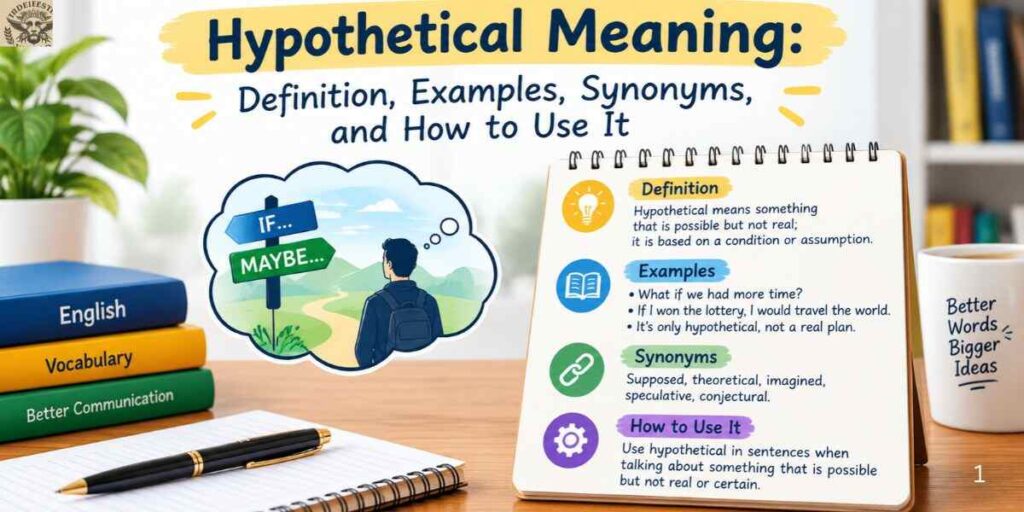
In simple English, hypothetical means something that is imagined, supposed, or considered as a possibility rather than something known to be true. Learning the hypothetical meaning, its synonyms, antonyms, and sentence examples can help improve English vocabulary and communication skills.
What Is the Hypothetical Meaning?
The hypothetical meaning refers to a situation, idea, question, or statement that is based on an assumption or possibility. It describes something people imagine or consider for discussion, even when it has not happened or may never happen. A hypothetical situation can be realistic, unlikely, or completely imaginary.
For example, consider the question, “What would happen if the internet stopped working for a whole week?” The internet has not necessarily stopped working, but the question asks people to imagine the possible consequences. This makes it a hypothetical question. Such questions help people think critically and explore different outcomes without claiming that the situation is real.
In Urdu, hypothetical can be translated as فرضی، خیالی، یا مفروضے پر مبنی. In simple words, it means thinking about a situation by assuming that something is true for the purpose of discussion. For example, “Agar kal school band ho jaye to tum kya karo ge?” is a hypothetical question because it asks someone to imagine a possible situation.
Hypothetical Meaning in Simple English
The simplest explanation of the hypothetical is “imagined or assumed for the sake of discussion.” It does not automatically mean that something is impossible or false. Instead, the word indicates that an idea is being considered as a possibility or assumption rather than presented as a confirmed fact.
For instance, a teacher might ask, “What would you do if you found a wallet full of money?” The student may never face that exact situation, but the question encourages them to think about honesty and responsibility. This is a hypothetical example because it explores what someone might do under an imagined set of circumstances.
The word is useful because it allows people to discuss ideas without needing those situations to happen first. Students can practise problem-solving, managers can prepare for business risks, and families can talk about future plans. Understanding the hypothetical meaning makes these conversations easier to follow and explain.
Hypothetical Meaning in Urdu
The Urdu meaning of hypothetical is فرضی، خیالی، مفروضاتی، یا قیاس پر مبنی. The best translation depends on the sentence and the context in which the word appears. It usually describes a situation that someone assumes or imagines for discussion.
For example, “This is a hypothetical situation” means “یہ ایک فرضی صورتِ حال ہے۔” Similarly, “Let us consider a hypothetical example” means “آئیے ایک فرضی مثال پر غور کرتے ہیں۔” These translations show how the word can be used in education, everyday conversation, and formal writing.
Here are some simple examples:
- Hypothetical question: فرضی سوال
- Hypothetical situation: فرضی صورتِ حال
- Hypothetical example: فرضی مثال
- Hypothetical possibility: ایک مفروضاتی امکان
- Hypothetical case: ایک فرضی معاملہ
For Urdu-speaking learners, remembering the word “فرضی” is a useful starting point. However, hypothetical can sometimes mean more than a simple fantasy. It can also describe a realistic possibility that people are considering without knowing whether it will actually happen.
Hypothetical Meaning in Everyday Life
People use hypothetical situations more often than they may realise. Questions such as “What if we missed the bus?” or “What would happen if it rained tomorrow?” ask someone to imagine possible outcomes. These questions can help people prepare for events, make decisions, and understand how different choices might affect their lives.
For example, a family planning a holiday might ask, “What if our flight is delayed?” The family can then discuss alternative transport, hotel arrangements, or changes to the travel schedule. The delay may never happen, but considering it in advance can make the trip easier to manage.
The hypothetical meaning is also useful when discussing personal choices. Someone might ask, “If you could learn any new skill, what would you choose?” This question does not require a real event or an immediate decision. It simply encourages the other person to imagine an option and explain their preference.
Read More:400+ Attractive Quotes About Beauty, Confidence, Love & Inner Beauty
Hypothetical Examples in Sentences

Understanding the hypothetical meaning becomes easier when the word is used in complete sentences. These examples show how hypothetical can describe imagined situations, possible outcomes, and questions used for discussion.
- The teacher gave us a hypothetical problem to solve.
- Imagine a hypothetical situation in which nobody had access to electricity.
- The manager discussed a hypothetical business failure during the meeting.
- Her answer was based on a hypothetical example, not a real event.
- The lawyer asked a hypothetical question to explain a legal principle.
- We considered a hypothetical case before making our final decision.
- The scientist studied a hypothetical explanation that required further testing.
- During the interview, I was asked to respond to a hypothetical challenge.
- The story presents a hypothetical future in which robots do most jobs.
- Our discussion focused on a hypothetical situation involving limited resources.
Each sentence describes an assumption, an imagined situation, or an idea considered for a particular purpose. Some examples involve realistic events, Hypothetical Meaning while others describe less likely possibilities. In both cases, the word hypothetical shows that the situation is being considered rather than necessarily reported as a real event.
Hypothetical Questions and Their Meaning
A hypothetical question asks someone to imagine a situation and explain what they might do, think, or expect. These questions often begin with phrases such as “What if,” “Suppose,” or “Imagine that.” They are common in classrooms, interviews, debates, and casual conversations because they encourage people to explain their reasoning.
For example, “What would you do if you became the manager of your company?” asks a person to imagine having a different role. The question helps reveal their priorities, leadership style, and decision-making skills. It does not suggest that the person has already become a manager.
Here are more hypothetical questions:
- What would you do if you won a million pounds?
- What if every student received free education?
- Suppose you could live in any country. Which would you choose?
- What would happen if people stopped using plastic?
- Imagine that you could change one rule at school. What would it be?
These questions can have many reasonable answers because they explore possibilities instead of requesting one established fact. Their purpose is to encourage thought, discussion, creativity, or preparation for possible situations.
Real-Life Examples of Hypothetical Situations
A hypothetical situation does not have to be unrealistic. It can describe something that might genuinely happen but has not been confirmed. Thinking through these situations allows people to prepare for challenges before they arise.
Education: A teacher may ask students what they would do if they had only one day to prepare for an examination. Students can discuss revision plans, time management, and the importance of prioritising difficult topics.
Business: A company may consider what would happen if the cost of raw materials increased by 20%. Managers can estimate expenses, review prices,Hypothetical Meaning and identify ways to protect the business from financial pressure.
Travel: A traveller may imagine what would happen if their passport went missing abroad. The situation encourages preparation, such as keeping document copies and learning how to contact the relevant embassy.
Technology: A technology company might examine a hypothetical situation in which its website becomes unavailable during a major sale. The team can consider backup systems, customer communication, and ways to restore service quickly.
Environment: Students may discuss what could happen if a city replaced many petrol-powered vehicles with electric alternatives. They could explore air quality, charging infrastructure, electricity demand, and environmental trade-offs.
These examples show that hypothetical thinking can support practical decisions. The situation is assumed for analysis, but the lessons learned may help people deal with real events.
Hypothetical vs Real: What Is the Difference?
The main difference between a hypothetical situation and a real situation is whether the circumstances are being assumed for discussion or are established as actual events. A hypothetical example explores what might happen, while a real example describes something that has happened or exists.
| Feature | Hypothetical Situation | Real Situation |
| Meaning | Assumed or imagined | Actual or established |
| Purpose | Explore possibilities | Describe facts or events |
| Example | What if it snowed in summer? | It snowed yesterday |
| Evidence | May not have direct evidence of occurrence | Can be supported by observations or records |
| Common use | Planning, teaching, interviews | Reporting, explaining, documenting |
| Certainty | Often uncertain or conditional | Depends on the available evidence |
A hypothetical situation can later become real. For example, a company might first discuss the possibility of launching a new product. If it eventually launches the product, the event is no longer hypothetical. Until then, the discussion concerns a possible future outcome.
It is also important to remember that a hypothetical statement is not necessarily untrue. It simply presents a situation as an assumption or possibility. A realistic hypothetical scenario can be based on strong evidence even when the predicted event has not happened.
Hypothetical vs Hypothetically
Hypothetical and hypothetically are related words, but they serve different grammatical purposes. Hypothetical is an adjective, meaning it describes a noun. Hypothetically is an adverb, meaning it describes how an action, statement, or discussion is considered.
For example, in “This is a hypothetical question,” hypothetical describes the noun question. In “Hypothetically, what would happen if prices doubled?” hypothetically introduces an imagined situation or explains the way the question is being considered.
| Word | Part of Speech | Example |
| Hypothetical | Adjective | We discussed a hypothetical problem. |
| Hypothetically | Adverb | Hypothetically, the plan could succeed. |
| Hypothesis | Noun | The scientist tested a hypothesis. |
Although these words share a root, they are not interchangeable in every sentence. Using the correct form makes English writing clearer and more natural.
Hypothetical Meaning in Different Fields
The hypothetical meaning can vary slightly according to the subject being discussed. The central idea remains the same: an assumption or imagined situation is considered for a particular purpose.
Hypothetical Meaning in Education
In education, hypothetical questions help students apply knowledge to situations they may not have experienced. A science teacher might ask what would happen if plants received no sunlight. Students can use their understanding of photosynthesis to explain the possible result.
Teachers also use hypothetical examples in history, mathematics, literature, and social studies. These activities encourage students to consider alternatives, justify their answers, and explain cause-and-effect relationships. A hypothetical question may have one strongly supported answer or several reasonable responses, depending on the task.
Hypothetical Meaning in Business
In business, hypothetical scenarios help teams prepare for uncertainty. Managers might consider what would happen if sales declined, a supplier stopped delivering materials, or a competitor reduced its prices. The team can then identify risks and compare possible responses.
For example, a retailer in the UK or USA might examine a hypothetical 15% increase in shipping costs. The business could evaluate different suppliers, Hypothetical Meaningreview delivery options, or adjust its budget. The scenario is not a claim that shipping costs have increased; it is a way to prepare for a possible change.
Hypothetical Meaning in Law
In legal education and discussion, a hypothetical case describes assumed facts that help explain a legal rule or test an argument. A lecturer might ask what legal questions could arise if a person signed an agreement without understanding one of its important terms.
The example allows students to analyse legal principles without claiming that the imagined case actually occurred. However, an answer to a hypothetical legal question does not automatically determine the outcome of a real dispute. Actual cases depend on the applicable law, evidence, and specific circumstances.
Hypothetical Meaning in Science
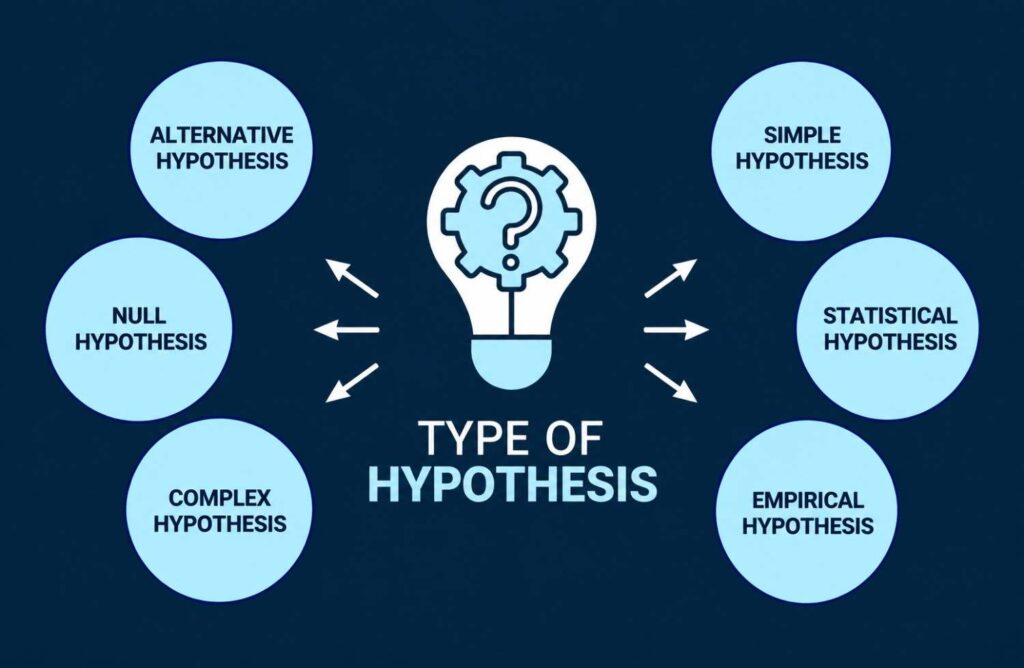
Scientists may use hypothetical explanations or models to explore how a process could work. A hypothesis is a proposed explanation that can often be tested through observation or experiments. A hypothetical scenario, by contrast, may be used to examine a possible outcome without necessarily proposing a formal scientific hypothesis.
For example, a researcher might ask what could happen to a local ecosystem if a particular species disappeared. The researcher can use scientific knowledge to predict possible effects, then compare those predictions with evidence where suitable. A hypothetical prediction remains distinct from a result that has been experimentally or observationally established.
Hypothetical Meaning in Interviews

Employers sometimes use hypothetical questions to understand how candidates might respond to workplace challenges. A question such as “What would you do if two colleagues disagreed about an important task?” encourages the candidate to explain their approach to communication and conflict resolution.
These questions are common in recruitment because they provide insight into a candidate’s reasoning. However, an imagined answer does not prove exactly how someone will behave in real life. Interviewers may also consider work experience,Hypothetical Meaning practical skills, and examples from previous situations.
Synonyms of Hypothetical
Synonyms are words that have similar meanings. Learning synonyms of hypotheticals can help improve vocabulary and prevent repetition in writing. However, not every synonym fits every context, so the intended meaning should always guide word choice.
| Synonym | Meaning | Example |
| Imaginary | Existing in the imagination | The child described an imaginary world. |
| Supposed | Assumed to be true | Let us consider a supposed problem. |
| Theoretical | Based on ideas or principles | The discussion remained theoretical. |
| Assumed | Accepted temporarily for discussion | We worked with an assumed figure. |
| Speculative | Based on uncertain possibilities | The report included speculative predictions. |
| Possible | Able to happen or exist | We discussed a possible outcome. |
| Conjectural | Based on an uncertain idea | The explanation remained conjectural. |
| Presumed | Believed or accepted without complete proof | The argument relied on a presumed fact. |
The words imaginary and hypothetical are often similar, but imaginary can suggest something created entirely in the mind. Theoretical usually relates to ideas or principles, while speculative places greater emphasis on uncertainty. Choosing the most suitable synonym makes the intended meaning more precise.
Antonyms of Hypothetical
Antonyms are words with opposite or contrasting meanings. Depending on the context, actual, real, factual, and established may contrast with hypothetical.
| Antonym | Meaning | Example |
| Actual | Existing in reality | The actual cost was lower than expected. |
| Real | Not imaginary | They discussed a real problem. |
| Factual | Based on facts | The article contains factual information. |
| Concrete | Specific and clearly defined | The manager presented a concrete plan. |
| Established | Accepted or demonstrated as true | The report relied on established findings. |
These words are not perfect opposites in every situation. For example, theoretical and factual can sometimes describe different aspects of the same subject. Still, understanding these contrasts helps readers distinguish imagined scenarios from established information.
Common Mistakes When Using Hypothetical
One common mistake is treating hypothetical as another word for impossible. A hypothetical situation may be quite realistic; it is simply being considered as an assumption rather than reported as an established event.
Another mistake is confusing hypotheticals with hypotheses. A hypothesis is a proposed explanation or prediction, especially in scientific work,Hypothetical Meaning while hypothetical is an adjective used to describe an assumed or imagined situation. For example, “a hypothetical problem” is grammatically correct, while “a hypothesis problem” usually does not express the intended meaning.
Writers should also avoid presenting a hypothetical prediction as a proven fact. If a company estimates that its sales might fall, the estimate does not establish that sales have actually fallen. Clear wording helps readers understand the difference between assumptions, predictions, and verified results.
How to Use Hypothetical in Daily English
The word hypothetical is useful in conversations, academic writing, professional discussions, and interviews. It can introduce an imagined situation, describe an example, or explain that a statement depends on an assumption. Using the word correctly can make explanations more precise.
In everyday conversation, a speaker might say, “That is only a hypothetical question.” This tells the listener that the question is intended for discussion rather than as a claim about an event. In a classroom, a teacher might say, “Consider a hypothetical situation in which the temperature drops suddenly.” The students can then explore what might happen.
In formal writing, hypotheticals often appear in phrases such as hypothetical scenario, hypothetical case, hypothetical example, and hypothetical situation. These expressions are useful when explaining ideas, evaluating risks, or comparing possible outcomes. The best approach is to use the word when it adds clarity, rather than including it simply to make a sentence sound more formal.
Why Understanding Hypothetical Is Important
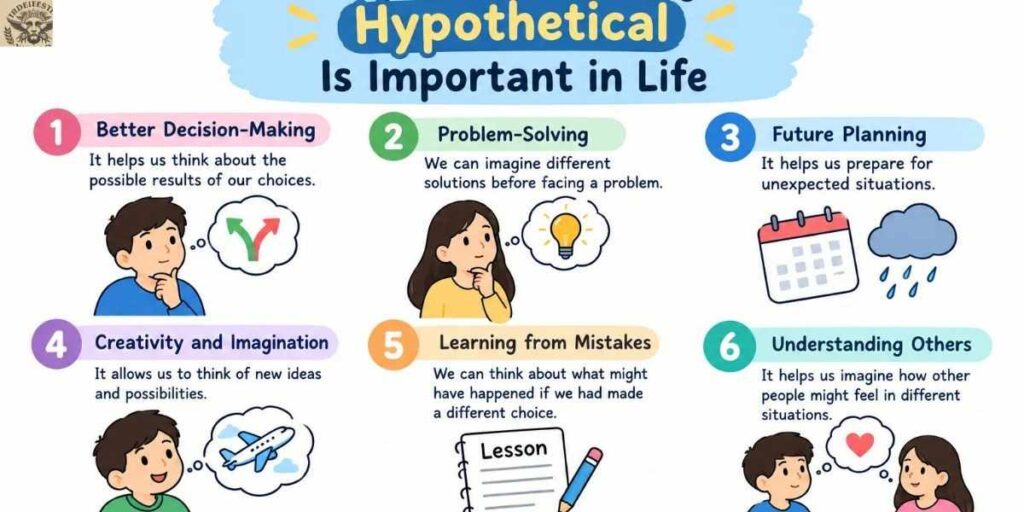
Understanding the hypothetical meaning helps people think beyond immediate facts and consider alternative possibilities. It can improve problem-solving by encouraging people to ask what might happen under different circumstances. Instead of waiting for a problem to occur, they can explore possible responses in advance.
Hypothetical thinking is also useful for communication. During a discussion, an imagined example can help explain an unfamiliar idea or make an abstract concept easier to understand. Students can use hypothetical questions to practise reasoning, while professionals can use scenarios to evaluate decisions and prepare for risks.
However, hypothetical reasoning has limitations. An imagined situation does not guarantee a particular outcome, and assumptions may not match real conditions. Good reasoning involves identifying assumptions, considering different possibilities, and checking conclusions against evidence when possible.
Frequently Asked Questions
What is the simple meaning of a hypothetical?
Hypothetical means imagined, assumed, or considered as a possibility rather than established as a fact. For example, asking what would happen if everyone worked four days a week is a hypothetical question.
What is the Urdu meaning of hypothetical?
The Urdu meaning of hypothetical is فرضی، خیالی، or مفروضے پر مبنی. It describes an assumed situation or idea used for discussion, explanation, or consideration.
What is an example of a hypothetical sentence?
“If I had a million pounds, I would buy a house” is an example of a hypothetical sentence. It describes an imagined situation rather than confirming that the speaker has that amount of money.
What is the difference between a hypothetical and hypothetical question?
Hypothetical is an adjective that describes an assumed or imagined situation. A hypothetical question is a question that asks someone to consider such a situation, such as “What would you do if you moved to another country?”
What are the synonyms of hypothetical?
Common synonyms include imaginary, supposed, theoretical, assumed, speculative, and conjectural. The best choice depends on the sentence and the exact meaning being expressed.
Conclusion
The hypothetical meaning is based on the idea of imagining or assuming a situation for discussion. It helps people explore possibilities, understand difficult concepts, prepare for challenges, and consider different outcomes without claiming that an imagined event has already happened.
The word is useful in everyday conversations as well as education, science, business, law, and interviews. Remember that hypothetical does not always mean impossible or unrealistic. It simply indicates that a situation is being considered as an assumption or possibility. By learning its definition, Urdu translation, synonyms, antonyms, and sentence examples, English learners can use the word more confidently and accurately.

