


The word hearsay refers to information that a person hears from someone else rather than learning directly through personal experience or observation. It is commonly used when people discuss rumours, second-hand information, news, and legal cases. Understanding the hearsay meaning helps readers recognise the difference between facts they have verified and information they have simply heard from another person.
For example, if a friend says that a company is closing because someone told them so, the statement is hearsay unless the information has been independently confirmed. The friend may be telling the truth, but they are repeating information received from another source. This is why hearsay should not automatically be treated as a proven fact.
The word is especially important in law, journalism, and everyday conversations. In legal settings, hearsay has a specific meaning and may be subject to rules about whether a statement can be used as evidence. In ordinary English, it often refers to unverified or second-hand information. Learning its definition, Urdu and Hindi translations, synonyms, and sentence examples makes the word easier to understand and use correctly.
What Is the Hearsay Meaning?
The hearsay meaning is information that someone receives from another person rather than knowing directly. It usually involves repeating something heard from a source without personally witnessing the event or independently confirming the details. The information may be true, false, or partly accurate.
For example, imagine that a student tells a classmate that a teacher is leaving the school because another student mentioned it. The classmate has not confirmed the news and has no direct knowledge of the situation. Until reliable information becomes available, the statement is hearsay.
Hearsay is not always a lie or an intentional rumour. Sometimes people repeat information because they believe it is correct. However, the source may have misunderstood the facts, left out important details, or received inaccurate information from someone else. Therefore, it is sensible to check important claims before accepting or sharing them.
Hearsay Meaning in Simple English
In simple English, hearsay means something heard from another person that has not been personally confirmed. It is second-hand information rather than direct knowledge. People often use the word when they are unsure whether a statement is accurate.
For example, someone might say, “I heard that the shop is moving to another location, but that is only hearsay.” This sentence makes it clear that the speaker has not verified the information. The shop may be moving, but the statement alone does not prove it.
The easiest way to remember the hearsay meaning is to think of information passed from one person to another. When the person repeating it has not checked the facts, it is sensible to treat the statement carefully. This is particularly important when the information could affect someone’s reputation, job, money, or personal relationships.
Hearsay Meaning in Urdu
The Urdu meaning of hearsay can be expressed as سنی سنائی بات (Suni sunai baat) or غیر مصدقہ سنی ہوئی خبر (Ghair musaddaqa suni hui khabar). These expressions describe information received from another person that has not been independently confirmed.
In simple Roman Urdu, hearsay means aisi baat jo kisi doosre se suni ho aur jis ki tasdeeq khud na ki ho. In other words, it is information repeated from another source without checking whether it is true.
Example:
- English: The news about his resignation is only hearsay.
- Urdu: اس کے استعفے کی خبر صرف سنی سنائی بات ہے۔
- Roman Urdu: Us ke isteefe ki khabar sirf suni sunai baat hai.
The phrase suni sunai baat is particularly useful in everyday Urdu conversations. It communicates that information has been heard from someone else but has not yet been confirmed.
Hearsay Meaning in Hindi
The Hindi meaning of hearsay is commonly expressed as सुनी-सुनाई बात (Suni-sunai baat) or अपुष्ट जानकारी (Apusht jaankari). These expressions refer to information that has been heard from others but has not been verified.
In simple Hindi, hearsay means aisi baat jo kisi doosre se suni gayi ho, lekin jiski sachchai ki pushti na hui ho. It describes second-hand information that may or may not be accurate.
Example:
- English: The story about the actor is only hearsay.
- Hindi: अभिनेता के बारे में यह कहानी केवल सुनी-सुनाई बात है।
- Roman Hindi: Abhineta ke baare mein yeh kahani keval suni-sunai baat hai.
These translations help Hindi speakers understand the word in everyday situations. However, in legal contexts, the meaning of hearsay can be more specific than its ordinary translation.
Hearsay Meaning in English, Urdu, and Hindi: Quick Comparison
The following table compares the English word with common Urdu and Hindi expressions.
| English | Urdu | Roman Urdu | Hindi | Roman Hindi |
| Hearsay | سنی سنائی بات | Suni sunai baat | सुनी-सुनाई बात | Suni-sunai baat |
| Second-hand information | دوسرے سے ملی ہوئی معلومات | Doosre se mili hui maloomat | दूसरे से मिली जानकारी | Doosre se mili jaankari |
| Unverified information | غیر مصدقہ معلومات | Ghair musaddaqa maloomat | अपुष्ट जानकारी | Apusht jaankari |
| Rumour | افواہ | Afwah | अफ़वाह | Afwah |
| Hearsay evidence | سنی سنائی بات پر مبنی شہادت | Suni sunai baat par mabni shahadat | सुनी-सुनाई बात पर आधारित साक्ष्य | Suni-sunai baat par aadharit saakshya |
| According to hearsay | سنی سنائی بات کے مطابق | Suni sunai baat ke mutabiq | सुनी-सुनाई बात के अनुसार | Suni-sunai baat ke anusaar |
These expressions are related, but they do not always mean exactly the same thing. For example, a rumour is often unverified information that circulates among people, while hearsay can simply refer to information received from another source. In law, hearsay evidence has a more specialised meaning.
How to Pronounce Hearsay

The word hearsay is pronounced HEER-say. It has two syllables, and the stress falls on the first syllable. The first part sounds like “hear,”Hearsay Meaning while the second sounds like “say.”
Correct pronunciation helps English learners use the word confidently in conversation, reading, and formal discussions. It is particularly useful when discussing news reports, workplace communication, or legal matters where the distinction between confirmed information and second-hand statements is important.
Here is a quick pronunciation guide:
- Word: Hearsay
- Pronunciation: HEER-say
- Part of speech: Noun
- Common phrase: Hearsay evidence
For practice, read the sentence aloud: “The claim was based on hearsay.” Pay attention to the two syllables and the stress on “HEER.”
Hearsay as a Part of Speech
Hearsay is primarily a noun. A noun names a person, place, thing, or idea, and hearsay names a type of information received indirectly. Unlike many ordinary nouns, it is generally used as an uncountable noun when referring to second-hand information as a concept.
For example, people commonly say, Hearsay Meaning “That is hearsay,” rather than “That is a hearsay.” The expression identifies the information as something heard from another source. In legal writing, the phrase hearsay evidence is also common.
The word usually appears in phrases such as based on hearsay, mere hearsay, and hearsay evidence. Learning these combinations helps writers use the term naturally without making grammatical mistakes.
Read More:World Space Week 2026: Dates, Theme, History, Activities, and Rocket Revolution
Common Expressions with Hearsay
| Expression | Meaning | Example |
| Mere hearsay | Information that has not been established as fact | The accusation was mere hearsay. |
| Based on hearsay | Founded on information received from others | The report was based on hearsay. |
| Hearsay evidence | A statement offered as evidence that may fall under legal hearsay rules | The lawyer challenged the hearsay evidence. |
| According to hearsay | According to information passed along by others | According to hearsay, the business may close. |
| Nothing but hearsay | Information without reliable confirmation | The claim was nothing but hearsay. |
These expressions are common in both spoken and written English. Their exact implications depend on the context, especially when the word appears in a legal discussion.
Examples of Hearsay in Sentences
Sentence examples make the hearsay meaning easier to understand because they show how the word is used in real situations. In everyday conversation, it often appears when a speaker wants to make clear that information has not been confirmed.
Here are several examples:
- The story about the new manager is only hearsay.
- I do not want to spread hearsay about someone else’s personal life.
- The report was based on hearsay rather than verified facts.
- She refused to believe the accusation because it was hearsay.
- The journalist checked the information instead of relying on hearsay.
- We should not make decisions based on hearsay.
- His claim about the company was nothing more than hearsay.
- The lawyer argued that the statement was hearsay.
- The rumour spread quickly, although it began as hearsay.
- The teacher asked students to separate facts from hearsay.
- I heard that the event was cancelled, but it may just be hearsay.
- The manager wanted reliable information instead of hearsay.
- Their disagreement started because someone repeated hearsay.
- The witness explained that the information was based on what another person had said.
- Before sharing the news, she checked whether it was more than hearsay.
These examples show that hearsay is often used to express uncertainty about a claim. It can also describe information that someone considers unreliable because the original source has not been checked.
Hearsay Sentences with Urdu Translation
For Urdu-speaking learners, English sentences with Urdu translations can make the word easier to remember. The translations below use familiar expressions such as suni sunai baat and ghair musaddaqa maloomat.
| English sentence | Urdu translation |
| The story is only hearsay. | یہ کہانی صرف سنی سنائی بات ہے۔ |
| We should not believe hearsay without checking the facts. | ہمیں حقائق کی جانچ کیے بغیر سنی سنائی بات پر یقین نہیں کرنا چاہیے۔ |
| His claim was based on hearsay. | اس کا دعویٰ سنی سنائی بات پر مبنی تھا۔ |
| The manager rejected the hearsay. | مینیجر نے غیر مصدقہ بات کو مسترد کر دیا۔ |
| Do not spread hearsay about other people. | دوسرے لوگوں کے بارے میں سنی سنائی باتیں نہ پھیلائیں۔ |
| The journalist checked the information. | صحافی نے معلومات کی تصدیق کی۔ |
| The accusation was nothing but hearsay. | یہ الزام محض سنی سنائی بات تھا۔ |
| The lawyer questioned the hearsay evidence. | وکیل نے سنی سنائی بات پر مبنی شہادت پر سوال اٹھایا۔ |
The Urdu translation can vary according to the sentence. In casual conversation, suni sunai baat is usually natural. In a formal report, ghair musaddaqa maloomat may be more suitable when the emphasis is on unverified information.
Hearsay Sentences with Hindi Translation
Hindi learners can understand the word by comparing it with expressions such as suni-sunai baat and apusht jaankari. The following examples show how hearsay can be used in common sentences.
| English sentence | Hindi translation |
| The story is only hearsay. | यह कहानी केवल सुनी-सुनाई बात है। |
| We should not believe hearsay without checking the facts. | हमें तथ्यों की जाँच किए बिना सुनी-सुनाई बात पर विश्वास नहीं करना चाहिए। |
| His claim was based on hearsay. | उसका दावा सुनी-सुनाई बात पर आधारित था। |
| The manager rejected the hearsay. | मैनेजर ने अपुष्ट जानकारी को खारिज कर दिया। |
| Do not spread hearsay about other people. | दूसरे लोगों के बारे में सुनी-सुनाई बातें मत फैलाओ। |
| The journalist checked the information. | पत्रकार ने जानकारी की जाँच की। |
| The accusation was nothing but hearsay. | यह आरोप केवल सुनी-सुनाई बात थी। |
| The lawyer questioned the hearsay evidence. | वकील ने सुनी-सुनाई बात पर आधारित साक्ष्य पर सवाल उठाया। |
These translations are intended to explain the meaning clearly rather than provide a strict word-for-word translation. The most natural wording can change depending on the speaker, region, and situation.
Hearsay Meaning in Everyday Life

Hearsay is common in daily life because people regularly exchange information with friends, family members, colleagues, and neighbours. Sometimes this information is accurate, but in other cases it may be incomplete or incorrect. The word becomes useful when someone wants to explain that a statement has not been confirmed.
For example, a person may hear that a local shop is closing,Hearsay Meaning a colleague is changing jobs, or a school is changing its timetable. If the information comes from another person and has not been checked, it can be described as hearsay.
The important point is that hearsay is not automatically false. It simply means the information has come through another source rather than direct knowledge. Checking a reliable source before repeating an important claim can prevent misunderstandings and unnecessary conflict.
Hearsay Among Friends
Friends often share information about social events, relationships, work, and other people’s plans. A friend may repeat something they heard without knowing whether the original statement was correct. This is a common setting in which the word hearsay can be used.
For example, someone might say, “I heard that Ali is moving abroad, but it may just be hearsay.” The speaker is not claiming to know the facts personally. They are making clear that the information came from someone else.
Being careful with hearsay can protect friendships and reputations. Before repeating personal information, it is better to consider whether the source is reliable and whether sharing the information is appropriate.
Hearsay in the Workplace
Hearsay can also appear in offices and other professional environments. Employees may hear that a company plans to reorganise, a manager is leaving, or a project is being cancelled. Until the organisation confirms the information, it may be unverified.
For example, an employee might tell a colleague, “The announcement about job cuts is hearsay until management confirms it.” This sentence shows that the employee does not want an unconfirmed statement to be mistaken for official information.
Workplaces can reduce confusion by communicating important changes clearly. Employees should rely on official announcements, written policies, and authorised sources when making decisions that affect their jobs.
Hearsay on Social Media
Social media allows information to travel quickly, sometimes before anyone checks whether it is correct. A post may be copied, shared, or discussed by thousands of people even when the original source is unclear. Such information may be described as hearsay in everyday conversation.
For example, a social media user might claim that a public figure has resigned because an anonymous account posted the story. If no reliable source has confirmed the claim, readers should avoid treating it as established fact.
Checking the original source, publication date, and statements from reliable organisations can help people assess online information. Hearsay can spread widely, but repeated sharing does not automatically make a claim true.
Hearsay Meaning in Law
In law, hearsay has a more specific meaning than it does in ordinary conversation. Broadly speaking, it concerns an out-of-court statement offered in legal proceedings to prove the truth of what the statement asserts. Whether a particular statement qualifies as hearsay and whether it can be admitted as evidence depend on the applicable legal system and the circumstances.
For example, a witness might tell a court, “My neighbour told me that the defendant was at the scene.” If the statement is offered to prove that the defendant was actually there, it may raise a hearsay issue. The court would need to consider the relevant evidence rules and any applicable exceptions.
It is important not to assume that every second-hand statement is automatically inadmissible in court. Different jurisdictions have different rules,Hearsay Meaning exceptions, and procedures. The legal meaning of hearsay should therefore be understood within the relevant country’s law.
What Is Hearsay Evidence?

Hearsay evidence generally involves an out-of-court statement that is offered to prove the truth of what it says. The statement may have been made in conversation, a message, a letter, or another form of communication. The important question is how the statement is being used in the legal proceeding.
For example, a person may testify that someone else said a particular event occurred. If the statement is offered to establish that the event really happened, it may be treated as hearsay under the applicable rules. If it is offered for a different purpose, the analysis may be different.
Courts often examine the purpose of the statement, the circumstances in which it was made, and whether a rule or exception applies. This is why the legal meaning cannot be reduced simply to “a statement that someone heard from another person.”
Hearsay in Court: A Simple Example
Imagine a court case in which a witness says, “My friend told me that the shop was closed at eight o’clock.” The witness did not personally see whether the shop was closed at that time. If the statement is offered to prove that the shop was closed, it may raise a hearsay question.
The court may need to consider whether the statement falls within the relevant legal definition and whether it can be admitted under an applicable exception. The answer depends on the jurisdiction and the purpose for which the statement is offered.
This example shows why direct knowledge and second-hand statements can be treated differently in legal proceedings. However, the word hearsay does not automatically mean that the information is false or that a court must reject it.
Difference Between Hearsay, Rumour, and Gossip
Hearsay, rumour, and gossip are related terms, but they are not identical. Hearsay focuses on information received indirectly from another source. A rumour is a claim that circulates among people without reliable confirmation, while gossip often involves informal conversation about other people’s personal lives.
For example, a person may repeat a statement they heard from a colleague. That is hearsay in ordinary usage. If the claim spreads around an office without confirmation, it may also become a rumour. If people discuss someone’s private relationships for entertainment, the conversation may be described as gossip.
Understanding these differences helps English learners select the right word. The terms can overlap, but each places emphasis on a different aspect of the information or conversation.
| Word | Meaning | Example |
| Hearsay | Information received from another source rather than direct knowledge | His statement was based on hearsay. |
| Rumour | An unconfirmed claim that circulates among people | A rumour spread that the business would close. |
| Gossip | Informal talk, often about other people’s private lives | The colleagues spent lunch discussing gossip. |
| Fact | Information that can be established as true | The official notice confirmed the date. |
| Evidence | Information used to support or challenge a claim | The documents provided evidence of the transaction. |
A claim can begin as hearsay, spread as a rumour, and later turn out to be either true or false. The source and quality of the information matter more than how often the claim is repeated.
Difference Between Hearsay and Evidence
Hearsay and evidence are not complete opposites. Evidence is a broad term for information that can support or challenge a claim. Hearsay refers to a particular type of second-hand statement, especially when discussed under legal evidence rules.
In everyday conversation, Hearsay Meaning someone may say that a claim is “only hearsay” to indicate that it has not been verified. However, a statement being second-hand does not automatically mean it has no value. It may provide a lead for further investigation or be relevant for a purpose other than proving the statement’s truth.
In legal settings, whether hearsay can be used as evidence depends on the applicable rules. Some second-hand statements may be excluded, while others may be admissible under particular exceptions. It is therefore important to distinguish ordinary English usage from legal terminology.
Synonyms of Hearsay
Synonyms are words or expressions with similar meanings. Learning them can improve vocabulary and make writing more varied. However, hearsay has a specific emphasis on information received from another source, so not every related word is a perfect replacement.
Common synonyms and related expressions include second-hand information, unverified information, rumour, and word of mouth. Each has a slightly different meaning. For example, word of mouth describes how information spreads between people, while unverified information emphasises that the facts have not been confirmed.
Common Synonyms and Related Expressions
| Word or phrase | Meaning | Example |
| Second-hand information | Information received through another person | The details were second-hand information. |
| Unverified information | Information that has not been confirmed | The website removed the unverified information. |
| Rumour | An unconfirmed claim that spreads among people | The rumour caused unnecessary concern. |
| Word of mouth | Information shared through personal communication | The restaurant became popular through word of mouth. |
| Gossip | Informal talk, often about personal matters | She avoided spreading gossip about colleagues. |
| Reported information | Information communicated by another source | The journalist checked the reported information. |
These alternatives are useful in different contexts. For example, a formal report may use “unverified information,” while a casual conversation may use “suni sunai baat” or “rumour.”
Antonyms and Opposite Ideas of Hearsay
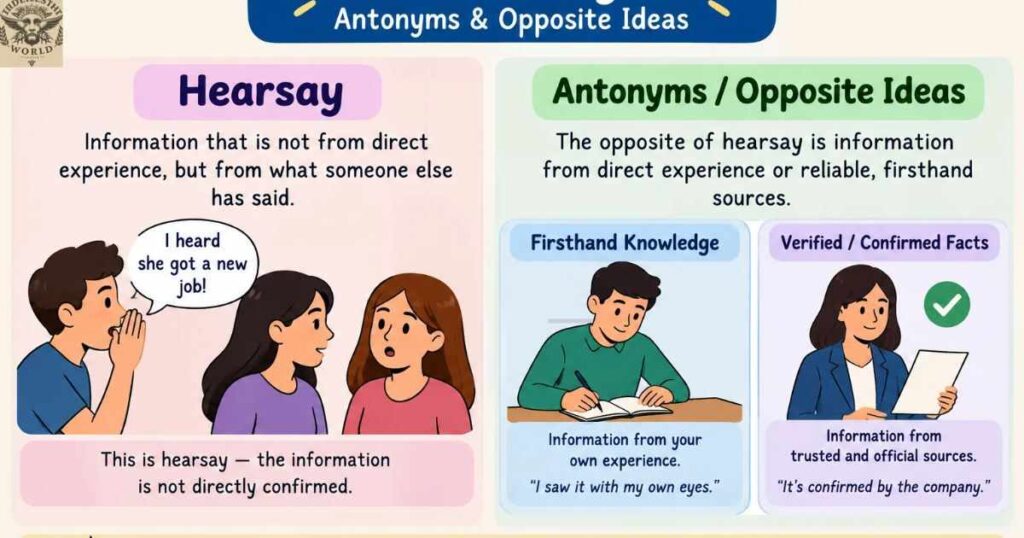
Hearsay does not have one perfect antonym in every context. However, words and phrases that describe direct knowledge, verified facts, or firsthand information can express a contrasting idea.
For example, firsthand information comes directly from a person’s own observation or experience. Verified information has been checked against reliable sources. Confirmed facts are statements supported by sufficient evidence in the relevant context.
Common contrasting expressions include:
- Firsthand information: Information gained through direct experience or observation.
- Verified information: Information that has been checked for accuracy.
- Confirmed fact: A claim established through reliable confirmation.
- Direct evidence: Evidence that directly supports a particular point, depending on the context.
- Personal observation: Something a person has seen or noticed directly.
These expressions are not exact opposites of hearsay in every legal or linguistic context. Still, they help explain the difference between repeating a statement and having direct or independently verified information.
How to Use Hearsay in a Sentence
The word hearsay is often used when someone wants to express doubt about the source or reliability of a statement. It can appear in casual conversation, professional communication, news discussions, and legal writing.
Common sentence patterns include “That is hearsay,” “The claim is based on hearsay,”Hearsay Meaning and “We should not rely on hearsay.” These expressions are useful when the speaker wants to distinguish second-hand information from confirmed facts.
For example, a manager might say, “Please check the official announcement rather than relying on hearsay.” The sentence encourages employees to verify information before making decisions. Similarly,Hearsay Meaning a journalist may explain that a claim remains unconfirmed until a reliable source supports it.
Common Mistakes When Using Hearsay
One common mistake is assuming that hearsay always means a lie. In fact, hearsay may be accurate, inaccurate, or incomplete. The word describes how information was received, not whether it is necessarily false.
Another mistake is using hearsay as though it always means gossip. Gossip often concerns personal matters, while hearsay can involve any kind of second-hand information. It may relate to business decisions,Hearsay Meaning public announcements, events, or legal statements.
A third mistake is assuming that every hearsay statement is automatically rejected in court. Legal rules vary, and some statements may fall within recognised exceptions. In formal writing, it is best to explain the context rather than make broad claims about admissibility.
Why Is Understanding Hearsay Important?
Understanding hearsay is important because people encounter second-hand information every day. News, social media posts, workplace conversations, and personal discussions often contain claims that have not been independently checked. Recognising hearsay encourages people to pause before accepting or repeating such information.
The word is also useful for protecting people’s reputations. Repeating an unconfirmed allegation can create unnecessary conflict or harm someone’s personal and professional life. Checking the source before sharing a claim is a responsible way to communicate.
In addition, the word appears in legal and academic discussions. Knowing that hearsay has a specialised legal meaning helps readers understand court reports and legal explanations more accurately. The general meaning is straightforward, but the details matter when the term is used in formal proceedings.
Frequently Asked Questions
What is the simple meaning of hearsay?
Hearsay means information that someone has heard from another person rather than learned directly or verified independently. It may be true or false, so important claims should be checked before being accepted as facts.
What is the Urdu meaning of hearsay?
The Urdu meaning of hearsay is سنی سنائی بات (Suni sunai baat). It can also mean unverified information received from another person.
What is the Hindi meaning of hearsay?
The Hindi meaning of hearsay is सुनी-सुनाई बात (Suni-sunai baat) or अपुष्ट जानकारी (Apusht jaankari). Both expressions describe information that has not been confirmed.
What is an example of hearsay in a sentence?
“The news about the company’s closure is only hearsay.” This means the speaker has heard the information from another source but has not confirmed whether it is true.
What does hearsay mean in law?
In law, hearsay broadly refers to an out-of-court statement offered to prove the truth of what it asserts.
Conclusion
The hearsay meaning refers to information that a person receives from someone else rather than learning directly or verifying independently. In Urdu,Hearsay Meaning it is commonly translated as suni sunai baat, while the Hindi translation is also suni-sunai baat. These expressions make the meaning easy to understand for Urdu- and Hindi-speaking learners.
Hearsay is common in everyday conversations, workplaces, social media, Hearsay Meaning journalism, and legal discussions. It is not automatically false, Hearsay Meaning but it should not be treated as a confirmed fact simply because someone has repeated it. Checking reliable sources helps prevent misunderstandings and protects people from the harm that unverified claims can cause.
Learning the word’s definition, pronunciation, synonyms,Hearsay Meaning translations, and sentence examples can strengthen English vocabulary. The key lesson is simple: understand where information came from, verify important claims, and use the word hearsay when describing second-hand information accurately.

