

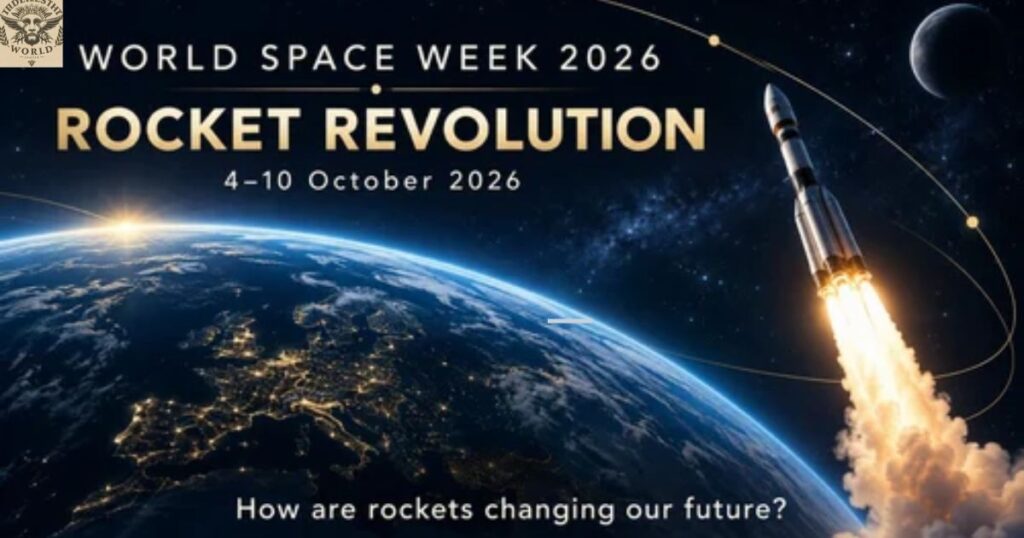
Space has always inspired people to look beyond Earth and imagine what may be possible in the future. From the first satellite to modern reusable rockets, space technology has changed how people communicate, travel, study weather, and understand the universe. World Space Week 2026 gives students, teachers, scientists, families, and space enthusiasts a chance to learn about these achievements.
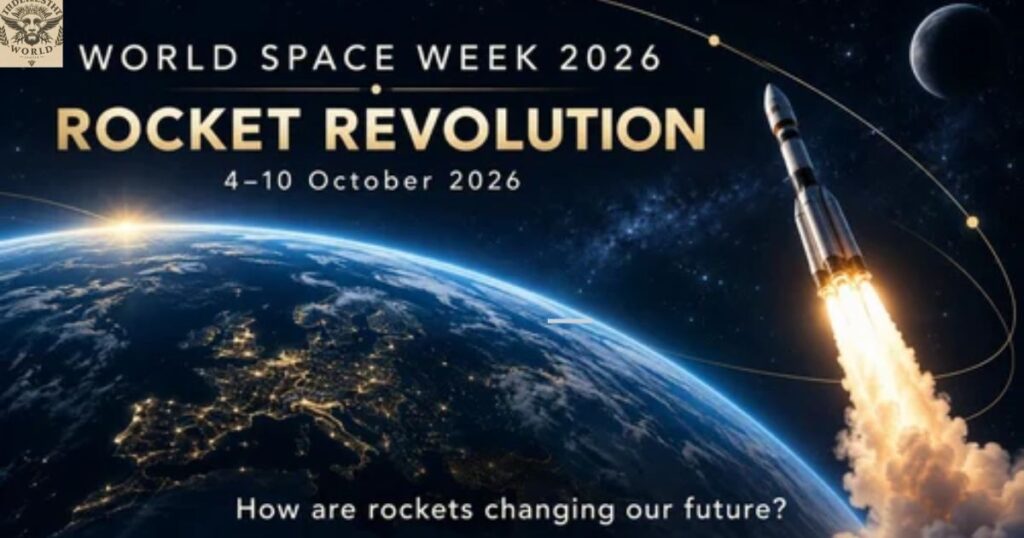
In 2026, World Space Week will be celebrated from October 4 to October 10. The official theme is “Rocket Revolution.” The theme focuses on the fast development of launch technology, reusable rockets, commercial spaceflight, new launch vehicles, and wider access to space.
The celebration is not limited to space agencies. Schools, universities, museums, astronomy clubs, companies, science groups, and communities can organize activities. World Space Week 2026 is therefore both an international celebration and an educational opportunity for people who want to understand how humanity is entering a new era of space exploration.
What Is World Space Week 2026?
World Space Week 2026 is the annual international celebration of space science, technology, exploration, and their benefits for humanity. It takes place every year between October 4 and October 10. The United Nations recognizes these dates because they connect two important milestones in the history of space exploration.
October 4 marks the launch of Sputnik 1 in 1957, the first human-made satellite to orbit Earth. October 10 marks the date in 1967 when the Outer Space Treaty entered into force. Together, these milestones represent the beginning of the Space Age and the development of international principles for peaceful activities in outer space.
World Space Week also helps make space science easier to understand. A child may learn about rockets through a classroom project, while an adult may attend a public lecture or astronomy event. This broad participation makes the week useful for both education and public awareness.
When Is World Space Week 2026?
World Space Week 2026 will take place from Sunday, October 4, through Saturday, October 10, 2026. The dates are observed worldwide rather than being limited to one particular country or location. The United Nations calendar lists the 2026 observance for October 4–10.
| Detail | World Space Week 2026 |
| Dates | October 4–10, 2026 |
| Duration | 7 days |
| Theme | Rocket Revolution |
| Main subject | Space science, technology, exploration, and launch innovation |
| Global organizer | World Space Week Association |
| UN connection | United Nations General Assembly |
| Pakistan coordinator | SUPARCO |
| Pakistan organizer | SEAD |
The week gives organizers enough time to hold different events instead of putting every activity on one day. Schools can arrange competitions, lectures, quizzes, rocket projects, exhibitions, and astronomy sessions throughout the week.
What Is the World Space Week 2026 Theme?
The World Space Week 2026 theme is “Rocket Revolution.” It highlights the major changes taking place in the way rockets are designed, launched, reused, and operated. For decades, reaching orbit required extremely expensive launch systems that were mainly operated by governments. Today, commercial launch providers, startups, universities, reusable rocket programs, and emerging national space agencies are creating more opportunities.
The Rocket Revolution is not only about making rockets faster or larger. It is also about reusability, affordability, launch frequency, new vehicles, and wider access to space. These developments can influence satellite services, scientific research, lunar missions, Earth observation, and future human exploration.
Why Is the Rocket Revolution Important?
A rocket is the basic transportation system that carries spacecraft beyond Earth. If launching a spacecraft becomes more affordable and reliable, more organizations can participate in space activities.Reusable launch systems are especially important because some rocket components can be recovered and prepared for another mission.
This can reduce waste and potentially lower the cost of launching payloads.The theme also shows how the space industry is becoming more diverse. Governments remain important, but private companies, universities, research groups, and startups are playing a larger role in the space economy.
World Space Week Timed Research: Why October 4–10 Matters
People searching for World Space Week timed research often want to know why these exact dates were selected. The answer goes back to two important events.On October 4, 1957, the Soviet Union launched Sputnik 1. It became the first human-made satellite to orbit Earth and marked a major moment in the Space Age.
On October 10, 1967, the Outer Space Treaty entered into force, creating important principles for the peaceful exploration and use of outer space. The United Nations General Assembly proclaimed World Space Week in 1999. Since then, October 4–10 has become a global period for space education, awareness, scientific activities, and public engagement.
Read More: Get Through Meaning: Definition, Uses, Examples & Synonyms
History of World Space Week
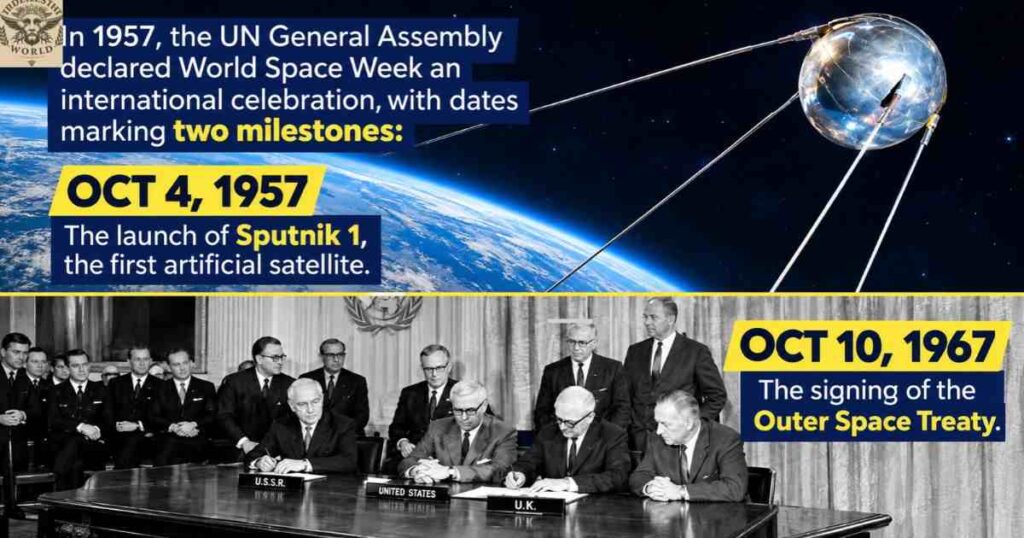
The history of World Space Week is closely connected with the development of modern space exploration. The launch of Sputnik 1 showed that a human-made object could successfully orbit Earth.A decade later, the Outer Space Treaty established basic principles for activities in outer space. The treaty helped create a framework for peaceful exploration and cooperation.
In 1999, the United Nations General Assembly officially proclaimed World Space Week. Since then, schools, universities, space organizations, museums, science centers, and communities around the world have participated in the annual event.
Sputnik 1 and the Beginning of the Space Age
Sputnik 1 was a small satellite, but its importance was enormous. Its launch demonstrated that a spacecraft could be placed into orbit around Earth.
The event encouraged further developments in satellite technology, communications, space science, and human spaceflight. It also started a period of rapid technological progress that eventually led to missions involving humans, robotic spacecraft, planetary exploration, and modern satellite networks.
The Outer Space Treaty
The Outer Space Treaty entered into force on October 10, 1967. It established principles concerning the exploration and use of outer space, including the Moon and other celestial bodies.
Its connection to World Space Week gives the celebration an additional purpose. Space exploration is not only about technology. It also involves international cooperation, responsible use of space, scientific research, and rules that help guide activities beyond Earth.
Why Do We Celebrate World Space Week?
The main purpose of World Space Week 2026 is to increase public awareness of space science and technology. It encourages people to understand how space activities affect daily life and future development.
Satellites support communication, navigation, weather forecasting, environmental monitoring, agriculture, disaster management, and many other services. Space research also contributes to scientific knowledge and technological innovation.
The celebration is especially valuable for young people. A student who joins a rocket challenge or astronomy activity may become interested in physics, engineering, computer science, mathematics, astronomy, or another STEM field.
Main Goals of World Space Week
| Goal | Why It Matters |
| Space education | Makes complex space topics easier to understand |
| STEM awareness | Encourages science, technology, engineering, and mathematics |
| Public awareness | Shows how space technology affects everyday life |
| International cooperation | Connects people and organizations across countries |
| Innovation | Encourages new ideas in space science and engineering |
| Career inspiration | Introduces students to space-related careers |
| Scientific curiosity | Encourages people to ask questions about the universe |
World Space Week 2026 Activities
There is no single way to celebrate World Space Week 2026. Activities can be simple or highly technical, depending on the age group and available resources.Schools can organize classroom projects, quizzes, drawing competitions, model rocket activities, presentations, exhibitions, and science demonstrations. Universities can host seminars and expert talks.
Astronomy clubs can arrange night-sky observation sessions.The global World Space Week program includes many different types of events, while Pakistan’s 2026 program includes contests, webinars, social-media activities, and educational resources.
Popular World Space Week Activities
- Rocket model building
- Space science quizzes
- Astronomy observation
- Poster design
- Space photography
- Rocket design challenges
- Science exhibitions
- Space-themed presentations
- Educational webinars
- Comic-book competitions
- STEM experiments
- Space documentaries and movie sessions
These activities allow people with different interests to participate. Someone interested in art can design a poster, while another student interested in engineering can build a model rocket.
World Space Week 2026 Poster
A World Space Week 2026 poster can be used to promote school events, competitions, exhibitions, and public activities. Since the 2026 theme is Rocket Revolution, a good poster can include rockets, launch systems, planets, satellites, stars, or a futuristic space background.
For official Pakistan activities, SEAD provides an editable poster resource for participating schools. The Best Space School Contest guidelines also require event media to display relevant SEAD, SUPARCO, World Space Week branding, and the Rocket Revolution theme.
A simple educational poster can include:
- World Space Week 2026
- October 4–10
- Rocket Revolution
- School or organization name
- Event date and time
- Main activities
- Registration details
- Space-themed graphics
World Space Week 2026 Logo
The World Space Week 2026 logo is useful for identifying official events and promotional material. Schools and organizations should follow the branding requirements provided by the relevant World Space Week coordinator when creating official event material.For general educational posters, organizers can combine the World Space Week identity with suitable space graphics.
However, official contests may have specific rules about logos and background designs.In Pakistan, the official 2026 school contest guidelines state that photos and media content should display a background containing SEAD, SUPARCO, and World Space Week branding along with the Rocket Revolution theme.
World Space Week 2026 ISRO Connection
Searches for World Space Week 2026 ISRO reflect the growing interest in India’s space program and its contribution to space science and exploration.India is one of the countries that has become an important participant in the modern space sector. The United Nations notes that the 21st-century space landscape has expanded beyond the traditional space race, with countries including India, China, Japan, and members of the European Union becoming important space actors.
ISRO’s work provides useful examples for students studying satellites, launch vehicles, planetary science, lunar exploration, Earth observation, and space technology.For Indian students, World Space Week can therefore be an opportunity to learn how national space programs contribute to science, communication, navigation, weather monitoring, and exploration.
World Space Week 2026 Pakistan
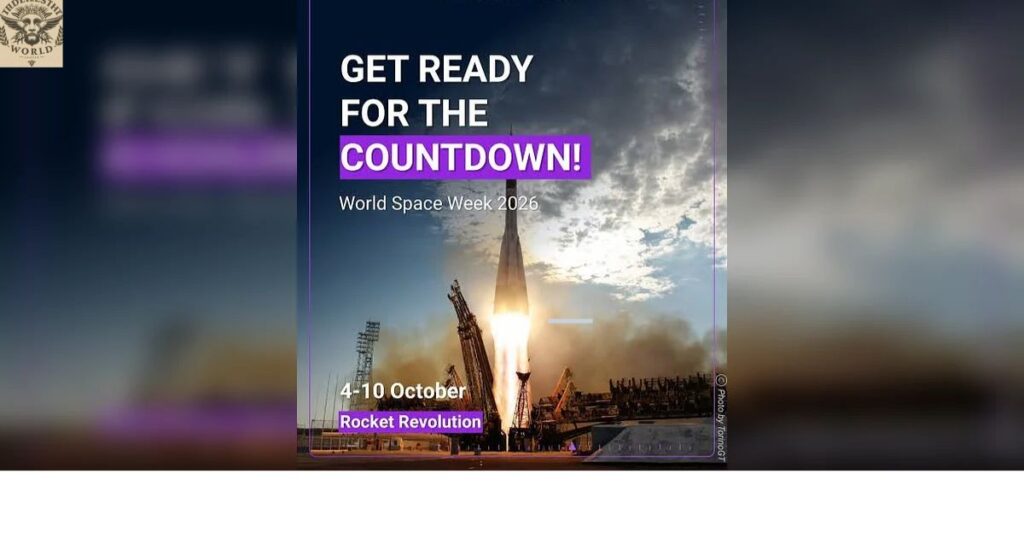
World Space Week 2026 Pakistan is being organized as a nationwide celebration of space science, technology, and exploration. Pakistan’s program is hosted by SUPARCO and organized by the Space Education and Awareness Drive (SEAD).The Pakistan program focuses strongly on students, schools, educators, space enthusiasts, and the general public.
It connects the Rocket Revolution theme with education and innovation.Pakistan’s space-related activities also demonstrate how space technology can support practical areas such as communication, navigation, Earth observation, environmental monitoring, disaster management, agriculture, and sustainable development.
World Space Week 2026 Pakistan Contests
The 2026 Pakistan program includes three main participation tracks:
| Contest | Who Can Participate? | Main Idea |
| Best Space School Contest | Educational institutions | Conduct space-related activities |
| Space Ambassador Contest | Individuals | Promote space science and Rocket Revolution |
| Public Contests | General public | Create space-themed entries |
The public contests include Comic Book, Design Your Rocket, and Astrophotography. Best Space School Contest
The Best Space School Contest invites educational institutions across Pakistan to organize World Space Week activities between October 4 and October 10. Schools must conduct at least two activities related to the Rocket Revolution theme to participate.
Schools can choose physical, online, or hybrid formats. After the activities, participating institutions have to submit their event reports according to the official requirements.
This creates a useful opportunity for schools to turn a normal science week into a practical space-learning experience.
World Space Week 2026 Location
One common search is World Space Week 2026 location. Unlike a single conference held in one city, World Space Week is a global observance.Events can take place in schools, universities, museums, science centers, observatories, community spaces, and online. The World Space Week Association maintains a global event network, while individual countries and organizations coordinate their own activities.
In Pakistan, activities are organized across the country through the national coordination framework involving SUPARCO and SEAD. This means participants do not need to travel to one international location to take part.
World Space Week 2026 and Rocket Technology
Rocket technology is the heart of the 2026 theme. Rockets provide the thrust needed to overcome Earth’s gravity and carry spacecraft into space.
Modern launch systems are becoming more advanced. Engineers are working on reusable boosters, improved engines, new materials, autonomous flight systems, and more efficient launch operations.
The result is a changing space industry. More frequent launches can support satellite constellations, Earth observation, scientific missions, communications, and future lunar exploration.
Reusable Rockets
Reusable rockets are one of the most important ideas connected with the Rocket Revolution. Instead of treating every major rocket component as disposable, engineers can design systems that return some hardware for inspection, refurbishment, and future flights.
Reusability can potentially reduce launch costs and increase launch frequency. It can also encourage new companies and research organizations to consider missions that were previously too expensive.
How Commercial Spaceflight Is Changing Space Exploration
Commercial spaceflight has become an important part of the modern space economy. Private companies are developing launch vehicles, spacecraft, satellite systems, communications networks, and other technologies.This does not mean government space agencies are becoming unimportant. Instead, governments and private organizations can work together in different ways.
Commercial launch providers can offer transportation services, while government agencies can focus on scientific missions, exploration, research, regulation, and long-term programs.This cooperation is one reason the Rocket Revolution theme is relevant to the future of space exploration.
World Space Week 2026 and STEM Education
STEM education is a major part of the educational value of World Space Week 2026. Space projects naturally combine science, mathematics, engineering, technology, and creativity.
A rocket model can introduce students to forces and motion. A satellite project can explain communication and orbital mechanics. An astronomy activity can teach students about planets, stars, light, and observation.Teachers can also use space topics to make difficult subjects more interesting.
Simple Classroom Ideas
| Activity | Skills Students Can Learn |
| Build a paper rocket | Design and creativity |
| Rocket launch simulation | Physics |
| Planet scale model | Mathematics |
| Satellite communication project | Technology |
| Astronomy observation | Scientific observation |
| Space quiz | General science |
| Rocket poster | Communication and art |
| Space presentation | Research and public speaking |
World Space Week 2026 for Students
Students are among the biggest beneficiaries of World Space Week 2026. The week creates opportunities to learn outside normal textbooks.A student does not need expensive equipment to participate. A simple paper rocket, astronomy poster, space quiz, or presentation can become a useful learning project.
Older students can explore more advanced subjects such as orbital mechanics, satellite engineering, propulsion, Earth observation, robotics, or planetary exploration.The important point is curiosity. Space science begins with simple questions such as: How does a rocket leave Earth? Why do satellites stay in orbit? How does GPS work? How do scientists study planets millions of kilometers away?
World Space Week 2026 for Teachers
Teachers can use the celebration to connect classroom lessons with real-world technology. Physics teachers can discuss propulsion and motion. Geography teachers can explain satellite imagery. Computer science teachers can introduce satellite data and automation.
A teacher can also organize a small Rocket Revolution project where students research how launch vehicles have changed over time.For schools participating in Pakistan’s Best Space School Contest, official guidance encourages multiple activities and innovative ideas related to the theme.
World Space Week 2026 Pokémon Connection
Another interesting search topic is World Space Week 2026 Pokémon.For 2026, the European Space Agency and The Pokémon Company International are collaborating on space-themed activities, including a Europe-wide exhibition and a Pokémon GO event. The partnership is designed to connect a familiar entertainment brand with interest in space and science.
This type of collaboration can help introduce younger audiences to space topics. Combining popular culture with science education can make astronomy and space exploration feel more accessible.It also shows that space communication does not have to be limited to traditional lectures or technical presentations.
How to Celebrate World Space Week 2026 at Home
Families can celebrate World Space Week 2026 without expensive equipment. A clear evening can become an opportunity to observe the Moon or learn about visible planets and constellations.
Children can create a cardboard rocket, draw a space poster, build a solar system model, or watch an educational space documentary.Parents can also encourage children to research a space mission and explain what they learned. This turns entertainment into an active learning experience.
Easy Home Activities
- Observe the Moon.
- Identify bright objects in the night sky.
- Build a paper rocket.
- Create a solar system model.
- Draw a Rocket Revolution poster.
- Read about Sputnik 1.
- Research a famous astronaut.
- Learn how satellites help Earth.
- Watch an educational astronomy program.
- Create a space quiz for family members.
How Schools Can Celebrate World Space Week 2026
Schools can create a full seven-day program around the theme. Each day can have a different activity.
For example, Monday can focus on rocket history, Tuesday on reusable launch systems, Wednesday on satellites, Thursday on astronomy, Friday on space careers, and the weekend can include a quiz or exhibition.
Schools can also invite science teachers, engineers, astronomers, or university students to speak about space careers.A good event does not need to be expensive. Creativity, student participation, and clear learning goals are often more important than expensive equipment.
World Space Week 2026 Events Around the World
World Space Week is a worldwide celebration involving many kinds of organizations. The official World Space Week Association reports events across more than 100 countries and tens of thousands of activities.
Events can include:
- Public lectures
- Science exhibitions
- School competitions
- Astronomy nights
- Rocket demonstrations
- Museum programs
- Industry events
- Online webinars
- STEM workshops
- Educational campaigns
For 2026, Space.com reports activities ranging from classroom projects and astronomy events to exhibitions and hands-on STEM programs.
Space Exploration and Everyday Life
Many people think space exploration is only about astronauts and rockets. In reality, space technology affects ordinary life on Earth.Satellites help provide navigation services, communications, weather information, environmental monitoring, disaster response, and agricultural information.
For example, satellite images can help monitor crops and floods. Weather satellites can provide information used for forecasting. Navigation satellites support location services used by vehicles and mobile devices.
This is why World Space Week is also about understanding the practical value of space technology.
The Role of Satellites in Modern Society
Satellites orbiting Earth perform many important jobs. Communication satellites can support television, internet connections, and other services. Earth-observation satellites collect information about land, oceans, clouds, vegetation, and environmental changes.Navigation satellites help determine location and timing. Scientific satellites allow researchers to study Earth, the Sun, distant stars, and other objects.
The growth of the space industry means that these services are becoming increasingly connected with economic development and daily life.
Space Exploration in the UK, USA, India, China, and Other Countries
The space sector is now international. The United States has major government and commercial space programs. The United Kingdom supports space science, satellite technology, and commercial space businesses.India has developed strong capabilities through ISRO, while China operates major launch, satellite, lunar, and space-station programs. European countries cooperate through the European Space Agency.
Countries such as Japan and many emerging space nations are also contributing to space science and technology. The United Nations describes the modern space environment as increasingly broad, with many national and international actors involved.Pakistan also participates through SUPARCO and educational outreach programs. World Space Week provides a way for students and communities in these countries to learn from one another.
Why Rocket Technology Matters for the Future
The future of space exploration depends heavily on transportation. If spacecraft cannot reach orbit efficiently, many ambitious missions become difficult or expensive.
Rocket innovation can therefore support:
- Lunar missions
- Mars missions
- Satellite deployment
- Space telescopes
- Scientific research
- Commercial space stations
- Earth observation
- Deep-space exploration
The Rocket Revolution theme encourages people to think about the next stage rather than only celebrating past achievements.
Future of World Space Week
The future of World Space Week will likely remain connected to new developments in space science and technology. As launch systems become more capable, public interest in space may continue to grow.Educational organizations can use the celebration to introduce students to new areas such as robotics, artificial intelligence, satellite data, planetary science, space medicine, and sustainable space operations.
The most important role of the celebration is to connect technological progress with people. A rocket is an engineering achievement, but its long-term value also depends on the scientists, engineers, teachers, students, and communities who use and understand the technology.
World Space Week 2026: Key Facts at a Glance
| Question | Answer |
| What is World Space Week? | A global celebration of space science, technology, and exploration |
| When is it held? | October 4–10 |
| When is World Space Week 2026? | October 4–10, 2026 |
| What is the 2026 theme? | Rocket Revolution |
| Why October 4? | Sputnik 1 launched on October 4, 1957 |
| Why October 10? | The Outer Space Treaty entered into force on October 10, 1967 |
| Who proclaimed it? | United Nations General Assembly in 1999 |
| What can people do? | Join educational, astronomy, STEM, rocket, and public activities |
| Who can participate? | Students, teachers, families, organizations, and space enthusiasts |
| Pakistan coordinator | SUPARCO |
| Pakistan organizer | SEAD |
Frequently Asked Questions:
When is World Space Week 2026?
World Space Week 2026 will be observed from October 4 to October 10, 2026. The same October 4–10 period is used for the annual international celebration.
What is the theme of World Space Week 2026?
The theme is “Rocket Revolution.” It focuses on changing launch technologies, reusable rockets, commercial spaceflight, new launch vehicles, affordability, and wider access to space.
Why is World Space Week celebrated?
It is celebrated to increase awareness of space science and technology, encourage education and STEM interest, and highlight the importance of space exploration and its benefits for humanity.
How can students participate in World Space Week 2026?
Students can join quizzes, rocket-building projects, poster competitions, astronomy activities, science exhibitions, presentations, astrophotography, and other educational events.
What happened on October 4 and October 10 in space history?
October 4, 1957, was the launch date of Sputnik 1, the first human-made satellite to orbit Earth. October 10, 1967, was the date the Outer Space Treaty entered into force.
Conclusion
World Space Week 2026 is more than a celebration of rockets and astronauts. It is an opportunity to understand how space science has developed and how new technologies may shape the future.The 2026 theme, “Rocket Revolution,” puts the spotlight on reusable rockets, commercial spaceflight, new launch vehicles, affordability, and broader access to space.
These developments could support new scientific missions, satellite services, lunar exploration, and future human activity beyond Earth.The most valuable part of World Space Week 2026 is the curiosity it creates. Every new question about rockets, satellites, planets, or the universe can become the beginning of a future scientific idea. As humanity enters another stage of space exploration, education and public participation will remain just as important as the technology itself.

