

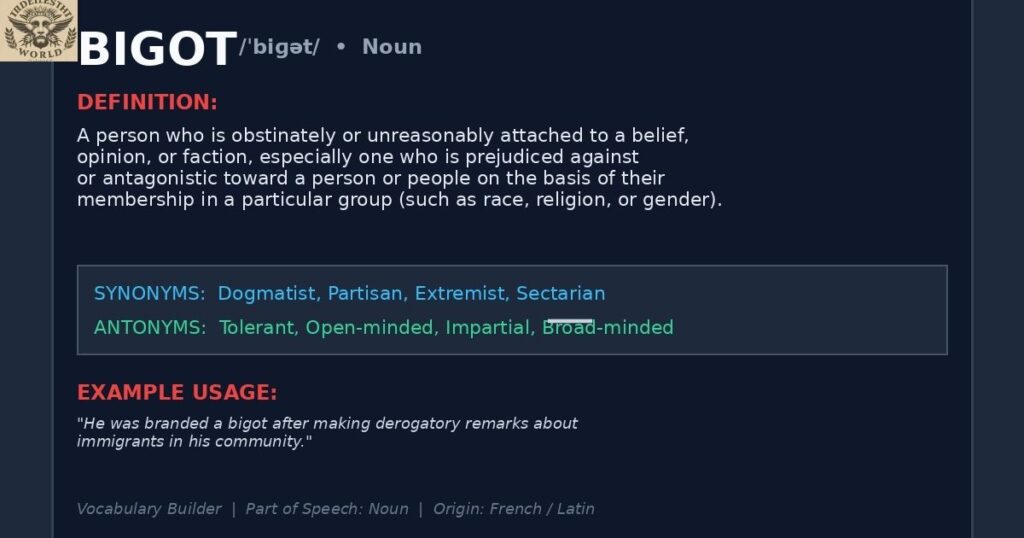
The bigot meaning refers to a person who holds strong and unreasonable beliefs about other people and refuses to accept people who have different beliefs, identities, backgrounds, or ways of life. The word is usually negative or disapproving. A bigot may show intolerance toward people because of race, religion, nationality, politics, culture, gender, or another personal or social difference.
The word bigot is common in British English and American English. It also appears in discussions about society, education, politics, religion, workplaces, news, and social media. Understanding the word can help English learners recognise strong language used to describe intolerance and unfair attitudes.
In simple English, bigot meaning can be understood as an intolerant person who strongly dislikes or rejects people who are different. The idea is not simply having a strong opinion. A key part of the word is an unreasonable refusal to accept or respect people with different views or ways of life. Cambridge defines a bigot as someone with strong, unreasonable beliefs who dislikes people with different beliefs or ways of life.
What Is the Bigot Meaning?
The bigot meaning is a person who has strong and unreasonable beliefs and treats people negatively because they do not share the same beliefs, identity, background, or way of life.
For example:
- The manager was accused of being a bigot after making insulting comments about a religious group.
In the sentence, bigot does not simply mean a person with a different opinion. It suggests intolerance and unwillingness to accept people who are different.
Oxford also describes a bigot as someone with very strong and unreasonable opinions about areas such as race, religion, or politics who refuses to listen to people who disagree.
Simple Definition of Bigot
- A simple definition is:
A bigot is a person who strongly and unfairly rejects people because they are different.
The difference may involve:
- Race
- Religion
- Nationality
- Culture
- Political beliefs
- Ethnic background
- Gender
- Sexual orientation
- Language
- Social background
- Lifestyle
- Personal beliefs
The exact subject can change, but the central idea remains intolerance toward people who are different.
Bigot Meaning in Simple English
In simple English, bigot means an intolerant person.
Imagine two people having different religious beliefs. A respectful person may disagree but still treat the other person with dignity. A bigot may believe that people with another religion are inferior, wrong, or unacceptable and may treat them badly because of that belief.
The word therefore describes more than disagreement.
For example:
- She has a different political opinion. — This is not necessarily bigotry.
- She believes everyone with another political opinion is inferior and refuses to respect them. — The behaviour may be described as bigoted.
The difference is important because disagreement is a normal part of life. Bigotry involves unreasonable intolerance.
Bigot Pronunciation
The word bigot is pronounced:
- BIG-uht
Phonetic pronunciation:
- /ˈbɪɡ.ət/
Both British and American English use essentially the same pronunciation. Cambridge lists the pronunciation as /ˈbɪɡ.ət/ for UK English and /ˈbɪɡ.ət/ for US English. The first syllable sounds like big, while the second syllable is weak and sounds similar to ht.
How to Say Bigot
Break it into two parts:
BIG + uht = BIG-uht
Avoid pronouncing it like big-oat. The final sound is short and unstressed.
Is Bigot a Noun or Adjective?
- Bigot is a noun.
It describes a person.
Example:
- He is a bigot.
The related adjective is bigoted.
Example:
- That was a bigoted comment.
The related noun is bigotry.
Example:
- The organisation has a policy against religious bigotry.
The three forms are:
| Word | Part of Speech | Meaning |
| Bigot | Noun | An intolerant person |
| Bigoted | Adjective | Showing unreasonable intolerance |
| Bigotry | Noun | The practice or attitude of intolerance |
Oxford defines bigoted as showing strong, unreasonable beliefs or opinions and refusing to change them.
Bigot vs Bigoted vs Bigotry
These words are closely connected, but they have different grammatical roles.
Bigot
Bigot means the person.
Example:
- The speaker was called a bigot after making discriminatory comments.
Bigoted
Bigoted describes an attitude, statement, action, or person.
Examples:
- That was a bigoted statement.
- The comments sounded bigoted.
Bigotry
Bigotry refers to the attitude, behaviour, or practice of intolerance.
Examples:
- The school has a zero-tolerance policy toward religious bigotry.
- Racial bigotry can create serious social divisions.
Cambridge defines bigotry as having and expressing strong, unreasonable beliefs while disliking people who have different beliefs or ways of life.
Read More: Biodegradable Meaning, Definition, Examples, Materials and Importance
Examples of Bigot in a Sentence
Understanding examples makes the bigot meaning easier to remember.
- The politician was criticised for appearing to be a bigot.
- Nobody wants to work with a bigot who insults people because of their background.
- The teacher explained why calling someone a bigot is a serious accusation.
- Her comments made several people believe that she was a religious bigot.
- The organisation removed the member after repeated bigoted behaviour.
- A person can disagree with another culture without becoming a bigot.
- The article discussed how racial bigotry affects communities.
- The manager warned staff that bigoted comments would not be tolerated.
- Social media users accused the actor of being a bigot after an offensive statement.
- The campaign aimed to challenge prejudice and bigotry.
These examples show that bigot is generally used when intolerance is directed at a group or at people who are perceived as different.
Bigot Meaning in a Sentence
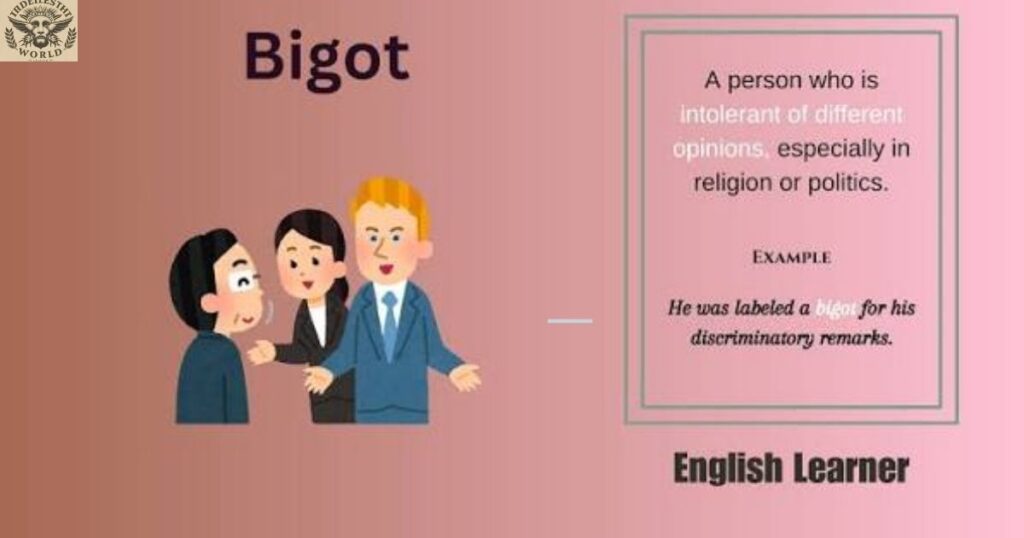
The easiest way to understand the word is to look at it in context.
Example 1
- He is a bigot who refuses to respect people from other cultures.
Here, bigot describes a person with an intolerant attitude toward people from different cultures.
Example 2
- The company dismissed the employee for making bigoted remarks.
Here, bigoted describes the remarks rather than directly naming the person.
Example 3
- Religious bigotry can damage relationships between communities.
Here, bigotry describes the broader attitude or behaviour.
Bigot Synonyms
Several words can be related to bigot, although they do not always have exactly the same meaning.
Common synonyms include:
- Intolerant person
- Prejudiced person
- Racist
- Fanatic
- Extremist
- Jingoist
- Segregationist
- Narrow-minded person
- Dogmatist
- Discriminator
Cambridge’s thesaurus lists words such as racist, prejudiced person, jingoist, and segregationist among related synonyms.However,Bigot Meaning, these words should not be treated as perfect replacements in every sentence.
Bigot vs Racist
A racist specifically expresses prejudice or discrimination based on race or ethnicity.
A bigot has a broader meaning. Bigotry can involve race, religion, nationality, politics, culture, or other differences.
For example:
- He is a racist.
focuses on race.
- He is a religious bigot.
focuses on religion.
Therefore, racist can describe a type of bigot, but the word bigot has a wider meaning.
Bigot vs Prejudiced Person
A prejudiced person holds an unfair opinion about a person or group.
A bigot generally suggests stronger and more unreasonable intolerance.
For example, a person may have an unconscious stereotype without openly expressing hatred. Calling that person a bigot may be stronger than simply describing the person as prejudiced.
Bigot vs Fanatic
A fanatic is someone who shows extreme enthusiasm or devotion toward an idea, cause, activity, or belief.
A bigot is specifically associated with intolerance toward people who are different.
Someone can be a sports fanatic without being a bigot.
Bigot Antonyms
The opposite of a bigot is not represented by one perfect antonym, but several words express the opposite qualities.
Useful antonyms include:
- Tolerant person
- Open-minded person
- Accepting person
- Respectful person
- Understanding person
- Inclusive person
- Broad-minded person
- Nonjudgmental person
For example:
- She is open-minded and respects people with different beliefs.
This expresses the opposite attitude of bigotry.
What Does Bigoted Mean?
Bigoted is an adjective meaning strongly and unreasonably intolerant of people who have different beliefs, backgrounds, or ways of life.
Examples include:
- Bigoted opinion
- Bigoted statement
- Bigoted attitude
- Bigoted comment
- Bigoted behaviour
- Bigoted language
Example:
- The newspaper criticised the politician for making a bigoted comment.
The word focuses on the nature of the comment.
Another example:
- The organisation has strict rules against bigoted behaviour.
Here, bigoted describes behaviour that shows intolerance.
What Does Bigotry Mean?
Bigotry is the noun form related to the concept.
It describes strong, unreasonable intolerance toward people who are different. Cambridge specifically connects bigotry with expressing unreasonable beliefs and disliking people with different beliefs or ways of life.
Examples include:
- Religious bigotry
- Racial bigotry
- Political bigotry
- Cultural bigotry
- Nationalistic bigotry
Example:
- The campaign was created to raise awareness about racial bigotry.
In that sentence, bigotry describes the broader social problem rather than one individual.
Religious Bigot Meaning
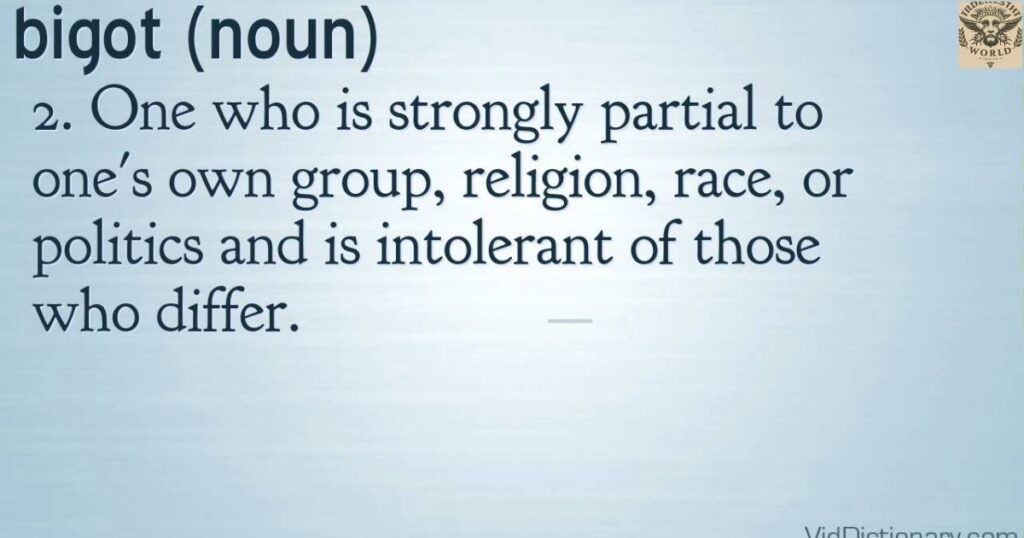
A religious bigot is a person who shows unreasonable intolerance toward people because of religion or religious beliefs.
For example, a person may refuse to respect anyone who follows another religion and may make insulting generalisations about an entire religious community.
The important distinction is between religious disagreement and religious bigotry.People can disagree about religion without being bigots.
For example:
- I do not agree with that religious belief.
This is a disagreement.
But:
- Everyone who follows that religion is inferior and deserves no respect.
This expresses a much more intolerant attitude.
Cambridge gives religious bigot as an example of how the word is commonly used.
Racial Bigot Meaning
A racial bigot is a person who shows strong and unreasonable prejudice or intolerance toward people because of race or ethnicity.
Examples can include:
- Making racial insults
- Treating one racial group as inferior
- Supporting unfair exclusion based on race
- Making sweeping negative claims about an ethnic group
- Refusing equal treatment because of racial identity
Racial bigotry can appear in personal interactions, workplaces, schools, politics, media, or online communities.
It is important to distinguish a factual discussion about cultural differences from a claim that an entire racial group is naturally inferior. The latter can cross into racial prejudice or bigotry when expressed as an unfair, hostile, or discriminatory belief.
Political Bigot Meaning
A political bigot is someone who holds extremely intolerant attitudes toward people with different political beliefs.Political disagreement is normal in democracies such as the United Kingdom, United States, India, Australia, Canada, and other countries.Disagreement alone does not make someone a bigot.
The term becomes relevant when a person refuses to accept the humanity,Bigot Meaning, dignity, or basic legitimacy of people simply because they support another political position.
For example:
- The debate became hostile when both sides started treating everyone with opposing views as enemies.
The behaviour may be described as politically intolerant. Whether bigot is appropriate depends on the context and severity.
Cultural Bigot Meaning
A cultural bigot is a person who unfairly rejects or looks down on people because of their culture, traditions, language, clothing, food, or lifestyle.Modern societies are culturally diverse. Large cities in the UK, USA, India, China, Canada, Australia, and Europe contain communities with many cultural backgrounds.Cultural differences do not automatically indicate a problem.
For example, learning that a particular culture has a different tradition is simply cultural knowledge.
Calling an entire culture inferior, refusing to respect its members, or treating people unfairly because of their cultural identity can be a form of prejudice or bigotry.
Is Calling Someone a Bigot an Insult?
Yes, bigot is generally a negative and disapproving word.
Calling someone a bigot is a serious accusation because it suggests that the person is strongly and unreasonably intolerant toward people who are different.
For that reason, the word should be used carefully.
A disagreement does not automatically make someone a bigot.
For example:
- I disagree with your political opinion.
is very different from:
- You are a bigot.
The second statement makes a strong judgment about the person’s attitude or behavior.
In formal writing, it can be better to describe the specific behaviour when evidence is important.
For example:
- The statement showed intolerance toward immigrants.
can be more precise than simply saying:
- The speaker is a bigot.
Bigot vs Disagreement
One of the most important points in understanding bigot meaning is knowing that disagreement is not automatically bigotry.
People naturally have different:
- Political opinions
- Religious beliefs
- Cultural practices
- Moral views
- Social values
- Personal preferences
A healthy society allows disagreement.
Bigotry involves a stronger pattern of unreasonable intolerance.
| Situation | Bigotry? |
| Having a different political opinion | Not necessarily |
| Disagreeing with a religion | Not necessarily |
| Asking respectful questions about another culture | No |
| Refusing to respect people because of their race | Potentially yes |
| Making hostile generalisations about a group | Potentially yes |
| Supporting unfair treatment because of identity | Potentially yes |
| Respectfully debating an issue | No |
Context matters.
Bigot vs Prejudice vs Discrimination
These three concepts are related but not identical.
Prejudice
Prejudice is an unfair or preconceived judgment about a person or group.
Bigotry
Bigotry involves strong and unreasonable intolerance toward people who are different.
Discrimination
Discrimination generally refers to unfair treatment based on characteristics such as race, religion, sex, disability, nationality, or another protected or socially relevant characteristic.
- A person may hold prejudice without openly discriminating.
- A person may also discriminate through actions even if the internal motivation is difficult to determine.
Understanding these differences helps create more accurate writing about social issues.
Bigot Meaning in the UK
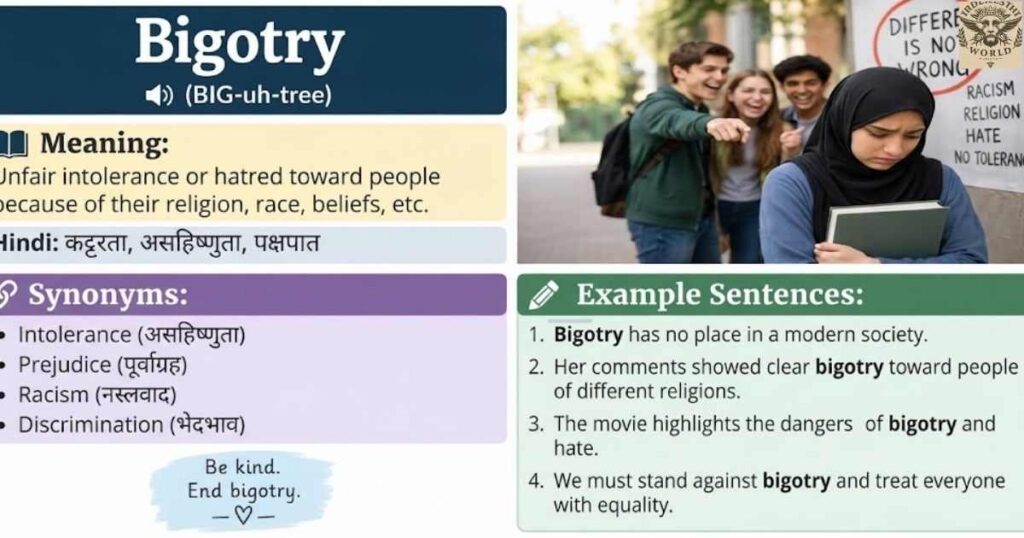
In the UK, bigot is commonly understood as a strongly intolerant person.British English uses the same core meaning found in major dictionaries. Cambridge gives the UK pronunciation as /ˈbɪɡ.ət/ and describes a bigot as a person with strong, unreasonable beliefs who dislikes people with different beliefs or ways of life.
The word can appear in British newspapers,Bigot Meaning, political discussions, television, literature, workplace conversations, and online discussions.
British examples may involve discussions about:
- Religion
- Immigration
- Race
- National identity
- Political ideology
- Cultural differences
Because bigot is a strong word, context remains important.
Bigot Meaning in the USA
In American English, bigot has essentially the same meaning.Oxford’s American English dictionary describes a bigot as someone with very strong and unreasonable opinions about subjects such as race,Bigot Meaning, religion, or politics who refuses to accept opposing opinions.
The word is frequently encountered in discussions about:
- Civil rights
- Religion
- Race
- Immigration
- Politics
- Social equality
- Cultural identity
American English also uses related forms such as bigoted and bigotry.
Bigot Meaning in India
In India, the word bigot can appear in English-language discussions about religion, caste, language, culture, politics, and regional identity.India is highly diverse, with many religions, languages, cultures, ethnic communities,Bigot Meaning, and regional traditions.
For example:
- A person who refuses to respect people from another religious community may be described as a religious bigot.
The word should still be applied carefully. A political disagreement or religious difference does not automatically mean bigotry.
Indian English also commonly uses related words such as:
- Intolerant
- Prejudiced
- Narrow-minded
- Communal
- Discriminatory
The precise word depends on the context.
Bigot Meaning in China
English-language discussions involving China may use bigot when discussing intolerance based on nationality, ethnicity, religion, culture, politics, or other identity-related differences.
For example:
- The writer criticised the comment as culturally intolerant.
A person learning English may encounter bigot, bigoted, and bigotry in international news or academic discussions.Cambridge also provides Chinese translations for bigot, showing that the word is used in multilingual English-learning contexts.
The broader lesson is that bigot is a global English vocabulary word, not a term limited to Britain or America.
Read More:Bilateral Meaning: Definition, Examples, Agreements, Relations, and How to Use It
Bigot Meaning in Other Countries
The word bigot can be useful for English learners across countries such as:
- Canada
- Australia
- New Zealand
- South Africa
- Singapore
- Ireland
- Pakistan
- Bangladesh
- Malaysia
- Philippines
- United Arab Emirates
- European countries
In international English, the central meaning remains the same: an intolerant person who holds strong and unreasonable views about people who are different.The exact social issue can vary by country.
In one place, discussions may focus on religion. In another, race, nationality, immigration, politics, language, or cultural identity may be more common.
Common Types of Bigotry
Bigotry can appear in many forms.
1. Religious Bigotry
- This involves intolerance toward people because of religious beliefs.
Example:
- The organisation spoke against religious bigotry.
2. Racial Bigotry
- This involves intolerance based on race or ethnicity.
Example:
- The law was created to address racial discrimination and promote equal treatment.
3. Cultural Bigotry
This involves treating another culture as inferior or unacceptable.
Example:
- Cultural bigotry can make minority communities feel excluded.
4. Political Bigotry
- This involves extreme intolerance toward people with different political beliefs.
Example:
- Political bigotry can make public debate less productive.
5. Nationality-Based Bigotry
This involves negative attitudes toward people because of nationality.
Example:
- The campaign encouraged people to challenge nationality-based prejudice.
Signs of Bigoted Behaviour
No single sentence or disagreement can always prove that someone is a bigot. Context and patterns matter.
Possible signs of bigoted behaviour include:
- Repeatedly insulting a particular group
- Treating a group as naturally inferior
- Refusing to accept people because of identity
- Making broad negative claims about an entire group
- Supporting unequal treatment based on identity
- Rejecting people without considering individual differences
- Using stereotypes to justify hostility
- Refusing reasonable dialogue with people from another group
These behaviours can overlap with prejudice and discrimination.
Bigot in Everyday Conversation
The word can appear in casual conversation, but it is still relatively strong.
Example:
- That comment sounded bigoted.
This is often less direct than:
- You are a bigot.
The first sentence focuses on a particular comment.
- The second labels the person.
In everyday communication, focusing on the behaviour can make the conversation more constructive.
For example:
- That statement seems unfair toward people from that community.
This may communicate the concern without immediately turning the discussion into a personal attack.
Bigot in Social Media
Social media has made words such as bigot, bigoted, prejudice, and bigotry very common.
People may use the word when reacting to:
- Political posts
- Religious debates
- News stories
- Celebrity comments
- Immigration discussions
- Cultural disagreements
- Controversial videos
- Online arguments
However, social media often encourages quick judgments.A single controversial statement may not provide enough context to determine a person’s overall attitude.
For accurate communication, it is useful to separate:
- What the person actually said
- What the statement appears to imply
- Whether the statement reflects a repeated pattern
- Whether the behaviour targets a specific group
This approach produces more precise language.
Bigot in the Workplace
A workplace may include people from different cultures, religions, nationalities, and backgrounds.Bigoted comments can create an uncomfortable or hostile environment.
Examples may include:
- Insulting a colleague’s religion
- Making racial jokes
- Rejecting applicants because of identity
- Mocking someone’s nationality
- Making stereotypes about a cultural group
- Treating one group unfairly
Professional workplaces usually encourage respectful communication.Instead of using labels immediately, workplace complaints often benefit from specific descriptions of the behaviour, the people affected, and the circumstances.
Bigot in Education
Schools and universities often teach students about diversity, inclusion, respectful disagreement, and discrimination.The word bigot may appear in literature, history, social studies, political discussions,Bigot Meaning, or English-language lessons.
For students, the easiest distinction is:
- Different opinion ≠ automatically bigotry.
A person can disagree with another person’s belief while still showing respect.Bigotry begins to become relevant when disagreement turns into unreasonable intolerance, hostility, exclusion, or unfair treatment toward people because of their identity or way of life.
How to Use Bigot Correctly
Use bigot as a noun when referring to a person.
Correct:
- The writer called him a bigot.
Incorrect:
- The writer called him bigoted person.
The second sentence needs an article:
- The writer called him a bigoted person.
- Use bigoted as an adjective.
Correct:
- The article contained a bigoted statement.
- Use bigotry as a noun for the attitude or practice.
Correct:
- The campaign aimed to challenge bigotry.
Quick Grammar Guide
| Form | Example |
| Bigot | He is a bigot. |
| Bigoted | That is a bigoted comment. |
| Bigotry | The community opposed bigotry. |
Common Phrases With Bigot
Some useful expressions include:
- Religious bigot
- Racial bigot
- Political bigot
- Cultural bigot
- Bigoted person
- Bigoted comment
- Bigoted attitude
- Bigoted behaviour
- Bigoted remarks
- Bigotry against minorities
- Religious bigotry
- Racial bigotry
- Political bigotry
These phrases can help English learners understand how the word naturally appears in sentences.
Common Mistakes About the Bigot Meaning
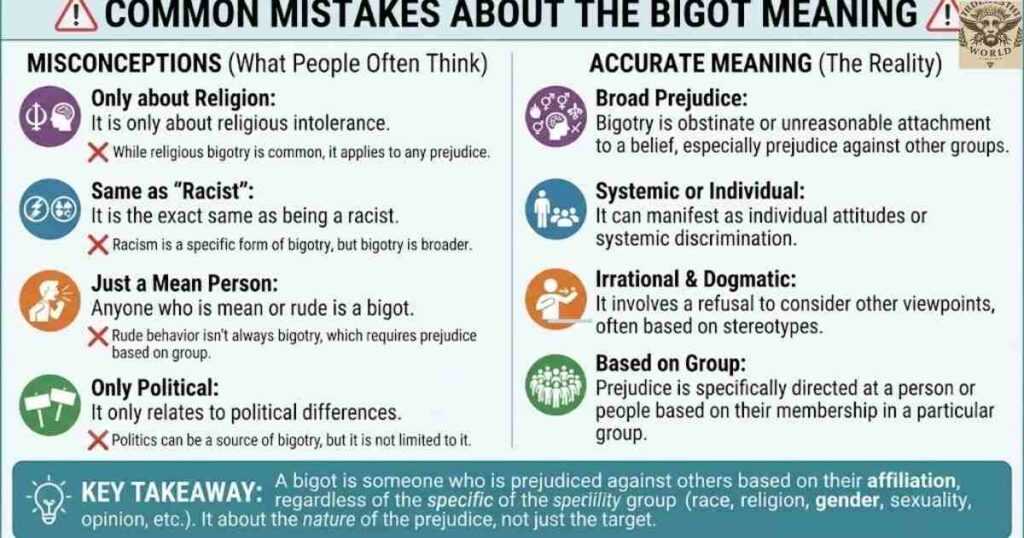
Mistake 1: Thinking Every Strong Opinion Is Bigotry
A strong opinion alone does not make someone a bigot.
A person can strongly support or oppose an idea while respecting people who disagree.
Mistake 2: Thinking Bigot Only Means Racist
Race is one area where bigotry can occur, but the word is broader.
A bigot can show intolerance based on religion, politics, culture, nationality, or other differences.
Mistake 3: Confusing Bigot With Fanatic
A fanatic may have extreme enthusiasm for a cause.
A bigot is characterised by intolerance toward people who are different.
Mistake 4: Using Bigot as a Casual Insult
Because bigot is a strong negative word,Bigot Meaning, casual use can weaken its meaning.
It is better to use the word when the context supports the description.
Is Bigot the Same as Racist?
No.
A racist specifically relates to race or ethnicity.
A bigot is broader and can relate to race, religion, politics, nationality, culture, or other differences.
For example:
- A racist may hold prejudiced beliefs about another racial group.
- A religious bigot may reject people because they follow another religion.
There can be overlap, but the words are not identical.
Is Bigot the Same as Homophobe?
Not exactly.
- A homophobe is a person who shows hostility, prejudice, or intolerance toward gay people.
- A bigot is a broader term for an intolerant person.
Therefore, a person who displays homophobic intolerance may also be described as a bigot, but bigot does not specifically refer to sexual orientation.
Is Bigot the Same as Prejudice?
Not exactly.
- Prejudice is an unfair preconceived opinion.
- Bigot describes a person who holds strong and unreasonable intolerant beliefs.
- Bigotry describes the broader attitude or behaviour.
These terms overlap, but each has a slightly different focus.
Why Understanding Bigot Meaning Matters
Learning the bigot’s meaning is useful for English learners because the word appears in news reports, books, films, political discussions,Bigot Meaning, academic writing, and online conversations.
It is also useful because the word carries strong emotional meaning.
Knowing the difference between:
- Bigot
- Bigoted
- Bigotry
- Prejudice
- Racism
- Discrimination
- Intolerance
- Fanaticism
helps readers understand the exact meaning of a sentence.
For students in the UK, USA, India, China, Canada, Australia, and other countries, this vocabulary can improve reading comprehension and everyday communication.
Bigot Meaning for English Learners
For a beginner, the easiest definition is:
- Bigot = an intolerant person who strongly rejects people who are different.
Remember the related forms:
- Bigot → person
- Bigoted → describing something
- Bigotry → the attitude or practice
A simple memory trick is:
- Bigot = person, bigoted = behaviour, bigotry = attitude.
This is not a complete linguistic rule for every context, but it is a useful starting point for vocabulary learning.
Examples of Bigoted and Non-Bigoted Statements
Context can make a major difference.
| Statement | What it shows |
| I disagree with that political policy. | Political disagreement |
| People with that political view are worthless. | Intolerant generalisation |
| I follow a different religion. | Personal belief |
| People from that religion should not be respected. | Religious intolerance |
| I enjoy my own culture. | Cultural preference |
| That culture is inferior to ours. | Cultural prejudice |
| I prefer speaking English. | Personal preference |
| People who speak another language are inferior. | Language-based prejudice |
The examples demonstrate why bigot meaning cannot be reduced to someone who disagrees.
How to Respond to a Bigoted Comment
When encountering an intolerant comment, a calm response can be more effective than an aggressive argument.
Possible responses include:
- That statement makes a broad assumption about an entire group.
- People can have different beliefs and still deserve respect.
- Could you explain why you believe that?
- That comment seems unfair toward people from that community.
In workplaces, schools, or other formal settings, reporting serious discriminatory behaviour through the appropriate process may be more suitable than engaging in a public argument.
Bigot Meaning in Literature and Movies
The word bigot often appears in literature and films when a character represents prejudice, intolerance, or social division.
Writers may use a bigoted character to explore:
- Social conflict
- Religious intolerance
- Racism
- Class divisions
- Cultural differences
- Political extremism
- Historical discrimination
The term can therefore be useful when analysing character development.
For example:
- The novel presents the character as a bigot to show the harmful effects of prejudice.
Historical Use of the Word
The word bigot has a long history in English and has developed into its modern meaning over time.Today, dictionaries use the word to describe strong and unreasonable intolerance toward people with different beliefs or ways of life. Modern usage commonly connects it with areas such as race, religion, politics, and identity.
Because meanings can develop over centuries, historical examples may not always use the word in exactly the same way as modern speakers.For present-day English, the safest understanding is an intolerant person with strong and unreasonable beliefs about people who are different.
Bigot and Tolerance
The opposite of bigotry is closely connected with tolerance, respect, openness, and inclusion.
Tolerance does not require agreement.
A person can think:
- I strongly disagree with that belief.
while also thinking:
- People who hold that belief still deserve basic respect.
That distinction is important in diverse societies.
Tolerance means accepting the existence of differences without automatically treating people as inferior or unacceptable.
Bigot and Open-Mindedness
An open-minded person is willing to listen, learn, and consider another perspective.
Open-mindedness does not mean accepting every claim as true.
For example, a person can hear a different political argument and decide:
- I understand the argument, but I still disagree.
That is different from refusing to listen because the speaker belongs to a particular group.
This distinction helps explain why bigot is associated with unreasonable intolerance rather than simple disagreement.
Frequently Asked Questions :
What is the simple meaning of bigot?
The simple bigot meaning is an intolerant person who has strong and unreasonable beliefs and dislikes or rejects people who are different.
Is bigot a bad word?
Yes. Bigot is normally a negative and disapproving word. It describes a person as strongly intolerant, so it can be a serious accusation.
What is the difference between bigot and bigoted?
Bigot is a noun for a person. Bigoted is an adjective describing a person, statement, attitude, or behaviour.
Example:
- He is a bigot.
- His comment was bigoted.
What is the noun form of bigoted?
The related noun is bigotry.
Example:
- The organisation spoke against religious bigotry.
Is a racist a bigot?
A racist can also be described as a bigot when the person’s racial intolerance fits the broader meaning of bigotry. However, bigot is a wider term and is not limited to race.
Conclusion
The bigot meaning is best understood as an intolerant person who holds strong and unreasonable beliefs and rejects people because they have different beliefs, identities, backgrounds, or ways of life. The word is negative and should be used carefully because calling someone a bigot makes a strong judgment about that person’s attitude or Behavior.
The related words are also important. Bigot is the person, bigoted describes an intolerant attitude or action, and bigotry describes the broader practice or attitude of intolerance. Understanding these differences makes English communication more accurate. Whether the discussion takes place in the UK, USA, India, China, Canada, Australia, or another country, the core meaning remains the same: bigotry is about unreasonable intolerance, not simply having a different opinion.

