

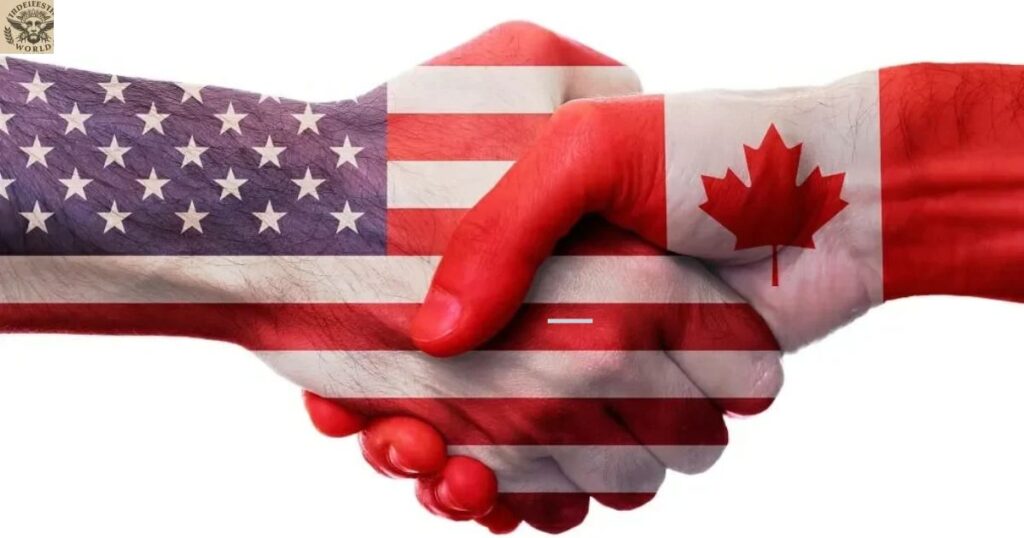
The basic meaning of bilateral is quite simple. If you break it down to its basic words, bilateral describes something that is between or pertains to two sides, two people, two groups, two organizations or two countries. The word is found in many parts of the English language, such as politics, international relations, business, law, medicine, biology, and in general, day to day communication.
To give examples, when two countries enter into an agreement with each other, that agreement is called a bilateral agreement. If two governments discuss trade or security, they would hold bilateral talks. In medicine, bilateral means that a condition pertains to both sides of the body. In everyday communication, Bilateral means symmetrically pertaining to both sides of the body. The meaning and context may vary, but the main idea is the same. Two sides are involved.
Knowledge of bilateral meaning can be useful for English learners, students, business professionals, journalists and anyone who reads or listens to formal communication in the UK or USA. Once the meaning is learned, understanding bilateral relations, bilateral trade, bilateral contracts, bilateral cooperation and bilateral symmetry would also be simpler.
Bilateral Meaning in Simple English
The simplest bilateral meaning is “involving two sides.” The two sides may be people, countries, businesses, organisations, political groups, or even two sides of the human body.
The word is often used in formal English. Instead of saying “an agreement between two countries,” a writer may say “a bilateral agreement.” Instead of saying “a relationship between two countries,” a writer may use “bilateral relations.”
Here are some simple examples:
- Two countries sign an agreement → a bilateral agreement
- Two countries trade with each other → bilateral trade
- Two governments discuss an issue → bilateral talks
- Two companies make a contract → a bilateral contract
- Both knees are affected → a bilateral medical condition
- An animal has matching left and right sides → bilateral symmetry
The key idea is always the same: two sides are connected or involved.
What Does Bilateral Mean?
Bilateral is an adjective used to describe something involving or relating to two sides or parties.
The two parties do not have to be countries. They could be individuals, companies, governments, organisations, groups, or other entities. The word can also describe something affecting both sides of the body.
For example, suppose Company A agrees to provide software to Company B, while Company B agrees to pay for the service. The arrangement involves two parties, so it can be described as bilateral.
Similarly, if the UK and another country negotiate a trade arrangement directly, the discussions can be described as bilateral talks.
In a medical setting, the meaning is slightly different but still follows the same basic idea. If a condition affects both ears, a doctor may describe it as bilateral. Therefore, the bilateral meaning depends on context, but the concept of two sides remains central.
Bilateral Definition
A straightforward bilateral definition is:
Bilateral means involving,Bilateral Meaning
affecting, or relating to two sides or two parties.
The word is often used when two sides have a direct connection, arrangement, discussion, responsibility, or relationship.
The following table makes the definition easier to remember:
| Word | Simple Definition | Example |
| Bilateral | Involving two sides | A bilateral agreement |
| Unilateral | Involving one side | A unilateral decision |
| Multilateral | Involving several sides | A multilateral agreement |
| Mutual | Shared by both sides | Mutual support |
| Reciprocal | Given or returned by both sides | Reciprocal benefits |
| Two-sided | Having two sides | A two-sided discussion |
A useful memory trick is to remember bi = two. The same prefix appears in words such as bicycle and bilingual. In bilateral, it helps indicate the idea of two sides.
What Is a Bilateral Agreement?
A bilateral agreement is an agreement between two parties. The parties can be two countries, two businesses, two organisations, or two individuals.
This is one of the most common uses of the word bilateral. Governments frequently make bilateral agreements to cooperate on trade, taxation, education, transport, Defance, environmental issues, investment, or other matters.
A bilateral agreement is different from a multilateral agreement because a bilateral agreement focuses on two main parties.
For example, imagine the United States and Country A agree to make it easier for certain products to enter each other’s markets. The arrangement involves two countries. Therefore, it can be described as a bilateral trade agreement.
Read more: Bankruptcy Meaning: Definition, Types, Process, Effects and UK vs USA Guide
Easy Example of a Bilateral Agreement
Here is a very simple example:
Ali owns a small business. Ahmed supplies him with products. They agree that Ahmed will provide 100 products every month, while Ali will pay an agreed amount.
There are two parties:
- Ali
- Ahmed
Both agree to specific terms. This can be described as a bilateral agreement.
The example does not involve governments or international politics. It shows that bilateral agreements can exist in ordinary business situations too.
Another Easy Example
Imagine two neighbours.
One neighbour agrees to repair a shared fence. The other agrees to pay half of the repair cost.
There are two sides making an arrangement. It can therefore be described as a bilateral agreement.
The word sounds formal, but the underlying concept is simple: two parties agree to something.
Bilateral Agreement Examples in Everyday Life
The idea of a bilateral agreement can be found in everyday situations.
Example 1: Business Deal
A bakery agrees to buy flour from a supplier every week. The supplier agrees to deliver the flour, and the bakery agrees to pay the agreed price.
This is an agreement between two parties.
Example 2: Service Agreement
A website owner hires a designer to create a website. The designer agrees to complete the work, while the website owner agrees to pay the agreed fee.
Again, two parties are involved.
Example 3: Rental Arrangement
A landlord agrees to rent a property to a tenant. The tenant agrees to pay rent according to the agreed terms.
The exact legal classification depends on the applicable law and contract, but the basic arrangement illustrates two parties entering an agreement.
Example 4: International Trade
Country A agrees to reduce certain import duties for goods from Country B. Country B agrees to provide corresponding trade benefits.
This is an example of a bilateral trade arrangement.
Example 5: Student and Tutor
A tutor agrees to provide weekly lessons, while a student agrees to attend the lessons and pay the agreed fee.
This illustrates the basic idea of a two-party arrangement.
Why Are Bilateral Agreements Important?
Bilateral agreements are important because they allow two parties to establish clear rules for cooperation.
Negotiated agreements have many uses. Governments can use them to improve international trade and diplomacy. Businesses can use agreements to allocate responsibilities and payments. Organizations can use them to create partnerships, joint ventures, and research agreements.
A written agreement can also make expectations clearer. Each side can understand what it has agreed to do.
In international relations,Bilateral Meaning
bilateral agreements can be particularly useful because two governments can focus directly on matters that affect their relationship.
For businesses in the UK and USA, bilateral arrangements can relate to trade, services, investment, taxation, technology, supply chains, and other commercial matters.
Bilateral Relations Meaning
Bilateral relations means the relationship between two countries, governments, organisations, or other parties.
The phrase is especially common in international politics and news reporting.
For example, a report might discuss UK-US bilateral relations. This means the relationship between the United Kingdom and the United States.
Bilateral relations can include:
- diplomatic communication
- trade
- investment
- education
- tourism
- defence
- technology
- scientific research
- cultural exchange
- environmental cooperation
Good bilateral relations may involve regular meetings and cooperation. Difficult bilateral relations may involve disagreements, disputes, or diplomatic tensions.
Bilateral Relations Between Countries
Countries often maintain bilateral relationships because decisions made by one country can affect another.
For example, two neighbouring countries may cooperate on border management. Two trading countries may negotiate tariffs. Two governments may work together on security or environmental projects.
Bilateral relations do not always mean that the two countries agree on everything. Two countries can have strong diplomatic relations while still disagreeing on individual issues.
The phrase simply identifies a relationship involving two countries.
Bilateral Meaning in Politics
In politics, the bilateral meaning often refers to something involving two governments or political entities.
Common political phrases include:
- bilateral talks
- bilateral relations
- bilateral agreement
- bilateral treaty
- bilateral cooperation
- bilateral negotiations
- bilateral diplomacy
- bilateral partnership
For example, if leaders from two countries meet privately to discuss trade, the meeting may be described as bilateral.
Bilateral diplomacy allows two governments to communicate directly without requiring every issue to be discussed through a larger group.
Read More: Bankruptcy Meaning: Definition, Types, Process, Effects and UK vs USA Guide
Bilateral Talks Meaning
Bilateral talks are discussions between two sides.
The sides may be governments, political representatives, Bilateral Meaning
companies, organisations, or other groups.
For example, if two governments meet to discuss a disagreement about trade, they may hold bilateral talks.
The goal of bilateral talks may be to:
- reach an agreement
- solve a dispute
- improve cooperation
- negotiate trade terms
- discuss security
- strengthen diplomatic relations
The word talks does not automatically mean that an agreement will be reached. It simply means that the two sides are discussing an issue.
Bilateral Negotiations
Bilateral negotiations involve two parties trying to reach an acceptable arrangement.
Imagine two companies negotiating the price of a long-term supply contract. One company wants a lower price, while the other wants stable revenue. They discuss the terms until they reach an arrangement.
That is a simple example of bilateral negotiation.
International negotiations can be much more complicated, but the basic concept remains the same.
Bilateral Meeting Meaning
A bilateral meeting is a meeting between two sides.
In international politics, Bilateral Meaning
leaders may have bilateral meetings during a larger summit. A US official might meet a UK official to discuss a particular issue. The meeting is bilateral because the main discussion involves two sides.
The phrase can also be used outside politics.
For example:
“The two company directors held a bilateral meeting to discuss the new partnership.”
Here, the word simply describes a meeting between two parties.
Bilateral Trade Meaning
Bilateral trade refers to trade between two countries.
When Country A sells products or services to Country B, and Country B trades with Country A, the relationship can be described as bilateral trade.
Bilateral trade may include:
- goods
- services
- technology
- agricultural products
- manufactured products
- energy
- financial services
The value and structure of bilateral trade can change over time because of economic conditions, tariffs, consumer demand, exchange rates, regulations, and political decisions.
What Is a Bilateral Trade Agreement?
A bilateral trade agreement is a trade arrangement between two countries.
Such an agreement may establish rules covering imports and exports. Depending on the agreement, it may address tariffs, The value and structure of bilateral trade can change over time because of economic conditions, tariffs, consumer demand, exchange rates, regulations, and political decisions.market access, product standards, services, investment, or other trade matters.
Here is an easy example:
Country A normally charges a 10% import tax on a particular product from Country B. The two countries negotiate an agreement that reduces the rate to 5%.
If the agreement is between those two countries, it is bilateral.
The actual terms of international trade agreements can be legally and economically complex, but the basic definition is easy to understand.
Bilateral Meaning in Business
In business, bilateral describes arrangements between two parties.
A business may have bilateral relationships with:
- suppliers
- customers
- distributors
- investors
- contractors
- service providers
- business partners
For example, a company and its supplier may negotiate a contract in which the supplier promises to deliver goods and the company promises to pay.
This is a useful example of bilateral business activity.
Bilateral Contract Meaning
A bilateral contract generally involves an exchange of promises between two parties.
For example:
A company promises to deliver 1,000 products, and the buyer promises to pay the agreed amount.
Both sides have made commitments.
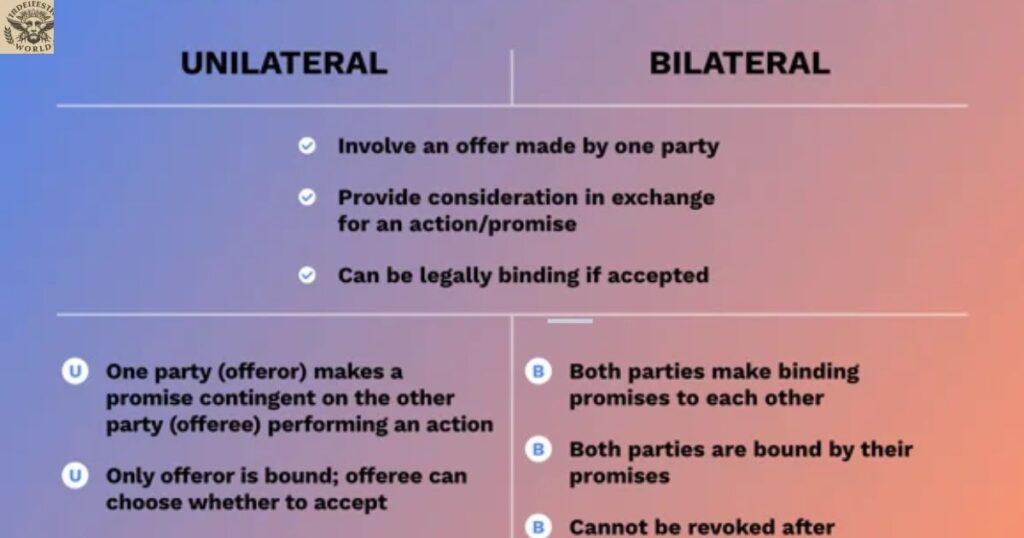
This differs from a unilateral arrangement, where one side generally makes an offer that is accepted through performance of a specified act.
Contract law can differ between the UK, the USA, The value and structure of bilateral trade can change over time because of economic conditions, tariffs, consumer demand, exchange rates, regulations, and political decisions.
and other jurisdictions. Therefore, the precise legal treatment of a particular agreement should be checked under the relevant law.
Bilateral Meaning in Law
In legal English, bilateral can describe a legal relationship, contract, or agreement involving two parties.
A bilateral legal arrangement may create responsibilities for both sides.
For example, two companies may sign a contract. One company agrees to provide a service, while the other agrees to pay for that service. Each party has obligations under the arrangement.
Legal uses of bilateral can be more precise than everyday uses, so the surrounding wording is important.
Bilateral Meaning in Medical Terms
In medicine, bilateral usually means affecting or relating to both sides of the body.
This is an important use of the word because patients may see it in medical reports.
For example:
- bilateral knee pain = pain in both knees
- bilateral ear infection = infection in both ears
- bilateral shoulder pain = pain in both shoulders
- bilateral leg weakness = weakness affecting both legs
- bilateral breast changes = changes involving both breasts
The opposite term is often unilateral, which means affecting only one side.
What Does Bilateral Mean on a Medical Report?
If a medical report uses the word bilateral, it generally indicates that a finding involves both sides.
For example, “bilateral knee arthritis” means arthritis affecting both knees.
The word itself does not tell us the severity of a condition. It describes its location or distribution.
A report saying “bilateral changes” therefore needs to be read alongside the rest of the medical information to understand exactly what the changes mean.
Bilateral Meaning in Anatomy
Anatomy uses bilateral to describe structures or conditions involving both sides of the body.
Humans have many paired body structures, including:
- eyes
- ears
- arms
- hands
- legs
- feet
- kidneys
- lungs
When something involves the corresponding structures on both sides, bilateral may be used.
For example, a medical professional may describe an issue involving both shoulders as a bilateral shoulder condition.
What Is Bilateral Symmetry?
Bilateral symmetry is a biological term describing a body structure that has corresponding left and right sides.
Humans are a familiar example. The human body generally has a left and right side arranged around a central axis.
Many animals also show bilateral symmetry, including dogs, cats, birds, butterflies, and many other species.
Bilateral symmetry does not mean that every part of the body is perfectly identical. Instead, it refers to a broad structural arrangement involving corresponding sides.
Bilateral Meaning in Biology
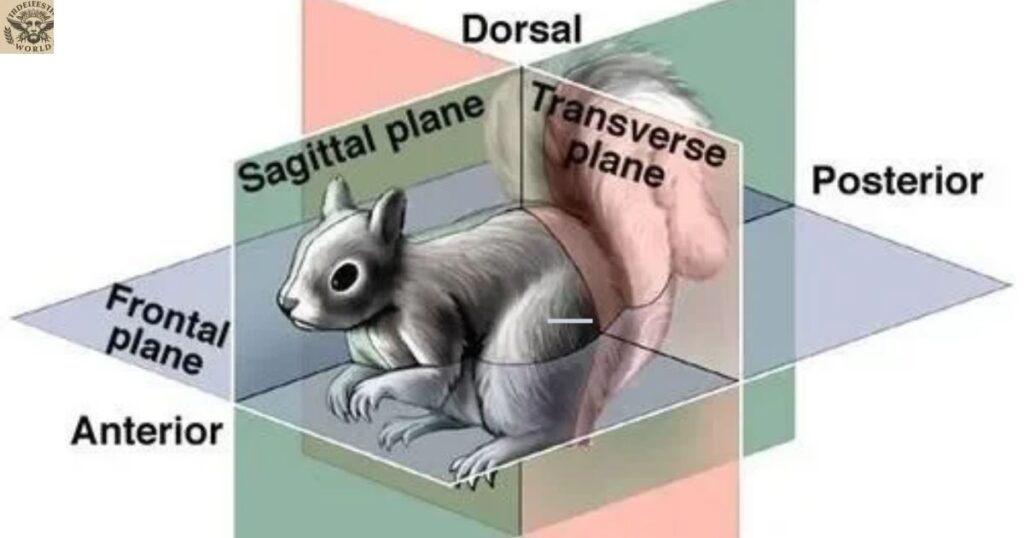
In biology, bilateral is commonly connected with bilateral symmetry.
An organism with bilateral symmetry has a body plan organised around an axis that creates corresponding left and right sides.
This concept is important in biology because it helps scientists classify and understand animal body structures.
For example, a butterfly has a left wing and a corresponding right wing. The two sides form a broadly symmetrical pattern.
Bilateral Meaning in Family and Ancestry
Bilaterals can also appear in discussions about family relationships and ancestry.
Bilateral descent refers to tracing family relationships through both the maternal and paternal sides.
For example, a person may consider relatives connected through their mother’s family and their father’s family.
This meaning is more specialised than bilateral agreement or bilateral relations, but it still follows the same basic concept of two sides.
Bilateral vs Unilateral
The difference between bilateral and unilateral is one of the most useful distinctions to learn.
Bilateral = two sides.
Unilateral = one side.
For example:
- bilateral agreement → two parties
- unilateral decision → one party
- bilateral knee pain → both knees
- unilateral knee pain → one knee
- bilateral cooperation → two sides cooperating
- unilateral action → one side acting
| Bilateral | Unilateral |
| Two sides | One side |
| Two parties | One party |
| Bilateral agreement | Unilateral decision |
| Both sides affected | One side affected |
| Bilateral talks | One-sided action |
Remembering this contrast makes many formal English terms easier to understand.
Bilateral vs Multilateral
Another important comparison is bilateral vs multilateral.
Bilateral means two parties.
Multilateral means several parties.
For example, an agreement between two countries can be bilateral. A large international agreement involving many countries can be multilateral.
The distinction is particularly important in international relations.
| Term | Number of Main Parties | Example |
| Unilateral | One | One country acts alone |
| Bilateral | Two | Two countries sign an agreement |
| Multilateral | Several | Several countries negotiate together |
Bilateral vs Reciprocal
Bilateral and reciprocal are sometimes confused because both words can appear in discussions about cooperation.
Bilateral focuses on the number of sides: two.
Reciprocal focuses on something being exchanged, returned, Bilateral Meaning
or shared between sides.
For example, a bilateral agreement involves two parties. If both parties provide benefits to each other, those benefits may be reciprocal.
Therefore, something can be bilateral without every aspect being reciprocal.
Bilateral Synonyms
Depending on the context, words similar to bilateral include:
- two-sided
- two-party
- mutual
- reciprocal
- dual-sided
- involving two parties
However, these words do not always have exactly the same meaning.
“Two-sided” is more general. “Mutual” often means shared by both sides. “Reciprocal” suggests an exchange or return. Bilateral specifically highlights the involvement of two sides.
Bilateral Antonym
The most common antonym of bilateral is unilateral.
Unilateral means involving one side or one party.
For example:
Bilateral: Two governments negotiate an agreement.
Unilateral: One government makes a decision without an agreement with another government.
Bilateral: Both knees are affected.
Unilateral: Only one knee is affected.
Another contrasting term is multilateral, which involves several parties.
Bilateral Pronunciation in UK and US English
The word bilateral can be pronounced slightly differently depending on the speaker’s accent.
A simple pronunciation guide is:
BY-lat-er-al
The first syllable receives the main stress in common UK and US pronunciation.
For English learners, it is useful to recognise the word when listening to news reports, academic discussions, business meetings, and medical explanations.
Origin of the Word Bilateral
The word bilateral comes from Latin-based word elements connected with the ideas of two and side.
The prefix bi- means two. The other part relates to the idea of a side.
This structure helps explain the modern meaning.
Once the connection is understood, the word becomes easier to remember:
bi = two → lateral = side → bilateral = involving two sides.
Bilateral and Bilaterally
Bilateral is an adjective.
Example:
- “The countries signed a bilateral agreement.”
Bilaterally is an adverb.
Example:
- “The two governments worked bilaterally to address the issue.”
A related noun is bilaterality. The worth and arrangement of bilateral trade can change over time on account of monetary issues, tolls, buyer interest, trade rates, and shifts in political or legitimate situations.
although it is less common in everyday English.
Knowing these forms can help when reading formal English.
Common Phrases With Bilateral
Several phrases commonly appear with the word bilateral.
Bilateral Agreement
An agreement involving two parties.
Bilateral Relations
A relationship between two countries or parties.
Bilateral Trade
Trade between two countries.
Bilateral Talks
Discussions between two sides.
Bilateral Negotiations
Negotiations involving two parties.
Bilateral Cooperation
Cooperation between two sides.
Bilateral Contract
A contract involving obligations or promises between two parties.
Bilateral Treaty
A treaty involving two parties, commonly two states.
Bilateral Symmetry
A biological pattern involving corresponding two sides.
Bilateral Partnership
A partnership between two parties.
Bilateral Examples in Sentences
Here are several sentence examples showing how bilateral can be used naturally:
- The two governments began bilateral talks.
- The countries signed a bilateral agreement.
- The meeting improved their bilateral relations.
- The companies entered into a bilateral contract.
- The two nations increased bilateral trade.
- The ministers discussed bilateral cooperation.
- The patient experienced bilateral knee pain.
- The doctor noted bilateral changes.
- The butterfly shows bilateral symmetry.
- The organisations created a bilateral partnership.
- The leaders held a bilateral meeting.
- The countries discussed a new bilateral treaty.
- The two businesses negotiated bilateral terms.
- The report examined bilateral relations between the two countries.
- The agreement created a framework for bilateral cooperation.
Simple Bilateral Agreement Examples for Students
Students often understand formal vocabulary better through simple situations.
Example A: Two Friends
Two friends agree to help each other with school projects.
One friend helps with mathematics, while the other helps with English.
Two sides are involved, so the arrangement illustrates the basic idea of bilateral cooperation.
Example B: Two Businesses
A clothing company agrees to buy fabric from a supplier.
The supplier agrees to deliver the fabric, Bilateral Meaning
and the company agrees to pay.
Two parties are involved.
Example C: Two Countries
Country A agrees to buy agricultural products from Country B under agreed trade rules.
The two countries are directly involved.
This is an example of a bilateral trade arrangement.
Example D: Two Organisations
A university and a technology company agree to work together on research.
The university provides researchers, while the company provides equipment or funding under agreed terms.
Again, two sides are cooperating.
Bilateral Meaning in International Relations
International relations is one of the fields where the word bilateral appears most frequently.
Governments use bilateral diplomacy to communicate directly with another government.
Bilateral relationships can cover:
- foreign policy
- trade
- defence
- security
- education
- science
- technology
- energy
- investment
- immigration
- environmental cooperation
For example, two countries may create a bilateral programme that allows students to participate in educational exchanges.
The word helps readers immediately understand that two countries or parties are at the centre of the arrangement.
Bilateral Diplomacy
Bilateral diplomacy is diplomacy conducted between two countries or governments.
Diplomats may communicate about political, economic, security, or cultural matters.
A bilateral diplomatic relationship can involve embassies, official visits, Bilateral Meaning
ministerial meetings, treaties, agreements, and regular communication.
Bilateral diplomacy can sometimes be more focused than negotiations involving many countries because the discussion centres on the interests of two sides.
Bilateral Cooperation
Bilateral cooperation means two parties working together.
For example, two countries may cooperate on:
- climate research
- education
- healthcare
- technology
- trade
- security
- scientific research
The same phrase can be used for organisations.
For example:
- “The two universities developed a bilateral research programme.”
The word simply identifies the two-sided nature of the cooperation.
Bilateral Partnership
A bilateral partnership is a partnership between two parties.
The parties could be countries, companies, Bilateral Meaning
universities, charities, or other organisations.
For example, two technology companies may establish a partnership to develop a product.
A bilateral partnership does not necessarily mean equal contributions. The precise responsibilities depend on the partnership agreement.
How to Remember Bilateral Meaning
A simple way to remember the bilateral meaning is:
Bi = two
Lateral = side
Therefore:
Bilateral = involving two sides.
Think of two countries signing an agreement. Think of two businesses making a contract. Think of both knees being affected by a condition.
All three examples use the same central concept.
Common Mistakes With Bilateral
One common mistake is assuming that bilateral always means “equal.”
Bilateral mainly tells us that two sides are involved. It does not automatically mean that both sides have equal power, equal money,Bilateral Meaning
or equal responsibility.
Another mistake is confusing bilateral with unilateral.
If two parties are involved, bilateral may be appropriate. If only one party acts, unilateral may be the better term.
A third mistake is confusing bilateral with multilateral. Multilateral involves several parties rather than two.
Why Bilateral Is Useful in Formal English
Bilateral is a useful word because it makes formal communication more precise.
Instead of writing:
“An agreement between two countries was signed.”
A writer can say:
“A bilateral agreement was signed.”
Instead of:
“The two governments discussed the issue.”
A formal report may say:
“The governments held bilateral talks.”
The shorter terminology is especially common in journalism, diplomacy, business reports, academic writing, and government communication.
Bilateral Meaning for English Learners
For English learners in the UK, USA, and elsewhere, Bilateral Meaning
bilateral is worth learning because it appears frequently in formal English.
It may appear in:
- newspapers
- government websites
- business reports
- medical documents
- academic textbooks
- international news
- legal writing
- science articles
The word is not usually difficult once the basic idea is understood.
The best shortcut is to remember:
Bilateral = two sides.
Frequently Asked Questions :
What is a bilateral contract?
A bilateral contract generally involves an exchange of promises between two parties. Each side agrees to perform an obligation under the contract.
What does bilateral relationship mean?
A bilateral relationship is a relationship between two parties. In international affairs, it commonly means the relationship between two countries.
What does bilateral symmetry mean?
Bilateral symmetry refers to a biological or structural pattern in which an organism has corresponding left and right sides.
Is bilateral formal English?
Yes. Bilateral is commonly used in formal, professional, academic,Bilateral Meaning
medical, legal, political, and business English.
How can bilateral be used in a sentence?
A simple sentence is: “The two countries signed a bilateral agreement.”
Conclusion
The word bilateral comes from bilateral meaning two sides. Anything with bilateral relations can mean two countries, two companies, two people, etc. Sometimes it means two parts of the body. The word is more common in written English. You may see it with bilateral relations, trade, talks, negotiations, contracts, and cooperation. Something with bilateral symptoms means it affects both sides of the body.
Something with bilateral symmetry means it is the same on both sides. The left and right sides are symmetrical. Bilateral usually means the same thing in many documents in England, the U.S., Europe, Asia, Africa, and other continents. It means bilateral talks are scheduled, or a new bilateral deal is formed. The central idea means bilateral describes something with two sides, whether it is something in an agreement, an institution, a person, or a deal.

