

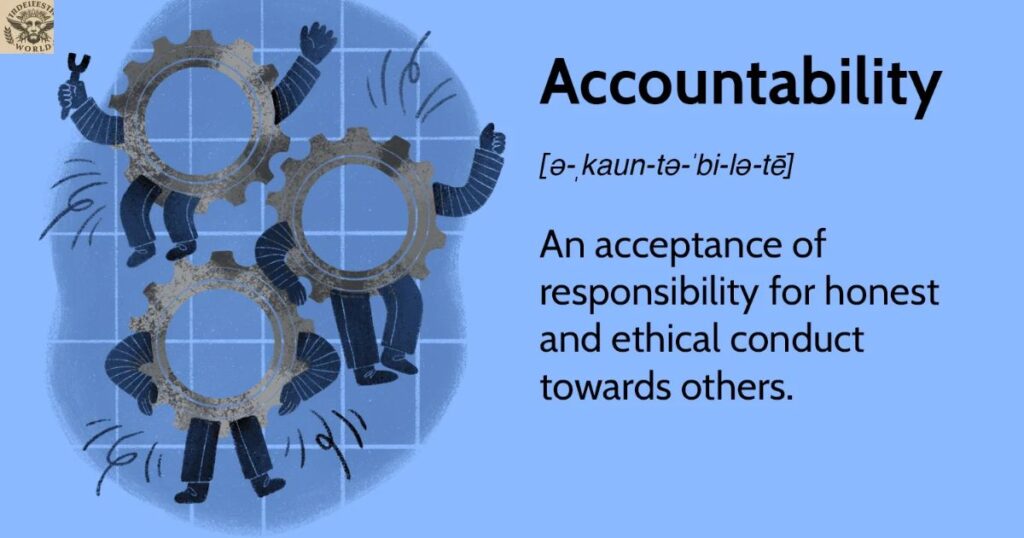
It is critical to know the definition of accountability because it is a word that comes up in the workplace, school, leadership, relationships, business, government, and other aspects of life. In simple English, accountability is defining the responsibility and taking the ownership to explain what happened.
Accountability isn’t simply just completing a task, it’s taking ownership of the result. It’s important that if the result is a positive outcome, an accountable person can explain how the result was achieved. On the other hand, it’s crucial that, in the case of a negative result, an accountable person does not avoid responsibility by blaming others. Rather, they accept responsibility and think of ways to improve the result in the future.
Accountability is related to responsibility, honesty, trust, and ownership. These terms can aid an individual in their personal and professional life. People who understand these terms have the opportunity to communicate with greater definition and strengthen their relationships.
What Is Accountability Meaning?
The basic accountability meaning is the obligation to accept responsibility for actions, decisions, duties, or results. It means being answerable for what a person does and being prepared to explain the outcome.
For example, if an employee is responsible for completing a report, accountability means taking ownership of the report’s completion and quality. If the report is late, the employee should be prepared to explain the reason and take steps to prevent the same problem from happening again.
Accountability is not only about admitting mistakes. It also includes following through on commitments, meeting expectations, communicating problems, and taking appropriate action when results are not as expected.
In simple words:
- Accountability means owning your actions and being answerable for their results.
Accountability Meaning in Simple English
For English learners, the easiest way to understand accountability meaning is:
Accountability means taking ownership of what you do and accepting responsibility for the results.
Consider a simple example. A student promises to complete an assignment by Friday. If the student finishes it on time, they have followed through on the commitment. If they cannot complete it, accountability means explaining the reason honestly rather than pretending that nothing happened.
Another example can be found at work. A manager gives an employee a specific project. The employee is expected to complete it and communicate progress. If a problem appears, an accountable employee informs the manager and works toward a solution.
What Does Accountability Mean?
What does accountability mean in everyday life? It means being answerable for your behavior, decisions, promises, and responsibilities.
A person can show accountability by:
- Keeping promises
- Admitting mistakes
- Meeting deadlines
- Explaining decisions
- Communicating problems
- Accepting consequences
- Correcting mistakes
- Following agreed rules
- Taking ownership of results
- Learning from failures
The accountability meaning becomes easier to understand when these behaviors are viewed together. Accountability is not simply saying “I am responsible. It involves actions that demonstrate ownership.
Read More: Anonymous Meaning: Definition, Examples, Uses, and Difference From Unknown
Accountability Meaning With Examples
Real examples make the concept easier to understand.
Example 1: Workplace
An employee accidentally sends the wrong file to a client. Instead of blaming a colleague, the employee admits the mistake, informs the manager, sends the correct file, and checks the process to avoid another error.
That is accountability.
Example 2: School
A student forgets to submit homework. The student explains the situation to the teacher and accepts the consequence instead of claiming that the assignment was lost by someone else.
That shows accountability.
Example 3: Business
A company promises to deliver an order on Monday but experiences a delay. The company informs the customer, explains the situation, and provides an updated delivery plan.
That is an example of organizational accountability.
Example 4: Personal Life
A person promises to call a friend but forgets. Instead of making an excuse, the person admits forgetting and apologizes.
That simple action demonstrates personal accountability.
Accountability Meaning in a Sentence
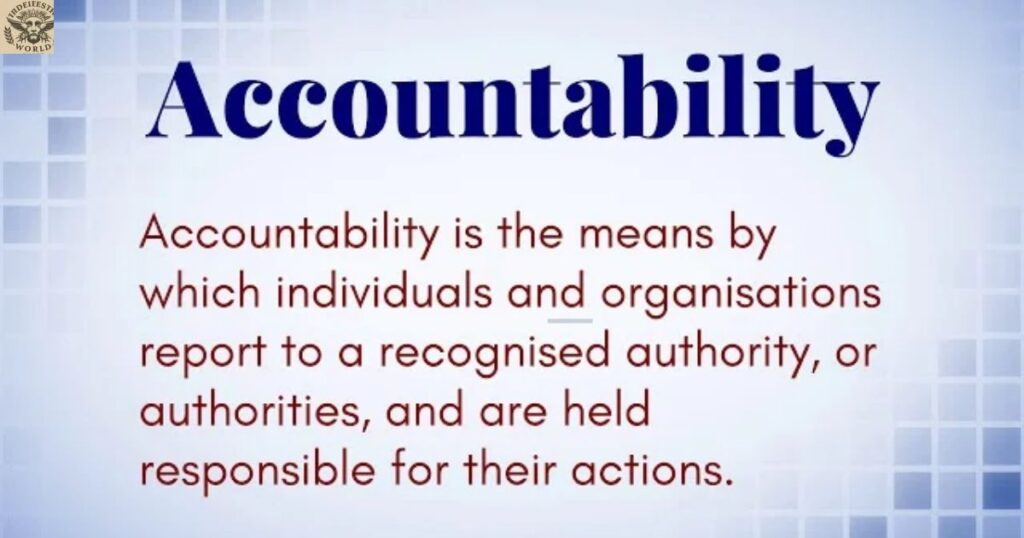
One of the best ways to understand accountability meaning is to see the word used naturally in sentences.
- The manager expects accountability from every team member.
- Accountability helps employees take ownership of their work.
- The company introduced new rules to improve accountability.
- She accepted accountability for the mistake.
- Good leadership requires accountability.
- The teacher encourages accountability among students.
- Personal accountability can help people achieve their goals.
- The team leader promoted accountability by setting clear expectations.
- He showed accountability by admitting his error.
- The organization values honesty and accountability.
These examples show that accountability can be used in personal, educational, professional, and organizational contexts.
Accountability Meaning in the Workplace
Workplace accountability means employees and managers take ownership of their responsibilities and results. It involves completing assigned tasks, meeting deadlines, communicating effectively, and addressing problems honestly.
For example, suppose an employee is responsible for preparing a monthly report. If the employee completes the report accurately and on time, the responsibility has been fulfilled. If an error is discovered, accountability means acknowledging the mistake and taking action to correct it.
A workplace with clear accountability often has clearly defined roles. Employees know what they are expected to do, managers can monitor progress, and problems can be addressed before they become larger issues.
The accountability meaning in a workplace is therefore closely related to ownership and answerability.
Accountability Meaning in Business
Businesses use accountability to establish clear expectations and improve performance. Managers may assign specific duties to employees, teams, or departments.
For example, a sales manager may be accountable for meeting a department target. A finance team may be accountable for accurate financial reporting. A customer service team may be accountable for responding to customer concerns.
Business accountability does not mean that one person is blamed for every problem. Good accountability systems identify roles, expectations, processes, and outcomes.
Clear communication is an important part of the process. People need to understand what they are accountable for before they can reasonably be expected to deliver results.
Accountability Meaning in Leadership
Leadership and accountability are closely connected. A leader who expects accountability from others should also demonstrate ownership of their own decisions.
An accountable leader communicates expectations clearly, accepts responsibility for decisions, listens to feedback, and addresses problems directly.
For example, if a team fails to meet an important deadline, an accountable leader does not simply blame the team. The leader can review what happened, identify contributing factors, communicate with the team, and make improvements.
This does not mean that every problem belongs to the leader alone. Instead, leadership accountability means recognizing the leader’s own role and responsibilities.
Accountability Meaning in Education
Accountability is also important in education. Students learn to take ownership of their schoolwork, attendance, deadlines, behavior, and academic goals.
For example:
- The teacher encouraged students to develop accountability for their assignments.
This means students were expected to take ownership of completing their work.
Teachers and school administrators can also have accountability responsibilities. They may be expected to provide instruction, communicate with families, manage classrooms, or follow established policies.
The concept works at different levels because accountability is about accepting ownership of one’s specific role.
Accountability Meaning in Personal Life
Personal accountability means taking ownership of your choices and actions. It applies to habits, commitments, relationships, finances, time management, and personal goals.
For example, someone who wants to improve their study habits may create a schedule and follow it. If they do not follow the schedule, personal accountability means recognizing the problem and adjusting the plan.
Personal accountability does not require perfection. Everyone makes mistakes. The important part is being willing to recognize those mistakes and take reasonable steps toward improvement.
Accountability Meaning in Relationships
Healthy relationships often involve accountability. People make promises, communicate expectations, and sometimes make mistakes.
For example, if someone says something hurtful to a friend, accountability involves recognizing the behavior, acknowledging its impact, apologizing sincerely, and making an effort to communicate more carefully in the future.
Accountability does not mean accepting blame for everything. It means taking responsibility for your own actions and recognizing how those actions affect others.
This distinction is important because accountability should be based on honest responsibility rather than unfair blame.
Accountability vs Responsibility
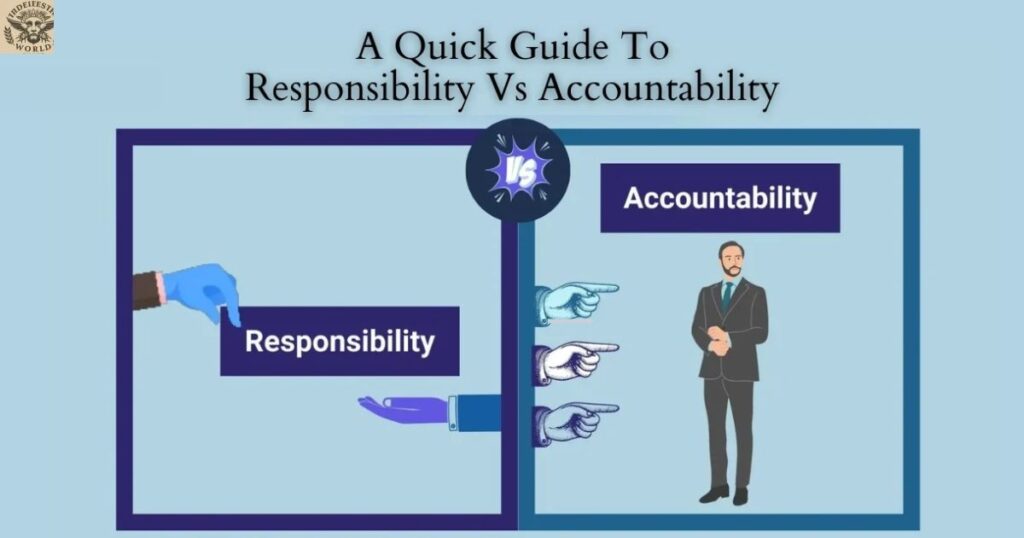
Accountability and responsibility are closely related, but they are not exactly the same.
Responsibility generally refers to having a duty or obligation to complete something. Accountability involves being answerable for the outcome of that responsibility.
For example, an employee may be responsible for preparing a presentation. The employee may then be accountable for the quality, completion, and delivery of that presentation.
A simple way to remember the difference is:
Responsibility = the duty to do something.
Accountability = being answerable for what happens as a result.
Accountability vs Responsibility Table
| Term | Meaning | Example |
| Responsibility | A duty or task someone is expected to handle | She is responsible for the report. |
| Accountability | Being answerable for actions or results | She is accountable for the report’s accuracy. |
| Ownership | Taking personal control of a task or result | He took ownership of the project. |
| Obligation | Something a person is expected or required to do | He has an obligation to meet the deadline. |
| Answerability | Being expected to explain an action or decision | The manager has answerability for the decision. |
These terms overlap, but they should not always be treated as exact synonyms.
Accountability Meaning vs Blame
Accountability is not the same as blame.
Blame usually focuses on identifying who caused a problem. Accountability focuses on understanding responsibility, addressing the problem, and improving the situation.
Imagine that a project misses an important deadline. A blame-focused response might simply ask, “Who caused this?
An accountability-focused response may ask:
- What happened?
- Who was responsible for each part?
- What information was missing?
- What could have been done differently?
- How can the team prevent the same problem?
This approach makes the accountability meaning more practical and constructive.
Why Is Accountability Important?
Accountability matters because it can help create trust and clarity. When people know who is responsible for specific tasks, confusion can be reduced.
Accountability can also encourage people to follow through on commitments. If employees, students, or team members understand their responsibilities, they are more likely to monitor their progress and communicate when problems arise.
Some important benefits associated with accountability include:
- Clear expectations
- Better communication
- Stronger trust
- Improved ownership
- Better problem-solving
- More consistent follow-through
- Learning from mistakes
- Greater transparency
Accountability alone does not guarantee success, but clear accountability can support effective teamwork and decision-making.
Accountability and Trust
Trust grows when people consistently do what they say they will do. Accountability supports that process because it encourages people to communicate honestly about commitments and results.
For example, if a colleague cannot finish a task on time, informing the team early is more accountable than staying silent until the deadline passes.
Trust can also be damaged when people repeatedly avoid responsibility or blame others for their own actions.
Therefore, accountability is often an important part of reliable relationships.
Accountability and Transparency
Transparency means making relevant information clear and accessible to appropriate people. Accountability means being answerable for actions and results.
The two concepts can work together.
For example, a company may clearly explain how a decision was made. The responsible managers may also be expected to explain the outcome of that decision.
Transparency helps people understand what happened, while accountability establishes who is answerable for the relevant decisions or actions.
Accountability in Teamwork
Teams need clear accountability because multiple people may contribute to the same project.
Imagine a website project involving writers, designers, developers, and managers. If nobody knows who is responsible for each stage, delays and confusion can occur.
A team can improve accountability by defining:
- Individual roles
- Project deadlines
- Expected results
- Communication channels
- Progress checks
- Decision-making responsibilities
When these expectations are clear, team members can understand their own responsibilities and coordinate with others.
Accountability Meaning in Management
Managers often use accountability to establish performance expectations. A manager may assign tasks, define deadlines, monitor progress, and review results.
Effective accountability should be realistic. People need the authority, resources, information, and time required to complete the responsibilities assigned to them.
For example, asking an employee to meet a target without providing the necessary tools may create an unfair accountability system.
Good management therefore connects expectations with resources and clear communication.
Personal Accountability Examples
Personal accountability can appear in ordinary situations.
- Keeping a Promise
If you promise to complete a task, completing it demonstrates accountability.
- Admitting a Mistake
If you make an error, acknowledging it shows ownership.
- Meeting a Deadline
Finishing work when promised demonstrates follow-through.
- Correcting a Problem
Fixing a mistake rather than ignoring it is another form of accountability.
- Communicating Early
If you know that a deadline cannot be met, informing the relevant person early can demonstrate responsible behavior.
These examples show that personal accountability is not limited to workplaces or formal institutions.
Accountability Meaning in Leadership and Teams
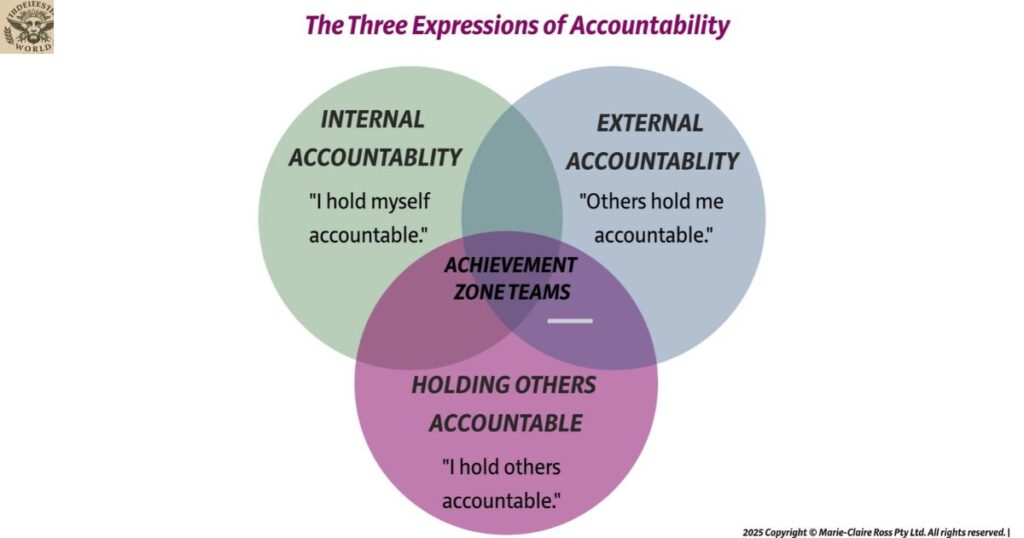
Leadership accountability can influence team culture. When leaders demonstrate ownership, team members may better understand the expectations around responsibility.
A leader can encourage accountability by:
- Setting clear expectations.
- Assigning specific responsibilities.
- Providing necessary resources.
- Checking progress.
- Listening to concerns.
- Recognizing successful work.
- Addressing problems fairly.
- Learning from failures.
The goal is not to create fear. The goal is to create clarity about roles and expectations.
How to Develop Personal Accountability
Personal accountability can be developed through practical habits.
- Set Clear Goals
A vague goal is difficult to measure. Clear goals make it easier to know whether progress is being made.
- Track Commitments
Writing down tasks and deadlines can make responsibilities easier to manage.
- Admit Mistakes
Everyone makes mistakes. Acknowledging an error allows a person to focus on solving it.
- Avoid Automatic Blame
Before blaming another person, consider your own role in the situation.
- Communicate Early
If a problem may affect a deadline, communicate before the problem becomes larger.
- Review Results
After completing a task, consider what worked and what could be improved.
These habits can strengthen personal accountability over time.
Accountability Meaning in Communication
Communication is a major part of accountability. People cannot effectively manage responsibilities if expectations are unclear.
For example, instead of saying:
“Finish it soon.
A clearer instruction would be:
- “Please complete the report by Friday at 3 p.m.
The second statement creates a measurable expectation.
Accountable communication also includes giving honest updates. If progress is slower than expected, communicating the issue early gives others an opportunity to respond.
Accountability Meaning in Performance
Performance accountability means being answerable for agreed results. It is commonly used in professional environments.
For example, a sales employee may have specific monthly goals. The employee and manager can review progress and discuss factors affecting the results.
Performance accountability should consider relevant circumstances. A fair system does not judge results without considering whether the person had the necessary resources, information, authority, and opportunity to perform the task.
Accountability Meaning in Organizations
Organizational accountability refers to how an organization accepts responsibility for its decisions, actions, policies, and outcomes.
An organization may establish accountability through:
- Clear policies
- Defined roles
- Internal controls
- Reporting systems
- Performance reviews
- Audits
- Feedback processes
- Ethical standards
The exact system depends on the type and size of the organization.
Accountability Meaning in Government and Public Institutions
The word accountability is also widely used when discussing public institutions. In this context, it generally refers to the expectation that officials and institutions explain decisions, follow applicable rules, and remain answerable for their actions.
For example:
- Public accountability requires clear explanations of important decisions.
The exact mechanisms can vary by country and institution. They may include reporting, audits, oversight, public records, formal reviews, or other established processes.
The key idea remains answerability.
Accountability Meaning in Finance
Financial accountability involves responsible management and reporting of money and financial resources.
For example, an organization may require employees to document expenses. A department may also have to report how a budget was used.
A simple example is:
- The finance department is accountable for maintaining accurate financial records.
This means the department has an obligation to manage and explain its financial responsibilities appropriately.
Accountability Meaning in Healthcare
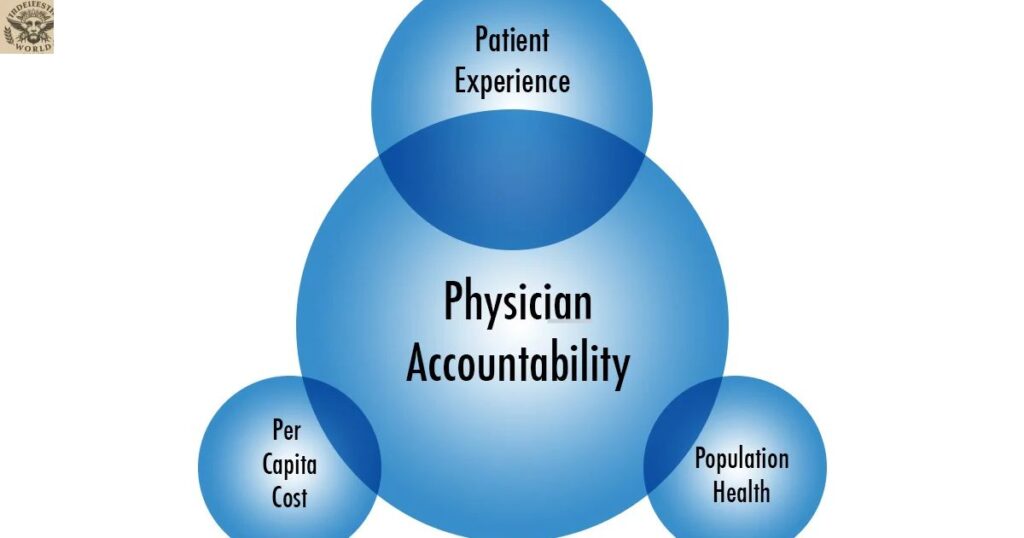
Healthcare organizations also use accountability to describe responsibilities related to patient care, professional duties, safety procedures, and organizational standards.
For example:
Healthcare professionals are accountable for following relevant professional standards.
The exact responsibilities depend on the role, workplace, and applicable rules.
Accountability Meaning in Customer Service
Customer service teams may be accountable for responding to customer questions, resolving problems, and following service standards.
For example:
The support team is accountable for responding to customer complaints within the agreed time.
Clear expectations can help both employees and customers understand what level of service is expected.
Accountability Meaning in Project Management
Project management depends heavily on clear accountability. A project usually contains many tasks, deadlines, and contributors.
Project managers can assign responsibilities for each stage and establish who is accountable for particular deliverables.
For example:
The designer is responsible for creating the graphics, while the project manager is accountable for delivering the completed project on schedule.
The exact division depends on the organization, but the example demonstrates the distinction between responsibility and accountability.
Accountability Meaning in Social Media
Social media discussions sometimes use accountability to describe taking ownership of online behavior.
For example:
The company accepted accountability for the misleading post and corrected the information.
Another example:
Users should take accountability for the content they publish.
Online accountability can be complicated because people may communicate under usernames, across different platforms, or with limited context. Still, the basic concept remains responsibility for one’s own actions.
Accountability Meaning in Daily Conversation
In casual English, people often use accountability when discussing personal goals.
Examples include:
- “I need more accountability to stay consistent.
- “My friend keeps me accountable.
- “We hold each other accountable.
- “He took accountability for his mistake.
- “The team needs greater accountability.
The phrase “hold someone accountable is particularly common.
What Does “Hold Someone Accountable Mean?
“Hold someone accountable means expecting a person to take responsibility for their actions, duties, or results.
For example:
- The manager held the employee accountable for the missed deadline.
This means the manager expected the employee to explain the situation and take responsibility for the relevant work.
Another example:
- The coach holds players accountable for following team rules.
The expression is common in workplaces, schools, sports, and personal relationships.
What Does “Take Accountability Mean?
“Take accountability means accepting ownership of one’s actions or results.
For example:
- She took accountability for the mistake.
This means she accepted responsibility rather than avoiding the issue.
In many contexts, “take responsibility is more traditional and natural English, while “take accountability is also widely used in modern professional communication.
What Does “Be Accountable Mean?
To be accountable means to be answerable for something.
Example:
- Managers are accountable for their team’s performance.
Another example:
- Each employee is accountable for completing assigned tasks.
Being accountable means understanding what you are expected to do and being prepared to explain the outcome.
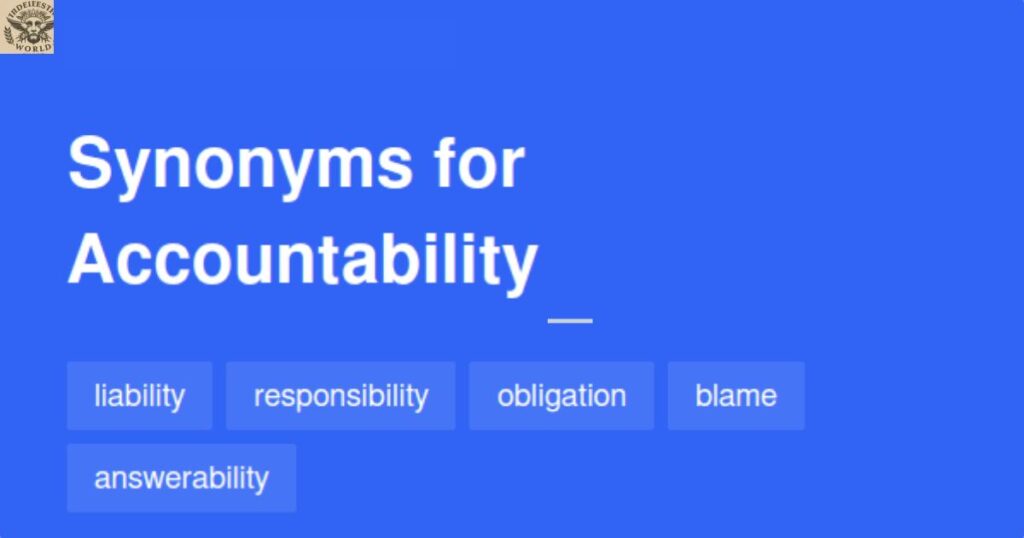
What Are the Synonyms of Accountability?
Common words and phrases related to accountability meaning include:
- Responsibility
- Answerability
- Ownership
- Liability
- Obligation
- Dependability
- Transparency
- Duty
- Commitment
- Reliability
These are not perfect synonyms in every context.
For example, liability often has a legal or financial meaning, while accountability is broader and can apply to everyday behavior.
Accountability Meaning: Related Words
Understanding related vocabulary can improve English comprehension.
Accountable
Accountable is an adjective.
Example:
- The manager is accountable for the final decision.
Accountability
Accountability is a noun.
Example:
- Accountability is important in effective teamwork.
Account
The word “account has several meanings and is not always connected to accountability.
For example:
- She gave an account of what happened.
In this context, account means a description or explanation.
Common Questions About Accountability
People often search for answers to questions such as:
- What is accountability in simple words?
- What does accountability mean?
- What is the difference between accountability and responsibility?
- Why is accountability important?
- How do you show accountability?
- What does it mean to hold someone accountable?
- Is accountability the same as blame?
- How can I develop personal accountability?
- What are examples of accountability?
- What does accountability mean at work?
These questions all connect to the central idea of being answerable for actions, decisions, duties, or results.
Accountability Meaning: Quick Examples Table
| Situation | Example of Accountability |
| School | A student accepts responsibility for missing an assignment. |
| Workplace | An employee owns a mistake and fixes it. |
| Leadership | A manager explains a decision and its results. |
| Business | A company addresses a customer problem openly. |
| Relationships | A person admits when their behavior caused harm. |
| Teamwork | Each member completes their assigned part. |
| Personal goals | A person tracks progress toward a commitment. |
| Finance | A department accurately reports how funds were used. |
Accountability Does Not Mean Perfection
An important point about accountability meaning is that accountability does not require a person to be perfect.
Mistakes are normal. Unexpected problems can happen even when people work carefully.
Accountability means responding honestly when something goes wrong. Instead of hiding the mistake, an accountable person can acknowledge it, understand what caused it, communicate with the relevant people, and take reasonable corrective action.
This makes accountability different from a demand for flawless performance.
Accountability and Learning From Mistakes
Mistakes can provide useful information. An accountable person can review what happened and identify ways to improve.
For example, if a project fails because the deadline was unrealistic, the team can review the planning process. If communication was poor, the team can improve its communication system.
The goal is not simply to identify a person at fault. The goal can also include understanding the process and reducing the chance of repeating the same problem.
Final Understanding of Accountability Meaning
The clearest accountability meaning is being answerable for your actions, decisions, responsibilities, and results. It involves ownership, honesty, communication, and a willingness to address problems when they occur.
Accountability appears in almost every part of life. Students are accountable for their schoolwork, employees for their assigned duties, managers for their decisions, organizations for their operations, and individuals for their personal choices.
The strongest understanding of accountability comes from looking at behavior rather than the word alone. Completing commitments, admitting mistakes, communicating honestly, correcting problems, and learning from outcomes are practical examples of accountability.
Frequently Asked Questions About Accountability Meaning
What is accountability meaning in simple words?
Accountability meaning in simple words is taking ownership of your actions and being answerable for their results. It means accepting responsibility rather than avoiding it.
What is an example of accountability?
An employee who makes a mistake, admits it, informs the manager, corrects the problem, and learns from the situation is showing accountability.
What is the difference between accountability and responsibility?
Responsibility usually means having a duty or task to complete. Accountability means being answerable for the actions, decisions, or results connected with that responsibility.
What does holding someone accountable mean?
Holding someone accountable means expecting them to take responsibility for their actions, duties, decisions, or results. It does not necessarily mean blaming them.
Why is accountability important?
Accountability can create clearer expectations, improve communication, strengthen trust, support better teamwork, and encourage people to address mistakes instead of ignoring them.
Conclusion
Accountability meaning centers on ownership and answerability. It means accepting responsibility for actions, decisions, duties, and results. The concept appears in workplaces, schools, businesses, leadership, relationships, personal development, and everyday communication. Accountability is demonstrated through practical behavior such as keeping commitments, admitting mistakes, communicating problems, and taking corrective action.
Learning accountability meaning also helps distinguish accountability from responsibility, blame, privacy, obligation, and ownership. Accountability does not mean perfection or accepting blame for everything. It means being honest about your own role and being willing to address the results of your actions. When practiced fairly and clearly, accountability can support trust, reliability, and effective cooperation.

