

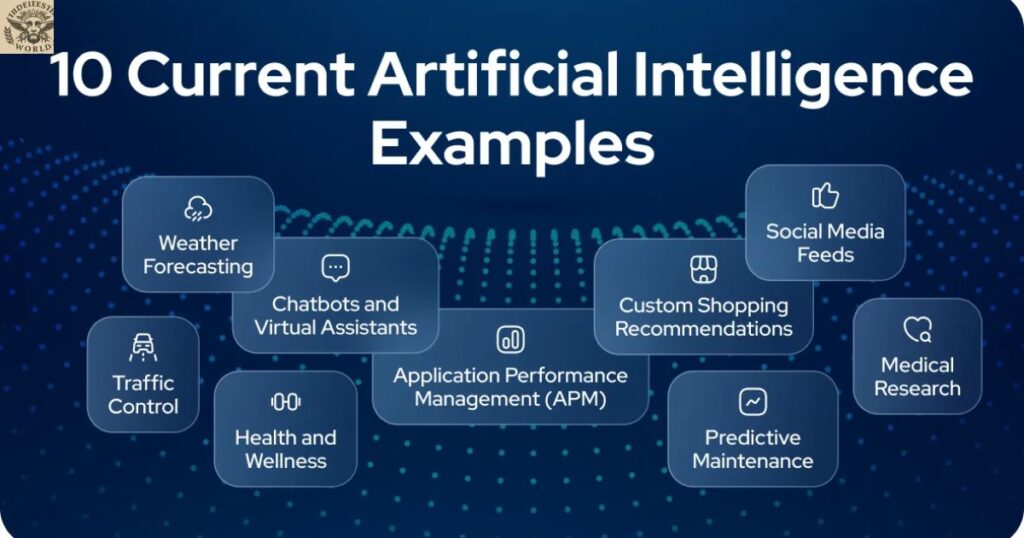
Artificial Intelligence meaning refers to the idea of computer systems performing tasks that normally require human intelligence. These tasks can include learning from information, understanding language, recognising images, solving problems, making predictions, and supporting decisions. AI allows software and machines to process information and produce useful results without following only a fixed set of instructions.
In simple terms, artificial intelligence helps machines perform intelligent tasks. Modern AI can be found in search engines, smartphones, recommendation systems, chatbots, translation tools, navigation apps, healthcare software, financial systems, and many other technologies. Some AI systems perform one specific task, while newer systems can work across several types of information and tasks.
Understanding the Artificial Intelligence meaning is important because AI has become part of everyday technology. It is not limited to robots or science-fiction movies. Many people interact with AI without noticing it, such as when an email service filters spam, a streaming platform recommends content, or a phone recognises speech.
What Is Artificial Intelligence?
Artificial intelligence is a field of computer science focused on creating systems that can perform tasks associated with human intelligence. These tasks may involve learning, reasoning, perception, language processing, pattern recognition, planning, and problem-solving. The system receives information, processes it using algorithms or models, and produces an output.
The Artificial Intelligence meaning can therefore be understood as the development of computer systems that can perform intelligent functions. AI does not necessarily mean that a machine thinks exactly like a human. Instead, an AI system is designed to complete particular tasks using computational methods, data, rules, or learned patterns.
Artificial Intelligence Meaning in Simple English
In simple English, artificial intelligence means teaching computers or machines to perform tasks that usually require human intelligence. A computer can analyse information, identify patterns, understand certain language, recognise objects, or make predictions based on the system it has been designed or trained to use.
For example, a voice assistant can process spoken words and respond to a request. A recommendation system can analyse previous activity and suggest products or videos. These examples show the practical side of the Artificial Intelligence meaning without requiring a machine to behave exactly like a human.
Artificial Intelligence Definition
Artificial intelligence is commonly described as the ability of machines or computer systems to perform functions associated with human intelligence. These functions can include learning from data, recognising patterns, understanding language, reasoning, planning, and solving problems.
The term covers a broad range of technologies rather than one single program. Machine learning, natural language processing, computer vision, robotics,Artificial Intelligence Meaning and other approaches can form part of the wider AI field. As a result, artificial intelligence can be applied to many different industries and tasks.
How Does Artificial Intelligence Work?

AI systems generally work by receiving information, processing that information, identifying patterns or applying programmed logic, and generating an output. The exact process depends on the type of AI system. A simple rule-based system may follow predefined instructions, while a machine-learning system can learn patterns from training data.
Modern AI systems often rely on models trained with large amounts of data and significant computing resources. During training, a model adjusts internal parameters to improve its performance on a particular task. After training, the model can process new information and generate predictions, classifications, recommendations, or other outputs.
Basic AI Process
| Stage | What Happens |
| Data input | Information is provided to the system |
| Processing | Algorithms or models analyse the information |
| Pattern recognition | The system identifies useful relationships or patterns |
| Learning | Some systems improve through training and feedback |
| Output | The system produces a prediction, response, or action |
| Evaluation | Results can be checked and improved |
The process can be much more complex in advanced systems, but these stages provide a simple way to understand how AI works.
What Are the Main Types of Artificial Intelligence?
AI can be classified in several ways. One common classification considers the capability of the system, while another considers how the system operates. The most widely discussed capability categories are narrow AI, artificial general intelligence, and artificial superintelligence.
Most AI applications used today are forms of narrow AI. They are designed to perform specific tasks or groups of related tasks. Artificial general intelligence and artificial superintelligence are broader concepts often discussed in research and future-oriented conversations rather than as ordinary consumer technologies.
Types by Capability
| Type | Meaning | General Status |
| Narrow AI | Designed for specific tasks | Widely used |
| Artificial General Intelligence | Hypothetical AI with broad human-like capabilities | Research concept |
| Artificial Superintelligence | Hypothetical intelligence exceeding human capabilities broadly | Theoretical concept |
These categories help explain the Artificial Intelligence meaning from a broader perspective. They should not be confused with individual AI products, because a single application may use several AI techniques.
What Is Narrow AI?
Narrow AI is an artificial intelligence system designed to perform a particular task or a limited range of tasks. Examples include spam detection, image recognition, speech recognition, recommendation systems, fraud detection, and language translation.
A narrow AI system can perform its intended task very effectively without possessing general human intelligence. For example, a system trained to identify objects in images may be highly capable at image classification but cannot automatically perform unrelated tasks such as preparing a legal document or repairing a machine.
Read More:Affidavit Meaning: Definition, Types, Uses, Examples, and How It Works
What Is Artificial General Intelligence?
Artificial General Intelligence, often called AGI, refers to a hypothetical form of AI capable of performing a broad range of intellectual tasks at a level comparable to general human intelligence. The concept goes beyond systems designed for one specific application.
AGI remains a subject of research and debate. Different researchers and organisations can also use different definitions of what would qualify as AGI. Therefore, claims about AGI should be evaluated carefully rather than treating every advanced AI system as general intelligence.
What Is Artificial Superintelligence?
Artificial superintelligence is a hypothetical concept describing an AI system that would exceed human intellectual abilities across a very broad range of tasks. It is mainly discussed in theoretical, philosophical, and future-oriented contexts.
Artificial superintelligence is not the same as the AI tools people commonly use today. Current AI applications are generally designed for specific capabilities and operate within technical, data, and system constraints.
What Is Machine Learning?
Machine learning is a major area of artificial intelligence in which computer systems use data to learn patterns and improve performance on a task. Instead of relying entirely on manually written rules for every possible situation, a machine-learning model can identify relationships within training data.
Machine learning is used in recommendation systems, fraud detection, forecasting, image recognition, speech technology, search systems, and many other applications. It is one of the most important technologies for understanding how modern AI systems can learn from examples.
What Is Deep Learning?
Deep learning is a type of machine learning that uses neural networks with multiple layers. These networks can learn complex patterns from large amounts of data and have become especially important for image, Artificial Intelligence Meaning,speech, language, and other high-dimensional tasks.
Deep learning has contributed to major advances in areas such as computer vision and natural language processing. However, deep learning is only one part of the larger AI field. Not every artificial intelligence system uses deep neural networks.
What Are Neural Networks?
Neural networks are computational models inspired loosely by the way biological neural systems process information. They contain connected units arranged in layers and can learn patterns by adjusting numerical parameters during training.
A neural network can receive inputs such as images, text, audio, or numerical data and transform them through several processing layers. During training, the system adjusts its parameters based on examples so that its output becomes more accurate for the intended task.
What Is Generative AI?
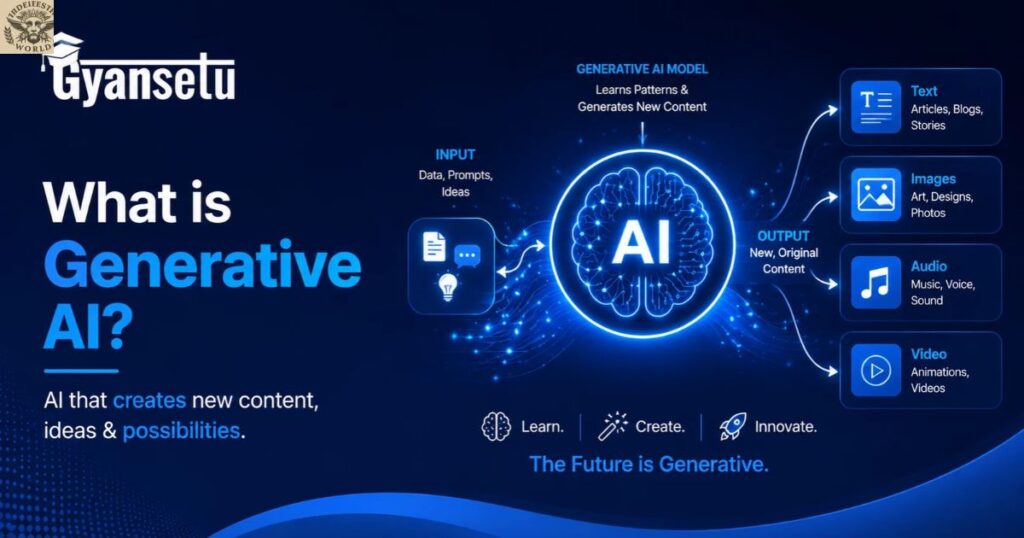
Generative AI refers to AI systems that can create new content based on patterns learned from data. Depending on the system,Artificial Intelligence Meaning, generated content can include text, images, audio, video, software code, or other forms of media.
Generative AI has expanded public awareness of the Artificial Intelligence meaning because people can interact directly with systems that produce human-readable or creative outputs. However, generated content can contain errors,Artificial Intelligence Meaning, so important information should be reviewed rather than accepted automatically.
Examples of Artificial Intelligence
AI is used in many everyday technologies. Search engines can use AI-related systems to understand queries and organise information. Email services can identify spam or suspicious messages. Streaming and shopping platforms can recommend content or products based on patterns in user activity.
Smartphones also use AI in features such as speech recognition, photography enhancement, face detection, translation, and predictive text. These applications show that the Artificial Intelligence meaning extends far beyond physical robots. Much of AI exists as software operating behind familiar digital services.
Everyday AI Examples
| Example | Possible AI Function |
| Voice assistants | Speech recognition and language processing |
| Search engines | Query understanding and ranking systems |
| Streaming platforms | Recommendations |
| Email services | Spam and threat detection |
| Smartphones | Image and speech features |
| Navigation apps | Route and traffic analysis |
| Online stores | Product recommendations |
| Translation tools | Language processing |
| Banking systems | Fraud detection |
| Customer service | Automated responses |
Uses of Artificial Intelligence
Artificial intelligence is used across many industries because computers can process large amounts of information quickly. Organisations use AI for tasks such as prediction, classification, automation, pattern detection, recommendation, and language processing.
The usefulness of AI depends on the quality of the data, the design of the system, the task being performed, and the way people use the output. AI can support human work,Artificial Intelligence Meaning, automate repetitive processes, or help professionals analyse information, but it does not remove the need for human oversight in every situation.
Artificial Intelligence in Healthcare
Healthcare organisations can use AI-related technologies for medical imaging, administrative automation, research, data analysis, clinical decision support, and other applications. AI can help identify patterns in large datasets and assist professionals with certain information-intensive tasks.
Healthcare is a sensitive area, so AI outputs require appropriate validation and professional oversight. An AI system should not automatically be treated as a replacement for qualified medical professionals. The reliability of any healthcare application depends on its specific design, training, validation, and intended use.
Artificial Intelligence in Education
AI can support education through personalised learning tools, automated feedback, language assistance, tutoring systems, accessibility features, and administrative tools. A learning system may adjust content or practice activities based on a student’s previous performance.
Teachers and educational institutions can also use AI to reduce repetitive administrative work. At the same time, educational use raises questions about accuracy, academic integrity, privacy, and appropriate student use. Clear policies can help define how AI tools should be used.
Artificial Intelligence in Business
Businesses use AI for customer service, sales forecasting, marketing analysis, fraud detection, document processing, recommendation systems,Artificial Intelligence Meaning, and workflow automation. AI can process large datasets and identify patterns that may be difficult to find manually.
For businesses, the value of AI depends on whether it solves a genuine problem. A well-designed system can reduce repetitive work and provide useful information, while a poorly designed system can produce inaccurate or biased results. Human review remains important for significant decisions.
Artificial Intelligence in Banking and Finance
Financial institutions use AI-related technologies for fraud detection, transaction monitoring, risk analysis, customer support, document processing, and other operations. These systems can analyse large numbers of transactions and identify unusual patterns.
Financial AI systems require strong controls because mistakes can affect people’s money and access to services. Data quality, security, privacy, transparency,Artificial Intelligence Meaning, and regulatory requirements are important considerations when deploying AI in financial environments.
Artificial Intelligence in Transportation
Transportation systems can use AI for traffic prediction, route optimisation, logistics planning, demand forecasting, and driver-assistance technologies. These systems can process information from maps, sensors, traffic conditions, and historical patterns.
AI can help transportation organisations make operations more efficient, but physical-world applications require particularly careful testing. A system that affects vehicles, infrastructure, or passenger safety needs appropriate engineering controls and human oversight.
Artificial Intelligence in Manufacturing
Manufacturers can use AI for quality inspection, predictive maintenance, production planning, robotics, supply-chain management, and process optimization. Computer vision systems can inspect products for certain defects,Artificial Intelligence Meaning, while predictive models can identify patterns associated with equipment problems.
AI can therefore support both automation and decision-making in factories. However, successful implementation requires suitable sensors, reliable data,Artificial Intelligence Meaning, integration with existing systems, and workers who understand how to monitor and manage the technology.
Artificial Intelligence in Everyday Life: Common Examples
Artificial intelligence is already part of everyday life, even when people do not realise that AI is being used. When a search engine suggests results, a streaming app recommends a movie, or a smartphone predicts the next word while typing, AI can be working behind the feature. These everyday examples make the Artificial Intelligence meaning easier to understand because they show how AI operates in familiar situations.
AI can also help with navigation, online shopping, email filtering, translation, photography, customer service, and social media recommendations. For example, a navigation app can analyse traffic information and suggest a route, while an email service can identify messages that may be spam. These systems demonstrate how AI can process information and provide useful results in seconds.
Common AI Examples in Daily Life
| Everyday Example | How AI May Be Used |
| Google Search | Understanding queries and organising search results |
| Google Maps | Route planning, traffic analysis, and travel estimates |
| YouTube | Recommending videos based on viewing activity |
| Netflix | Personalised movie and show recommendations |
| Voice assistants | Understanding spoken commands and responding |
| Face unlock | Recognising a user’s facial features |
| Predictive text | Predicting words while typing |
| Email spam filters | Detecting unwanted or suspicious messages |
| Online shopping | Recommending products based on activity |
| Social media | Recommending posts, videos, and accounts |
| Translation apps | Processing and translating languages |
| Smartphone cameras | Scene recognition and image enhancement |
| Customer-service chatbots | Answering common questions automatically |
| Banking apps | Detecting unusual transactions or possible fraud |
| Smart home devices | Responding to commands and automating functions |
AI in Smartphones
Smartphones provide some of the clearest examples of AI in everyday life. Features such as voice recognition, face detection, predictive text, photo enhancement, translation, and personalised suggestions can use AI-related technologies. These features process information and provide results without requiring the user to understand the underlying technology.
For example, a smartphone camera may recognise a scene and automatically adjust image settings. A keyboard can predict the next word based on the text being entered. These simple interactions show the practical Artificial Intelligence meaning and explain why AI is no longer limited to specialised laboratories or advanced robots.
AI in Search and Recommendations
Search engines use sophisticated systems to understand what people are looking for and provide relevant results. Recommendation systems also use patterns in activity to suggest videos, music, products, news, or other content that may interest a user.
For example, watching several videos about a particular subject may influence the recommendations shown later. Similarly, an online store may suggest products related to previous searches or purchases. These systems demonstrate how AI can use patterns in data to personalise digital experiences.
AI in Navigation
Navigation applications can use AI-related technologies to analyse traffic conditions, road information, travel patterns, and other data. The system can then provide route suggestions or estimated travel times.
When traffic conditions change, the application may recommend another route. This is a practical example of how computer systems can process large amounts of information and produce useful predictions or recommendations for everyday decisions.
AI in Email
Email services can use AI and machine-learning techniques to identify spam, suspicious messages, and potentially harmful content. The system can analyse characteristics of incoming messages and classify them according to learned patterns or rules.
AI can also help users organise information and identify important messages. Although automated filtering is useful, no system is perfect, so users may still need to check spam folders and review important messages manually.
AI in Online Shopping
Online shopping websites often use recommendation systems to suggest products. These suggestions can be influenced by searches, viewed products, purchases, browsing patterns, and other information.
AI can also help retailers forecast demand, detect unusual transactions, manage inventory, and provide customer support. As a result, the Artificial Intelligence meaning becomes easier to understand when viewed through common shopping experiences rather than only through technical definitions.
AI in Social Media
Social media platforms can use automated systems to recommend posts, videos, accounts, advertisements, and other content. These systems can analyse patterns in user activity and interactions to determine which content may be relevant.
AI can also support content moderation, image analysis, spam detection, and other platform functions. The exact technology varies between platforms, but the general idea is similar: software processes large amounts of information to produce classifications or recommendations.
AI in Customer Service
Many websites now use AI-powered chatbots to answer common questions. A chatbot can recognise a user’s request and provide information about orders, account services, products, appointments, or other routine topics.
More complicated issues may still require human support. AI customer service therefore often works as an additional layer that handles simple or repetitive requests while human representatives manage cases that need greater context or judgment.
AI in Smart Homes
Smart home systems can use AI-related technologies to respond to voice commands, automate certain functions, recognise patterns, and personalise settings. Examples include smart speakers, security cameras, thermostats, and other connected devices.
For example, a smart device may recognise a spoken command and perform a requested action. A security system may analyse camera footage for certain types of activity. Such applications show how AI can connect digital intelligence with physical devices in the home.
Artificial Intelligence in Marketing
Marketing platforms can use AI to analyse customer behaviour, segment audiences, personalise recommendations, generate content, and predict trends. AI can process large datasets and help marketers identify patterns in customer interactions.
Generative AI has also changed content workflows by helping create drafts, ideas, summaries, images, and other materials. Human review remains important because AI-generated marketing content can contain inaccurate claims, unsuitable language, or information that does not match a brand’s requirements.
Benefits of Artificial Intelligence
One major benefit of AI is its ability to process large amounts of information efficiently. A suitable AI system can analyse patterns much faster than a person performing the same repetitive calculation manually.
AI can also automate routine tasks and provide decision-support information. When implemented responsibly,Artificial Intelligence Meaning, it can help organisations save time, identify patterns, improve consistency, and create new services. The benefits, however, depend on the quality and suitability of the system.
Key Benefits
| Benefit | Description |
| Automation | Performs repetitive tasks |
| Speed | Processes large datasets quickly |
| Pattern detection | Finds relationships in data |
| Personalisation | Supports customised recommendations |
| Productivity | Can reduce certain manual workloads |
| Availability | Software systems can operate continuously |
| Decision support | Provides predictions or analysed information |
| Accessibility | Can assist with language and communication tasks |
Limitations of Artificial Intelligence
AI has important limitations. A model can produce incorrect information, misunderstand a request, rely on incomplete data, or generate an output that appears convincing but is wrong. Performance can also vary depending on the task and the quality of training or input data.
Another limitation is that AI systems do not automatically understand the world in the same way humans do. A system can recognise patterns without having human experience or common-sense understanding. For important decisions, people need to evaluate the context and limitations of the AI output.
AI Bias and Fairness
AI systems can reflect problems in their training data, design, or deployment. If the information used to develop a system contains imbalances or historical biases, the resulting model may reproduce or amplify some of those patterns.
Fairness is therefore an important part of responsible AI development. Organisations can use testing, monitoring, diverse datasets, documentation, human review, and other safeguards to identify and reduce unwanted outcomes. The appropriate approach depends on the particular application.
Artificial Intelligence and Privacy
AI systems can process large amounts of information, including personal or sensitive data in some applications. This creates important privacy considerations concerning collection, storage, access, sharing, and retention.
Organisations using AI should consider applicable privacy laws and establish appropriate data-management practices. Users should also understand what information an AI service collects and how that information may be handled when using digital tools.
Artificial Intelligence and Cybersecurity
AI can support cybersecurity by helping detect unusual activity, identify potential threats, analyse logs, and prioritise alerts. Security teams can use automated systems to process large volumes of information that would be difficult to review manually.
At the same time, AI can introduce new security risks. Attackers can use automation and AI-related techniques for harmful purposes, while AI applications themselves can become targets. Strong security controls are therefore important throughout the AI development and deployment process.
Artificial Intelligence and Jobs
AI can change the way people perform many types of work. Some repetitive tasks may become automated, while other jobs may increasingly involve working with AI tools,Artificial Intelligence Meaning, checking AI outputs, or managing AI-supported processes.
The effect is unlikely to be identical across every occupation. Some roles may change significantly, while others may experience smaller changes. New tasks and occupations can also develop as technology evolves. Human skills such as communication, judgment, creativity, domain expertise, and problem-solving can remain important alongside technical tools.
Is Artificial Intelligence the Same as a Robot?
No. Artificial intelligence and robotics are related but different concepts. AI refers to computational systems that perform tasks associated with intelligent behaviour, while robotics involves machines that can sense, move, and interact with the physical world.
A robot may use AI, but it does not have to. Similarly, most AI systems do not have a physical body. A chatbot, recommendation system, or translation model can be an AI system without being a robot.
Artificial Intelligence vs Machine Learning
Artificial intelligence is the broader field, while machine learning is one approach used to create AI systems. AI includes many techniques,Artificial Intelligence Meaning, such as rule-based reasoning, search, planning, machine learning, language processing, and computer vision.
Machine learning focuses on systems that learn patterns from data. Therefore, machine learning can be considered a major part of modern AI, but the two terms should not always be treated as exact synonyms.
AI vs Machine Learning
| Feature | Artificial Intelligence | Machine Learning |
| Meaning | Broad field of intelligent computing | Approach based on learning from data |
| Scope | Wider | Narrower |
| Methods | Includes many approaches | Uses statistical and computational learning methods |
| Data requirement | Varies | Usually important |
| Example | Rule-based expert system | Predictive model trained on examples |
Artificial Intelligence vs Human Intelligence
Human intelligence involves many abilities, including learning, reasoning, emotions, social interaction, physical experience, creativity,Artificial Intelligence Meaning, and adaptation. Artificial intelligence systems can reproduce certain functions associated with intelligence but operate through computational mechanisms.
An AI system may perform a specific task extremely well while lacking abilities that humans use naturally. Comparing AI with human intelligence therefore requires looking at a particular task rather than assuming that success in one area means general human-like intelligence.
Why Is Artificial Intelligence Important?
Artificial intelligence is important because it provides new ways to process information and automate tasks. Organisations can use AI to work with datasets,Artificial Intelligence Meaning, recognise patterns, personalise services, and support decisions.
The technology also affects how people search for information, communicate, create content, learn, shop, and interact with digital services. Understanding the Artificial Intelligence meaning helps people use these systems more effectively and recognise both their benefits and limitations.
Future of Artificial Intelligence
The future development of AI is likely to involve improvements in language systems, computer vision, robotics, scientific research, automation, personalised software, and other areas. AI may become more deeply integrated into everyday applications and professional workflows.
At the same time, future development will involve questions about safety, privacy, reliability, copyright, employment, security, accountability, and regulation. Technical progress alone does not determine how AI affects society. The way systems are designed, governed, and used also matters.
How to Learn About Artificial Intelligence
A beginner can start by understanding basic concepts such as algorithms, data, machine learning, neural networks, natural language processing, and computer vision. Learning through simple examples can make technical ideas easier to understand.
After learning the fundamentals, a learner can explore practical projects using programming languages and AI libraries. It is also useful to study responsible AI topics, including privacy, bias, security, evaluation, and reliability. A strong foundation helps people understand both the capabilities and limitations of modern AI.
Common Examples of AI Tools
Many modern digital products use AI in some form. Examples include chatbots, image-generation systems, speech-recognition software, translation tools, recommendation engines, search technologies, fraud-detection systems, and predictive analytics platforms.
The capabilities of these tools can change quickly as models and software are updated. Therefore, it is useful to evaluate a specific AI product based on its current features, intended purpose, reliability, privacy practices, and limitations rather than assuming that all AI tools work in the same way.
Common Misconceptions About Artificial Intelligence
One common misconception is that every AI system can think like a human. Most current AI applications are designed around particular tasks, and their capabilities depend heavily on their architecture, training, data, and operating environment.
Another misconception is that AI always produces correct answers. AI systems can make mistakes, produce incomplete information, or generate confident-looking responses that require verification. Understanding these limitations is an essential part of using AI responsibly.
Frequently Asked Questions:
What is Artificial Intelligence?
The Artificial Intelligence meaning is the use of computer systems to perform tasks associated with human intelligence.
What is artificial intelligence in simple words?
Artificial intelligence means creating computer systems that can perform certain tasks that normally require human intelligence.
What is an example of artificial intelligence?
Examples include voice assistants, recommendation systems, spam filters, image-recognition software, translation tools, fraud-detection systems, and generative AI applications.
What are the main types of AI?
AI is often discussed in terms of narrow AI, artificial general intelligence, and artificial superintelligence.
Is ChatGPT artificial intelligence?
Yes. ChatGPT is an AI-based conversational system that can process user prompts and generate responses.
Conclusion
The Artificial Intelligence meaning is best understood as the use of computer systems to perform tasks associated with human intelligence. These tasks can include learning from data, recognising patterns, understanding language, making predictions, solving problems, and generating content. AI is a broad field that includes machine learning, deep learning, natural language processing, computer vision, robotics, and other approaches.
Artificial intelligence is already used in healthcare, education, finance, transportation, manufacturing, marketing, cybersecurity, smartphones, search systems, and everyday digital services. At the same time, AI has limitations involving accuracy, bias, privacy, security, and reliability. Understanding how AI works and where its limitations exist can help people use the technology more effectively and responsib.

