


Triple lock meanings describe a pension protection system used for the UK State Pension. The system connects annual pension increases with three measures: inflation, average earnings growth, and a 2.5% minimum. The highest of these three figures determines the yearly increase in the State Pension.
The main purpose of the triple lock is to help protect pension income against rising prices and changes in wages. It also provides a minimum annual increase when inflation and earnings growth are both low. The policy has played an important role in UK pension discussions since its introduction.
Understanding triple lock meanings can make pension news easier to follow. The system affects millions of pensioners, but the exact amount received depends on pension entitlement, National Insurance records, pension type, and other rules. The sections below explain how the system works in simple terms.
What Does Triple Lock Mean?
The triple lock meaning refers to a UK policy that determines how the State Pension is increased each year. Three figures are considered during the calculation: Consumer Prices Index inflation, average earnings growth,Triple lock meanings and a fixed 2.5% floor. The highest figure becomes the annual increase.
In simple terms, the State Pension has three possible protection levels. Inflation can provide protection when prices rise quickly, earnings growth can provide protection when wages rise faster, and the 2.5% floor provides a minimum increase during periods of weaker growth. That structure explains why the policy is called a triple lock.
What Is the Triple Lock on State Pensions?
The State Pension triple lock applies to the basic State Pension and new State Pension under the annual uprating system. Each year, the relevant economic figures are assessed before the government sets the new pension rates. The mechanism is designed to maintain the value of pension income over time.
Triple lock pension meaning can therefore be understood as an annual State Pension increase based on the highest of three measures. The policy does not mean every pension payment rises by exactly the same amount because individual pension entitlement can vary according to National Insurance records and pension circumstances.
How Does the Triple Lock Work?
The triple lock mechanism compares three annual growth measures. CPI inflation, average earnings growth, and 2.5% are placed alongside one another, and the highest percentage is used for the State Pension increase. The process creates a simple rule for annual pension uprating.
For example, if inflation is 3%, earnings growth is 4%, and the 2.5% floor remains below both figures, the increase would be 4%. If inflation reaches 6% while earnings growth reaches 3%, the 6% figure would be used. If both economic measures remain below 2.5%, the minimum becomes relevant.
Triple Lock Meanings:
Triple lock meanings can also refer to the wider idea of three separate safeguards working together. In pension policy,Triple lock meanings, the three safeguards are price protection through inflation, wage protection through earnings growth, and a minimum annual increase through the 2.5% floor.
The system therefore combines different forms of protection rather than relying on one economic indicator. A pensioner may benefit from inflation protection during a period of high prices, while wage growth can become the main measure during periods of strong earnings increases.
Read More: Latest Gaming Play My World A Complete Guide to Gaming News, Guides and Updates
Why Is It Called the Triple Lock?
The name comes directly from the three-part structure of the policy. The State Pension increase is linked to three possible measures, with the highest measure determining the annual increase. Each measure acts as part of the overall pension protection mechanism.
The word “lock” refers to the protection built into the arrangement. The policy is designed to prevent the annual increase from falling below the highest applicable measure, including the 2.5% minimum. That combination gives the policy its widely used name, the triple lock.
What Are the Three Parts of the Triple Lock?
The three parts are CPI inflation, average earnings growth, and the 2.5% minimum. CPI measures changes in consumer prices, while average earnings growth measures changes in wages. The final component creates a floor for the annual State Pension increase.
| Triple lock measure | What it represents | Role in the system |
| CPI inflation | Changes in consumer prices | Helps protect purchasing power |
| Average earnings | Changes in wages | Links pensions with wage growth |
| 2.5% minimum | Fixed minimum increase | Provides a pension increase floor |
The highest of the three figures becomes the relevant annual increase. For that reason, the State Pension uprating can change from year to year. The system does not use a fixed percentage every year because inflation and wage growth can move differently.
How Inflation Affects the Triple Lock
Inflation is one of the most important parts of the triple lock calculation. When consumer prices rise strongly, the CPI figure can become the highest of the three measures. A higher inflation figure can therefore lead to a larger annual State Pension increase.
Inflation protection matters because pensioners may face higher costs for food, energy, housing, transport, and other household expenses. A higher State Pension increase can help maintain purchasing power, although the actual effect depends on how individual household costs change over time.
How Average Earnings Affect the Triple Lock
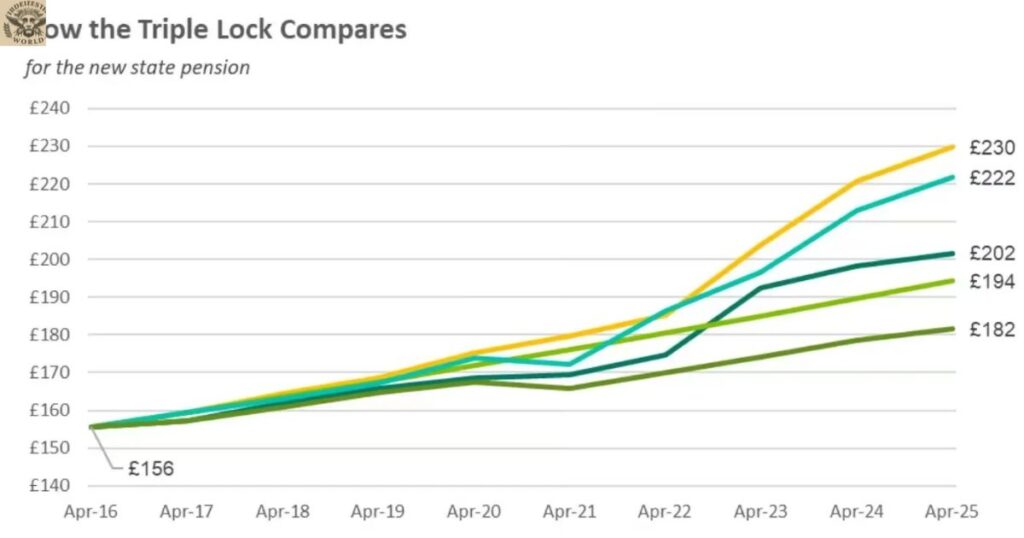
Average earnings growth represents changes in wages across the economy. When wage growth is higher than CPI inflation and also above 2.5%, earnings growth becomes the relevant triple lock percentage. Pension increases can therefore move in line with wider wage trends.
The earnings link also reflects the relationship between pension income and working-age incomes. Without an earnings element, State Pension growth could fall behind wages during periods of strong wage growth. The triple lock includes earnings as one of its three possible measures.
What Does the 2.5% Minimum Mean?
The 2.5% minimum means the State Pension increase cannot fall below 2.5% under the triple lock mechanism. The floor becomes important when both inflation and average earnings growth are lower than 2.5%. In such a situation, the 2.5% figure becomes the highest measure.
For example, if inflation is 1.5% and earnings growth is 2%, the annual increase would be 2.5%. The minimum therefore provides an additional layer of pension protection during periods of low economic growth. It is one of the main features that separates a triple lock from a simple inflation or earnings link.
How Is the Triple Lock Increase Calculated?
The triple lock calculation compares the relevant CPI inflation figure with the average earnings growth figure and the 2.5% floor. The highest percentage is selected for the annual State Pension increase. The calculation is therefore based on comparison rather than adding all three percentages together.
| CPI inflation | Earnings growth | 2.5% floor | Resulting increase |
| 2.0% | 3.0% | 2.5% | 3.0% |
| 5.0% | 3.5% | 2.5% | 5.0% |
| 1.2% | 1.8% | 2.5% | 2.5% |
| 4.0% | 4.8% | 2.5% | 4.8% |
The resulting percentage is then applied to the relevant State Pension rate. Individual pension payments can differ because entitlement depends on factors such as National Insurance records and pension history. The triple lock determines the uprating percentage, not a universal payment amount for every pensioner.
Triple Lock Examples: How the Formula Works
Suppose CPI inflation is 4%, average earnings growth is 3%, and the minimum is 2.5%. The highest figure is 4%,Triple lock meanings so the State Pension increase would be 4%. The other two figures do not get added to the inflation figure.
A second example can show the role of the floor. Suppose inflation reaches 1.4% and earnings growth reaches 1.9%. The 2.5% minimum is higher than both economic measures, so 2.5% becomes the applicable increase. Such examples make the triple lock formula easier to understand.
When Was the Triple Lock Introduced?
The UK triple lock was announced by the coalition government following the 2010 general election and was implemented from 2011/12. The policy changed the way State Pension increases were determined by introducing the three-part protection mechanism.
Before the triple lock, State Pension uprating had used different approaches over time. The introduction of the triple lock placed inflation, earnings growth, and a 2.5% minimum into one annual framework. House of Commons Library material records the policy history and its later changes.
Triple Lock Pension Latest News Today
For the 2026/27 financial year, the UK State Pension increased by 4.8% under the triple lock. The full new State Pension rose from £230.25 per week in 2025/26 to £241.30 per week in 2026/27. The full basic State Pension rose from £176.45 to £184.90 per week.
The 2026 increase reflects the earnings measure used for that year’s triple lock calculation. GOV.UK reported that more than 12 million pensioners were affected by the State Pension increase, with the full new State Pension rising by up to £575 a year for people receiving the full rate.
Triple Lock History
The history of the triple lock begins with its introduction for State Pension uprating in 2011/12. Since then, the mechanism has remained a major part of UK pension policy and has generated debate about pension protection, government spending, and long-term affordability.
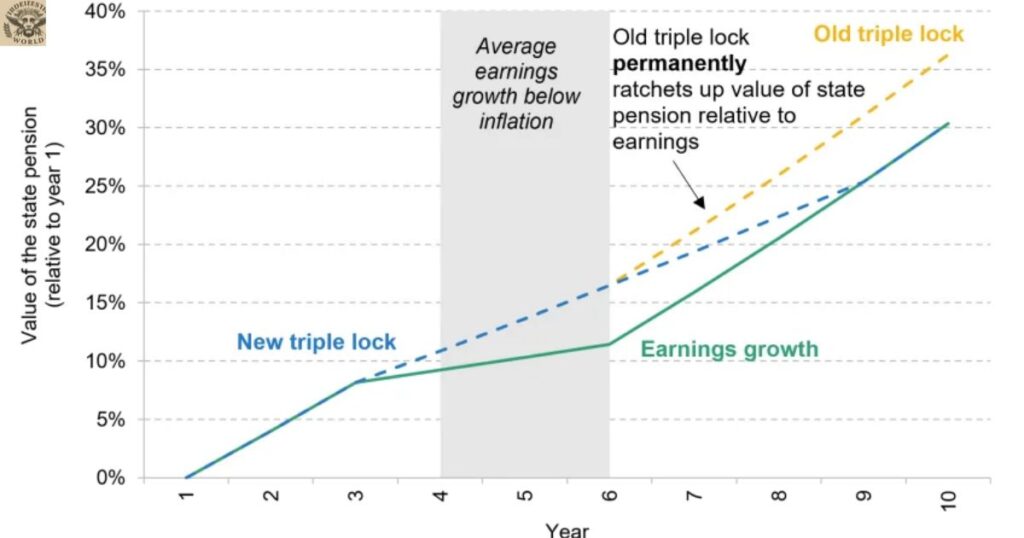
The policy has also experienced an unusual change. During the coronavirus period, earnings growth became unusually high because of economic distortions and labour-market effects. The earnings part of the triple lock was temporarily suspended for 2022/23, with legislation setting a different approach for that year.
Triple Lock Pension 2026
For 2026/27, the full new State Pension is £241.30 per week. The full basic State Pension is £184.90 per week. Actual payments can differ because not every person qualifies for the full amount. National Insurance records and individual pension circumstances affect entitlement.
The 4.8% increase shows how the triple lock can respond to earnings growth when earnings provide the highest applicable measure. Current government material also confirms a commitment to the Triple Lock for the duration of the Parliament, although future policy can depend on later government decisions and legislation.
Triple Lock Cost
The triple lock creates additional government pension spending when the chosen annual increase is higher than an alternative uprating method would have produced. The financial effect can become significant because State Pension payments cover millions of people.
The cost debate also involves long-term demographic trends. An ageing population can increase the number of people receiving pensions relative to the working population. For that reason, discussions about triple lock affordability often include government spending, pension sustainability, and intergenerational fairness.
Triple Lock Messi
“Triple lock Messi” is not a term used in UK State Pension policy. Triple lock meanings normally relate to pension uprating, Triple lock meanings,while Messi refers to football and has no role in the State Pension triple lock mechanism.
Search results can sometimes combine unrelated words because people search for different topics at the same time. For pension research, the relevant terms are triple lock, State Pension, CPI inflation, average earnings, and the 2.5% minimum.
Why Was the Triple Lock Introduced?
The triple lock was introduced to provide stronger protection for the value of the State Pension. Its structure links pension increases with both economic prices and wage growth while also creating a minimum annual increase. The policy was intended to support pension income during retirement.
Another aim was to improve the position of pensioners relative to wider society. If wages rise faster than prices,Triple lock meanings, the earnings element can help State Pension income keep pace with working-age earnings. If prices rise sharply, the inflation measure can provide protection against falling purchasing power.
How Has the Triple Lock Changed Over Time?
The triple lock has remained based on three measures, but its operation has been affected by unusual economic events. The clearest example came during the pandemic, when earnings data produced an exceptional increase that led to a temporary suspension of the earnings element for 2022/23.
The policy has also remained part of wider debates about pension reform. Supporters focus on pension security and income protection, while critics have raised questions about affordability and the relationship between pensioner income and working-age incomes. These positions represent different policy arguments rather than a single settled conclusion.
Who Benefits From the Triple Lock?
People receiving the UK State Pension can benefit from annual uprating under the triple lock. The mechanism can provide increases linked to inflation or earnings growth when those figures are higher than the 2.5% floor. The effect depends on the pension rate and individual entitlement.
People receiving the full new State Pension or full basic State Pension see the increase applied to the relevant rate. Other State Pension components and additional pension amounts can follow separate rules. GOV.UK explains that actual new State Pension amounts depend on National Insurance records and individual circumstances.
Does the Triple Lock Apply to Everyone?
The triple lock does not mean every person receives the same pension payment. Eligibility for the State Pension depends on factors such as State Pension age and National Insurance history. A person can receive less than the full rate if the required contribution conditions are not met.
The triple lock also does not automatically apply to every private or workplace pension. Private pensions and workplace pensions operate under separate arrangements. The State Pension triple lock specifically concerns State Pension uprating and related government pension rules.
Triple Lock and the New State Pension
The new State Pension was introduced in 2016 and is uprated under the State Pension rules. The full rate is available only to people meeting the relevant qualifying conditions. National Insurance records play a central role in determining the amount.
For 2026/27, the full new State Pension is £241.30 per week. GOV.UK notes that the amount a person receives can differ from the full rate because of individual National Insurance records, contracted-out history, and other circumstances.
Triple Lock and the Basic State Pension
The basic State Pension applies mainly to people who reached State Pension age before the new State Pension system began. Its rate is also uprated under the State Pension framework. The amount depends on the person’s qualifying National Insurance record and applicable pension rules.
For 2026/27, the full basic State Pension is £184.90 per week. The rate increased by 4.8% from £176.45 in 2025/26. The annual increase demonstrates how the State Pension uprating mechanism affects both major State Pension rates.
Triple Lock vs Private and Workplace Pensions
The State Pension triple lock should not be confused with private pension investment or workplace pension arrangements. The State Pension is provided through the government system, while workplace and personal pensions normally involve individual savings, employer contributions, investment performance, and scheme rules.
Private and workplace pensions can have different protections and increase mechanisms. Some benefits may be linked to inflation or other measures, while defined contribution pensions depend heavily on contributions and investment performance. The triple lock specifically concerns State Pension uprating.
| Pension type | Main basis | Triple lock applies? |
| New State Pension | National Insurance record | Yes |
| Basic State Pension | National Insurance record | Yes |
| Workplace pension | Employer and employee pension scheme | No |
| Personal pension | Individual contributions and investments | No |
| Private annuity | Contract terms | No |
Does the Triple Lock Protect Pensioners From Inflation?
The triple lock can provide protection against inflation when CPI inflation is the highest of the three measures. A higher State Pension increase can help maintain purchasing power when prices rise quickly. The protection is based on the selected annual inflation measure rather than every individual household expense.
The system cannot guarantee that every pensioner’s purchasing power will remain unchanged. Household spending patterns differ, and some costs can rise faster or slower than overall CPI inflation. The triple lock provides a national pension uprating mechanism rather than a personal cost-of-living guarantee.
How Does the Triple Lock Affect Pension Income?
A higher annual uprating percentage increases the value of the State Pension. For people receiving the full rate, a larger percentage can produce a noticeable annual difference. The effect becomes more significant over multiple years because each new rate starts from the previous pension level.
For example, a 5% increase produces a larger payment than a 2.5% increase on the same starting pension. However,Triple lock meanings, individual income can include workplace pensions, personal pensions, savings, benefits, and other sources. The triple lock therefore represents one part of total retirement income.
Triple Lock and Pensioner Poverty
The triple lock is often discussed in relation to pensioner poverty and retirement living standards. Higher State Pension increases can provide additional income for households that depend heavily on the State Pension. The effect can be particularly relevant when household costs are rising.
At the same time, pensioner incomes vary widely. Some households have substantial private or workplace pension income, while others rely more heavily on State support. Discussions about pensioner poverty therefore involve the State Pension, other benefits, housing costs, savings, and household circumstances.
Triple Lock and Generational Fairness

Generational fairness is one of the major issues in the triple lock debate. Supporters of the policy can point to pension security and the need to protect retirement income. Critics have raised concerns about whether pension spending grows faster than support available to working-age households.
The debate involves several competing considerations, including pensioner living standards, wage growth, taxation, government spending, population ageing, and retirement security. There is no single measurement that resolves all of these questions because different policy choices distribute costs and benefits differently across age groups.
Why Is the Triple Lock Controversial?
The triple lock is controversial because it combines strong pension protection with potentially higher public spending. When inflation or earnings growth rises sharply,Triple lock meanings, the State Pension can receive a larger increase. The 2.5% floor can also produce a higher increase during periods when both other measures are low.
Critics have questioned the long-term affordability and fairness of the policy, while supporters have emphasised the role of pension income protection. The debate therefore includes fiscal, economic, and social considerations. Different political parties and policy organisations can propose different approaches to future pension uprating.
How Much Does the Triple Lock Cost?
The cost of the triple lock depends on the annual increase that results from the three measures. A higher pension increase means greater spending compared with a lower uprating method. Because millions of people receive the State Pension, even a small percentage difference can affect public finances significantly.
Long-term cost estimates also depend on future inflation, earnings growth, pensioner numbers, State Pension rates, and wider economic conditions. The triple lock cost cannot therefore be represented by one permanent figure. Each year’s economic conditions can produce a different spending effect.
What Are the Arguments for Keeping the Triple Lock?
One argument for keeping the triple lock is pension income protection. The system can help State Pension payments respond to rising prices and wage growth while maintaining a 2.5% floor. Supporters can therefore view the mechanism as a way to reduce the risk of pension income falling behind economic conditions.
Another argument concerns retirement security. People planning retirement may value a clear annual uprating mechanism because future State Pension income forms part of long-term financial planning. The earnings link can also maintain a connection between pension income and the incomes of people still working.
What Are the Arguments for Changing the Triple Lock?
Arguments for changing the triple lock often focus on affordability and long-term sustainability. Critics can argue that the 2.5% floor may produce increases that are higher than inflation and earnings growth during some periods. Such increases can raise pension spending relative to alternative uprating methods.
Another area of debate concerns intergenerational fairness. A reform could change how pension increases relate to working-age incomes or government expenditure. Possible approaches include removing the 2.5% floor, using an earnings link, or adopting a double lock. Such approaches remain policy options unless adopted through government decisions and legislation.
What Is a Double Lock and How Is It Different?
A double lock generally means using two measures instead of three. A commonly discussed version would link State Pension increases to inflation and earnings growth while removing the separate 2.5% minimum. The higher of the two economic measures would then determine the annual increase.
| Feature | Triple lock | Double lock |
| Inflation measure | Included | Included |
| Earnings growth | Included | Included |
| 2.5% floor | Included | Usually removed |
| Number of measures | Three | Two |
| Minimum guarantee | 2.5% floor | No separate 2.5% floor |
A double lock could therefore produce a lower increase during periods when inflation and earnings growth are both below 2.5%. The exact effect would depend on the detailed rules adopted by the government. “Double lock” can refer to different proposals,Triple lock meanings, so policy descriptions should always be checked carefully.
Does the Triple Lock Apply to UK Pensioners Living Abroad?
The treatment of the UK State Pension abroad depends on the country where a pensioner lives. The UK uprates State Pensions in some countries but not in others because of existing rules and agreements. Pensioners living in countries without an applicable uprating arrangement can have a frozen State Pension rate.
Government Actuary material confirms that pensioners living in frozen countries do not receive annual State Pension increases in the same way as pensioners in uprated countries. As a result, the phrase “triple lock for expats” does not mean identical treatment for every UK pensioner living overseas.
Could the Triple Lock Change in the Future?
The future of the triple lock remains a policy question because governments and Parliament can change pension legislation and uprating arrangements. Current government material states a commitment to the Triple Lock for the duration of the Parliament, but future governments can consider different pension policies.
Possible reform discussions include retaining the existing system, changing the 2.5% floor, using an earnings-only approach, or adopting a double lock. Each option would change how future State Pension increases respond to inflation and wage growth. Any future change would need to be assessed against the legislation and policy in force at that time.
Pension Triple Lock Meanings
Pension triple lock meanings mainly describe the annual State Pension protection mechanism based on three measures. The highest of CPI inflation, average earnings growth, and 2.5% determines the relevant annual increase.
The phrase can also appear in searches about pension reform, State Pension rates, retirement income, pensioner poverty, and government spending. Understanding the three measures provides the foundation for understanding most discussions about the UK pension triple lock.
Triple Lock Pension Calculator
A simple triple lock calculator compares the three relevant percentages. For example, enter CPI inflation, average earnings growth, and 2.5%, then select the highest figure. That percentage represents the annual increase under the basic triple lock formula.
A calculator can show the percentage increase, but it cannot determine an individual’s complete State Pension entitlement. National Insurance records, pension age, pension type, and other rules can affect the actual payment. GOV.UK provides official information for checking individual State Pension entitlement.
Frequently ask question:
What is a quadruple lock?
A quadruple lock would add a fourth protection measure to the existing three-part system. The UK State Pension currently uses the triple lock rather than a standard quadruple-lock mechanism.
What is the 2.5% pension guarantee?
The 2.5% figure is the minimum element of the triple lock. If both inflation and earnings growth are below 2.5%, the 2.5% floor becomes the relevant increase.
Who qualifies for the triple lock?
The triple lock relates to the UK State Pension rather than a separate payment available to every resident. Actual State Pension entitlement depends on age, National Insurance history, and pension rules.
Does the triple lock apply every year?
The triple lock is designed as an annual State Pension uprating mechanism. The relevant economic measures are assessed before the government sets the rates for the new financial year.
Is the triple lock guaranteed forever?
No policy should be treated as permanent regardless of future legislation. Current government policy includes a commitment to the Triple Lock for the duration of the Parliament, while future governments can consider changes.
Conclusion
Triple lock meanings explain a three-part system used to determine annual increases in the UK State Pension. The system compares CPI inflation, Triple lock meanings, average earnings growth, and a 2.5% minimum, with the highest figure determining the annual increase. The mechanism was introduced from 2011/12 and remains a major part of UK pension policy.
The triple lock affects State Pension income, pensioner living standards, government spending, and discussions about pension reform. The 2026/27 State Pension increase of 4.8% shows how the mechanism works in practice. Understanding the calculation, eligibility rules, overseas treatment, and policy debate provides a clearer picture of the UK pension system.

